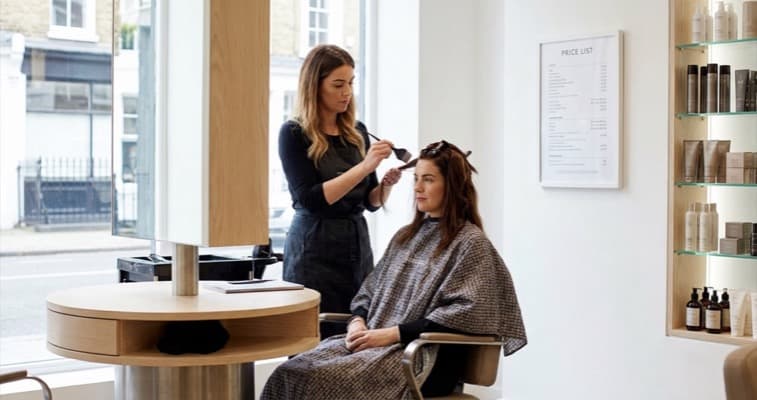
UK hair salon pricing benchmarks for 2026. Average costs for cuts, colours, blow-dries, plus junior vs senior tiers and regional price differences.
You've just sat down with your price list for the first time in eighteen months. Your product costs are up. Your energy bill hasn't budged from its new, uncomfortable normal. And your juniors are pushing for better wages. Meanwhile, the salon two streets over hasn't changed their prices since last year, and they're somehow still busy.
Sound familiar? Hair salon pricing isn't about cheapness. It's about clarity: being clear on what your time and expertise are worth, and pricing that way. Charge too little and you devalue your expertise. Charge too much without the positioning to back it up and you lose bookings. This guide gives you real UK hair salon pricing benchmarks for 2026, regional data, and a practical framework for setting prices that hold.
Related: Beauty Salon Pricing Strategy · Salon Pricing List · Gender Neutral Hair Salon Pricing
What you'll learn:
- Average UK hair salon prices by service type for 2026
- How to structure junior, senior, and director pricing tiers
- Regional price differences across the UK
- How to audit and update your price list this week
Average Hair Salon Prices in the UK (2026)
UK hair salon pricing in 2026 spans a wide range, but the national mid-market gives you a useful benchmark. The table below shows typical prices for established mid-range salons with qualified stylists.
| Service | Mid-Range UK Price |
|---|---|
| Women's cut | £28-£45 |
| Men's cut | £18-£32 |
| Blow-dry | £20-£35 |
| Full-head colour | £55-£90 |
| Balayage | £90-£130 |
| Root touch-up | £35-£55 |
UK mid-market benchmarks. Budget salons typically charge 15 to 20% less; premium salons charge more.
Info
One thing the data makes clear: underpricing signals low quality. The goal isn't to be cheap; it's to be correctly priced for your positioning.
For example, a senior stylist in Leeds significantly undercharging relative to comparable salons isn't winning on value; they're simply losing on every appointment. At volume, that adds up to significant foregone revenue across a year.
For a full strategic framework, see our beauty salon pricing strategy guide, which covers how to build a price increase plan your clients actually accept.
Pricing by Service: Cuts, Colours, and Treatments
Now that you have the benchmarks, here's how to think about pricing across each service category, because not all services carry the same margin or time cost, and your hair salon pricing menu should reflect that.
Cuts
Women's cuts typically run higher than men's for the same reason they always have: time and technique, not just geography. The table in section 1 gives you the benchmark ranges. Within those ranges, the variation comes down to technique, time, and salon positioning.
A barbershop-style cut and dry might take 25 minutes. A precision cut with consultation, blow-dry, and styling could take 75. Pricing them the same makes no sense. Break your cut menu into logical tiers: dry cut, cut and blow-dry, cut and restyle, and specialist cuts (curly, textured, precision). Each tier should reflect the actual time and skill involved.
For example, a busy independent salon in Manchester might offer a dry cut, a cut and blow-dry, and a specialist curly cut, all at clearly different price points that reflect time and technique. Clients understand the structure immediately, and the price feels justified.
Colours
Colour is where margin varies most dramatically. Root touch-ups are quick but lower margin; balayage is slower and often justifies premium pricing because clients perceive it as a specialist skill.
In the UK mid-market, colour service prices span a wide range: root touch-ups are the most accessible entry point, highlights sit higher depending on coverage, and balayage typically commands the highest rate for colour work. (See the benchmark table in section 1 for specific ranges.)
Pro Tip
Toning and gloss services are often the most underpriced item on a salon menu: they feel like a quick add-on but require real product and chair time.
Don't charge less for toning just because it's applied at the basin. If you're not charging separately for a toner you're giving it away, and you're doing it dozens of times a month. If you're pricing toning as a freebie you'll always subsidise colour clients at your own expense.
Treatments
Treatment pricing is often where salons leave money on the table. In practice, most salon owners undercharge here because treatments feel secondary to the main service, but they represent some of the best margin per minute in the business. A keratin smoothing service, on the other hand, reflects genuine specialist skill and four or more hours of chair time.
If you don't have treatments on your menu, you're leaving repeat revenue behind. Most clients will add a treatment when it's offered at the basin; they just need to be asked.
Upsell at the right moment
Never wait until the end of a service to mention it. By then the client's already thinking about leaving.
For help structuring your full menu, our salon pricing list template covers formatting and service groupings that convert.
Junior vs Senior vs Director Pricing
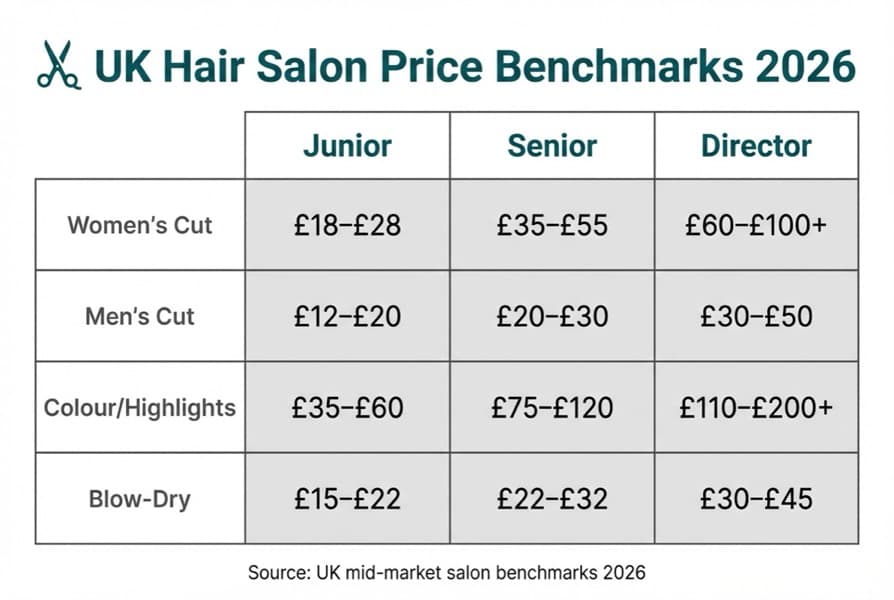
UK hair salon pricing benchmarks by stylist tier and service type, 2026
Building on service pricing, here's the next lever most salons underuse: tiering by experience. This is where hair salon pricing really rewards strategic thinking.
Info
Tiered pricing by experience level is the industry standard, and for good reason. It lets you fill your junior column's book while protecting senior and director time for higher-value appointments.
Here's how the tiers typically look in the UK:
| Stylist Level | Experience | Typical Cut | Typical Colour |
|---|---|---|---|
| Junior | 0-2 years | lowest tier | lowest tier |
| Mid-level | 3-7 years | mid-range | mid-range |
| Senior | 8+ years | premium | premium |
| Director | Specialist | top of range | top of range |
Tiers vary by salon: the key is that each level is priced distinctly.
A junior stylist working on a supervised basis can offer genuine value at lower prices: it's not about cutting corners, it's about being transparent with clients about who they'll be seeing. Many clients actively prefer junior pricing for simple cuts and return when they've built a relationship with a specific stylist.
For example, a junior might offer a women's cut and blow-dry at a significantly lower rate than the senior who trained them. Both prices are defensible, and the career ladder is visible to the client.
If you're only setting two tiers (junior and senior), you'll always lose senior clients to juniors when the price gap is too dramatic. A three-tier structure gives clients natural progression points and protects your highest earners from being undercut internally. That's usually a sign your pricing architecture needs restructuring, not your staff.
Getting the tiers right:
- Juniors should be 30 to 40% below senior prices, not 60 to 70%
- Seniors are your retention engine: clients who book with them rarely leave
- Director pricing should reflect genuine specialist positioning (colour correction, specialist cuts)
Regional Price Differences Across the UK
So you've got the benchmarks; however, those national figures only tell you so much. How much you actually charge depends heavily on your market. Geography moves the needle significantly.
- London: The most expensive market nationally. A cut and colour in Greater London runs well above the national average. Premium postcode salons charge considerably more.
- Major cities (Manchester, Birmingham, Glasgow, Leeds): Expect to price 10 to 20% above national averages. Colour services are similarly elevated.
- Market towns and suburban areas: Close to the national baseline, with modest variation by local competition density.
- Lower-cost regions (Wales, rural North West, Midlands): Rates typically sit 10 to 20% below national averages. Middlesbrough is frequently cited as one of the more affordable UK markets for hair services.
The practical implication: don't price against a national benchmark if your market is regional. Research what established, busy salons in your specific town are charging, and position relative to them, not relative to London.
Competitor audit check
If you can't tell whether your prices are competitive locally or just in line with the national average, that's usually a sign you haven't done a proper competitor audit in the last 12 months.
Our gender neutral hair salon pricing guide also covers how regional pricing varies for inclusive service menus, including the move away from gendered price lists across many UK markets.
How to Set Your Hair Salon Prices
Now that you know what the market charges and how it varies by region, here's how to build a hair salon pricing structure that's sustainable, not just competitive.
- Calculate your cost per hour. Add up fixed costs (rent, utilities, insurance, software) and variable costs (products, laundry, booking fees). Divide by your billable hours per week to get your break-even rate.
- Know your time per service. If a balayage takes 3.5 hours and your cost per hour is £22, you need at least £77 to break even before wages. Most salons underprice colour because they don't track actual chair time.
- Add your profit margin. A healthy salon targets 15 to 25% net profit. Factor this into every service price, not just your most popular ones.
- Validate against your market. Check three competitor salons nearby. If you're always fully booked with no waiting list, you're probably underpriced.
- Build your tiering logic. Junior prices should be 30 to 40% below senior prices. A gap that's too wide makes juniors look unqualified rather than developing.
For example, a suburban salon might calculate their break-even minimum for a women's cut based on actual costs, but their current price is lower. Every appointment in that scenario is a loss-making one. That's not a sustainable pricing strategy, regardless of how busy the salon is.
Pro Tip
Rule of thumb: If you're always fully booked with no waiting list and no price increases in the past year, you're almost certainly underpriced.
Most salon business advisers recommend annual price reviews as a minimum: many suggest every six months given recent cost pressures from energy bills, wage increases, and rising product costs.
If you're only reviewing prices reactively you'll always be behind. Don't wait for a supplier invoice to force the issue: build price reviews into your quarterly calendar the same way you schedule team training.
If you're using booking software, our salon software pricing guide covers how different platforms handle tiered pricing display: it reduces pricing confusion and abandoned bookings.
Review Your Prices This Week
Finally, let's turn all of this into action. If you're thinking "I know I need to sort out my hair salon pricing but it keeps getting pushed back," you're not alone. Getting hair salon pricing right takes an hour of focused time that most salon owners struggle to carve out. Most put pricing reviews on the back burner until a supplier invoice or energy bill forces the issue.
If you only have 30 minutes a week, start here:
- Day 1-2: Pull your service menu and note the last time each price changed. Flag anything older than 12 months.
- Day 3: Calculate your actual cost per service for your three highest-volume services. Compare against what you're charging.
- Day 4: Check three competitor salon websites. Note their tiering and any obvious price gaps.
- Day 5-7: Update prices where gaps exist. If increasing, send a short client email: transparency lands better than a silent change.
The salons that review pricing quarterly don't just survive cost pressures: they build sustainable businesses. The ones who delay play catch-up on margins that never quite recover.
For instance, a salon owner who reviews prices in January each year, ahead of the NMW increase, is never caught out mid-year scrambling to cover suddenly unprofitable colour appointments.
Your prices aren't just a number on a menu. They're a statement of what your time and expertise are worth.
You'll also want to align your pricing with how your website presents it. See our beauty salon pricing guide for how to display pricing that converts browsers into bookings.
For chair renters, see our tanning salon pricing guide for how rental-model salons approach pricing differently to employed teams.
Actionable checklist for this week:
- List every service and when it was last priced
- Calculate break-even cost for your top three services
- Research three local competitor salons' pricing
- Identify any service priced below break-even
- Draft a client communication for any upcoming price increases
Weekly Action
- Take one hour to map your current hair salon pricing against the UK benchmarks in this guide.
- Identify your three most underpriced services, and work out what a 10% increase would mean for your monthly revenue.
- Small increases applied consistently add up to significant annual gains.
Related: Beauty Salon Pricing Strategy · Salon Pricing List · Gender Neutral Hair Salon Pricing · Boss Your Salon Pricing Calculator
Frequently Asked Questions
How much does a haircut cost in the UK in 2026?
Women's haircuts at mid-range UK salons run from the mid-£20s to mid-£40s. Men's cuts are typically lower. London prices run well above the national average, so what costs £35 in Manchester might cost considerably more in central London.
How much should a junior hairdresser charge?
Junior stylists should be priced 30 to 40% below senior prices, enough to reflect their development stage without making the gap so large that clients question quality. A gap of 60 to 70% makes junior appointments look poor value rather than good value.
How much does a balayage cost in the UK?
Balayage varies significantly based on hair length, density, and stylist experience. Mid-range UK salons typically charge more for a full balayage than for highlights, reflecting the additional time and specialist skill involved. See the benchmark table in section 1 for specific ranges.
When should a hair salon increase prices?
Most salon industry advisers recommend annual hair salon pricing reviews as a minimum, with many suggesting every six months given recent cost pressures. Key signs: bookings are consistently full, product costs have risen significantly, or you haven't raised prices in over 12 months.
For restaurants, salons, and local businesses
Need help with your marketing?
We help UK businesses turn social media into real results, not busywork.
Start freeKey Takeaway
Hair salon pricing in the UK isn't about matching the cheapest competitor: it's about understanding your costs, tiering by experience, and reviewing regularly. Use the benchmarks in this guide to audit your current prices, build a clear junior-to-director structure, and commit to quarterly reviews. The salons that price strategically don't just survive cost pressures: they build businesses that grow year on year. For the full strategic framework, explore our beauty salon pricing strategy guide and the industries/beauty-salons resources.
Get More Marketing Tips
Practical marketing tips for UK business owners, straight to your inbox. No spam, unsubscribe anytime.
About the Author
Local Brand Hub
Empowering UK Businesses
Local Brand Hub provides comprehensive business management tools designed specifically for UK local businesses to streamline operations, automate marketing, and grow revenue.
More articlesRelated Articles
 Industry Insights
Gender Neutral Hair Salon Pricing: How to Switch and Why
How to implement gender neutral hair salon pricing in your UK salon. Price by length and complexity with Equality Act guidance and communication tips.
 Industry Insights
Nail Salon Pricing UK 2026: Gel, Acrylic, BIAB & More
UK nail salon pricing benchmarks for 2026: gel manicure, acrylic nails, BIAB, dip powder and nail art prices. What to charge and why it matters.
 Tutorials
Boss Your Salon Pricing Calculator: A Complete Guide
How the Boss Your Salon pricing calculator by Maddi Cook works, what inputs it needs, and the DIY treatment pricing formula every salon owner needs.