
Set beauty salon prices that cover every cost and grow your margins. Learn cost-plus, value-based pricing, packages, and when to raise prices.
You're fully booked yet still not making the money you expected. Your treatment rooms are earning, but your bank balance tells a different story. A beauty salon pricing strategy is the system you use to set, structure, and adjust your treatment prices so your business covers costs and earns a profit. Get it right and your books stay full.
What You'll Learn
- Why the wrong pricing kills salons that should thrive
- The psychology behind what clients actually perceive as "worth it"
- How to calculate a treatment price that covers every cost
- The three pricing models, and when to use each
- Menu design tactics that guide clients to higher-value bookings
- How to raise your prices without losing regulars
Related: Salon Pricing List: a complete breakdown of what to include on your treatment menu
Why Your Beauty Salon Pricing Strategy Matters More Than You Think
First, let's look at why pricing kills salons that should thrive. You did a full day of treatments. Back aching, feet sore. You count up the day's takings and wonder: is this it?
The problem is rarely that you're not busy enough. It's that busy doesn't automatically mean profitable. Beauty salons fail not because they can't attract clients, but because their beauty salon pricing strategy doesn't reflect the true cost of delivering each treatment.
A weak beauty salon pricing strategy is often invisible, until you run the numbers and realise the gap.
According to the National Hair & Beauty Federation (NHBF), the sector faced combined additional cost pressures of approximately £139 million following April 2025 changes. These included employer National Insurance rising to 15%, increases to the national minimum wage, and reductions in business rates relief (NHBF, 2025). A salon running on prices set before those changes is quietly losing money with every appointment.
Why this matters: One beauty salon documented that when a client needed an extra £5 of colour product, the price had to increase by £12 to cover costs, because National Insurance, commissions, PAYE, and VAT absorb approximately 70% of revenue. That's the reality of running a treatment business in the UK.
If you're only reviewing pricing once a year you'll always lose ground to competitors adjusting theirs quarterly. Pricing is not a one-time decision.
Related: Beauty Salon Business Plan: build the financial foundation before you set a single price
The Psychology Behind Beauty Salon Pricing
So you know pricing matters. Here's the part most beauty salon pricing strategy guides skip: clients don't make rational decisions about what a treatment is worth. They make emotional ones, and justify them afterwards.
Pricing is marketing. The number on your menu communicates quality, positioning, and confidence before a client even books.
Anchoring works. When a client sees a £95 signature facial before a £55 standard facial on your menu, the standard facial suddenly feels like a bargain, even if £55 was exactly what you'd planned to charge all along. The first number they see creates the reference point for every other price on the page.
Non-round pricing signals precision. There's a reason £49 outperforms £50. The left-digit bias means clients focus on the first number. £49 reads in the "£40s". £50 reads as "£50". This difference matters more than it should rationally.
Pro Tip: A beauty studio might raise prices and reposition as a "specialist nail and lash bar" (rather than a general beauty salon), increasing average spend per client, even though they lose a handful of price-sensitive regulars. Clients typically associate higher prices with better results. When you're cheap, you're raising doubt about your quality.
Visuals justify premium pricing. Before-and-after photos, treatment photography, and results imagery perform a specific psychological function: they show the transformation, not just the service. When a client can see what £85 looks like on someone else, the price feels less abstract.
Would you book a treatment at your own salon based on the pricing and how it's presented? If the answer is no, or even a hesitant maybe, that's usually a sign your beauty salon pricing strategy needs work. Psychology is a core part of any effective beauty salon pricing strategy, not an optional extra.
For a deeper look at what to charge per treatment category, see our Beauty Salon Pricing guide.
How to Calculate Your Treatment Prices
Let's look at the numbers. Here's how to calculate a price that actually covers your costs.
Most beauty salon owners set prices by looking at competitors and adding or subtracting a few pounds. That approach works until it doesn't.
The foundation of any sound beauty salon pricing strategy is understanding your true cost per treatment. Here's a straightforward four-step calculation:
- Step 1: Calculate your weekly overhead: Add up rent, rates, utilities, insurance, and software subscriptions. Divide by the number of client appointments you can realistically complete in a week. That's your overhead cost per client.
- Step 2: Add your time cost: Decide your target hourly rate, not what you've been paying yourself, but what you need to earn for the business to be sustainable. Multiply by the treatment duration.
- Step 3: Add materials: Products used per treatment (wax, gel, lashes, skincare) add up quickly. A gel manicure can use £4 to £8 in product costs alone. Don't absorb this; price it in.
- Step 4: Add your margin: This is profit: money for new equipment, training, and reserves. Most advisors suggest a 20 to 30% margin as a starting target.
Example in practice: A beauty therapist with £18 overhead per client, targeting £25/hour for her time, using £7 in gel products per manicure: her floor price is £50. She is charging £38. Every manicure at that price costs her £12 from her own wages. Not profit. Loss. Once you run this calculation for your most popular treatments, you can't un-see it.
Use a calculator: Our Boss Your Salon Pricing Calculator runs these figures automatically: enter your costs and it outputs a recommended price floor for each service.
For nail-specific pricing, see Nail Salon Pricing. For hair pricing benchmarks, see Hair Salon Pricing.
With your floor price established, the next question is which pricing model to use, and that's where most salons leave money on the table.
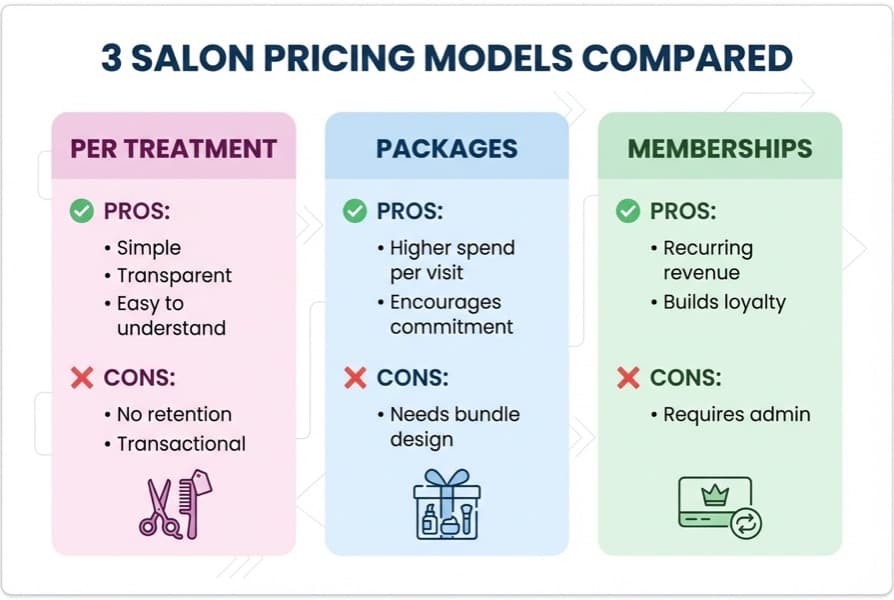
The three main pricing models: most established salons use a combination
Pricing Models: Per Treatment vs Packages vs Memberships
Moving on to how you structure your prices. There's no single correct approach. Each one serves a different purpose, and most established salons use a combination.
| Model | Ideal For | Strength | Limitation |
|---|---|---|---|
| Per Treatment | New clients, varied services | Simple, transparent | No retention mechanism |
| Packages | Courses, complementary services | Higher upfront spend | Requires compelling bundle design |
| Memberships | Regular monthly treatments | Predictable recurring revenue | Requires admin and booking software |
Per Treatment Pricing
The standard approach. Each service is priced individually on your menu. Clients book and pay per appointment.
Ideal for: Salons with a varied client base, new clients exploring, or high-turnover services like express treatments.
Limitation: Per treatment pricing creates a transactional dynamic. Each booking is a separate decision. There's no automatic reason for a client to return.
For example, a beauty therapist might price a standard facial at £55, a back massage at £45, and a gel manicure at £35. These are clear and transparent, but there's nothing binding the client to the next visit.
Package Pricing
Bundled treatments sold together at a slight discount. A client pays upfront for multiple sessions or a combination of services.
A beauty studio might offer a "Bridal Prep Package" (skin consultation, two facial treatments, and a lash tint) for £165 instead of £195 booked separately. The discount encourages commitment; the bundle increases total spend.
Ideal for: Treatments that work best in a course (skin treatments, lash lifts, massage), or complementary services clients typically book together.
Practical tip: Keep packages simple. Three to five clear bundles outperform a complicated menu of twenty options. Decision fatigue is real.
Membership Pricing
Clients pay a monthly fee for a set number of treatments or ongoing discounts. Common in aesthetics clinics and nail bars.
A nail bar might offer a £45/month membership covering one gel manicure, with 15% off additional bookings. That's £540/year in predictable revenue from a single client, regardless of seasonal fluctuations during quiet January or the summer slowdown.
Ideal for: Salons with regular clients booking the same services monthly. Provides predictable income and improves cash flow.
Limitation: Memberships require administration and work best when paired with booking software that can manage recurring payments.
Related: Beauty Salon Booking System: manage membership bookings and recurring payments
Once your pricing model is clear, the next layer is how you present it, which is where menu design either supports or undermines everything you've built.
Menu Design: Making Your Price List Sell
Menu design is the layer of your beauty salon pricing strategy that clients actually see. Your price list is a sales tool. Most beauty salons treat it like a directory. Whether it's printed or on your booking page, keeping your treatment menu and offers in one place makes it easier to update prices and highlight your best sellers.
Five Menu Design Principles That Work
- Lead with premium services: The first thing a client sees anchors their expectations. If your opening section is "Express Treatments from £12", that's the price frame you've set. Lead with your signature or high-value services instead.
- Group by outcome, not category: Instead of "Hands and Feet", use "Hands & Nails". Instead of "Facial Treatments", use "Skin Treatments & Anti-Ageing". Connect the treatment to the result the client wants.
- Remove underperformers: A treatment that costs nearly as much in time and materials as it earns is deadweight. If a service regularly requires discounting to sell, remove it from the standard menu.
- Add-ons are margin without extra booking time: A £10 hand massage upgrade at the end of a manicure. A £15 scalp treatment added to a blow-dry. A £12 eyebrow tint alongside a lash lift. These complete the treatment, not sell an extra.
- Highlight your best-value option: Use a visual indicator (a star, a box, a "most popular" label) on one or two services to guide undecided clients towards higher-value bookings.
For instance, a nail bar might star their "gel manicure + cuticle treatment" at £42, rather than the plain gel manicure at £35. The starred option earns £7 more per booking with minimal additional product cost. Multiply that across a week of appointments and the difference is substantial.
Related: Salon Pricing List: full guidance on structuring a treatment menu
For specialist service menus, see Hair Salon Pricing, Tanning Salon Pricing, and Gender Neutral Hair Salon Pricing.
When and How to Raise Your Prices
Price increases are often among the most neglected parts of a beauty salon pricing strategy, and often the highest-value change you can make. So you've calculated your costs, chosen your model, and designed a menu that sells. The question most salon owners dread: when do you raise prices?
For many UK salons in 2026, the answer is: probably sooner than you think.
If you haven't raised your prices in the past 12 months, there's a good chance you're earning less in real terms than you were in early 2025.
The reality for most independent beauty salons is that a price rise feels riskier than it is. Clients who leave over a £3 increase were typically price-shopping anyway.
How often should you raise prices?
Most salon business advisors recommend reviewing prices every 6 to 12 months and adjusting annually as a baseline. According to the NHBF, approximately 70 to 78% of UK hair and beauty businesses planned price increases following changes to employer National Insurance and the national minimum wage (NHBF, 2025). Costs don't stay still, and prices can't either.
How much to raise by?
A 5 to 10% annual increase is typically manageable for established clients and aligns with broader inflation. Larger increases benefit from advance notice and a clear explanation.
How to communicate a price rise without losing regulars:
- Give at least four weeks' notice via email, text, or social media
- Frame it around your commitment to quality: "Our prices are increasing in April to reflect our rising costs; your experience with us won't change"
- Offer loyal clients a discounted rate for pre-booking at the current price before the increase takes effect
- Consider a loyalty card programme alongside the increase: one free treatment for every ten bookings signals you value long-term clients
For example, an aesthetics clinic planning a 10% increase might send existing clients a personalised message four weeks out: "Book your next treatment before 1st April and pay the current price." That's a loyalty signal, and it typically fills several appointment slots in the process.
If you're reading this thinking you've been putting off a price rise for too long, you're not alone. Most salon owners undercharge for years before addressing it. The longer you wait, the bigger the jump required.
Related: Beauty Salon Marketing: communicate price changes and keep clients coming back
Related: Salon Promotion Ideas: build promotions that protect your margins
If You Only Have 30 Minutes This Week
A complete beauty salon pricing strategy overhaul takes time. But the first step takes thirty minutes. If you only have 30 minutes a week to work on your beauty salon pricing strategy, do this:
This week, audit your salon pricing:
- Day 1-2: Write down your three most popular treatments. Run the cost calculation (overhead per client + your time cost + materials). Write your current price next to each.
- Day 3-4: Check your menu: remove any service you've been quietly avoiding because it's not worth the time. Identify one add-on to introduce alongside your most-booked treatment.
- Day 5-7: If any treatment is below its calculated floor price, draft a price increase notice for next month. Give four weeks' notice before it takes effect.
If your three most popular treatments are covering costs and generating a reasonable margin, your pricing foundation is solid. If they're not, that's the most important thing to fix before working on marketing, social media, or anything else. A busy salon with wrong prices isn't a growth story. It's a slow squeeze.
For instance, a beauty therapist running 25 gel manicures per week at £38 against a £50 floor price is leaving £300 per week on the table: £15,600 per year. That's a meaningful number.
Related: How to Start a Beauty Business: foundational guidance for building a salon from scratch
Tools: Salon Software Pricing: find booking and management software that handles pricing, memberships, and payments
Beauty Salon Pricing Strategy Checklist
Before publishing your updated price list, run through these checks:
- Calculate true cost (overhead + time + materials) for each treatment
- Set floor prices: confirm no service is priced below its cost floor
- Identify three to five package bundles for your most popular treatment combinations
- Review menu structure: are premium services listed first?
- Add at least one "most popular" indicator to guide undecided clients
- Identify one or two add-on treatments to introduce
- Set a price review date (calendar reminder in six months)
- Draft a client communication for any upcoming price increase
- Remove any service that consistently requires discounting to sell
FAQ: Beauty Salon Pricing Strategy
What is a pricing strategy for a salon?
A beauty salon pricing strategy is a framework that determines how much to charge for each treatment, how to structure packages and memberships, and when to adjust prices over time. The pricing strategy framework covers three core areas: cost calculation (to protect margins), model selection (per treatment, packages, or memberships), and positioning (how your prices communicate value in your local market).
What are the 4 pricing strategies?
The four main pricing strategies used by beauty salons are: (1) cost-plus pricing: add a margin to your total costs; (2) value-based pricing: price based on the transformation and results clients receive; (3) competitive pricing: set prices relative to local competitors; and (4) tiered pricing: different rates for different experience levels or service complexity.
What are the 5 C's of pricing?
The 5 C's of pricing are: Costs (what it costs to deliver the service), Competition (what others charge), Customers (what your target clients are willing to pay), Constraints (regulations, platform fees, tax), and Channels (how and where you sell: in-person vs online booking vs packages). Together they form a complete picture of what price the market will support.
What are the 7 pricing strategies?
Beyond the core four, salons also use: psychological pricing (non-round numbers like £49), package pricing (bundled services at a discount), and membership or subscription pricing (recurring fees for ongoing access). Most established beauty salons use a combination of three or four of these simultaneously.
How often should a beauty salon raise its prices?
A sustainable beauty salon pricing strategy includes a scheduled annual price review. Most advisors recommend reviewing prices every six to twelve months and adjusting at least annually. The NHBF found that approximately 72% of UK hair and beauty businesses planned price increases following the April 2025 cost changes (NHBF, 2025). An annual adjustment of 5 to 10% is typically manageable for established clients.
Key Takeaway
Your beauty salon pricing strategy is either working for your business or working against it. There's no neutral setting.
Pick one treatment this week. Calculate its true cost using the four-step method above. If the price on your menu is below your floor price, raise it, not next quarter, this week. Your time has value. Price it accordingly.
Explore more salon business resources on our beauty salons industry page.
Key Takeaway
Your beauty salon pricing strategy is either making you money or costing you money. Calculate your true cost per treatment (overhead + time + materials + margin). If your current price is below that floor, raise it this week, not next quarter. Use packages and memberships to build predictable income and client loyalty. Review your prices every six to twelve months. A busy salon with wrong prices isn't a growth story. It's a slow squeeze.
For restaurants, salons, and local businesses
Need help with your marketing?
We help UK businesses turn social media into real results, not busywork.
Start freeGet More Marketing Tips
Practical marketing tips for UK business owners, straight to your inbox. No spam, unsubscribe anytime.
About the Author
Local Brand Hub
Empowering UK Businesses
Local Brand Hub provides comprehensive business management tools designed specifically for UK local businesses to streamline operations, automate marketing, and grow revenue.
More articlesRelated Articles
 Marketing Tips
Salon Pricing List: Create One That Sells
How to create a salon pricing list that wins clients. Templates, layout tips, digital vs printed formats, and mistakes that cost bookings. UK guide.
 Business Growth
Brow Business Names: 30+ Ideas by Style
30+ brow business name ideas by style. Covers brow bar vs brow studio naming, threading bars, and UK name availability checks.
 Business Growth
Lash Business Names: 40+ UK Ideas by Style
Browse 40+ lash business names by style: glamorous, minimalist, quirky, and location-based. UK availability checks and trademark costs included.