UK nail salon pricing benchmarks for 2026: gel manicure, acrylic nails, BIAB, dip powder and nail art prices. What to charge and why it matters.
You've been running the same price list since you opened. Your gel supplier just put costs up again. Your BIAB system costs more than standard gel. And the nail tech two streets over just raised her prices, and her books are still full. Sound familiar? Most nail salons are undercharging somewhere.
Nail salon pricing in the UK covers a wide range of services: from standard gel manicures and acrylic full sets to BIAB overlays, dip powder, gel pedicures, and nail art add-ons. Prices vary by technique complexity, product quality, location, and whether you operate from a fixed premises or as a home-based tech.
Nail salon pricing is not a set-and-forget decision. It is a living part of your business, and most nail salons are undercharging somewhere on their menu. This guide covers current UK benchmarks by technique, nail art add-on structure, how to think about product costs, and what to do when home-based techs are undercutting you. Read our full beauty salon pricing strategy guide if you want the complete framework first.
What You'll Learn About Nail Salon Pricing
- Current UK price benchmarks for every major nail technique
- How to structure nail art add-on pricing without guessing
- The actual product cost behind each service, and how to price around it
- Why competing with home-based techs on price is the wrong move
- A step-by-step plan for updating your nail prices this week
Nail Salon Prices in the UK (2026)
First, here's the lay of the land. UK nail salon prices vary meaningfully depending on your location, whether you operate from a fixed premises, and the product systems you use. These benchmarks reflect market data across UK nail salons and nail bars in 2025 to 2026.
| Service | Mid-Market Price |
|---|---|
| Gel manicure | £35-£45 |
| Gel pedicure | £40-£55 |
| Acrylic full set | £45-£60 |
| BIAB overlay | £45-£55 |
| Dip powder | £40-£50 |
Source: UK Nail Salon Market Benchmarks, Professional Beauty, 2025 to 2026.
Mid-market is the right anchor for most independent UK nail salons. Budget operators and home-based nail techs sit below; premium salons in central London and Edinburgh will sit above.
A basic manicure (no gel) typically ranges from the mid-teens to mid-twenties at mid-market salons. Acrylic infills are typically priced at 60 to 70% of the full set price.
If you're currently charging below these ranges for your tier, that is usually a sign you have not updated since your opening price list. Revisit your salon pricing list at least twice a year.
So you've got the benchmarks. Now let's look at what actually drives the difference in pricing between techniques, because not all nail services are created equal.
Pricing by Technique: Gel, Acrylic, BIAB, Dip
Now let's look at what drives the differences. Each technique carries a different product cost, application time, and client expectation. Pricing them the same, or within a few pounds of each other, leaves money on the table and signals to clients that you have not thought through your service menu.
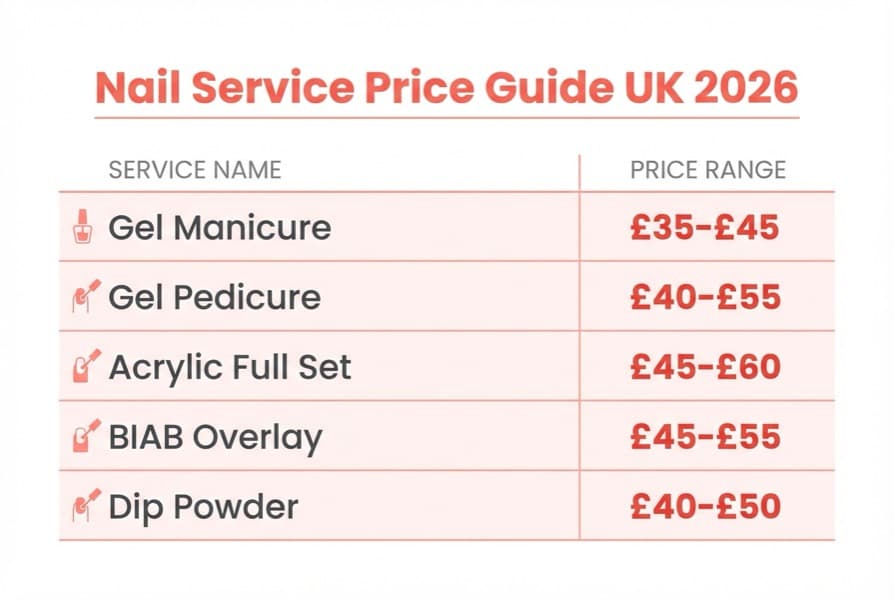
UK nail service pricing by tier: budget, mid-market, and premium.
Gel Manicure
Gel manicures remain the most booked nail service in the UK. A standard gel manicure takes 45 to 60 minutes. Mid-market pricing sits at the £35 to £45 range across most of England (see the table above for your region).
For example, a nail salon in a suburban shopping centre might charge £38 for a gel manicure with cuticle work. That pricing reflects the time cost, not just product spend.
Common pricing mistake: Charging the same for a basic gel manicure and a gel manicure with removal, cuticle prep, and hand massage. These are different services. Split them on your price list.
Acrylic Nails
Acrylics carry a higher skill level and longer appointment time (90 to 120 minutes for a full set). The work is more physically demanding and requires more technical precision than soak-off gel. Your pricing should reflect that premium.
Acrylic infills (typically booked every 2 to 3 weeks) should be priced at 60 to 70% of your full set price, not the same as a gel manicure just because they take less time.
BIAB (Builder in a Bottle)
BIAB has become one of the fastest-growing nail techniques in the UK, particularly for clients who want natural nail enhancement without the commitment of acrylics.
BIAB overlays take 60 to 75 minutes and use slightly more product than standard soak-off gel. That premium should be reflected in your pricing. If you're only charging gel manicure prices for BIAB, you're leaving money on the table. Clients perceive it as a specialist service and will pay accordingly.
Dip Powder
Dip powder (SNS-style systems) offers long wear but requires more product per client and careful removal. It deserves its own price point, sitting slightly above a standard gel manicure. See the benchmark table above for typical ranges.
Once you've got your core technique pricing right, the next place most nail salons leave money is on nail art. It is often the last thing on a price list and the first thing undercharged.
Nail Art Add-On Pricing
However, technique pricing is only part of the picture. Nail art is where many nail technicians undersell themselves significantly. A detailed floral design or chrome powder effect takes real skill and time, yet many salons charge a flat £5 for "nail art" regardless of complexity.
A better structure is complexity-based. Three tiers work well:
- Basic (single line, dot, French tip): a few pounds per nail, or a small flat-rate set fee
- Standard (ombre, geometric, simple florals): mid-range add-on, typically £5 to £8 per nail
- Advanced (hand-painted art, 3D gel, chrome effects): premium add-on, priced per design or per set
For example, a nail bar might charge a flat £15 add-on for an ombre gel effect, and a flat-rate fee of £45 to £55 for a detailed botanical hand-painted set. That flat-rate approach makes it easier for clients to understand what they are paying upfront.
This structure removes ambiguity. Clients know what they are paying before they sit down, and you stop undercharging for 40 minutes of detailed nail art work.
The most common trap is if you're only charging £5 per nail for detailed work you'll always lose to clients who undervalue the skill, and you'll burn out. Price the complexity, not the technique name.
If you're thinking "but my clients won't pay that much for nail art", that's usually a sign they don't yet understand what goes into it. A quick post showing your process changes that faster than a price drop.
With nail art pricing sorted, it is worth stepping back to look at what your services actually cost to deliver, because that affects every price on your menu.
Product Costs vs Treatment Prices
Now that you've sorted technique and nail art pricing, here's the foundation underneath everything: understanding product costs is essential for setting profitable nail salon pricing. Most nail technicians know their favourite gel brand. Fewer know what each service actually costs in product.
If you can't tell whether a price rise from your supplier is being absorbed or passed on, that's usually a sign your pricing has drifted too low.
Approximate product cost per service (2026):
| Service | Product Cost | 15-20% Minimum Price |
|---|---|---|
| Gel manicure | £3-£6 | £30 |
| Acrylic full set | £5-£9 | £45 |
| BIAB overlay | £5-£9 | £42 |
| Dip powder | £6-£10 | £40 |
Product cost includes gel, remover, base coat, top coat, wipes, and foils. Not consumables.
A standard nail salon should aim for product costs to represent no more than 15 to 20% of the treatment price. If they creep above that, raise prices or switch suppliers.
A nail salon might track product cost in absolute terms (the bottle cost) but miss the percentage creep, absorbing supplier increases until margins feel tight with no obvious cause. Tracking cost as a percentage of retail price solves that.
The pricing rule of thumb
Multiply your product cost by five to six. That is the minimum retail price where product stays at 15 to 20%.
When wholesale prices go up, and they will, your retail prices need to follow. Build a price review into your business plan at least twice a year.
Pro Tip
Create a simple spreadsheet with your five most-booked services. For each: note the product cost and the current retail price. If the product cost represents more than a fifth of the retail price, it needs addressing before your next quarterly review.
So you've got your product costs under control. The harder conversation is what happens when the local competition is charging half what you do.
Competing With Home-Based Nail Techs on Price
However, even with solid pricing in place, here is the reality most nail salon owners face: there is almost always someone local charging less. Often significantly less. The temptation is to match them, or undercut them, to protect your booking volume. That rarely works, and it will exhaust you trying.
If you're reading this wondering whether to lower your prices to compete, you are not alone in that thought. Most nail salon owners face this pressure regularly. The answer is almost never to lower prices.
Home-based nail techs operate on a fundamentally different cost base:
- No premises rent or rates
- No reception or admin overhead
- Often lower insurance premiums
- A smaller, simpler service menu
If you are operating from a fixed nail salon or nail bar, you cannot match their prices without operating at a loss. That is not a failure on your part. It is just arithmetic.
The better question is not "how do I compete on price?" but "what am I offering that they cannot?"
What a fixed-premises nail salon offers that a home tech cannot:
- A professional treatment room with proper ventilation and hygiene standards
- A full menu including gel removal, nail art, and pedicure treatments
- NHBF or BABTAC-certified technicians
- The ability to rebook the next appointment before a client leaves
These matter. Your clients who understand them will stay, and they are the ones worth building your business around.
The experience is different. Your pricing should reflect that, not apologise for it.
If you're reading this thinking "but clients keep asking about the cheaper option", that is usually a positioning problem, not a pricing problem. Better communication about your environment, products, and qualifications changes the conversation. See how salon software pricing and a strong online presence through our beauty salon tools can do that positioning work for you.
Update Your Nail Prices This Week
Finally, here's how to put all of this into action. Nail salon pricing is not about charging what feels comfortable. It is about charging what your skill, your time, and your treatment room are worth. The most profitable nail salons are not the cheapest. They are the ones that know their numbers and communicate their value clearly. If marketing your salon is part of that cost picture, it is worth working out how much time and money the right tools could save you so it does not quietly eat into the margin you have just protected.
If you have not reviewed your nail salon pricing in the last 12 months, this is the week to do it. Here is a practical week-by-week structure:
This week, update your nail salon pricing:
- Day 1-2: List every nail service and its current price. Note the last time each was updated. Flag any service priced below the mid-market benchmarks in this guide.
- Day 3-4: Calculate product cost for your three most-booked services. Check each sits below 20% of your current retail price.
- Day 5-7: Benchmark against two or three nearby fixed-premises salons. Raise any service that is clearly under-market. Update your price list page, Google Business Profile, and booking system.
If you only have 30 minutes this week, do this: Calculate the product cost for your most-booked service. If it is above 20% of your current price, raise that price by £3 to £5 today. That one change pays for itself within a week of bookings.
Would you book a gel manicure or a full set of acrylics at your own nail salon based purely on your current prices and how they're presented? If the answer is "I'm not sure", that's the place to start.
Weekly Action
Review your three most-booked nail services this week. For each one: check the product cost percentage, compare against local mid-market pricing, and make any necessary update before your next no-show or late cancellation costs you another hour of unpaid time.
Frequently Asked Questions: Nail Salon Pricing UK
How much does a gel manicure cost in the UK?
A gel manicure in the UK typically costs between £25 and £45 at mid-market salons in 2026. London and major cities sit at the higher end. For example, a mid-range nail bar in a suburban high street would typically charge around £38 to £42 for a gel manicure with cuticle work included.
Are gel or acrylic nails more expensive?
Acrylic nails are generally more expensive. An acrylic full set reflects the longer application time and higher skill level required, typically sitting above the price of a standard gel manicure. Infills are usually priced at 60 to 70% of the full set price.
How much should I charge for BIAB nails?
For a mid-market UK nail salon, BIAB overlays should be priced above a standard gel manicure: typically in the £45 to £55 range in 2026. BIAB uses more product and requires specialist knowledge, so clients requesting it expect to pay a premium.
How do I calculate what to charge for nails?
Start with your product cost per service. Multiply by five to six to ensure product represents 15 to 20% of the retail price. Then benchmark against local fixed-premises competitors. Factor in your appointment length, premises costs, and any specialist certifications you hold.
How often should I update my nail salon price list?
Review your nail salon pricing at least twice a year: once in January and once in summer, when product costs and market rates typically shift. Any time a major supplier increases wholesale prices, review affected services immediately.
Start with your price list today. Raise the one service you know is underpriced. Then work your way through the rest.
For the full pricing strategy framework, read our beauty salon pricing strategy guide or explore our beauty salon pricing overview. You can also compare approaches across hair salon pricing and tanning salon pricing, or use the Boss Your Salon pricing calculator to model your numbers. For gender-inclusive pricing strategies, see our guide to gender-neutral hair salon pricing.
For restaurants, salons, and local businesses
Need help with your marketing?
We help UK businesses turn social media into real results, not busywork.
Start freeKey Takeaway
Nail salon pricing should be reviewed at least twice a year and benchmarked against local fixed-premises competitors, not home-based techs. Price each technique separately based on product cost, application time, and skill level. Structure nail art add-ons in three tiers by complexity. Keep product costs below 20% of the retail price, and raise prices immediately when suppliers increase wholesale costs. The most profitable nail salons are the ones that know their numbers and communicate their value clearly.
Get More Marketing Tips
Practical marketing tips for UK business owners, straight to your inbox. No spam, unsubscribe anytime.
About the Author
Local Brand Hub
Empowering UK Businesses
Local Brand Hub provides comprehensive business management tools designed specifically for UK local businesses to streamline operations, automate marketing, and grow revenue.
More articlesRelated Articles
 Industry Insights
Hair Salon Pricing UK 2026: Complete Guide
UK hair salon pricing benchmarks for 2026. Average costs for cuts, colours, blow-dries, plus junior vs senior tiers and regional price differences.
 Tutorials
Boss Your Salon Pricing Calculator: A Complete Guide
How the Boss Your Salon pricing calculator by Maddi Cook works, what inputs it needs, and the DIY treatment pricing formula every salon owner needs.
 Industry Insights
Gender Neutral Hair Salon Pricing: How to Switch and Why
How to implement gender neutral hair salon pricing in your UK salon. Price by length and complexity with Equality Act guidance and communication tips.