
Write a beauty salon business plan that wins funding. Step-by-step UK guide covering financial projections, treatment pricing, and market analysis.
A beauty salon business plan is a structured document that outlines your salon's vision, target market, treatment menu, financial projections, and marketing strategy. It serves as both your operational roadmap and the document that lenders and banks require before approving funding for your business.
You have the skills. You can do a flawless set of lashes, a perfect gel manicure, and a facial that has clients rebooking before they leave the chair. But when someone asks you to put it all into a business plan, the blank page feels worse than a quiet January.
This guide walks you through each section of a beauty salon business plan, with UK-specific numbers and practical examples you can adapt for your own salon. Whether you are opening a beauty studio, a nail bar, or a mobile beauty business, the structure is the same. 9 min read.
What You Will Learn
- The seven essential sections every beauty salon business plan needs
- Realistic UK startup costs and monthly running expenses
- How to build financial projections lenders actually trust
- Treatment pricing strategy that protects your profit margins
- Common mistakes that sink salon business plans before they reach a bank
Step 1: Write Your Executive Summary
Let's start writing. The executive summary is the first section of your beauty salon business plan, but write it last. It is a one-page snapshot of everything that follows, and lenders read it first to decide whether the rest is worth their time. The gov.uk business plan guide covers the general framework, but here is what matters specifically for beauty salons.
If you are still in the early stages of planning, our complete guide to starting a beauty business covers the broader picture before you get into the business plan detail.
Your executive summary should answer these questions:
- What type of beauty salon are you opening? (Beauty studio, nail salon, aesthetics clinic, mobile beauty business)
- Where will it be located and who is your target client?
- How much funding do you need and what will you spend it on?
- What makes your salon different from the competition?
For example, a nail bar opening in a commuter town might write: "NailStudio is a dedicated nail salon targeting professional women aged 25-45 in Guildford town centre. We require £28,000 in startup funding to cover fit-out, equipment, and three months' working capital. Our differentiation is 30-minute express treatments designed for lunch-break appointments."
Keep It Short
Keep your executive summary to one page. If a lender cannot understand your concept in 60 seconds, the plan needs simplifying, not more words.
Step 2: Conduct Your Market Analysis
With your executive summary drafted, the next step in your beauty salon business plan is proving there is demand. This section shows lenders you understand your local market and have identified a genuine gap. Ask yourself: if a stranger walked past your planned location, would they think "this area needs another beauty salon"?
What to research:
- Local competition. Visit every beauty salon, nail salon, and aesthetics clinic within a two-mile radius. Note their pricing, services, opening hours, and Google reviews.
- Target demographics. Who lives and works nearby? Commuters, students, families? Your treatment menu should match their needs and budgets.
- Foot traffic and accessibility. Is the location on a high street, in a shopping centre, or residential? Can clients park easily?
A beauty salon owner who skips market analysis typically ends up competing on price alone: that rarely works long-term. If you cannot explain what your salon offers that the three competitors down the road do not, that is usually a sign your positioning needs more thought.
Whether you are buying an existing salon or starting from scratch, the competitive landscape is key. Our guide on beauty businesses for sale explains how to evaluate existing salon opportunities as part of your research.
Quick competition audit checklist:
- List every competitor within two miles (name, services, price range)
- Read their Google reviews: note what clients praise and complain about
- Identify the gap: what are they not offering that clients want?
- Check their online booking: are they fully booked or have availability?
Step 3: Plan Your Treatment Menu and Pricing
Now that you understand the market, you can design a menu that fills the gaps. Your treatment menu is the core of your beauty salon business plan. It determines your revenue, your staffing needs, and your brand positioning.
| Treatment | UK Price Range | Notes |
|---|---|---|
| Gel manicure | £25-£40 | High rebooking rate |
| Classic lash extensions | £45-£80 | Premium service, high margin |
| Express facial | £30-£50 | Good for walk-ins |
| Full set acrylic nails | £30-£55 | Popular, moderate margin |
| Waxing (legs) | £20-£35 | Quick turnover |
Prices vary by location. City centres typically charge more. These are estimates from UK salon booking platforms. Consult local competitors for your area.
If you pick just one treatment to anchor your beauty salon business plan around, gel manicures often offer the best combination of rebooking rate, manageable duration, and healthy margins.
If you are considering a hair and beauty business that combines hairdressing with beauty treatments, your menu and staffing section will need to reflect both disciplines.
Pricing strategy decisions to make:
If you are thinking "I will just undercut everyone nearby", that is the fastest route to burnout and closure. Price your treatments based on your costs, not your competitors' prices. For instance, a beauty salon in central London and a home-based beauty salon in a rural town have completely different cost structures, so their pricing should differ too.
Info
The 3x rule is a framework that splits each treatment price into three equal portions: product costs (one-third), therapist time (one-third), and overheads plus profit (one-third). Apply this to every service on your beauty salon business plan menu to check your margins are viable.
Step 4: Build Your Financial Projections
Here is where most beauty salon business plans fall apart, and if you are reading this thinking "I am a therapist, not an accountant," you are not alone. But lenders do not want optimistic guesses. They want conservative, evidence-based numbers.
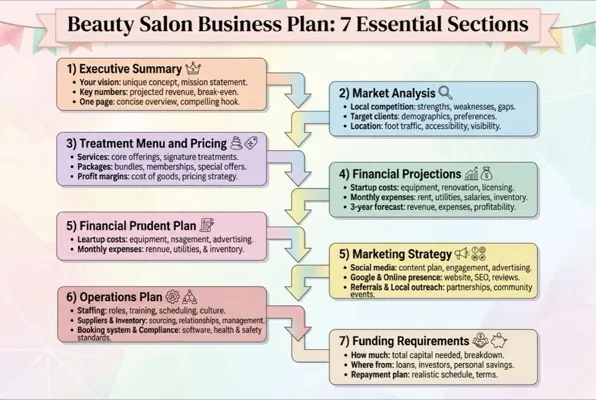
The seven core sections every beauty salon business plan should cover.
Startup costs for a UK beauty salon typically range from £20,000 to £50,000 depending on size, location, and the scope of fit-out required (NHBF, 2026).
| Cost Category | Estimated Range |
|---|---|
| Premises deposit and rent | £1,800-£6,000 |
| Fit-out and refurbishment | £8,000-£35,000 |
| Equipment and furniture | £5,000-£15,000 |
| Insurance, licences, registrations | £1,000-£3,500 |
| Stock, marketing, and branding | £2,000-£8,000 |
| Working capital (3-6 months) | £5,000-£15,000 |
These are estimates. Your local area may vary. Consult an accountant for personalised projections.
Monthly running costs for a small beauty salon typically include rent, utilities, product restocking, insurance, software subscriptions, and marketing. Staff costs often represent around 60% of total operating expenses in the hair and beauty sector (NHBF, 2026). Budget for at least three to six months of operating expenses as a cash buffer.
If your plan involves renting chairs rather than hiring employees, see our guides on chair rental in hair salons and hairdressing chair rental for the financial implications of each model.
If you are only planning your first year's finances you will always lose to salon owners who project three years ahead. Lenders want to see Year 1, Year 2, and Year 3 revenue forecasts showing a realistic path to profitability.
Step 5: Write Your Marketing Plan
With the numbers in place, your beauty salon business plan needs to explain how you will actually attract clients. A marketing plan does not need to be complex; it needs to be realistic.
Include these channels:
- Google Business Profile. Free and essential. Most beauty salon clients search "beauty salon near me" before booking; our free local SEO checklist walks you through claiming and completing yours.
- Social media. Instagram is typically the strongest platform for beauty businesses: visual content drives bookings.
- Referral programme. Offer existing clients a discount or free add-on for referring friends.
- Local partnerships. Connect with hairdressers, wedding planners, and gyms for cross-referrals.
For example, a beauty studio launching in a residential area might allocate £200 per month to Instagram ads targeting women aged 25 to 45 within a five-mile radius, while spending nothing on print advertising.
Step 6: Detail Your Operations Plan
With marketing covered, your beauty salon business plan needs an operations section. This covers the practical day-to-day running of your salon. Lenders want to know you have thought beyond the treatments.
Key operations questions to answer:
- Staffing. Will you hire employees or rent chairs? How many therapists do you need at launch?
- Suppliers. Which product brands will you stock? Do you have backup suppliers?
- Opening hours. Will you offer evening and weekend appointments? These often generate the highest revenue.
- Booking system. Which salon software will you use? Manual diaries create bottlenecks as you grow.
- Health and safety. Insurance, patch testing protocols, hygiene standards, and BABTAC or NHBF membership.
If you plan to operate as a self-employed hairdresser or rent a room in an existing salon, your operations plan will look quite different from a traditional salon setup, but lenders still need to see it.
If you are reading this thinking "I will figure operations out as I go", stop. The operations section is where lenders separate serious applicants from hobby businesses. Every detail matters, from how you handle a late cancellation to where you store client data under GDPR.
For the health and safety specifics that lenders expect to see in this section, our health and safety guide for beauty salons covers insurance, hygiene protocols, and compliance requirements in full.
Thinking about bringing in apprentices to grow your team? Our guide on hairdressing apprenticeships explains the costs, funding options, and what to include in your staffing plan.
Step 7: Avoid These Common Mistakes
With all seven sections outlined, let's look at what sinks most beauty salon business plans before they reach a lender's desk.
Mistake 1: Overestimating first-year revenue. New beauty salons rarely hit full capacity in year one. A realistic plan assumes around half chair occupancy in the first six months, growing gradually by year's end. If your projections show full bookings from month one, no lender will take them seriously.
Mistake 2: Ignoring seasonality. Beauty salons experience predictable dips: quiet January, post-holiday slowdowns, summer holidays. Your cash flow projection should account for these. Build in seasonal promotions like pre-wedding packages or prom season offers to smooth the gaps.
Mistake 3: No contingency fund. If your plan allocates every pound of funding with nothing left over, one broken piece of equipment or a late-paying client could derail the business. Budget at least 10% of your total startup costs as contingency.
Mistake 4: Copying a template without adapting it. Templates are starting points, not finished documents. A lender can spot a generic business plan immediately. Customise every section with your location, your numbers, and your market research.
Write It for Yourself
If you are only writing a beauty salon business plan because someone told you to, that never works. The plan should be your reference document, the thing you check monthly to see if reality matches your projections.
Frequently Asked Questions
How much does it cost to open a beauty salon in the UK? Total startup costs typically range from £20,000 to £50,000, depending on location, size, and fit-out scope. A home-based beauty salon or mobile beauty business can launch for significantly less: often under £5,000 for equipment and insurance alone (NHBF, 2026).
Do I need a business plan for a small beauty salon? Yes, even if you are not seeking external funding. A beauty salon business plan forces you to think through pricing, costs, and competition before committing money. Salons that plan typically make better financial decisions in their first year.
What should an executive summary include for a beauty salon? Your salon concept, location, target market, funding requirements, and what makes you different from competitors. Keep it to one page. This is the section lenders read first.
If You Only Have 30 Minutes a Week
- Day 1 to 2 (10 min): List your planned treatments and research what three local competitors charge for the same services. Note the gaps.
- Day 3 to 4 (10 min): Draft your startup cost estimate using the table above. Add your specific rent, equipment, and insurance quotes.
- Day 5 to 7 (10 min): Write a one-paragraph executive summary. Name your salon concept, location, target client, and funding requirement.
Explore more tools and guides for beauty salon owners on our beauty salons industry page.
For restaurants, salons, and local businesses
Need help with your marketing?
We help UK businesses turn social media into real results, not busywork.
Start freeKey Takeaway
A beauty salon business plan has seven core sections: executive summary, market analysis, treatment menu, financials, marketing, operations, and funding request. UK startup costs typically range from £20,000 to £50,000, with staff costs representing around 60% of monthly running expenses. Price treatments using the 3x rule: product cost, therapist time, and overheads each take roughly one-third. Project three years of financials, not just one, and assume conservative occupancy rates. Lenders spot generic templates immediately: customise every section with your own research and numbers. A business plan is not a one-off document: review it monthly against your actual performance.
Get More Marketing Tips
Practical marketing tips for UK business owners, straight to your inbox. No spam, unsubscribe anytime.
About the Author
Local Brand Hub
Empowering UK Businesses
Local Brand Hub provides comprehensive business management tools designed specifically for UK local businesses to streamline operations, automate marketing, and grow revenue.
More articlesRelated Articles
 Business Growth
Room for Rent in Salon: Owner's Revenue Guide
Room for rent in salon explained: UK regional pricing benchmarks, essential contract clauses, and HMRC employment status rules. Practical owner guide.
 Business Growth
Chair Rental in Hair Salon: A Renter's Guide
Chair rental in hair salon explained: UK costs by region, what to check before you sign, contract must-haves and how to build your brand as a renter.
 Business Growth
Hairdressing Chair Rental: UK Pricing and Legal Guide (2026)
Hairdressing chair rental in the UK: 2026 regional pricing, HMRC employment status rules, contract requirements and insurance obligations fully explained.