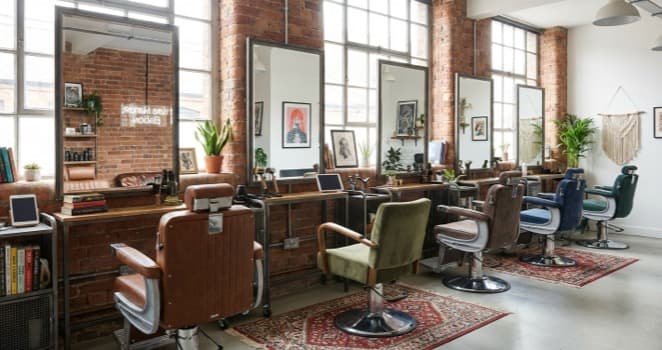
Hairdressing chair rental in the UK: 2026 regional pricing, HMRC employment status rules, contract requirements and insurance obligations fully explained.
Hairdressing chair rental is a business model where a self-employed hairdresser pays a salon owner a fixed fee to use a styling station, keeping their own clients, prices, and schedule. It is one of the fastest-growing arrangements in the UK hair and beauty sector.
You have heard the term on job boards, in salon chats, and across industry forums. But between the pricing claims, tax confusion, and employment status grey areas, it is hard to know what hairdressing chair rental looks like in practice across the UK.
This guide gives you the full picture: what it costs region by region, how HMRC views it, what your contract needs, and where the market is heading. Whether you own a salon or rent a chair, this is the reference you need. 8 min read.
What You'll Learn
- How hairdressing chair rental works in the UK and why it is growing
- Regional pricing benchmarks from London to rural areas
- HMRC employment status rules and what triggers an investigation
- Contract and insurance requirements for both owners and renters
- Where the UK hairdressing chair rental market is heading next
How Hairdressing Chair Rental Works in the UK
First, the basics. Hairdressing chair rental means a salon owner rents out individual styling stations to self-employed hairdressers for a fixed weekly or monthly fee. The renter keeps all client income, manages their own bookings, and runs their business from within the salon.
In 2025, roughly 65% of newly opened beauty spaces in the UK used a rental model (Hotpatch, 2025). Over 70,000 hair and beauty professionals now work as freelancers. Cities like Birmingham, Leeds, and Cardiff have seen rental listings grow threefold year on year.
The model works for both sides:
- Salon owners gain steady income without employment obligations
- Renters get a professional workspace without the capital cost of their own premises
For example, a stylist with 20 regular clients can often earn significantly more through hairdressing chair rental than through a standard salon commission structure, provided their bookings cover the rent each week.
Warning
Hairdressing chair rental is not a simple landlord-tenant deal. HMRC watches these arrangements closely. Getting the employment status wrong carries serious penalties for both parties.
If you are just getting started in the beauty industry, read the complete guide to starting a beauty business for the full picture before committing to a rental model.
UK Hairdressing Chair Rental Prices by Region (2026)
With that context, here is what hairdressing chair rental actually costs across the UK. Pricing depends on location, salon quality, and what the fee includes.
Regional pricing overview:
| Region | Weekly Rate | Monthly Rate |
|---|---|---|
| Central London | £250-£400 | £1,000-£1,500+ |
| Outer London / South East | £175-£300 | £700-£1,200 |
| Midlands | £100-£200 | £400-£800 |
| North (Manchester, Leeds) | £100-£200 | £400-£800 |
| Scotland | £90-£180 | £360-£720 |
| Wales | £80-£160 | £320-£640 |
| Rural and small towns | £50-£120 | £200-£480 |
Sources: Hotpatch (2025), UK Therapy Rooms (2025), salon listing analysis (2026)
The average daily rate across the UK sits between £40 and £60, translating to roughly £180 to £350 per week for a full-time renter (Hotpatch, 2025).
If you are thinking "those ranges are wide", they are, because inclusions vary hugely. A £100-per-week station with no products, no reception, and limited hours is a different deal from a £200-per-week station that includes everything.
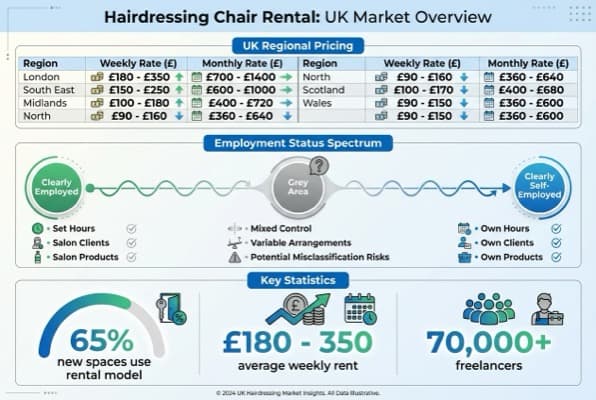
UK hairdressing chair rental pricing varies widely by region and what the fee includes.
For the renter's perspective on finding and evaluating a chair, read what to expect as a chair renter.
Employment Status: The Legal Framework
This is where hairdressing chair rental gets complicated, and where the stakes are highest. HMRC does not accept that calling someone a "chair renter" makes them self-employed. The actual working arrangement decides the status, not the contract.
HMRC's three key tests:
- Mutuality of obligation: Is the salon required to provide work? Self-employed renters choose their own hours and clients.
- Control: Does the salon dictate how, when, or where work is done? Genuine renters set their own schedule.
- Personal service: Must the person do the work themselves? The ability to send a substitute points to self-employment.
For example, a hairdresser who sets their own hours, books their own clients, uses their own products, and takes holidays without asking permission is more likely to be genuinely self-employed. A hairdresser who works set shifts, uses only salon products, and receives clients from the salon reception is more likely to be classed as an employee, regardless of what the contract says.
Info
If you are thinking "our contract says self-employed, so we are fine", that is not how HMRC sees it. They look at the reality, not the paperwork.
For a deeper look at self-employment in the beauty sector, read understanding self-employment as a hairdresser.
HMRC's View on Hairdressing Chair Rental
HMRC published sector-specific guidance for hair and beauty, developed with industry input (HMRC, 2025). This guidance includes real-world examples of when hairdressing chair rental qualifies as genuine self-employment.
Indicators of genuine self-employment:
- Sets own working hours and takes holidays freely
- Sources and keeps their own client list
- Uses personal products and equipment
- Sets prices independently
- Runs their own business bank account
- Carries their own insurance
- Earns nothing when they have no appointments
Indicators of employment:
- Working hours set by the salon
- Clients provided by the salon
- Uses salon products exclusively
- Fixed payment regardless of bookings
- Cannot work at other salons
Check Your Status
Use the free HMRC CEST tool to test your hairdressing chair rental arrangement. It is not legally binding but gives a strong indication.
If you are only relying on contract wording you will always lose to salon owners who make sure the daily reality matches the paperwork. That is usually a sign the arrangement will hold up under scrutiny.
Warning
Disclaimer: This article provides general guidance, not legal or tax advice. Consult HMRC or a professional adviser for your specific situation.
Insurance and Liability for Hairdressing Chair Rental
Insurance is non-negotiable for any hairdressing chair rental arrangement. Both salon owner and renter need specific cover, and the responsibilities differ.
Insurance requirements:
| Cover Type | Salon Owner | Chair Renter |
|---|---|---|
| Public liability (£1m-£5m) | Required for premises | Required for own clients |
| Professional indemnity | Own services only | Required for own work |
| Employer's liability | Only if employing staff | Not needed |
| Contents insurance | Premises and fixtures | Own equipment and stock |
For example, if a renter's client has an allergic reaction to a product the renter applied, the renter's professional indemnity covers the claim, not the salon owner's policy. This must be clear in the rental agreement.
The NHBF recommends salon owners request proof of current insurance before any renter begins working. Keep copies on file and check annually.
BABTAC offers insurance packages designed for self-employed beauty professionals, often at group rates for members.
For more on compliance in salon environments, read health and safety requirements for beauty salons.
The Future of Hairdressing Chair Rental in the UK
Where is hairdressing chair rental heading? The UK hair and beauty industry is valued at roughly £5.8 billion, with growth of 9.5% CAGR between 2020 and 2025 (IBISWorld, 2025). Chair rental is one of the fastest-expanding segments.
Key trends shaping hairdressing chair rental:
- Freelancer growth: over 70,000 professionals now work independently, rising year on year (Hotpatch, 2025)
- Platform-driven discovery: Hotpatch, UK Therapy Rooms, and similar platforms make it easier to find and fill chairs
- Regulatory attention: HMRC's new sector guidance signals closer monitoring of chair rental arrangements
- Hybrid salons: owners combining employed staff, apprentices, and chair renters under one roof
- Rising costs: commercial rent and energy prices are pushing more stylists toward the lower-overhead rental model
For example, a salon in Cardiff that struggled to recruit employed stylists switched two stations to a hairdressing chair rental model. Within three months, both chairs were occupied by experienced freelancers who brought their own clients and required no management, while the owner continued to employ two junior stylists and an apprentice.
Ask yourself: whatever side of hairdressing chair rental you are on, does your current arrangement genuinely reflect self-employment? If the answer is unclear, use the CEST tool this week.
For the owner's perspective on renting out space, read how to rent out a room in your salon. If you are exploring other business models, see buying an existing beauty business or running a combined hair and beauty business.
If You Only Have 30 Minutes a Week, Do This
- Day 1 to 2 (10 min): Check current hairdressing chair rental prices in your region using Hotpatch or UK Therapy Rooms
- Day 3 to 4 (10 min): Run your arrangement through the HMRC CEST tool and note any grey areas
- Day 5 to 7 (10 min): Review your rental agreement against the contract and insurance checklists in this article
Whether you are a salon owner, a renter, or someone considering a hairdressing apprenticeship before going self-employed, getting the fundamentals right now saves significant trouble later. You can also explore writing a beauty salon business plan or read the step-by-step beauty business startup guide if you are still at the planning stage.
If you run a salon or are building your beauty business online, visit our beauty salon industry page to see how LocalBrandHub helps beauty professionals attract and retain clients, including tools to create social posts that keep your chair booked.
For restaurants, salons, and local businesses
Need help with your marketing?
We help UK businesses turn social media into real results, not busywork.
Start freeKey Takeaway
Hairdressing chair rental is growing fast, with 65% of new UK beauty spaces using a rental model in 2025. UK weekly rates range from £50 in rural areas to £400+ in central London. Always check what is included. HMRC judges employment status on actual working practices, not contract wording. Both owners and renters need their own insurance, with responsibilities clearly documented. A written rental agreement is essential for legal protection and tax compliance. The UK hair and beauty market is worth £5.8 billion, with hairdressing chair rental as a key growth area. Regulatory scrutiny is increasing. Make sure your arrangement genuinely reflects self-employment.
Get More Marketing Tips
Practical marketing tips for UK business owners, straight to your inbox. No spam, unsubscribe anytime.
About the Author
Local Brand Hub
Empowering UK Businesses
Local Brand Hub provides comprehensive business management tools designed specifically for UK local businesses to streamline operations, automate marketing, and grow revenue.
More articlesRelated Articles
 Business Growth
Chair Rental in Hair Salon: A Renter's Guide
Chair rental in hair salon explained: UK costs by region, what to check before you sign, contract must-haves and how to build your brand as a renter.
 Tutorials
Nail Technician Business: Mobile, Chair Rental & Going Solo
How to run a nail technician business as a sole trader. Covers mobile vs chair rental vs home salon, HMRC self-employment and personal branding in the UK.
 Tutorials
Self Employed Hairdresser: UK Tax and Setup Guide
How to become a self employed hairdresser in the UK. HMRC registration, tax rates, insurance costs, pricing, and building your client base.