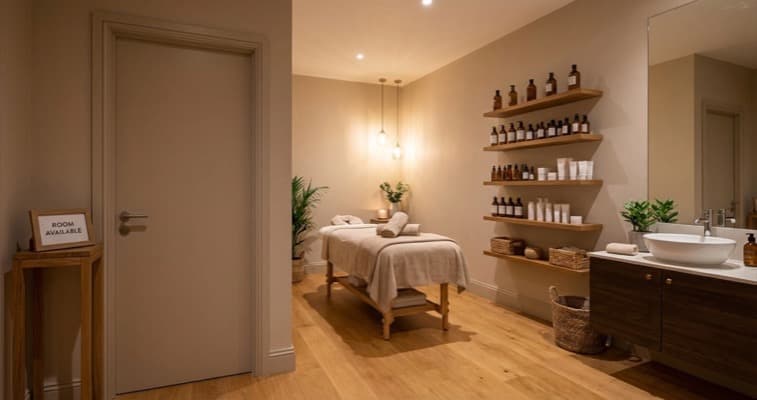
Room for rent in salon explained: UK regional pricing benchmarks, essential contract clauses, and HMRC employment status rules. Practical owner guide.
A room for rent in a salon is a dedicated treatment space that a salon owner leases to an independent beauty therapist or hairdresser, typically on a weekly or monthly basis. The renter operates as self-employed, bringing their own clients while the owner earns rental income.
You have a treatment room sitting empty three days a week. The overheads keep coming (rent, utilities, insurance) whether the room earns or not. Meanwhile, a qualified beauty therapist down the road is scrolling listings for a room for rent in a salon near her. That empty room is not dead weight. It is an opportunity worth £2,000 to £15,000 a year.
This guide covers how to set the right room for rent in salon price, find reliable renters, structure your contract, and stay on the right side of HMRC. 9 min read.
What You'll Learn
- How to price a room for rent in your salon competitively
- Where to find quality renters and what to look for
- Essential room for rent in salon contract clauses that protect your business
- HMRC employment status rules you cannot afford to ignore
- How to manage the landlord-renter relationship long term
Why Rent Out a Room in Your Salon?
So why would you hand over part of your premises to someone else? Because a room for rent in a salon creates a predictable income stream that does not depend on your own appointment book.
Unlike commission-based arrangements, room rental gives you fixed revenue regardless of how busy the renter is.
For example, a beauty salon in a market town charging £100 per week for a treatment room earns £5,200 annually, before the renter brings a single client through your door. That footfall often benefits your own services through cross-referrals.
The model works well if you have underused space during quieter periods. A business plan that accounts for room for rent in salon income can reduce the pressure on your own client bookings.
| Benefit | Detail |
|---|---|
| Predictable income | Fixed weekly or monthly rent, paid regardless of renter's bookings |
| Reduced overheads | Shared utility costs across more people |
| Cross-referrals | Renter's clients discover your services |
| No employment obligations | Self-employed renters handle their own tax and National Insurance |
| Flexibility | Adjust terms as your business needs change |
Would you rather earn £100 a week from a room someone else uses, or £0 a week from a room nobody uses? That is the real question.
If you're thinking "I don't want someone else using my space," that is understandable. But the alternative is paying full overheads on a room that earns nothing.
For most salon owners, starting with a weekly rental to a complementary therapist typically offers a strong balance of income and control.
Setting the Right Rental Price
With the benefits clear, the next question is: how much should you charge? Room for rent in salon prices across the UK vary significantly depending on location, what is included, and the size of the space.
Getting this right matters: too high and you will struggle to find renters, too low and you are subsidising someone else's business.
UK room rental benchmarks (2026):
| Location | Weekly Rate | Monthly Rate |
|---|---|---|
| Central London | £200-£400 | £800-£1,500+ |
| Other London boroughs | £150-£300 | £600-£1,200 |
| Major cities (Manchester, Birmingham, Leeds) | £100-£250 | £400-£1,000 |
| Towns and suburbs | £60-£150 | £250-£600 |
| Rural areas | £40-£100 | £160-£400 |
Sources: Hotpatch (2025), UK Therapy Rooms (2025), Gumtree rental listings analysis (2026)
For example, a small treatment room in Bedfordshire can rent for around £25 per day including bills (UK Therapy Rooms, 2025), while a nail station in Greenwich commands roughly £1,200 per month.
What affects your pricing:
- A room with utilities, Wi-Fi, product storage, reception use, and laundry service justifies a higher rate than bare space
- Dedicated treatment rooms command more than shared stations
- Ground-floor access and parking add value for clients with mobility needs
If you're only offering a room and a power socket, that's usually a sign your pricing needs to reflect the limited package.
Finding the Right Renter for Your Salon Room
Now that you have a price in mind, the next step is finding someone worth renting to. The wrong renter causes more problems than an empty room. Look beyond qualifications: you need someone whose working style, client base, and professional standards complement your salon.
Where to advertise your room for rent in salon:
- NHBF job board and membership networks
- Professional Beauty classifieds
- Local Facebook groups for beauty professionals
- UK Therapy Rooms and Hotpatch listing platforms
- Your own social media channels
What to check before agreeing:
- Valid insurance: public liability and professional indemnity are non-negotiable
- Relevant qualifications: verified certificates, not just claims
- Their own client base: a renter with no clients will struggle to pay rent
- Professional reputation: check reviews, social profiles, previous salon references
- Complementary services: a lash technician in a hair salon adds value; a competing hairdresser may not
For example, a nail salon owner in Leeds advertised a room for rent in her salon on three platforms simultaneously: the NHBF board, a local Facebook group, and Hotpatch. She had four enquiries within a week and chose a semi-permanent makeup artist whose services complemented her existing nail and lash offering without competing for the same clients.
If you're only advertising on one platform you'll always lose to salon owners who cast a wider net. The best renters get snapped up quickly.
Room rental is one of several revenue models in the hair and beauty business. If you're considering buying an existing salon rather than building from scratch, see our guide to beauty businesses for sale.
Essential Contract Terms for Salon Room Rental
With that settled, here's where many salon owners slip up.
A written room for rent in salon agreement is not optional: it protects both parties and helps establish the renter's self-employed status with HMRC. Without one, disputes become costly and HMRC may question the arrangement.
Your contract should cover:
| Clause | Why It Matters |
|---|---|
| Rental amount and payment schedule | Prevents disputes over what is owed and when |
| Notice period (typically 4-8 weeks) | Gives both parties time to adjust |
| What is included (utilities, Wi-Fi, reception, storage) | Avoids arguments over hidden costs |
| Insurance requirements | Confirms the renter carries their own cover |
| Access hours and key holder arrangements | Sets boundaries on when the space can be used |
| Maintenance responsibilities | Clarifies who repairs what |
| Termination conditions | Covers breach of contract, non-payment, conduct |
| Data protection (GDPR) | Both parties handle client data: responsibilities must be clear |
For example, a beauty salon owner in Nottingham might include a clause requiring 6 weeks' notice and a £200 deposit, with rent fixed at £150 per week including utilities and towel service.
Disclaimer: This is general guidance, not legal advice. Have a solicitor review your room for rent in salon agreement before use.
Where to find contract templates:
- Simply Docs: downloadable salon rental agreement templates
- Practical Law: professional legal templates with guidance notes
Employment Status: Renter vs Employee (HMRC)
However, a signed contract does not guarantee HMRC will agree with what it says. This is the section that trips up most salon owners offering a room for rent in a salon. HMRC does not care what your contract says: they look at the actual working relationship. Get this wrong and you could face backdated tax, National Insurance, and penalties.
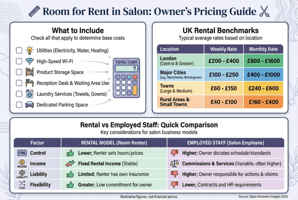
Room for rent in salon pricing benchmarks and employment status indicators across UK regions
HMRC indicators of genuine self-employment:
- The renter sets their own hours and takes time off without asking permission
- They source and maintain their own client list
- They use their own products and equipment
- They set their own prices
- They operate their own business bank account
- They carry their own insurance
- They do not earn anything when they have no appointments (HMRC Employment Status Guidance, 2025)
Red flags that suggest employment:
- You set the renter's working hours
- You provide their clients via your reception
- The renter uses your products exclusively
- You pay them a fixed wage regardless of bookings
- They cannot work at other salons
HMRC has published sector-specific guidance for hair and beauty, developed with industry input. Use the free Check Employment Status for Tax (CEST) tool to test your arrangement.
Run the CEST tool first
Run the CEST tool before you advertise the room for rent in your salon, not after. Restructuring an existing arrangement is harder than setting one up correctly from the start.
If you're thinking "we've always done it this way and nobody has asked," that does not mean you are compliant.
The penalties for misclassification include:
- Backdated PAYE and employer NICs
- Interest on unpaid amounts
- Potential fines for repeated non-compliance
Ask yourself: if HMRC walked in tomorrow, would the day-to-day reality match what your contract describes? If you employ junior staff alongside your renters, the hairdressing apprenticeship route has its own distinct employment obligations.
Managing the Landlord-Renter Relationship
Finally, the room for rent in your salon is occupied, the contract is signed, and HMRC would approve. What now? A good rental arrangement should feel like a professional partnership, not a property dispute. Clear communication from the start prevents most problems.
Practical management tips:
- Monthly check-ins: a quick 10-minute conversation about how things are going
- Shared calendar: avoid double-bookings and coordinate quiet days
- Clear boundaries: whose products go where, who cleans what, reception protocols
- Review rent annually: adjust for inflation, utility costs, and market rates
- Document everything: keep records of payments, communications, and any issues
The reality for most salon owners is that the first few weeks feel awkward. You are used to running everything yourself. Having someone operate independently in your space takes adjustment.
The way you manage the relationship directly affects HMRC's view of the employment status. Treating a renter like staff creates both a personal and a legal problem.
One common mistake is treating the renter like an employee: telling them when to arrive, which clients to see, what products to use. This undermines both the relationship and the employment status. Let them run their business. Your role is landlord, not manager.
For example, a salon owner who checks in monthly over a coffee and discusses shared marketing opportunities builds a stronger partnership than one who sends daily instructions about opening times and cleaning rotas. The first approach strengthens self-employment status. The second undermines it.
If things go wrong, refer to your contract. If you do not have one, you have no leverage, which is exactly why the contract section above matters.
If You Only Have 30 Minutes a Week, Do This
- Day 1-2 (10 min): Research room for rent in salon prices in your area on Hotpatch, UK Therapy Rooms, and local Facebook groups
- Day 3-4 (10 min): List what your room includes (utilities, Wi-Fi, storage, reception) and calculate a fair weekly rate
- Day 5-7 (10 min): Download a rental agreement template from Simply Docs and note which clauses you need to customise
Getting found online starts with the fundamentals: a local SEO checklist walks through the Google Business Profile and listing steps that help both clients and quality renters discover you. If you are building your salon's online presence to attract both clients and quality renters, explore tools designed for beauty salon owners to create a professional digital presence that works for your business.
For restaurants, salons, and local businesses
Need help with your marketing?
We help UK businesses turn social media into real results, not busywork.
Start freeKey Takeaway
A room for rent in a salon can generate £2,000 to £15,000+ annually depending on location and terms. Price your room based on local benchmarks and what is genuinely included. Always use a written contract: it protects you and supports the renter's self-employed status. Check HMRC's employment status indicators before advertising: misclassification carries serious financial penalties. Find renters whose services complement yours rather than compete. Manage the relationship professionally: you are a landlord, not an employer. Review terms annually to keep the arrangement fair for both sides.
Get More Marketing Tips
Practical marketing tips for UK business owners, straight to your inbox. No spam, unsubscribe anytime.
About the Author
Local Brand Hub
Empowering UK Businesses
Local Brand Hub provides comprehensive business management tools designed specifically for UK local businesses to streamline operations, automate marketing, and grow revenue.
More articlesRelated Articles
 Business Growth
Chair Rental in Hair Salon: A Renter's Guide
Chair rental in hair salon explained: UK costs by region, what to check before you sign, contract must-haves and how to build your brand as a renter.
 Business Growth
Hairdressing Chair Rental: UK Pricing and Legal Guide (2026)
Hairdressing chair rental in the UK: 2026 regional pricing, HMRC employment status rules, contract requirements and insurance obligations fully explained.
 Business Growth
Beauty Business for Sale: A UK Buyer's Guide
Find a beauty business for sale in the UK. Covers valuation, due diligence, legal steps, and your first 90 days as a new salon owner.