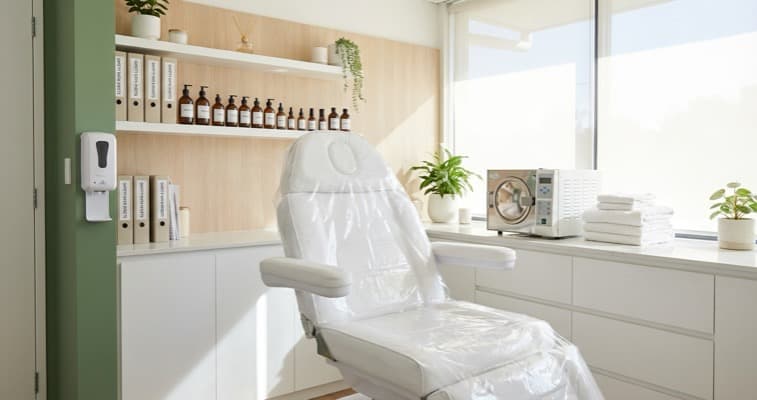
Health and safety for beauty salon owners in the UK. COSHH assessments, risk assessments, patch testing and exactly what inspectors look for during visits.
Health and safety for beauty salon businesses covers the legal duties UK salon owners have to protect staff, clients, and visitors from workplace hazards. This includes COSHH assessments for chemicals, risk assessments for treatments, hygiene standards, and fire safety measures. Local authority officers enforce compliance through inspections.
You have got a treatment room that runs like clockwork. Clients rebook. Reviews glow. Then an environmental health officer turns up without warning and asks to see your COSHH folder. Your stomach drops. If you are thinking "I don't even know what COSHH stands for," you are far from alone, and this is where most beauty salon owners quietly panic.
This guide walks through every health and safety requirement for beauty salons in the UK, with steps you can act on today. No jargon without explanation. No scare tactics. Just what you need to do and how to prove it. 16 min read.
What You'll Learn
- How to complete a COSHH assessment for every chemical product in your salon
- What risk assessments you need and how often to update them
- Hygiene and sterilisation standards that pass inspection
- Patch testing requirements and how to document them properly
- Exactly what environmental health inspectors look for during a salon visit
Step 1: Understand Your Legal Duties Under UK Health and Safety Law
So where does health and safety for beauty salon owners actually start? With the law.
Who Does the Law Apply To?
The Health and Safety at Work Act 1974 places a legal duty on employers to protect the health, safety, and welfare of employees and anyone affected by their work (HSE, 2025). If you employ anyone, even one Saturday girl, this applies to you. Sole traders working alone still have duties to protect clients and visitors.
For example, a nail technician working from a home studio still needs to assess the risks of acrylic dust and ensure proper ventilation. In other words, the law does not care whether you are on a high street or in a spare bedroom.
Risk Assessment Duties
The Management of Health and Safety at Work Regulations 1999 require every employer to carry out a suitable assessment of workplace risks. For a beauty salon, this means assessing risks for each treatment you offer, not just a single generic document for the premises.
If you are planning to open your own salon, our guide to starting a beauty business covers the full setup process from licensing to launch.
Key legislation for beauty salon owners:
| Legislation | What It Covers |
|---|---|
| Health and Safety at Work Act | Duty to protect employees, clients, visitors |
| COSHH Regulations | Control of hazardous substances |
| Management of H&S at Work Regulations | Risk assessments and safety management |
| Fire Safety Order | Fire risk assessments and procedures |
| Local Government (Misc Provisions) Act | Registration for piercing, tattooing, beauty |
This guide provides general information about UK health and safety requirements. Regulations may vary by local authority. Consult your local council and a qualified health and safety adviser for guidance specific to your business.
Step 2: Complete Your COSHH Assessments
Now you know the legal framework. But the piece that catches most beauty salon owners off guard is COSHH. Here's what it means and why it matters. COSHH stands for Control of Substances Hazardous to Health. The COSHH Regulations require any business that uses or stores hazardous chemicals to assess the risks and put controls in place (HSE, 2025).
Which Products Fall Under COSHH?
In a beauty salon, that means almost every product you use:
- Acrylic monomer and nail glue
- Eyelash adhesive
- Hair dye containing PPD
- Depilatory wax
- Cleaning products and disinfectants
If you are thinking "I use these products every day and nothing bad has happened," that does not mean the risk is zero: it means you have been lucky so far.
For example, a beauty therapist performing acrylic nail extensions works with methyl methacrylate (MMA) or ethyl methacrylate (EMA) monomers. As a result, without proper ventilation, repeated exposure can cause headaches, skin sensitisation, and respiratory issues.
The Five Steps to a COSHH Assessment
- Identify the hazard: List every chemical product you use. Check the Safety Data Sheet (SDS) from the manufacturer for each one.
- Decide who might be harmed: Staff applying the product, clients receiving the treatment, and other people in the salon breathing the fumes.
- Evaluate the risk and decide on precautions: Is ventilation adequate? Are gloves required? Does the SDS specify a maximum exposure time?
- Record your findings: Write down your assessment, the controls you have put in place, and who is responsible for maintaining them.
- Review and update regularly: Whenever you introduce a new product, change a procedure, or after an incident.
If you are thinking "this sounds like a lot of paperwork for nail glue," consider this: COSHH is one of the first things an inspector checks. Having a folder of completed assessments with the corresponding Safety Data Sheets shows you take compliance seriously.
Save time with a template
Create a COSHH assessment template once and reuse it for each product. Most beauty salon products fall into similar hazard categories, so the controls section will be similar across products. One hour of setup saves dozens of hours later.
Your salon layout and ventilation play a role in chemical safety; see our beauty salon design ideas for practical tips.
Common beauty salon chemicals requiring COSHH assessment:
| Product | Key Hazard | Typical Controls |
|---|---|---|
| Acrylic monomer | Respiratory sensitiser, flammable | Local exhaust ventilation, nitrile gloves |
| Eyelash adhesive (cyanoacrylate) | Eye and skin irritant, fumes | Well-ventilated room, client eye pads |
| Hair dye (PPD-containing) | Skin sensitiser, allergen | Patch test 48 hours prior, gloves |
| Nail polish remover (acetone) | Flammable, skin irritant | Ventilation, avoid naked flames |
| Barbicide / disinfectant | Skin and eye irritant | Gloves, correct dilution ratio |
| Depilatory wax | Burn risk, skin irritant | Temperature testing, patch test |
Step 3: Write Risk Assessments for Your Treatments
Now that your COSHH folder is sorted, let's move on. Chemicals are only part of health and safety for beauty salon businesses. A risk assessment covers everything else that could cause harm: slips, burns, allergic reactions, cross-contamination, and electrical equipment.
Under the Management of Health and Safety at Work Regulations, you must assess risks and record findings if you have five or more employees. However, even below that threshold, it is considered best practice and most insurance policies require it (NHBF, 2025).
You need a risk assessment for:
- Each category of treatment (nails, lashes, waxing, facials, massage)
- General premises risks (slippery floors, trailing cables, hot wax spills)
- Electrical equipment (steamers, UV lamps, autoclaves)
- Client-specific risks (allergies, medical conditions, pregnancy)
For instance, a waxing risk assessment should cover burn risk from overheated wax, allergic reaction to wax ingredients, cross-contamination from double-dipping spatulas, and how to respond if skin lifting occurs. If you can't tell whether your wax is at the right temperature without testing on a client, that's usually a sign the therapist needs extra training in wax temperature management.
Writing a beauty salon business plan? Make sure your risk assessments are part of the operational section.
How often to review: Review risk assessments annually, after any incident or near-miss, when you add a new treatment, or when you change products or equipment. Keep signed and dated copies in a central health and safety for beauty salon file that any staff member can access.
Ask yourself: if an inspector walked in right now, could you show them a completed risk assessment for every treatment on your menu? If the answer is no, start with your most popular service and work through the rest this month.
Step 4: Meet Hygiene and Sterilisation Standards
Moving on from paperwork to practice: this is where health and safety for beauty salon businesses gets hands-on. Environmental health officers expect salons to show robust infection control, especially for tools that contact broken skin (HSE, 2025).
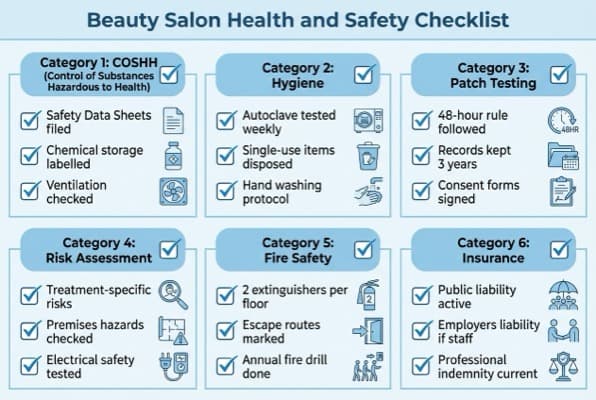
A complete health and safety compliance checklist for beauty salon owners
Sterilisation hierarchy:
- Autoclave (Class B recommended): Required for any tool that pierces skin or contacts blood, including cuticle nippers, callus removers, and extraction tools. Class B autoclaves use vacuum pressure to sterilise hollow, hinged, and wrapped instruments effectively.
- Chemical disinfection: Suitable for tools that contact intact skin only, such as tweezers used for routine plucking on unbroken skin. Barbicide or equivalent hospital-grade disinfectant at correct dilution.
- Single-use items: Disposable where possible. Wax spatulas, cotton pads, sponges, and nail files should never be reused between clients.
If you are only relying on a UV cabinet for sterilisation, that is usually a sign you need to upgrade. UV cabinets maintain sterility of already-sterilised tools during storage. They do not sterilise. An autoclave is the gold standard for any tool that breaks or touches broken skin.
PPE for beauty therapists:
| Treatment | Minimum PPE |
|---|---|
| Nail extensions (acrylic/gel) | Nitrile gloves, dust mask (FFP2 recommended) |
| Waxing | Disposable gloves, apron |
| Lash extensions / tinting | Gloves, eye protection available |
| Facials / microdermabrasion | Gloves, apron |
| Any treatment involving blood | Gloves, apron, eye protection, sharps disposal |
A professional website builds trust with clients before they even step through the door; see our guide to salon websites and SEO.
Step 5: Get Patch Testing Right
Now let's tackle another critical area. Sterilisation protects against infection, but patch testing protects against allergic reactions, and it is one of the most common areas where beauty salon health and safety falls short.
Is a Patch Test Legally Required?
Patch testing before certain treatments is best practice and strongly recommended by product manufacturers, the NHBF, and BABTAC. While no single UK statute explicitly mandates a 48-hour patch test, failing to carry one out when the manufacturer recommends it could leave you exposed in a negligence claim (NHBF, 2025).
Treatments that typically require a patch test:
- Hair colouring containing PPD or PTD
- Eyelash and eyebrow tinting
- Lash lift and brow lamination chemicals
- Certain facial peels
How to Conduct a Patch Test
- Apply a small amount of the product behind the client's ear or inner elbow at least 48 hours before the treatment
- Record the date, time, product name, batch number, and the area tested on a client record card
- Instruct the client to contact you if any reaction occurs
- Check the test area before proceeding with the treatment
- Record the result (positive or negative) and keep the record for a minimum of three years
For example, a beauty salon offering lash lift treatments should patch test every new client, even if they have had the treatment elsewhere. Different brands use different formulations. A client who tolerated one product may react to another.
If you are thinking "nobody actually does 48-hour patch tests," think again. If a client has a severe allergic reaction and you cannot produce a documented negative patch test, your insurance provider may refuse the claim.
Step 6: Prepare for Environmental Health Inspections
Now that you have got your products assessed, risks documented, tools sterilised, and patch tests logged, let's address the part that makes salon owners nervous: the inspection itself.
Registration Requirements
Local authority environmental health officers can visit your beauty salon with or without notice. Under the Local Government (Miscellaneous Provisions) Act 1982, businesses offering certain treatments including ear piercing, electrolysis, tattooing, and semi-permanent makeup must register with the local council. Many councils also expect registration for acupuncture, microblading, and cosmetic procedures.
New Licensing Framework for Cosmetic Procedures
Additionally, from 2025, the UK Government is rolling out a licensing framework for non-surgical cosmetic procedures. As a result, practitioners need to hold appropriate indemnity insurance cover, operate from premises meeting hygiene standards, and demonstrate infection control training (gov.uk, 2025).
What inspectors typically check:
- COSHH folder with completed assessments and Safety Data Sheets
- Risk assessments for treatments and premises
- Sterilisation records and autoclave test logs (spore tests)
- Patch test records and client consent forms
- Staff training records for health and safety, first aid, and fire safety
- Insurance certificates (public liability, employer's liability if applicable)
- Fire risk assessment and evidence of fire extinguisher servicing
- Waste disposal arrangements (clinical waste contract if you produce sharps)
- First aid kit stocked and in-date
Make sure your Google Business Profile is up to date so inspectors and clients alike can find accurate details about your salon. Once compliance is under control, a local SEO checklist is a good next step for the marketing side.
If you're thinking "I'll sort all this out when I have a quiet week," the reality for most beauty salon owners is that quiet weeks do not exist. If you're only updating records you'll always lose to salons that build compliance into their daily routine. Don't wait until an inspection because you'll regret it.
Keep a Living Compliance Folder
Keep a single health and safety for beauty salon folder (physical or digital) that gets updated in real time. Five minutes after each product delivery or treatment change is easier than five hours of panic before an inspection.
For example, a beauty salon in Manchester received an unannounced visit and passed with no issues because the owner updated her COSHH folder every time she ordered new stock. The salon next door received an improvement notice because their patch test records were six months out of date. Same street, different outcomes: entirely down to daily habits.
Step 7: Use This Health and Safety for Beauty Salon Checklist
Finally, here's everything in one place. Print this checklist and use it as your rolling compliance tracker.
| Category | Requirement | Frequency |
|---|---|---|
| COSHH | Safety Data Sheets for all products | On purchase / product change |
| COSHH | Written COSHH assessment per product category | Annual review + new products |
| Risk Assessment | Treatment-specific risk assessments | Annual + after incidents |
| Risk Assessment | General premises risk assessment | Annual |
| Hygiene | Autoclave spore testing | Weekly (or per manufacturer) |
| Hygiene | Sterilisation log completed | Every cycle |
| Patch Testing | Client patch test records | Every new client + product change |
| Fire Safety | Fire risk assessment | Annual |
| Fire Safety | Fire extinguisher service | Annual |
| Fire Safety | Emergency evacuation drill | At least annually |
| First Aid | First aid kit check | Monthly |
| First Aid | Trained first aider on-site | During all opening hours |
| Insurance | Public liability insurance (minimum £1 million recommended) | Annual renewal |
| Insurance | Employer's liability insurance (£5 million legal minimum) | Annual renewal (if you employ staff) |
| Training | Staff health and safety induction | On hiring |
| Training | COSHH awareness refresher | Annually |
Fire Safety Requirements
Beauty salons should have two fire extinguishers per floor: one foam or water extinguisher for carbonaceous fires and one CO2 extinguisher for electrical fires. Emergency lighting, fire safety signage, and a documented evacuation plan are also required under the Regulatory Reform (Fire Safety) Order.
Tick items off as you complete them and review the full list every quarter. Health and safety for beauty salon compliance is a rolling process, not a one-off exercise.
If You Only Have 30 Minutes a Week, Do This
Here's the minimum viable plan to start building your health and safety for beauty salon compliance.
- Day 1-2 (10 min): Collect every Safety Data Sheet for the products you use. If any are missing, email the supplier and request them. Start a COSHH folder.
- Day 3-4 (10 min): Write a one-page risk assessment for your most common treatment. Use the HSE's free risk assessment template at hse.gov.uk/simple-health-safety/risk.
- Day 5-7 (10 min): Check your patch test record system. If you do not have one, create a simple form: client name, date, product, batch number, result. Print ten copies and start using them tomorrow.
Frequently Asked Questions About Health and Safety for Beauty Salon Owners
What are the 7 key areas of health and safety in a beauty salon?
The seven key areas that cover health and safety for beauty salon businesses are: COSHH (chemical safety), risk assessments, hygiene and infection control, fire safety, electrical safety, first aid, and insurance. Each area requires its own documentation, and environmental health officers may check any of them during an inspection.
Do I need a health and safety policy if I work alone?
If you are a sole trader with no employees, you are not legally required to have a written health and safety policy. However, you still have a duty of care to clients and visitors. Most insurers and professional bodies such as the NHBF recommend having documented procedures regardless of business size.
How often should a beauty salon update its risk assessments?
Review risk assessments at least annually. You should also update them after any incident or near-miss, when adding a new treatment to your menu, when changing products or suppliers, or when the layout of your salon changes. Always date and sign updated documents.
What happens if I fail an environmental health inspection?
Outcomes vary by local authority. Officers may issue an improvement notice giving you a deadline to fix issues, a prohibition notice stopping a specific activity immediately, or in serious cases, prosecution. In practice, most inspectors work with salon owners to resolve issues before taking formal action.
What insurance do I need for a beauty salon?
At minimum, you need public liability insurance (£1 million cover is standard for beauty salons). If you employ staff, employer's liability insurance of at least £5 million is a legal requirement. Professional indemnity insurance is also recommended, and will be mandatory for practitioners offering non-surgical cosmetic procedures under the 2025 licensing framework.
More Resources for Beauty Salon Owners
Whether you are just starting out or looking to grow, these guides cover the key areas for running a successful beauty business in the UK:
- How to start a beauty business: the complete startup guide
- Step-by-step beauty business guide: a practical walkthrough
- Writing a beauty salon business plan: finances, forecasts, and funding
- Hair and beauty business: combining services under one roof
- Buying a beauty business: due diligence and valuation
- Chair rental in a hair salon: how chair rental works
- Hairdressing chair rental: pricing and agreements
- Renting a room in a salon: finding the right space
- Self-employed hairdresser: going it alone
- Hairdressing apprenticeships: training the next generation
Explore our beauty salons industry page to see how Local Brand Hub helps salon owners build their online presence.
Weekly Action
- Download your Safety Data Sheets: Contact every product supplier and request the current SDS for each product you use. Save them in a single folder labelled "COSHH" with the date you collected them.
- Complete one COSHH assessment: Pick your highest-risk product (usually acrylic monomer or eyelash adhesive) and work through the five steps above. Once you have done one, the rest follow the same pattern.
For restaurants, salons, and local businesses
Need help with your marketing?
We help UK businesses turn social media into real results, not busywork.
Start freeKey Takeaway
Health and safety for beauty salon businesses starts with the Health and Safety at Work Act, which applies whether you employ staff or work alone. COSHH assessments are required for every hazardous product, from acrylic monomer to cleaning solutions. Risk assessments must be treatment-specific, not a single generic document for the whole salon. Autoclaves are required for tools that pierce skin or contact blood: UV cabinets only store sterile tools. Patch testing is best practice and likely required by your insurer, even without a specific legal mandate. Environmental health officers can visit without notice. Keep your compliance folder current and review all assessments annually, after incidents, and when you change products or procedures.
Get More Marketing Tips
Practical marketing tips for UK business owners, straight to your inbox. No spam, unsubscribe anytime.
About the Author
Local Brand Hub
Empowering UK Businesses
Local Brand Hub provides comprehensive business management tools designed specifically for UK local businesses to streamline operations, automate marketing, and grow revenue.
More articlesRelated Articles
 Tutorials
Nail Technician Business: Mobile, Chair Rental & Going Solo
How to run a nail technician business as a sole trader. Covers mobile vs chair rental vs home salon, HMRC self-employment and personal branding in the UK.
 Tutorials
Hairdressing Apprenticeship: Your Complete UK Guide
Complete UK hairdressing apprenticeship guide. Covers NVQ Level 2 and 3, pay rates, how to find openings, employer funding, and salary progression.
 Tutorials
Self Employed Hairdresser: UK Tax and Setup Guide
How to become a self employed hairdresser in the UK. HMRC registration, tax rates, insurance costs, pricing, and building your client base.