
Chair rental in hair salon explained: UK costs by region, what to check before you sign, contract must-haves and how to build your brand as a renter.
Chair rental in a hair salon is an arrangement where a self-employed stylist pays a fixed fee to use a station within an established salon, bringing their own clients and setting their own prices. The renter keeps all earnings minus the rent and runs their business independently.
You have the skills, a loyal handful of clients, and a phone full of five-star reviews. What you do not have is £30,000 for a salon lease, a shop fit-out, and six months of overheads. Chair rental in a hair salon bridges that gap: you get a professional workspace without the financial risk of going fully independent.
This guide walks you through what chair rental in a hair salon actually costs across the UK, how to pick the right salon, and how to build your brand from someone else's chair.
What You'll Learn
- What chair rental in hair salon arrangements involve and how they differ from employment
- Realistic UK chair rental costs by region so you can budget properly
- A checklist for evaluating salons before you commit
- Contract clauses that protect your interests
- How to grow your personal brand while renting a chair
What Is Chair Rental in a Hair Salon?
The chair rental model is a business arrangement where you pay a weekly or monthly fee for access to a styling station, mirror, and basic salon facilities. In return, you keep all your client income, manage your own diary, and run your business on your own terms.
For example, a stylist renting a chair in Nottingham might pay £150 per week for a station with utilities, Wi-Fi, towels, and booking system access.
This is fundamentally different from being employed. Nobody tells you when to work, which clients to see, or what to charge. You are running a business from a shared space.
If you are thinking "that sounds like a lot of responsibility", it is. But it also means every pound your clients pay goes to you, minus rent and expenses. The arrangement works well for experienced stylists with an existing client base. It is typically harder for newly qualified hairdressers who have not built a following yet.
Ask yourself: do you have enough regular clients to cover rent from week one? If the answer is no, chair rental might not be the right move yet.
How Much Does Chair Rental Cost?
Next, let us look at the numbers. Chair rental costs vary depending on where you rent and what is included. Here are current UK benchmarks.
UK chair rental costs (2026):
| Location | Weekly Rate | Monthly Rate |
|---|---|---|
| Central London | £250-£400 | £1,000-£1,500+ |
| Outer London | £200-£350 | £800-£1,200 |
| Major cities | £150-£250 | £600-£1,000 |
| Towns and suburbs | £100-£175 | £400-£700 |
| Rural areas | £80-£150 | £300-£550 |
What is typically included in your chair rental fee:
- Styling chair, station, and mirror
- Utilities (electricity, water, heating)
- Wi-Fi and communal areas
- Towels and laundry (varies by salon)
- Reception and booking system access
What is often NOT included:
- Your own products and tools
- Professional indemnity and public liability insurance
- Marketing and advertising costs
- Parking (may be extra at some salons)
If you are only comparing the weekly rent you will always lose to renters who calculate the full cost. Add insurance, products, and marketing before deciding. Work out your true monthly cost and compare it to your realistic income.
What to Look for When Choosing a Salon
With that in mind, how do you choose the right chair rental opportunity? Not every salon advertising a chair is worth your time or money. Evaluate the salon as you would a business partner, because that is what the owner becomes.
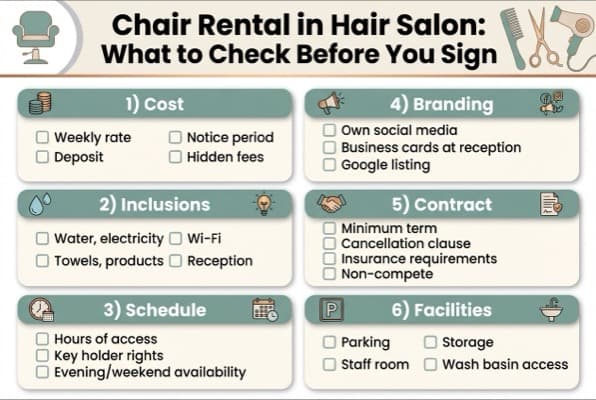
Key factors to evaluate before signing a chair rental agreement
Your evaluation checklist:
- Location and footfall: Is the salon somewhere your clients already visit?
- Salon reputation: Check Google reviews, social media, and upkeep
- Existing clientele: Does the salon attract clients you want?
- Access hours: Can you work evenings and weekends?
- Storage: Is there secure space for your products?
- Branding freedom: Can you display business cards and run your own Google listing?
- Parking: Will your clients reach you easily?
- Atmosphere: Spend a day there before committing
For example, a stylist who specialises in bridal hair should look for a salon with strong wedding season demand and space for longer appointments, not a quick-service barbershop.
The cheapest chair rental is rarely the best deal. A salon charging £20 less per week but offering no parking, poor reviews, and a restrictive contract will cost you more in lost clients.
What Should Be in Your Rental Agreement
Even the perfect salon can cause problems without a proper contract. Never rent a chair on a handshake.
A written agreement protects you and helps prove your self-employed status with HMRC.
Essential contract clauses:
| Clause | What to Look For |
|---|---|
| Rent and payment terms | Fixed amount, due date, payment method |
| Notice period | 4-8 weeks standard, avoid over 12 weeks |
| Deposit | 2-4 weeks' rent, refundable on departure |
| Inclusions | Utilities, Wi-Fi, towels, reception, storage |
| Access hours | Key holder rights, evening/weekend use |
| Insurance | Public liability + professional indemnity required |
| Branding rights | Your cards, social media, Google listing |
| Non-compete | Restrictions on working nearby if you leave |
| Termination | Grounds for early exit by either party |
Red flags in a chair rental contract:
- No written agreement at all
- Salon owner sets your working hours
- You cannot use your own products
- Minimum terms over 6 months
- Non-compete covering an unreasonable area
Disclaimer: This is general guidance, not legal advice. Consult a solicitor if unsure about any contract term.
For example, a stylist in Bristol signed a chair rental agreement that included a 12-month non-compete clause covering a 5-mile radius. When she left after 8 months, the clause prevented her from working nearby, and she lost clients who would not travel further. A 10-minute review with a solicitor before signing would have flagged that clause immediately.
If you are thinking "do I really need to read every clause?", yes. A 10-minute review now prevents a 10-month dispute later.
Building Your Brand as a Chair Renter
Renting a chair does not mean you are invisible. You are building your own business. The salon is just the venue. The most successful chair renters treat their station like a shop within a shop, and they make sure clients searching nearby find them, not just the salon, with a solid set of local SEO tools working in their own name.
Brand-building essentials:
- Google Business Profile: list your name and the salon address so local clients find you
- Social media: Instagram and Facebook in your own name, not the salon's
- Business cards: always visible at your station
- Your own booking system: even a simple online calendar signals independence
- Client loyalty programme: referral discounts, rebooking offers
For example, a colourist renting a chair in Manchester built an Instagram following by showcasing balayage work, tagging the salon location, and offering £10 referral discounts. All without spending anything on premises.
Pro Tip: One common mistake is relying on the salon's marketing. If the salon promotes itself, your work might appear, but enquiries go to them, not you. Own your client relationships from day one.
Tax obligations for chair renters:
- Register as self-employed with HMRC within three months
- File a Self Assessment tax return each year
- Pay Class 2 and Class 4 National Insurance
- Keep records of income and expenses (rent, products, insurance, travel)
- Set aside roughly 25-30% of income for tax and NICs
Chair Rental vs Employment: Making the Right Choice
Finally, let us compare both paths. Neither option is universally better. The right choice depends on your career stage, client base, and risk tolerance.
Rule of thumb: If you have 15+ regular clients and 2+ years' experience, chair rental typically works. If not, employment gives you time to build.
| Factor | Chair Rental | Employment |
|---|---|---|
| Income | Keep all minus rent | Salary or commission |
| Hours | You decide | Set by employer |
| Clients | Your own | Salon provides |
| Tax | Self-assessment | PAYE |
| Holiday pay | None | Statutory entitlement |
| Sick pay | None | Statutory sick pay |
| Risk | Higher | Lower |
| Growth | Unlimited | Limited by pay structure |
Chair rental often suits you if: you have 15+ regular clients, at least 2 years' experience, and want to control your income.
Employment often suits you if: you are newly qualified, still building clients, or prefer income security.
For most stylists ready to go self-employed, chair rental in a hair salon typically offers the lowest-risk entry point compared to opening your own premises.
If you are thinking "I'm not sure I have enough clients yet", you are not alone. Many stylists feel that way. A junior stylist in Birmingham worked employed for two years, built a client list of 25 regulars, then switched to chair rental, covering her rent from week one because she had done the groundwork first.
If You Only Have 30 Minutes a Week, Do This
- Day 1-2 (10 min): List your regular clients and estimate weekly income: can it cover chair rental rent plus 30% for tax?
- Day 3-4 (10 min): Search Hotpatch, UK Therapy Rooms, and local Facebook groups for chair rental listings and note prices
- Day 5-7 (10 min): Download the free HMRC CEST tool and check whether your planned arrangement qualifies as self-employment
Further Reading
Looking for more guidance on starting out in the beauty industry? Browse our beauty salon resources for tools and tips tailored to salon professionals. You might also find these related guides helpful:
- How to start a beauty business: the complete hub guide
- Beauty salon business plan
- Step-by-step beauty business guide
- Room for rent in salon
- Beauty business for sale: what to look for
- Health and safety for beauty salons
For restaurants, salons, and local businesses
Need help with your marketing?
We help UK businesses turn social media into real results, not busywork.
Start freeKey Takeaway
Chair rental in a hair salon lets you run your own business without the cost of premises. UK weekly rates range from £80 in rural areas to £400+ in central London. Always get a written contract covering notice periods, inclusions, branding rights, and non-compete clauses. Budget for the full cost: rent plus insurance, products, marketing, and 25-30% for tax. Build your brand from day one with a Google Business Profile, social media, and business cards. Chair rental suits experienced stylists with clients; employment works better for those still building. Register as self-employed with HMRC and file Self Assessment annually.
Get More Marketing Tips
Practical marketing tips for UK business owners, straight to your inbox. No spam, unsubscribe anytime.
About the Author
Local Brand Hub
Empowering UK Businesses
Local Brand Hub provides comprehensive business management tools designed specifically for UK local businesses to streamline operations, automate marketing, and grow revenue.
More articlesRelated Articles
 Business Growth
Hairdressing Chair Rental: UK Pricing and Legal Guide (2026)
Hairdressing chair rental in the UK: 2026 regional pricing, HMRC employment status rules, contract requirements and insurance obligations fully explained.
 Tutorials
Nail Technician Business: Mobile, Chair Rental & Going Solo
How to run a nail technician business as a sole trader. Covers mobile vs chair rental vs home salon, HMRC self-employment and personal branding in the UK.
 Tutorials
Self Employed Hairdresser: UK Tax and Setup Guide
How to become a self employed hairdresser in the UK. HMRC registration, tax rates, insurance costs, pricing, and building your client base.