
Find a beauty business for sale in the UK. Covers valuation, due diligence, legal steps, and your first 90 days as a new salon owner.
A beauty business for sale is an existing salon, clinic, or treatment-based business being offered to a new owner: complete with its client base, equipment, premises, and (ideally) a track record of revenue. Buying an established beauty business can be a faster route to ownership than starting from scratch.
You have the skills. You have the ambition. But the thought of spending months building a client base from zero is exhausting before you even start. What if you could skip the hardest part and walk into a salon that already has bookings?
This guide covers how to find a beauty business for sale in the UK, how to value it properly, what to check before you sign anything, and how to make the first 90 days count.
What You'll Learn
- Where to find beauty businesses for sale across the UK
- How to value a beauty salon using industry-standard methods
- A due diligence checklist to protect your investment
- The legal steps to complete the purchase
- How to retain clients and build your online presence after buying
Why Buy an Existing Beauty Business Instead of Starting From Scratch
When it comes to acquiring a beauty business for sale, the advantages over a cold start are significant:
- You inherit an existing client base and trained staff
- The premises are already fitted and operational
- You gain a reputation that took years to build
Starting from scratch typically takes six months or more before you see your first client. Our startup timeline guide covers this in detail. Buying puts you behind the reception desk within weeks.
For example, a nail salon with 200 regular clients and three therapists on the books gives you immediate revenue from day one, something a brand-new salon simply cannot offer.
However, buying also carries risk. You are inheriting someone else's lease terms, staff contracts, and reputation. If you're thinking "surely any salon with clients is a safe bet," that is rarely the case. The reasons behind the sale matter as much as the numbers on the spreadsheet.
Where to Find Beauty Businesses for Sale in the UK
Now that you understand the advantages, here's where to actually search for a beauty business for sale in the UK.
Online Business-for-Sale Platforms
- Daltons Business: one of the UK's largest business-for-sale directories, with a dedicated health and beauty category
- BusinessesForSale.com: international platform with strong UK coverage, filtering by region and price
- RightBiz: UK-focused platform backed by the government's British Business Bank
Off-Market Routes
- Business transfer agents (brokers): Specialist brokers handle salon sales and often have off-market listings. They typically charge the seller, not the buyer.
- NHBF and industry networks: The National Hair & Beauty Federation connects members and sometimes shares listings.
- Local word-of-mouth: Ask suppliers, insurance providers, and landlords. Many salon sales never reach public listing.
If you're thinking "I've been searching for months and nothing good comes up," that is normal. The best beauty businesses for sale often sell through brokers before they hit public platforms. If you're only relying on online listings you'll always lose to buyers who also work broker networks and local contacts.
How to Value a Beauty Business for Sale
Moving on to what is often the most important part of evaluating any beauty business for sale: working out what it is actually worth.
The Two Main Valuation Methods
1. EBITDA multiplier: Hairdressing salons and beauty businesses in the UK typically sell for 2.0 to 4.0 times their annual EBITDA (earnings before interest, tax, depreciation, and amortisation). A salon generating £50,000 EBITDA would typically be valued between £100,000 and £200,000.
2. Asset-based valuation: Add up tangible assets (equipment, stock, fit-out) and intangible assets like the client database and brand. This method often produces a lower figure and is useful as a floor price.
| Valuation Factor | What to Check | Red Flag |
|---|---|---|
| Revenue trend | 3 years of accounts | Declining year-on-year |
| Profit margin | Net profit as % of revenue | Below 8% consistently |
| Client retention | Rebooking rate and frequency | Fewer than 40% rebooking |
| Staff stability | Turnover rate, notice periods | Key therapist leaving soon |
| Lease terms | Remaining years, rent reviews | Lease expiring within 12 months |
Valuations vary by location, business model, and market conditions; always seek professional advice.
What Drives the Multiplier Up or Down
A beauty salon with strong social media following and high rebooking rates might command the top end of the range. A salon where the owner is the primary therapist, and all clients are booked with them personally, would sit at the lower end, because clients may leave when the owner does.
If you cannot tell whether the business's revenue depends on the owner or the brand, that's usually a sign to dig deeper into the booking data.
Check the Booking Data
Ask to see the booking system data, not just the financial accounts. Accounts tell you what happened; booking records tell you why, and whether it will continue after the sale.
Due Diligence Checklist Before You Buy
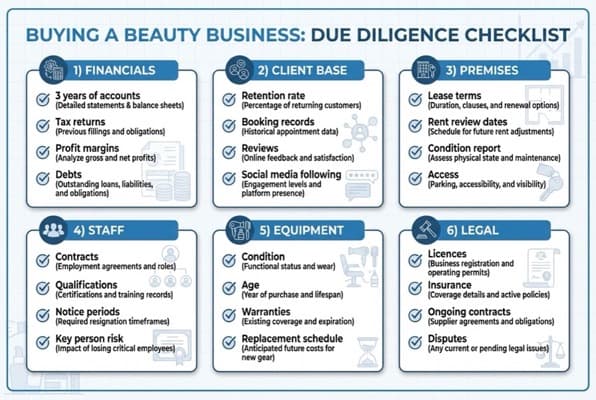
Cover every angle before committing to a beauty business purchase.
Building on the valuation, here's what to check before you commit to any beauty business for sale. Due diligence protects you from hidden problems that look fine on paper.
- Financial records: Request three years of accounts, tax returns, and bank statements. Look for consistency, not just profit.
- Client base: Ask for anonymised booking data showing visit frequency, average spend, and retention rates.
- Staff contracts: Review employment contracts, notice periods, and any restrictive covenants. Are key therapists on short notice?
- Premises lease: Check remaining term, rent review dates, break clauses, and any restrictions on business use or assignment.
- Equipment condition: Get an inventory with age and condition of every major item. Budget for replacements within year one.
- Licences and insurance: Confirm all council registrations, treatment licences, and insurance policies are current and transferable.
- Online reputation: Check Google reviews, social media following, and any unresolved complaints. A poor online reputation is expensive to repair.
- Debts and liabilities: Ask the seller's solicitor to confirm there are no outstanding debts, tax liabilities, or legal disputes attached to the business.
If you're thinking "this is a lot of work," it is. But every item on this list exists because someone skipped it and regretted the decision. Consider getting your business plan documented alongside due diligence so your funding application is ready.
Legal Steps to Complete the Purchase
Now that due diligence is done, let's cover the legal process. Buying a beauty business for sale in the UK follows a well-established path, but you need professional support.
Appointing the Right Solicitor
Step 1: Appoint a solicitor. Choose one experienced in business transfers, not just property conveyancing. They handle the sale agreement, lease assignment, and staff transfer.
Step 2: Agree the deal structure. Most beauty business sales are asset purchases (you buy equipment, goodwill, and client list) rather than share purchases (buying the company itself). Asset purchases are simpler and let you avoid inheriting unknown liabilities.
Step 3: Handle staff transfers. Under TUPE regulations, existing employees transfer to you on their current terms. You cannot change their pay, hours, or conditions simply because you are the new owner.
For example, if the salon employs two part-time therapists on permanent contracts, those terms carry over to you. If you're thinking "I'll just renegotiate after completion," that approach often fails under TUPE and can lead to tribunal claims.
Completing the Transfer
- Step 4: Transfer the lease. Your solicitor negotiates the lease assignment with the landlord. Most commercial leases require landlord consent, which can take several weeks.
- Step 5: Update registrations. Transfer or re-apply for council registrations, insurance, and treatment licences. Also update the Google Business Profile ownership; this is often overlooked and can cause online visibility problems.
The entire legal process typically takes 6 to 12 weeks from agreeing terms to completion.
Make sure health and safety requirements are in place before you reopen under new ownership.
Your First 90 Days After Buying a Beauty Salon
Finally, you have the keys. Here's how to make the transition work. The first 90 days determine whether clients stay or leave.
Days 1 to 30: Listen and learn.
- Keep everything the same initially. Resist the urge to rebrand, redesign, or change the treatment menu immediately.
- Meet every staff member individually. Understand their concerns, strengths, and what they would change.
- Contact the top 50 clients personally: a brief email or text introducing yourself goes a long way.
Days 31 to 60: Optimise quietly.
- Review pricing against local competitors. If prices have not been updated in over a year, consider a modest increase with advance notice.
- Set up your own systems: booking platform, payment processing, stock management. Switching from a paper diary to an online booking system like Fresha can increase rebooking rates within weeks.
- Start marketing your salon: refresh social media, update your website, and work through a local SEO checklist so your Google listing reflects the new ownership.
Days 61 to 90: Make your mark.
- Introduce one new treatment or service based on client feedback, not your own preferences.
- Run a loyalty initiative to reward existing clients and encourage referrals.
- Review your first full month of financial data against the projections from due diligence.
If you are only competing on keeping things exactly the same, you'll always lose to competitors who improve. The goal is controlled evolution, not revolution.
Ask yourself honestly: if you were a regular client, would you stay after the ownership change? If the answer is not confidently yes, prioritise client communication above everything else.
If You Only Have 30 Minutes a Week, Do This
- Day 1 to 2 (10 min): Search Daltons Business and BusinessesForSale.com for beauty businesses for sale in your target area; save three listings to compare
- Day 3 to 4 (10 min): For each listing, note the asking price, stated revenue, and years of accounts available; flag any that do not disclose financials
- Day 5 to 7 (10 min): Contact a local business transfer agent and ask whether they have any off-market salon listings matching your budget
Whether you're buying your first salon or expanding an existing hair and beauty business, it helps to understand the different paths into the industry. If you're still weighing up buying versus starting fresh, read our comprehensive guide on how to start a beauty business.
For those considering a more flexible route, you might also explore chair rental in a hair salon, hairdressing chair rental, or renting a room in a salon. If you're thinking about going independent, our guide on becoming a self-employed hairdresser is worth a read. And if you're earlier in your career, explore options for a hairdressing apprenticeship.
You can also explore our full collection of resources for salon owners on the beauty salons industry page.
For restaurants, salons, and local businesses
Need help with your marketing?
We help UK businesses turn social media into real results, not busywork.
Start freeKey Takeaway
Buying a beauty business for sale gives you an existing client base, premises, and staff, but also inherits the seller's decisions. Value the business using EBITDA multipliers (typically 2.0 to 4.0x for UK beauty businesses) and verify with asset-based valuation. Complete every item on the due diligence checklist, especially booking data, lease terms, and staff contracts. Appoint a solicitor experienced in business transfers, not just property. Under TUPE, staff transfer on existing terms, so factor their costs into your purchase decision. The first 90 days should focus on client retention before any changes. Buying a salon is not a shortcut. It is a different route to the same destination, one that trades startup risk for due diligence discipline.
Get More Marketing Tips
Practical marketing tips for UK business owners, straight to your inbox. No spam, unsubscribe anytime.
About the Author
Local Brand Hub
Empowering UK Businesses
Local Brand Hub provides comprehensive business management tools designed specifically for UK local businesses to streamline operations, automate marketing, and grow revenue.
More articlesRelated Articles
 Business Growth
How to Start a Beauty Business in the UK
How to start a beauty business in the UK. Covers business plans, startup models, regulations, staffing, and marketing for new beauty salon owners.
 Tutorials
How to Start a Beauty Business: 6-Month Timeline
How to start a beauty business in the UK with this 6-month timeline. Covers costs, legal setup, premises, equipment, and marketing to open your doors.
 Business Growth
Room for Rent in Salon: Owner's Revenue Guide
Room for rent in salon explained: UK regional pricing benchmarks, essential contract clauses, and HMRC employment status rules. Practical owner guide.