
How to become a self employed hairdresser in the UK. HMRC registration, tax rates, insurance costs, pricing, and building your client base.
A self employed hairdresser is a hairdresser who works for themselves rather than being employed by a salon. In the UK, this means registering with HMRC for Self Assessment, paying your own income tax and National Insurance, arranging your own insurance, and managing your own client bookings and finances.
You are cutting hair six days a week. The column is full. But the salon owner takes their share, and after chair rent, products, and tax, you are left wondering where it all went. If you are thinking "I could earn more on my own," you are probably right, but only if you set it up properly.
This guide covers everything you need to go self employed as a hairdresser in the UK: from registering with HMRC to setting your prices and getting insured.
What You'll Learn
- How to register as self employed with HMRC and what deadlines matter
- Which National Insurance classes you pay and how much
- What insurance you need and what it typically costs
- How to set your prices so you actually earn more than employed
- The key tax deductions that reduce your bill
Step 1: Understand What Self Employed Hairdresser Means in the UK
First, let's clarify the basics. Being a self employed hairdresser means you are running your own business. You are not on a salon's payroll. You control your own schedule, set your own prices, and manage your own appointments. Around 60.5% of people working in hairdressing and barbering in the UK are self-employed (NHF, 2025), so you would be joining the majority.
How HMRC Defines Self-Employment
HMRC updated their guidance on employment status for hair and beauty professionals in 2025. The key tests are straightforward:
- You are likely self employed if you: set your own hours, set your own prices, choose which clients to take, and do not get paid when you have no appointments
- You may be employed if: the salon tells you when to work, sets your prices, provides all your tools, and pays you a regular wage
The "rent a chair" model sits in a grey area. If you rent a chair but the salon controls your schedule and pricing, HMRC could classify you as employed, regardless of what your contract says. For this reason, make sure your working arrangement genuinely reflects self-employment. For more on chair rental models, see our guides on chair rental in hair salons and hairdressing chair rental.
If you are starting from scratch, our guide on how to start a beauty business covers the full picture from concept to launch.
This guide provides general information about UK tax and business requirements. It is not tax or legal advice. Consult an accountant or visit gov.uk for guidance specific to your situation.
Step 2: Register With HMRC for Self Assessment
Here's the practical first step. Every self employed hairdresser must register for Self Assessment with HMRC to declare their income (gov.uk, 2025).
Registration Process
- Log into your Government Gateway account (or create one)
- Complete the Self Assessment registration form with your business details
- Wait for HMRC to send your 10-digit Unique Taxpayer Reference (UTR) and activation code
- Activate your online account
Key Deadlines for Self Employed Hairdressers
| Deadline | What It Is |
|---|---|
| 5 October | Register for Self Assessment by this date in the tax year you start |
| 5 April | Tax year end |
| 31 January | File your Self Assessment return and pay your tax bill |
For example, if you go self employed in September 2025, you must register by 5 October 2025. Your first Self Assessment return covers 6 April 2025 to 5 April 2026 and is due by 31 January 2027.
Missing the registration deadline can result in penalties, so do not put it off. If you can't tell whether you should register immediately or wait, that's usually a sign you should register sooner rather than later.
Step 3: Understand Your Tax and National Insurance
Moving on to the numbers. As a self employed hairdresser, you pay income tax and National Insurance on your profits (income minus allowable expenses).
Income Tax Rates (2025-26 Tax Year)
| Income Band | Tax Rate |
|---|---|
| Up to £12,570 | 0% (Personal Allowance) |
| £12,571 to £50,270 | 20% (Basic rate) |
| £50,271 to £125,140 | 40% (Higher rate) |
| Over £125,140 | 45% (Additional rate) |
National Insurance Contributions
- Class 2 NIC: A flat weekly rate (check gov.uk for the current amount; it has changed in recent years)
- Class 4 NIC: Payable on profits over £12,570 per year. The rate is a percentage of your profits within certain bands
Tax Savings Tip
Put 25-30% of every payment you receive into a separate savings account for tax. This avoids the January shock when your Self Assessment bill arrives.
What a Self Employed Hairdresser Typically Takes Home
A self employed hairdresser earning £40,000 per year before expenses would typically take home approximately £31,400 after income tax and National Insurance, roughly £600 per week (GoSimpleTax, 2025). However, your actual take-home depends on your allowable expenses.
If you are considering a broader beauty business rather than hairdressing alone, our hair and beauty business guide covers the wider picture.
Step 4: Get the Right Insurance
Now that you understand the tax side, let's cover protection. Every self employed hairdresser needs insurance. It is not optional: most salon owners require proof of insurance before letting you rent a chair, and clients increasingly expect it.
Insurance You Need
| Insurance Type | What It Covers | Required? |
|---|---|---|
| Public liability | Injury to clients or damage to property | Strongly recommended (minimum £1 million) |
| Professional indemnity | Claims from treatments that cause harm | Recommended |
| Employer's liability | Only if you employ anyone, even an apprentice | Legal requirement if you employ staff |
| Personal accident / income protection | Covers you if you cannot work due to illness or injury | Optional but sensible |
For example, if a client has an allergic reaction to a product you applied and takes legal action, professional indemnity insurance covers the legal costs. Without it, you pay out of pocket.
If you are thinking "insurance is just another expense I can't afford," the reality for most self employed hairdressers is that one uninsured claim could cost more than a decade of premiums. Don't rely on luck because if a client gets hurt you'll face the bill alone. Many providers offer combined packages for self employed hairdressers starting from around £50-£100 per year for basic public liability cover.
For a full breakdown of health and safety obligations, see our guide on health and safety for beauty salons.
Step 5: Set Your Prices as a Self Employed Hairdresser
This is where most newly self employed hairdressers get it wrong. They take their old employed rate and charge the same, forgetting they are covering their own tax, insurance, products, and pension.
How to Calculate Your Hourly Rate
- Start with your target annual income: What do you want to take home after tax? For instance, £30,000.
- Add your estimated costs: Chair rent, products, insurance, training, phone, travel. For instance, £8,000 per year.
- Add your tax liability: On £38,000 profit, roughly £6,500 in tax and NIC.
- Divide by your working hours: If you work 40 hours per week, 46 weeks per year (6 weeks off), that is 1,840 hours. £44,500 / 1,840 = roughly £24 per hour minimum.
Employed vs Self Employed: Income Comparison
| Factor | Employed | Self Employed |
|---|---|---|
| Gross pay control | Set by salon | Set by you |
| Tax handled | Employer deducts PAYE | You file Self Assessment |
| Holiday pay | Entitled to 28 days | No paid holidays |
| Sick pay | May receive SSP | No sick pay unless insured |
| Pension | Employer contributes | You arrange your own |
| Products | Usually provided | Usually your cost |
| Schedule | Set by salon | Set by you |
If you're only charging the same as you earned employed you'll always lose to the costs of being self employed. Factor in everything before you set a single price.
Step 6: Claim Your Tax Deductions
Additionally, one of the biggest advantages of being a self employed hairdresser is claiming business expenses against your tax bill. Every legitimate business cost reduces your taxable profit.
Common Tax Deductions for Self Employed Hairdressers
- Chair rent or salon space: Your biggest expense, fully deductible
- Products and colour stock: Everything you use on clients
- Tools and equipment: Scissors, dryers, straighteners, clippers
- Insurance premiums: Public liability, professional indemnity
- Training and CPD courses: Provided they relate to your existing trade
- Travel costs: If you are mobile or travel between locations (not home to a fixed salon)
- Phone and internet: The business-use proportion
- Uniforms and protective clothing: Aprons, gloves, salon wear
- Professional memberships: NHBF, NHF, freelance hairdresser associations
- Accountancy fees: If you hire an accountant to file your return
Receipt Tracking
Keep every receipt. Use a free app like FreeAgent or QuickBooks Self-Employed to photograph receipts as you go. HMRC can request evidence up to 22 months after you pay your tax bill (HMRC, 2025).
Ask yourself: are you tracking every business expense, or just the obvious ones? Most self employed hairdressers leave money on the table by forgetting to claim for phone bills, parking, and professional memberships.
Step 7: Build Your Client Base From Scratch
Finally, the practical reality. Going self employed means building a client base, or bringing one with you. Here's what works.
Quick-Win Client Building Strategies
- Tell existing clients: If you are leaving a salon, let regular clients know where you are going (check your contract for non-compete clauses first)
- Set up a Google Business Profile: Free, and it puts you on the map for "hairdresser near me" searches
- Use Instagram and Facebook: Post before-and-after photos, stories of your work, and booking links
- Ask for reviews: After every appointment, ask happy clients to leave a Google review
- Referral incentive: Offer £10 off their next appointment for every new client they refer
For example, a self employed hairdresser who moved from a city-centre salon to a chair rental in a suburb built a full column within three months by combining Google reviews with an Instagram presence and a simple referral discount.
If you're thinking "I don't have time for marketing on top of cutting hair," the reality is that every self employed hairdresser spends some time on it. The ones who do it consistently fill their columns faster. Working through a simple local SEO checklist once covers the essentials (Google Business Profile, reviews, and directory listings) so new clients can actually find you.
If you are considering taking on an apprentice as your business grows, see our guide on hairdressing apprenticeships.
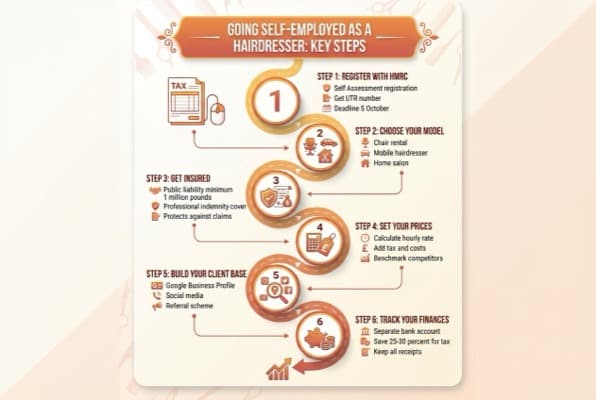
Key steps to becoming a self employed hairdresser in the UK
If You Only Have 30 Minutes a Week, Do This
Here's the minimum viable plan to get started as a self employed hairdresser.
- Day 1-2 (10 min): Create a Government Gateway account and start the HMRC Self Assessment registration. You need your National Insurance number handy.
- Day 3-4 (10 min): Get three insurance quotes from providers that specialise in hairdresser cover. Compare public liability and professional indemnity packages.
- Day 5-7 (10 min): Calculate your minimum hourly rate using the formula above. Write down your target income, estimated costs, and tax liability.
Frequently Asked Questions
How much does a self employed hairdresser earn in the UK?
Self employed hairdressers in the UK typically earn between £30,000 and £60,000 per year, though this varies significantly by location, specialism, and client base size. The average hourly rate across all hairdressers is approximately £13.30 (NHF, 2025). Advanced colourists and those in London or affluent areas can command higher rates.
What can a self employed hairdresser claim for on tax?
You can claim for chair rent, hair products and colour stock, tools and equipment, insurance, training courses, travel between work locations, phone and internet (business proportion), uniforms, professional memberships, and accountancy fees. Keep receipts for everything.
Do I need to register as self employed if I only do hair on the side?
Yes. If you earn more than £1,000 from self-employment in a tax year, you must register with HMRC for Self Assessment. This applies even if hairdressing is a side income alongside employment (gov.uk, 2025).
What is the 60/40 chair rental split?
In a 60/40 arrangement, the self employed hairdresser keeps 60% of their takings and pays 40% to the salon owner. This covers the chair, use of salon facilities, and sometimes products. Splits vary: some salons charge a flat weekly fee instead.
Further Reading
Whether you are planning to rent a chair, set up your own space, or buy an existing business, these guides cover the next steps:
- How to Start a Beauty Business: the complete startup guide
- How to Start a Beauty Business: Step-by-Step Guide: a detailed walkthrough
- Beauty Salon Business Plan: writing a plan that works
- Beauty Business for Sale: buying an existing business
- Room for Rent in a Salon: finding and negotiating salon space
Explore our beauty salon resources for more tools and guides tailored to hair and beauty professionals.
For restaurants, salons, and local businesses
Need help with your marketing?
We help UK businesses turn social media into real results, not busywork.
Start freeKey Takeaway
Around 60.5% of UK hairdressers are self employed: you are joining the majority, not the minority. Register with HMRC for Self Assessment before 5 October in the tax year you start, put 25-30% of income aside for tax, and get public liability insurance at minimum. Calculate your hourly rate based on your target income plus all costs, not your old employed wage. Claim every allowable expense and build your client base through Google Business Profile, social media, and referrals.
Get More Marketing Tips
Practical marketing tips for UK business owners, straight to your inbox. No spam, unsubscribe anytime.
About the Author
Local Brand Hub
Empowering UK Businesses
Local Brand Hub provides comprehensive business management tools designed specifically for UK local businesses to streamline operations, automate marketing, and grow revenue.
More articlesRelated Articles
 Tutorials
Nail Technician Business: Mobile, Chair Rental & Going Solo
How to run a nail technician business as a sole trader. Covers mobile vs chair rental vs home salon, HMRC self-employment and personal branding in the UK.
 Business Growth
Chair Rental in Hair Salon: A Renter's Guide
Chair rental in hair salon explained: UK costs by region, what to check before you sign, contract must-haves and how to build your brand as a renter.
 Business Growth
Hairdressing Chair Rental: UK Pricing and Legal Guide (2026)
Hairdressing chair rental in the UK: 2026 regional pricing, HMRC employment status rules, contract requirements and insurance obligations fully explained.