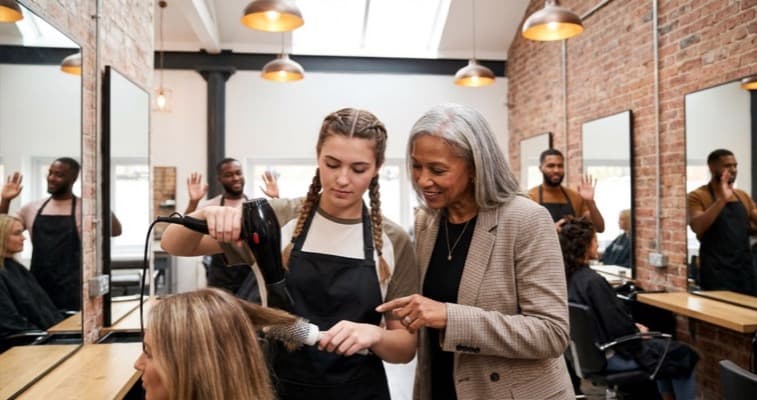
Complete UK hairdressing apprenticeship guide. Covers NVQ Level 2 and 3, pay rates, how to find openings, employer funding, and salary progression.
A hairdressing apprenticeship is a government-backed training programme that combines hands-on salon work with a nationally recognised NVQ qualification at Level 2 or Level 3. Apprentices earn a wage while learning, splitting their week between a working salon and a college or training provider.
You have been scrolling job listings all week. Every salon wants "two years' experience minimum", but how are you supposed to get experience if nobody will hire you? Or maybe you run a beauty salon and cannot find trained staff at any price. Either way, you need honest answers, not recruitment brochures.
This guide covers both sides: what the apprenticeship involves if you want one, and what salon owners need to know about hiring and funding apprentices. We break down NVQ levels, realistic pay, how to find openings, and the employer benefits that often go overlooked.
What You'll Learn
- The difference between Level 2 and Level 3 apprenticeships and which suits your goals
- Current UK apprenticeship pay rates and realistic salary progression to senior stylist
- How to find and apply for a place, including as an adult learner
- What salon owners gain from taking on an apprentice, including government funding
- How it compares to beauty therapy routes
What Is a Hairdressing Apprenticeship?
Let's start with the fundamentals. It is a structured training pathway where you work in a salon, typically four days per week, and spend one day with a training provider studying for a recognised qualification. You are employed, you earn a wage, and you finish with credentials that employers across the UK accept.
The programme follows the Hairdressing Professional standard, approved by the Institute for Apprenticeships and Technical Education. For example, a Level 2 apprentice at a busy high-street salon might spend Mondays at college learning colour theory, then apply those skills on real clients Tuesday through Friday under supervision.
If you're thinking "I could just do a full-time college course instead", that's usually a sign you haven't compared the outcomes. Apprentices earn while they learn. Full-time students pay fees and miss out on 18 months of real salon experience. Most salons prefer someone who has handled a packed Saturday over someone with only a classroom qualification.
If you are considering launching your own beauty business further down the line, our guide to starting a beauty business covers everything from business plans to regulations.
Apprenticeship enrolments in hairdressing have fallen significantly over the past decade (British Hair Consortium, 2026). That means less competition for the places that remain, and salons that are increasingly willing to invest in anyone who shows genuine commitment.
NVQ Levels Explained: Level 2 vs Level 3
Now that you understand the basics, let's look at the two qualification levels. Not all of these apprenticeships are equal. The level you choose shapes what you can do, what you earn, and how quickly you progress.
| Feature | Level 2 (Intermediate) | Level 3 (Advanced) |
|---|---|---|
| Duration | 12-18 months | 18-24 months |
| Academic equivalent | GCSEs | A-levels |
| Key skills | Shampooing, blow-drying, basic cuts | Advanced cutting, colouring, colour correction |
| Entry requirements | No formal qualifications needed | Usually requires Level 2 |
| Typical next step | Junior stylist or Level 3 | Senior stylist or management |
For most people starting out, Level 2 is the right entry point. It builds your foundation: you learn to consult with clients, shampoo and condition properly, cut using a range of techniques, and maintain health and safety standards. The end-point assessment pass rate sits at 95.7% (Institute for Apprenticeships, 2026), so if you put in the work, you will qualify.
Level 3 is where you become the stylist clients specifically request. You master advanced colouring, creative cutting, and often specialise in areas like bridal hair or colour correction. A Level 3 apprenticeship is equivalent to A-levels and opens the door to teaching, management, or launching your own business.
Choosing the right level
If you can't decide between Level 2 and Level 3, ask yourself: do I want to learn the basics from scratch, or do I already have salon experience and want a formal qualification? That answer tells you which level fits.
You might also find our piece on the broader hair and beauty business landscape useful for understanding where these qualifications fit into the industry.
Hairdressing Apprenticeship Salary and Pay (UK 2026)
So you understand the levels. But what does it actually pay?
The UK apprenticeship minimum wage is £6.40 per hour for apprentices in their first year or aged under 19 (gov.uk, 2026). After your first year and once you turn 19, you move to the standard National Minimum Wage for your age group.
| Age / Status | Hourly Rate | Approx. Annual |
|---|---|---|
| Apprentice (first year / under 19) | £6.40 | ~£9,984 |
| 18-20 (after first year) | £8.60 | ~£13,416 |
| 21+ (after first year) | £11.44 | ~£17,846 |
Always check gov.uk for the latest figures, as rates typically rise each April.
Where does the money go from here? Once qualified, salaries climb steadily. Junior stylists typically start around £16,000 to £20,000, moving to £20,000 to £25,000 at mid-level with commission on top (Indeed UK, 2026). Senior stylists and salon managers in city salons can earn £25,000 to £36,000 (National Careers Service, 2026).
If you're only looking at the starting wage you'll always lose to people who see the bigger picture. The apprenticeship is an investment: lower pay now in exchange for a career with real earning potential, especially once you build a loyal client base.
Would you rather stay in retail indefinitely, or invest 18 months and then earn £25,000+ with a career that grows? The maths speaks for itself.
How to Find a Hairdressing Apprenticeship
You know what the apprenticeship involves and what it pays. Now the practical question: how do you actually get one?
1. Government apprenticeship portal The official Find an Apprenticeship service on gov.uk is the primary resource. Search by location and filter for hairdressing. New vacancies appear regularly, particularly between August and October when training cycles begin.
2. Contact salons directly Many independent salons never advertise formally. Walk in with a CV and genuine interest. For example, a beauty salon owner who has never considered an apprentice might agree if you explain the government funding available.
3. Training providers Colleges and private training providers often have partnerships with local salons. They match you with a placement. Check your local FE college's hairdressing department.
4. Industry job boards Indeed, Reed, and Salon Spy all list apprenticeship vacancies. Use location filters to find roles near you.
If you already run a salon, a strong beauty salon business plan can help you budget for an apprentice's wages and training costs.
Application checklist:
- Updated CV highlighting customer service experience and reliability
- Short cover letter explaining your genuine interest in hairdressing
- Research into the salon you are applying to (their style, services, clientele)
- Availability for a trial day, most salons will ask you in before offering a position
- Prepare examples of styles or trends that inspire you
What to Expect During Your Hairdressing Apprenticeship
You have secured a place. What does the day-to-day actually look like?
The typical structure splits your week between salon and training. Most apprentices spend four days in the salon and one day at college, though some programmes vary.
In the salon:
- Start with reception, shampooing, and maintenance
- Progress to blow-drying and assisting senior stylists with colour
- Eventually take on your own clients under supervision
- Learn the commercial side: rebooking rates, retail, managing late cancellations
At college:
- Study hair science, colour theory, and health and safety
- Practise on training heads before working on real clients
- Build a portfolio for your end-point assessment
- Complete functional skills in English and maths if needed
If you're thinking "I don't have time for college on top of work", the college day is part of your contracted hours. Your employer pays you for it. It is not extra.
The end-point assessment is the final step. You complete a practical skills test on a real model, a professional discussion with an assessor, and submit your portfolio. With a 95.7% pass rate (Institute for Apprenticeships, 2026), this is achievable with consistent effort.
For Salon Owners: Taking On an Apprentice
Everything above is written for people considering an apprenticeship. But what about the other side of the table? If you run a hair salon, beauty salon, or barbershop, taking on an apprentice is often the most cost-effective way to build your team. But it only works if you approach it properly.
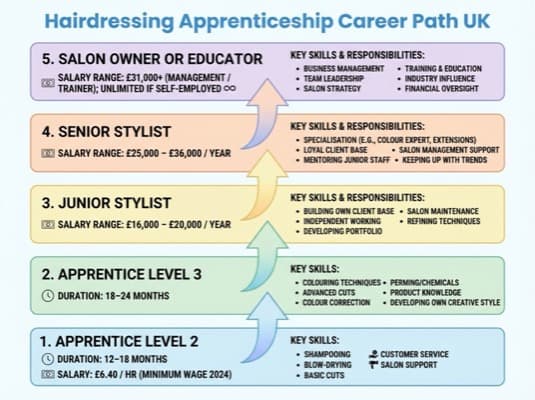
The hairdressing career path from apprentice to salon owner
Government funding covers most of the training cost. For non-levy paying employers (most salons), the government co-invests 95%. You pay just 5%. For a typical apprenticeship costing £7,000 to £9,000, the salon contribution is often between £350 and £450 (gov.uk, 2026). For apprentices aged 16 to 18, the government may cover 100%.
| Employer Type | Your Cost | Government Covers |
|---|---|---|
| Non-levy, apprentice 16-18 | £0 | 100% |
| Non-levy, apprentice 19+ | 5% | 95% |
| Levy-paying employer | Via levy account | Varies |
Consult your training provider or check gov.uk for current funding rules.
For example, a three-chair salon in Manchester took on a 17-year-old apprentice and paid nothing for the training. Within 12 months, the apprentice was handling Saturday blow-dry appointments independently, freeing the owner to focus on higher-value colour services.
Beyond funding, here is what salon owners gain:
- Loyalty. Staff trained in-house typically stay longer. You shape their technique and their understanding of your brand from day one.
- Fresh energy. Apprentices often bring social media fluency that experienced staff lack.
- Succession planning. Growing your own senior stylists is far cheaper than recruiting them.
If you're only recruiting experienced stylists and ignoring apprenticeships, you'll always lose to salons who build their own talent pipeline. The hair and beauty sector has seen consistent workforce declines in recent years (British Hair Consortium, 2026). The salons that are thriving are the ones training their replacements now.
Thinking about how to promote your salon once your team is growing? Our guide to starting a beauty business covers marketing and growth strategies for new and expanding salons.
Your obligations as an employer:
- Pay at least the apprenticeship minimum wage
- Allow time off for training (typically one day per week)
- Provide a safe working environment and a named mentor
- Complete regular reviews with the training provider
For health and safety requirements, we have a dedicated guide covering COSHH, risk assessments, and compliance essentials for beauty salons.
Hairdressing Apprenticeship vs Beauty Therapy Apprenticeship
With the employer perspective covered, let's tackle a common question for anyone considering a career in the broader beauty industry. The two pathways overlap slightly but lead to quite different careers.
| Aspect | Hairdressing | Beauty Therapy |
|---|---|---|
| Focus | Cutting, colouring, styling | Skincare, waxing, nails, makeup |
| Setting | Hair salon, barbershop | Beauty salon, nail salon, spa |
| Level 2 duration | 12-18 months | 12-15 months |
| Starting salary | Higher average | More specialist routes |
| Progression | Colour specialist, salon owner | Aesthetics, clinic owner |
For example, if you love transforming someone's look with a dramatic colour change, hairdressing is your path. If skincare, lash treatments, or nail art appeal more, beauty therapy through a beauty salon or aesthetics clinic makes better sense.
Some larger beauty salons offer both disciplines. In those cases, you might start in one and cross-train later.
If you are exploring opportunities to buy an existing salon rather than starting from scratch, see our guide to beauty businesses for sale.
Is There an Age Limit for Hairdressing Apprenticeships?
This comes up constantly, so let's be clear. No. There is no upper age limit for apprenticeships in the UK. Whether you are 16 or 56, you can apply (gov.uk, 2026).
The funding structure changes slightly for learners aged 25 and over: the government still co-invests 95% for non-levy employers, though additional eligibility checks may apply. The key requirement is that the apprenticeship teaches you substantial new skills.
If you're reading this at 30 or 40 and thinking "I've left it too late", you haven't. Look for training providers that support mature learners. The pace and style of learning may suit you better than a classroom full of school leavers. Ask yourself: would I be comfortable learning alongside 16-year-olds, or do I need a provider geared towards adults?
Once qualified, many mature apprentices go on to work as a self-employed hairdresser, offering flexibility and higher earning potential. Others explore chair rental in a hair salon or hairdressing chair rental arrangements, while beauty therapists often look into renting a room in a salon.
Frequently Asked Questions
How long is a hairdressing apprenticeship? A Level 2 apprenticeship typically takes 12 to 18 months. A Level 3 apprenticeship takes 18 to 24 months. The exact duration depends on your training provider and how quickly you meet the required competencies.
Can you do an apprenticeship without going to college? Some training providers deliver all learning in the salon rather than at a separate college campus. However, you still need structured off-the-job training: at least 20% of your contracted hours must be dedicated to learning (gov.uk, 2026).
What GCSEs do you need for an apprenticeship? Most Level 2 apprenticeships have no formal entry requirements. GCSEs in English and maths at grade 4 or above are helpful but not essential; if you do not have them, you complete functional skills alongside your apprenticeship.
How much should a Level 3 apprentice earn? A Level 3 apprentice in their first year earns the apprenticeship minimum wage of £6.40 per hour. After the first year and aged 19+, they move to the National Minimum Wage for their age group. Many salons pay above the minimum to retain good apprentices.
Is 25 too old to start an apprenticeship? No. There is no upper age limit for UK apprenticeships. Adults of any age can apply, and funding remains available through the government co-investment scheme. The key requirement is that the apprenticeship teaches you substantial new skills rather than accrediting what you already know.
If You Only Have 30 Minutes a Week
- Day 1-2 (10 min): Search the Find an Apprenticeship portal for hairdressing vacancies in your area. Save any that match your location and availability.
- Day 3-4 (10 min): Update your CV with relevant experience: customer service, part-time work, creative skills. Write a one-paragraph cover letter explaining why you want a hairdressing career.
- Day 5-7 (10 min): Visit two local salons in person. Ask whether they take on apprentices. Leave your CV with the manager.
Whether you are an aspiring stylist or a salon owner looking to grow your team, working with a platform built for beauty salon businesses can help you market your services and attract the right people. If you're weighing up the cost, compare the plans and pricing to find one that suits a growing salon.
For restaurants, salons, and local businesses
Need help with your marketing?
We help UK businesses turn social media into real results, not busywork.
Start freeKey Takeaway
A hairdressing apprenticeship combines paid salon work with a nationally recognised NVQ qualification: Level 2 for beginners, Level 3 for advanced skills. The apprenticeship minimum wage starts at £6.40 per hour, but qualified stylists typically earn £20,000 to £36,000 depending on experience and location. There is no upper age limit, and government funding covers 95 to 100% of training costs for most salons. The end-point assessment pass rate of 95.7% means completing the programme is realistic for dedicated learners. It is not cheap labour; it is the fastest route from zero experience to a career people actually want.
Get More Marketing Tips
Practical marketing tips for UK business owners, straight to your inbox. No spam, unsubscribe anytime.
About the Author
Local Brand Hub
Empowering UK Businesses
Local Brand Hub provides comprehensive business management tools designed specifically for UK local businesses to streamline operations, automate marketing, and grow revenue.
More articlesRelated Articles
 Tutorials
Nail Technician Business: Mobile, Chair Rental & Going Solo
How to run a nail technician business as a sole trader. Covers mobile vs chair rental vs home salon, HMRC self-employment and personal branding in the UK.
 Tutorials
Health and Safety for Beauty Salon: UK Guide
Health and safety for beauty salon owners in the UK. COSHH assessments, risk assessments, patch testing and exactly what inspectors look for during visits.
 Tutorials
Self Employed Hairdresser: UK Tax and Setup Guide
How to become a self employed hairdresser in the UK. HMRC registration, tax rates, insurance costs, pricing, and building your client base.