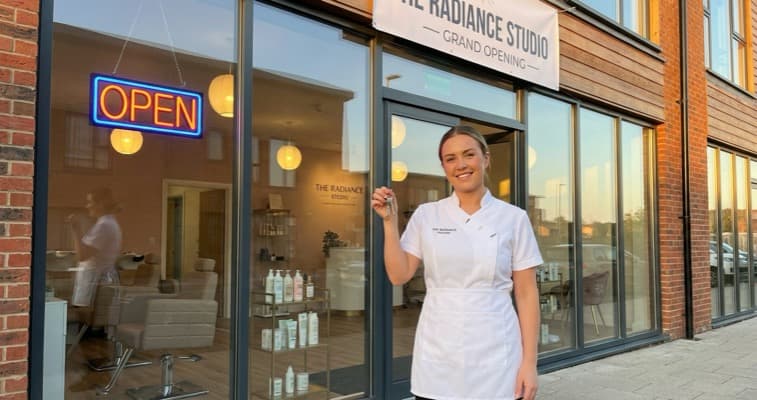
How to start a beauty business in the UK with this 6-month timeline. Covers costs, legal setup, premises, equipment, and marketing to open your doors.
How to start a beauty business is the process of planning, registering, and launching a beauty salon or treatment-based venture in the UK: from choosing your business model and securing premises to obtaining licences and booking your first clients.
You have been thinking about this for months. Maybe years. You are brilliant at what you do: clients rebook every time and tell their friends. But every time you search "how to start a beauty business," you get the same vague advice: write a plan, get insurance, believe in yourself. None of it tells you what to do this week.
This guide gives you a concrete 6-month timeline for starting a beauty business, from your first decision to your opening day. Every month has a clear purpose and specific actions. 12 min read.
What You'll Learn
- How to start a beauty business by choosing the right model for your budget and goals
- The legal and council registration steps you must complete before trading
- Realistic startup costs for home-based, chair rental, and salon premises
- A month-by-month action plan from planning to your first paying client
- How to build your online presence before doors open
Month 1: Research Your Business Model and Market
First, when it comes to how to start a beauty business, you need to choose the right model for your situation. This single decision shapes your costs, your risk, and your daily working life.
There are three main routes, and each suits a different stage of career and budget.
| Business Model | Startup Range | Best For |
|---|---|---|
| Home-based salon | Under £8,000 | Therapists testing demand with low risk |
| Chair or room rental | Under £3,000 | Building a client base before committing |
| Own premises | £20,000-£50,000 | Established therapists ready to scale |
Costs are approximate and vary by location. Always research your specific area.
For example, a nail technician with a loyal rebooking list might start from a converted spare room, keeping overheads under £500 a month while testing whether demand supports a move to commercial premises within 12 months.
If you're thinking "I can't afford £20,000 upfront", you're not alone. Most people figuring out how to start a beauty business begin small. Chair rental in smaller towns often starts from around £250 a month (NHBF, 2025).
Info
Related: Write your business plan first; it forces you to answer every question in this section before spending a penny.
Research your local market during this month. Visit competing salons as a customer. Check Google Maps for how many beauty businesses sit within a 2-mile radius. If you're thinking "there are already loads of salons near me", that's usually a sign of healthy demand, not oversaturation. The real question when working out how to start a beauty business is not whether demand exists; it is whether you can offer something competitors do not.
Month 2: Legal Setup and Registration
Now that your business model is decided, this is the part of how to start a beauty business that most people dread. The legal requirements are manageable, but you must complete them before you take a single booking.
Step 1: Register your business. Choose between sole trader (simplest: register with HMRC for Self Assessment) or limited company (register with Companies House, typically £12 online). Most solo beauty therapists start as sole traders.
Step 2: Register with your local council. If you are offering treatments that involve skin piercing, including microblading, acupuncture, or semi-permanent makeup, you typically need a special treatments licence from your local authority. Standard beauty treatments like facials, nails, and waxing may still require registration depending on your council. Check your specific council's requirements, as rules vary across the UK.
Step 3: Obtain insurance. You need, at minimum:
- Public liability insurance: covers claims from clients injured on your premises
- Professional indemnity insurance: covers claims arising from your treatments
- Employers' liability insurance: legally required if you hire anyone, even part-time
Insurance for a sole-trader beauty therapist typically costs £500 to £2,000 per year depending on your cover level (Salon Gold, 2025).
Step 4: Check your qualifications. While the UK does not legally require a specific qualification to offer most beauty treatments, reputable insurers and professional bodies expect at least an NVQ Level 2 or 3 in Beauty Therapy (or equivalent VTCT/CIBTAC qualification). Without recognised qualifications, getting insurance, and therefore clients, becomes significantly harder.
For example, a mobile beauty therapist offering lash lifts and brows would register as a sole trader, get professional indemnity and public liability insurance, and check whether their council requires a special treatments registration, all achievable in a single focused week.
If you're only doing one thing this month, get your insurance sorted. Everything else builds on it.
Stay organised from day one
Keep a folder (digital or physical) with your registration confirmation, insurance certificate, and qualifications; you will need them for council inspections, client queries, and supplier applications. Starting organised saves hours later.
Info
Related: Health and safety compliance covers the full checklist for treatment rooms and premises.
Month 3: Premises and Interior Design
Now that the legal setup is behind you, here's the exciting part: deciding where you will actually work.
Home-based setup: You need a dedicated, private treatment room with its own entrance if possible. Check your mortgage or tenancy agreement for business-use restrictions. Your council may require planning permission for change of use: this is the step most home-based therapists miss.
Renting commercial premises: Monthly rent varies widely, but a mid-range salon unit typically costs £600 to £2,000 a month (NHBF, 2025). Negotiate hard on the lease: aim for a break clause at 12 or 18 months so you are not locked in if the location does not work.
Interior fit-out: A full salon conversion can easily cost £35,000, but a single treatment room can be fitted out for far less. Focus on what clients actually see and touch (the treatment bed, the lighting, the storage) rather than on expensive fixtures you do not need yet.
For example, a beauty studio offering facials and lash treatments might need only two treatment beds, a reception area, and a small retail display, keeping costs well under half the full salon figure.
Think about your client's journey from the moment they walk through the door. The waiting area, the lighting, the scent, the temperature. These details cost almost nothing but shape whether clients rebook or vanish.
Month 4: Equipment, Stock, and Pricing
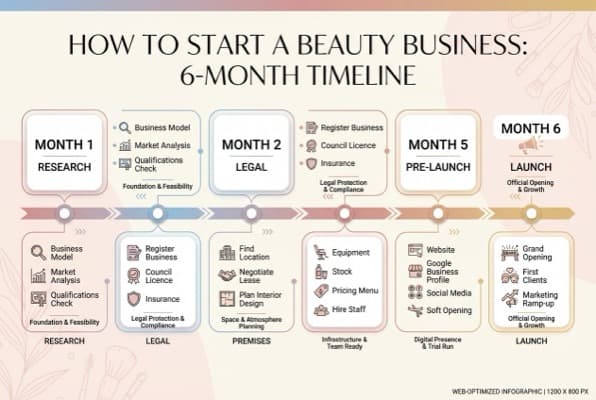
A 6-month timeline for starting a beauty business: from research to your first paying client.
Moving on to the next step in how to start a beauty business: equipping your space. Month four is where people face their biggest temptation: buying everything at once. Equipment costs can reach £30,000 for a fully kitted-out salon (NHBF, 2025), but you do not need the top end on day one.
Essential equipment by treatment type:
- Facial and skin treatments: Treatment bed, magnifying lamp, steamer
- Nails: Manicure table, UV/LED lamp, extraction system
- Waxing: Wax heater, couch, disposables
- Lashes and brows: Treatment bed, good lighting
For example, a beauty salon specialising in lash extensions and brows might start with two treatment beds, professional lighting, and initial product stock, then add a facial steamer three months later once revenue supports it. If you cannot tell whether a piece of equipment will pay for itself within six months, that's usually a sign to wait.
Pricing your services: Research what local competitors charge, then decide whether to position below, at, or above market rate. If you're only competing on price you'll always lose to competitors who compete on experience instead.
- Research local competitor pricing for your core treatments
- Calculate your hourly cost (rent + products + insurance + tax, divided by working hours)
- Add your desired hourly wage plus a 20% margin for reinvestment
- Set your opening price list: you can always adjust after 3 months
Stock management: Start lean. Order enough product for your first few weeks of bookings, then reorder based on actual usage.
Month 5: Marketing and Pre-Launch
Now that your equipment is in place and your prices are set, let's talk about the step that separates salons that thrive from those that struggle: marketing before you open. The best advice anyone learning how to start a beauty business can hear: your salon does not exist until people know about it.
Online presence (do these first):
- Set up your Google Business Profile: this is how local clients find you. Add photos, services, and opening hours.
- Create a simple website with online booking, service menu, and pricing. If you are thinking "I'll just use Instagram", that's usually a sign you need both. Social media builds awareness; a website converts browsers into bookings.
- Claim your social profiles: Instagram and Facebook at minimum. Post behind-the-scenes content of your fit-out to build anticipation, and lean on a social post generator so keeping them active never eats your evenings.
Offline marketing:
- Introduce yourself to neighbouring businesses: hairdressers, nail bars, and coffee shops often refer clients to complementary services
- Print simple A5 flyers with an opening offer: a small discount or a free add-on treatment works well
- Consider a soft opening for friends, family, and local influencers two weeks before your public launch
Booking system: What happens when three people try to book the same slot on a Tuesday afternoon? Manual diary management breaks down the moment you get busy. Use a professional booking platform from day one: systems like Fresha, Treatwell, or Timely offer free or low-cost tiers for new salons.
If you're only doing one thing from this section: set up your Google Business Profile. It is free and typically drives more local bookings than any other single channel.
Month 6: Soft Opening and First Clients
Finally, here's the moment every guide on how to start a beauty business builds toward: actually opening your doors.
Your soft opening (Week 1 to 2):
- Offer treatments to friends and family at a reduced rate in exchange for honest feedback and Google reviews
- Test every system: booking flow, payment processing, consultation forms, patch test procedures
- Adjust appointment timing: your estimates will be wrong at first, and that is normal
Your public launch (Week 3 to 4):
- Open your online booking to the public
- Run a launch offer: something valuable but not so deep that it attracts bargain hunters who never return
- Post before-and-after content (with client consent) on social media daily for the first month
For example, an aesthetics clinic might offer a free skin consultation during soft opening week, collecting client details and booking follow-up treatments, rather than discounting their signature facial by 50%.
Tracking what matters: From day one, record your rebooking rate. This is often the most important metric for any beauty business. If fewer than 40% of new clients rebook, something in your service, not your marketing, needs attention.
The UK hair and beauty industry includes approximately 45,000 businesses generating around £8 billion in annual revenue (NHBF, 2025). There is room for you, but only if you treat the first six months as the foundation, not the entire building.
Year 1: Growing Beyond Startup
Building on the first six months, knowing how to start a beauty business is only half the challenge. Once you survive the first six months, the game changes: you shift from "getting clients" to "keeping clients and growing revenue per client."
Key milestones for your first year:
- Month 7 to 9: Analyse which treatments generate the most profit (not just revenue). Double down on those. Consider going self-employed full-time if you have not already.
- Month 10 to 12: Introduce retail products. Retail often offers higher margins than treatments alone. Start with products you genuinely use and recommend during appointments.
- Ongoing: Join the NHBF or BABTAC for industry support, legal advice, and insurance packages tailored to beauty professionals.
For instance, a nail salon might introduce a monthly membership offering one gel manicure plus a free repair visit, giving clients a reason to commit rather than shop around each time.
If you are only competing on treatments you'll always lose to competitors who also sell products, memberships, and experiences. Ask yourself: would I keep coming back to my own salon? If the answer is not an immediate yes, that is where your year-one improvements should focus.
If You Only Have 30 Minutes a Week, Do This
- Day 1 to 2 (10 min): Decide your business model (home, rental, or premises) and write down your top three treatments
- Day 3 to 4 (10 min): Check your local council website for beauty business registration requirements and download any application forms
- Day 5 to 7 (10 min): Get three insurance quotes online: compare public liability and professional indemnity cover
Ready to build your beauty business's online presence from day one? Local Brand Hub's beauty salon tools help you manage your marketing, track local visibility, and attract more clients, all in one place.
For restaurants, salons, and local businesses
Need help with your marketing?
We help UK businesses turn social media into real results, not busywork.
Start freeKey Takeaway
Learning how to start a beauty business begins with choosing your model: home-based salons start from under £8,000, while own premises typically require £20,000 to £50,000. Register with HMRC or Companies House before you trade. Insurance is non-negotiable: expect £500 to £2,000 per year. Begin marketing at least four weeks before opening, not after. Your rebooking rate is often the most important metric from day one. Join a professional body like NHBF or BABTAC for ongoing support and credibility. Start lean on stock and equipment: every successful beauty business scales based on actual demand, not optimism.
Get More Marketing Tips
Practical marketing tips for UK business owners, straight to your inbox. No spam, unsubscribe anytime.
About the Author
Local Brand Hub
Empowering UK Businesses
Local Brand Hub provides comprehensive business management tools designed specifically for UK local businesses to streamline operations, automate marketing, and grow revenue.
More articlesRelated Articles
 Business Growth
Beauty Business for Sale: A UK Buyer's Guide
Find a beauty business for sale in the UK. Covers valuation, due diligence, legal steps, and your first 90 days as a new salon owner.
 Business Growth
How to Start a Beauty Business in the UK
How to start a beauty business in the UK. Covers business plans, startup models, regulations, staffing, and marketing for new beauty salon owners.
 Tutorials
Nail Technician Business: Mobile, Chair Rental & Going Solo
How to run a nail technician business as a sole trader. Covers mobile vs chair rental vs home salon, HMRC self-employment and personal branding in the UK.