
Learn how to implement a restaurant menu price increase that protects your margins without losing customers. Step-by-step UK strategies with real examples.
UK food prices have risen 27% over the past three years. Energy costs doubled. National Minimum Wage increases hit every April. Yet you are staring at the same menu prices you set two years ago, and the numbers simply do not work anymore. Every time you think about a restaurant menu price increase, you picture regulars walking out.
Info
Related: Restaurant Menu Pricing - Complete guide to pricing your menu
What You'll Learn
- Why UK restaurant costs are rising and what is driving food inflation
- How to calculate and implement price increases strategically
- The communication approach that keeps customers loyal through changes
- A practical weekly action plan to audit and adjust your menu pricing
Here is what most restaurant owners discover too late: a well-communicated restaurant menu price increase rarely costs you customers. Avoiding the conversation altogether costs you your business.
Info
Related: How to Price a Restaurant Menu - Step-by-step pricing guide
What is Causing an Increase in Food Prices?
First, what is actually driving up your costs? The price increase framework is a structured approach that helps you understand and respond to rising costs. It is a systematic method rather than a reactive one.
Food prices are rising due to supply chain pressures, elevated energy costs, and inflation that has not fully subsided since the post-pandemic spike.
In the UK, food inflation has been running at 4-5% year-on-year according to ONS data. Projections suggest it could climb higher by year-end according to industry analysis.
For restaurant owners, this translates directly to higher ingredient costs. A gastropub in Manchester, for instance, might see their beef supplier raise prices three times in a single year as farm costs and transport expenses compound.
The factors driving this include:
- Global commodity price volatility
- Elevated transport and logistics costs
- Post-Brexit impacts on agricultural labour availability
- Energy costs affecting food production and cold chain storage
Over the past three years, the cost of a basic food basket has increased by approximately 27% to 29% depending on household size, according to The Food Foundation research. Your suppliers are paying more. That cost inevitably reaches your kitchen.
If you cannot tell whether your food costs are rising faster than your prices, that's usually a sign you need a margin audit before your next restaurant menu price increase.
What Are Menu Costs of Inflation?
Now that you understand why prices are rising, let us look at what it actually costs to change them.
Menu costs of inflation refer to the operational expenses restaurants incur when adjusting prices. The term comes from economics, where it originally described the literal cost of reprinting menus. Today, it encompasses updating digital ordering systems, retraining staff, and the management time spent analysing which items to adjust.
For instance, a family-run Italian restaurant might spend a full afternoon recalculating portion costs, two hours updating their POS system, and another hour briefing staff on how to discuss changes with customers.
The hidden cost is psychological. Many owners delay increases because the process feels overwhelming. This delay often proves more expensive than the adjustment itself.
Industry research suggests implementing smaller, more frequent price adjustments of 3-5% quarterly. This conditions customers to accept gradual changes more readily than sudden large increases.
Digital Menus Reduce Costs
Modern POS systems and digital menus have dramatically reduced the literal cost of price changes. If printed menus are holding you back from necessary adjustments, the format may be costing you more than it saves.
If you are only updating prices once a year you will always lose margin to competitors who treat pricing as an ongoing process rather than an annual event.
Why Are Food Prices Still Rising in the UK?
Building on the basics, let us examine the specific UK context that makes this situation particularly challenging.
UK food prices continue rising because fundamental cost pressures have not resolved. Energy costs remain elevated. Labour shortages persist due to post-Brexit immigration changes. Global supply chains still experience periodic disruptions.
The hospitality sector faces particularly acute pressure:
- Working capital deficit of approximately £3.1 billion across UK hospitality
- More than 400 pubs closed in England and Wales in a single year
- UK hospitality employment costs increased by approximately £3 billion following recent Budget measures, per UKHospitality
Many closures came from operators who tried to hold prices steady rather than adjust in line with costs. Absorbing costs indefinitely rarely works as a long-term strategy.
Example: A neighbourhood bistro in Birmingham held their prices steady for 18 months despite rising costs. By the time they finally adjusted, they needed a 15% increase to break even.
Half their regulars noticed the jump. A competitor down the road who had raised prices gradually by 3% every quarter faced no such backlash.
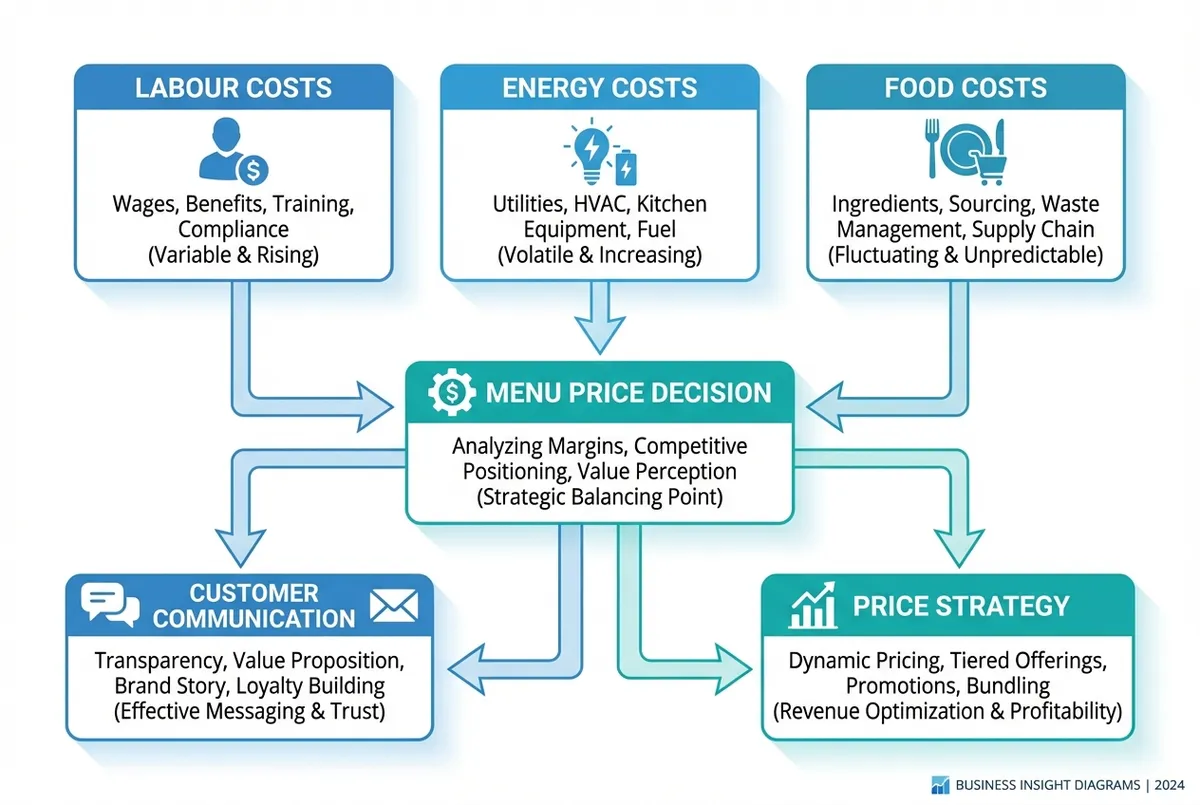
UK Restaurant Cost Pressure Framework
What makes the UK situation distinctive is the compounding effect of multiple pressures arriving simultaneously. The April 2025 increases to employer National Insurance contributions and National Minimum Wage add to already elevated costs.
Your restaurant menu pricing strategy must account for these ongoing increases, not just current levels. Would you raise prices by 5% if you knew costs would rise another 8% next quarter?
How to Handle Price Increases
Therefore, understanding the problem is one thing. Here is what to actually do about it.
Key Insight
Handling a restaurant menu price increase effectively comes down to strategy, timing, and communication.
Here is a practical framework for independent restaurants.
Step 1: Audit your current margins
If you have been avoiding the spreadsheet because the numbers stress you out, you are not alone. Most owners feel the same way.
Before raising any prices, understand which dishes generate profit and which barely break even. Full-service restaurants typically operate at 3-6% net profit margins. Food costs should ideally stay below 30-35% of the dish price. Use a restaurant pricing calculator to help with the maths.
Example: A cafe discovering their avocado toast costs £4.50 to produce but sells for £8 is operating at a healthy 44% food cost. Their fish and chips at £6 production cost and £12 selling price runs at 50%, signalling a prime candidate for adjustment.
Step 2: Target your strongest sellers first
If the thought of raising prices on your signature dish makes you nervous, take a breath. Research shows customers are less price-sensitive to menu items they love.
Raise prices on signature dishes and popular classics before touching your most expensive offerings, which are already perceived as premium.
The menu pricing psychology behind this approach is well-documented. Loyal customers accept paying more for dishes they order specifically at your restaurant.
Step 3: Use incremental adjustments
Rather than a single large increase, implement smaller changes more frequently:
- Review food costs monthly
- Identify items where margins have compressed below target
- Adjust prices by 3-5% every three to four months when needed
- Track customer response after each adjustment
A dish moving from £12.80 to £13.40 over two quarters feels different from a sudden jump to £14.50.
Step 4: Apply psychological pricing
Position prices just below round numbers. £14.40 feels meaningfully different from £15.00. Consider removing pound signs from your menu entirely, which studies suggest makes customers less price-conscious.
Step 5: Give advance notice
Announce price changes at least four weeks before implementation. Use newsletters, social media, and table talkers. A social media calendar helps you plan and schedule those announcements ahead so nothing gets forgotten in the rush of service. Your regulars should never be surprised by new prices.
Step 6: Train your team
Your staff will field questions. Equip them with clear, honest answers. "We have adjusted prices to maintain the quality you expect while covering increased costs" works better than defensive responses.
If you are thinking about how competitors handle this, understanding competitive pricing in restaurants provides useful benchmarks.
Communicating Your Price Increase to Customers
Next, you have set your new prices. Now comes the part many owners dread: telling customers.
The communication around your restaurant menu price increase matters as much as the increase itself. Customers accept changes when they understand the reasoning and feel respected.
Be transparent, not apologetic. Explain the factors driving the increase. Rising energy costs, supplier prices, and fair wages are all legitimate reasons customers understand.
If you are struggling to find the right words, remember that your regulars want you to stay in business. Avoid excessive apology, which signals you have done something wrong.
Lead with gratitude. Start any announcement by thanking customers for their continued support. This frames the conversation positively before introducing the news.
Highlight what stays the same. Reassure customers that your commitment to quality, service, and their experience remains unchanged. The price adjustment protects these things.
Gather feedback actively. After implementing changes, ask customers directly how they feel. If you can't tell whether customers are leaving because of prices or for other reasons, that's usually a sign you need a proper feedback system. This gives early warning of concerns before they become walk-outs.
If you are reading this thinking "I do not have time for all this communication planning," you are not alone. Consider this: a few hours spent on clear messaging prevents weeks of damage control later.
Pro Tip
Ask yourself: If I received this price increase message from my favourite restaurant, would I accept it or feel frustrated?
The reality for most independent restaurants is that customers are already paying more at supermarkets and petrol stations. Your restaurant menu price increase is unlikely to be the shock you fear.
Info
Related: Restaurant Food Cost Formula - Calculate your true costs
How Much Should You Increase Prices?
Additionally, with your strategy in place, let us talk specific numbers.
The right increase depends on your current margins, competitive position, and cost pressures. General guidance suggests:
| Increase Type | Recommended Range | When to Use |
|---|---|---|
| Routine adjustment | 3-5% | Quarterly or bi-annual maintenance |
| Cost catch-up | 5-8% | After extended period without changes |
| Emergency adjustment | 8-12% | Major cost shock, paired with value additions |
Note: These ranges reflect typical UK hospitality practice and may vary based on your specific market position.
Avoid increases above 10% on any single item without pairing them with visible improvements to the dish or dining experience.
The top-performing UK restaurant groups increased profits by 18% through price increases combined with operational efficiency and menu engineering, according to industry analysis. Your independent restaurant can apply the same principles at a smaller scale.
Example: A fish and chip shop in Bristol reviewed their menu quarterly and found their mushy peas, priced at £1.50 for years, cost them 60% of the selling price after ingredient increases. A modest adjustment to £1.95 barely registered with customers but improved margins across hundreds of weekly orders.
Weekly Action
If you only have 30 minutes this week, here is what to prioritise:
- Day 1-2: Calculate food cost percentages for your top 10 selling dishes
- Day 3-4: Identify items where margins have compressed below 60% gross
- Day 5-7: Draft new prices for those items using psychological pricing principles (just below round numbers)
Key Takeaways: Restaurant Menu Price Increase
If you run a restaurant and want to see how Local Brand Hub can support your marketing, explore our restaurant marketing tools.
Key Takeaways: Restaurant Menu Price Increase
In summary, here is what matters most.
Implementing a restaurant menu price increase is not about squeezing customers. It is about ensuring your business survives to serve them.
The Essential Points
- UK restaurant costs have increased substantially, with hospitality facing approximately £3 billion in additional employment costs from April 2025
- Delaying price increases often proves more damaging than implementing them thoughtfully
- Small, frequent adjustments of 3-5% are better received than infrequent large changes
- Target your best-selling dishes first, where customer loyalty provides pricing flexibility
- Communicate changes four weeks in advance using multiple channels
- Train your team to explain increases with confidence
"Your competitors do not have lower costs. They have shorter gaps between price adjustments."
The restaurants that thrive through cost pressures are not the ones with the lowest prices. They communicate value clearly and price menus to reflect the quality they deliver.
If you have been putting off a necessary adjustment, your customers already expect prices to rise. They are waiting to see how you handle it.
Frequently Asked Questions
How often should restaurants raise prices?
Most operators adjust prices two to four times per year. Quarterly reviews are ideal during periods of high inflation.
Pro Tip
The key is consistent small adjustments rather than dramatic annual increases.
Will customers leave if I raise prices?
Research consistently shows that well-communicated price increases rarely cause significant customer loss. Customers leave when quality drops or they feel the value proposition no longer makes sense. A 5% increase with maintained quality typically has minimal impact on retention.
Should I raise all prices at once or gradually?
Gradual increases across different menu sections work better than blanket changes. Start with your most popular items where loyalty provides flexibility, then adjust other items in subsequent months.
How do I know if my prices are too low?
If your food costs exceed 35% of menu prices or your net profit margin falls below 3%, your prices likely need adjustment. Compare your pricing to similar restaurants in your area while accounting for your specific quality positioning.
Get More Marketing Tips
Practical marketing tips for UK business owners, straight to your inbox. No spam, unsubscribe anytime.
About the Author
Local Brand Hub
Empowering UK Businesses
Local Brand Hub provides comprehensive business management tools designed specifically for UK local businesses to streamline operations, automate marketing, and grow revenue.
More articlesRelated Articles
 Operations
Restaurant Pricing Calculator: Set Menu Prices That Work
Use a restaurant pricing calculator to set menu prices that protect your margins. Step-by-step examples, free tools, and UK-specific guidance.
 Operations
How to Price a Restaurant Menu: A Step-by-Step UK Guide
Calculate food costs, set healthy margins, and apply the 30/30/30 rule to price every dish on your restaurant menu correctly.
 Operations
Restaurant Food Cost Formula: A Step-by-Step Guide
Master the restaurant food cost formula to protect margins. Step-by-step COGS calculation, portion costing examples, and 28-35% benchmarks.