
What UK corporate flower contracts must fix on scope, substitutions, price reviews and payment, and the legal defaults you inherit when they stay silent.
Corporate flower contracts are business to business supply agreements, and each one fixes six things: what you deliver, how often, who lets you in, when the price can move, how it ends, and when you get paid. Write those terms yourself, or the buyer's standard paperwork and a default you never chose will quietly supply them for you.
You are not really selling a company flowers. You are lending it stems, labour and van diesel a month at a time, then waiting on a payment date somebody in a finance office set without meeting you. That is the part nobody mentions when they call corporate work steady money.
If it is Tuesday morning and you are conditioning stems for an account that last paid you in June, you already know the flowers were never the risk.
Winning the account is a separate job. This is about the document you sign afterwards, which decides whether the win was worth having.
What is a corporate flower contract?
A corporate flower contract is a supply agreement for regular deliveries into a business: an office reception, a hotel lobby, a restaurant, a showroom. The flowers are the recurring bit. The contract says what recurring means. A nod in a reception and a cheerful yes on the phone record none of it: not the sites, not the cadence, not the payment date. Only the page does.
Your wedding terms were written for one nervous couple who read every line twice. A corporate agreement is skimmed once by a facilities manager, then obeyed exactly by a purchase ledger that never reads it. A ledger does what the page says, and only that.
Related: Wedding Florist Contracts
Which is why this clause list looks nothing like the wedding one: there you protect a date you can sell once, here a margin tested weekly.
Which clauses do corporate flower contracts need?
Six, and each earns its place because of a specific way these accounts go wrong.
- Scope and cadence. Name the sites, the positions inside each, the size band and the delivery days. Reception, boardroom and two lift lobbies is a different contract from reception.
- Substitution rights. Crops fail and auctions move. Write in the right to substitute by colour and form at equal value, and a line saying you will say so.
- Access and delivery window. Put the window, the entrance and the passes in writing, then add the sentence that is easiest to leave out: what happens when you arrive on time and nobody lets you in.
- Price review. Name a date and a trigger: the anniversary, and a right to re quote when the wholesale cost of the specified stems moves beyond an agreed percentage. A fixed price with no trigger is a bet on a market with seasonal swings.
- Term and notice. How long it runs, how much notice ends it, whether it rolls on. A twelve month term with thirty days of notice is not a twelve month term.
- Payment terms. Its own section below, because it decides whether the other five mattered.
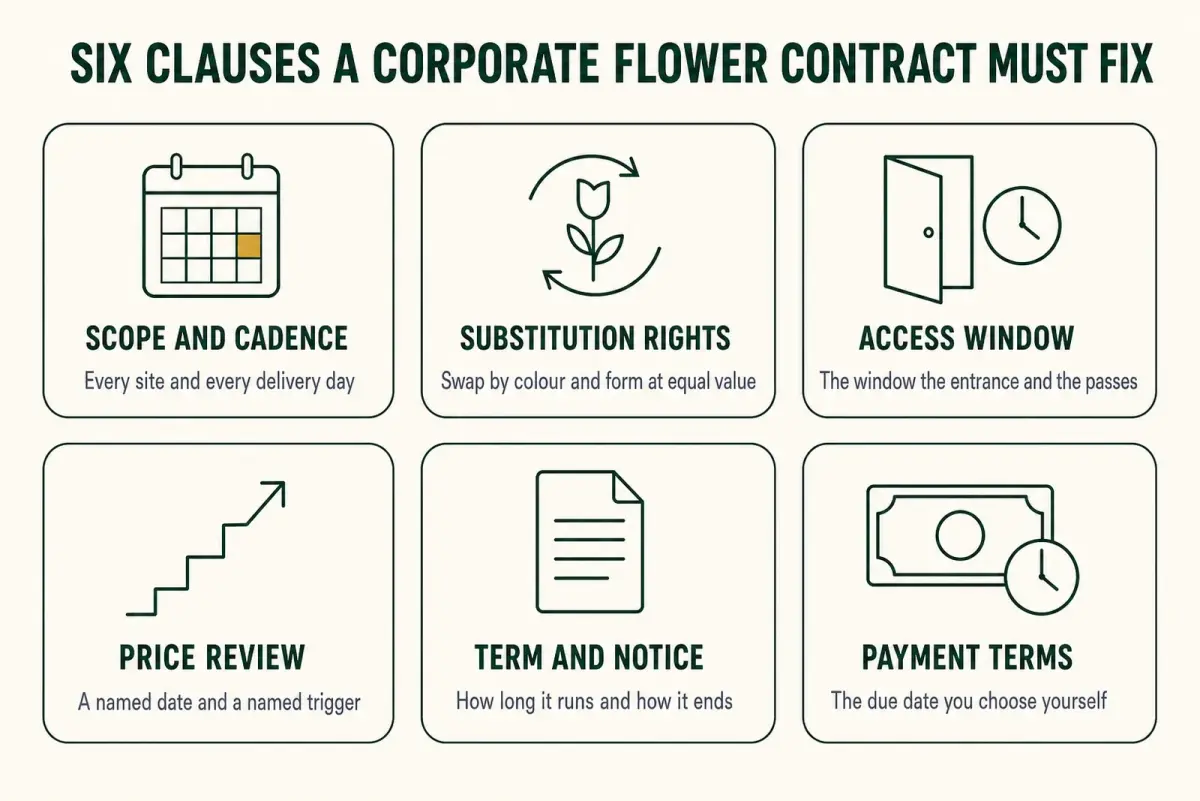
The six clauses a corporate flower contract has to fix, and the line each one has to say.
What payment terms should a corporate flower contract set?
The ones you write down. Write none and the law supplies one: GOV.UK guidance on invoicing and taking payment from customers states that unless you agree a payment date, the customer must pay you within 30 days of getting your invoice or the goods or service.
That fallback is not the bad outcome. The bad outcome is signing the buyer's standard supplier terms unread. Standard terms are drawn up to suit the party who wrote them, and that party was not the one holding your Dutch auction bill.
So propose the clause rather than receive it: a due date, an invoicing rhythm and the buyer's own reference. Ask before the first delivery which reference has to appear on the invoice. Chasing one that was never matched to a purchase order is the slowest conversation in your week.
If pinning a client to a payment date feels pushy, remember the date exists whether you name it or not. The only question is who chose it.
Then say what happens when the date passes. On late commercial payments, GOV.UK puts the statutory interest one business can charge another at 8% plus the Bank of England base rate. It also states you can charge a fixed recovery sum on top: £40 on a debt up to £999.99, £70 on a debt of £1,000 to £9,999.99, and £100 on a debt of £10,000 or more.
Why this matters: imagine a hotel account invoiced at around nine hundred pounds a month running three weeks late. The interest is small change. A clause quoting both remedies, in an agreement the buyer signed, turns your chasing email into a term they agreed to.
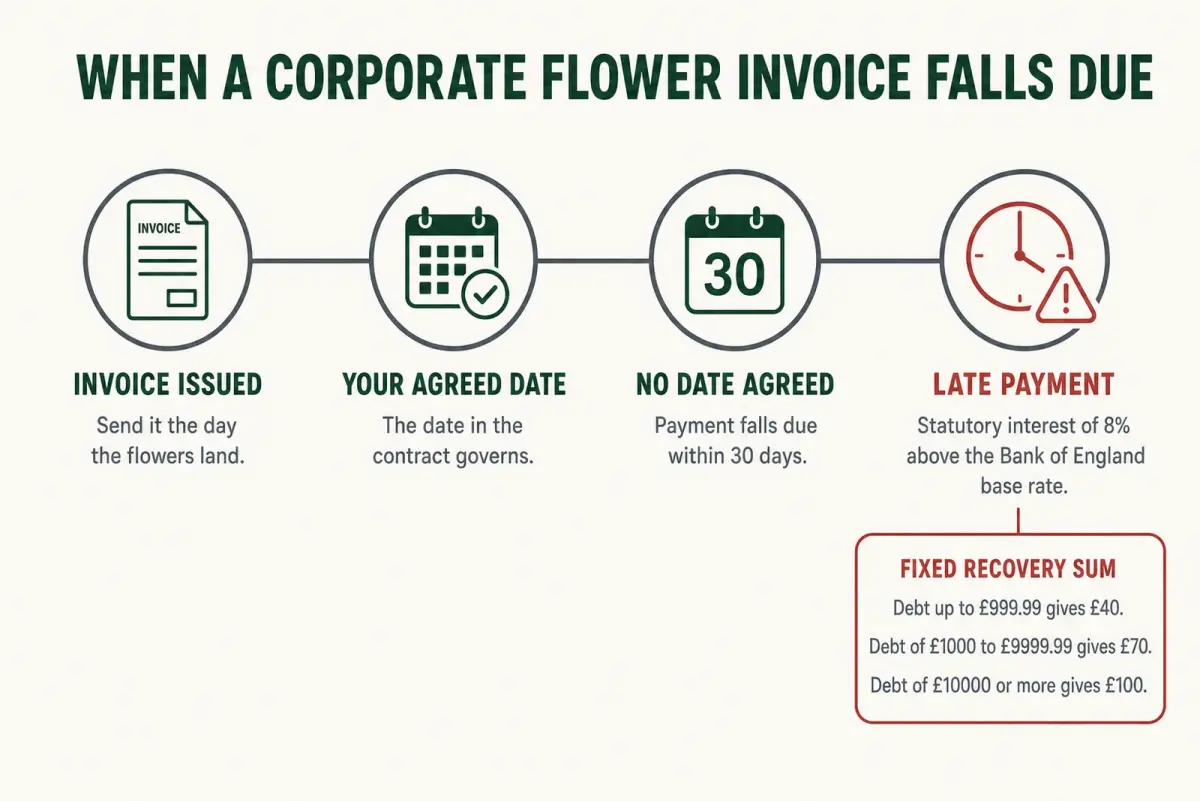
The clock a corporate flower invoice runs on, and where the late payment remedies land.
How do you check a corporate client before you sign?
Signing a monthly supply agreement is a credit decision in a florist's apron. You would not lend a stranger several hundred pounds a month on a handshake, and that is what an account is.
For the biggest buyers you do not have to guess. Under GOV.UK guidance on the duty to report, regulations introduced a duty on the UK's largest companies and LLPs to report on a half yearly basis on their payment practices, policies and performance, published on a government web based service. That published record is where to look, at check payment practices, before you commit a stem.
A buyer that reports slow payment is not one to refuse. It is one whose contract needs a tighter due date and a late payment clause you intend to use. Smaller buyers are not caught by the duty, so ask those for trade references and start short.
What changes once the contracts add up?
Three good accounts do not just fill your Monday. Two changes are worth seeing coming.
Tax first. GOV.UK's VAT registration guidance says you must register if your total taxable turnover for the last 12 months goes over £90,000, or if you expect it to go over £90,000 in the next 30 days. Contract income stacks quietly, so speak to a qualified accountant about watching the rolling figure.
Related: Corporate Florist Pricing
Then concentration. On the day one buyer is a third of your turnover, that buyer's notice period is your business plan. Contract work breaks a florist out of walk in trade dependency, which is the point, but it hands a quiet year to somebody else's timetable. Keep the counter and the subscription side alive alongside it, and the everyday marketing going in the weeks you have no time for it, which is what LocalBrandHub helps florists do.
None of this makes the flowers matter less. The arrangement in that lobby is what the buyer sees; the contract decides whether a second year of it is worth your Tuesdays. Pull up your current contract this week and find the payment clause. No due date in it? You have found your first job.
Frequently Asked Questions
What should a corporate flower contract include?
Scope, substitution rights, an access and delivery window, a price review point, the term and notice, and payment terms. Anything left open gets decided later by somebody else, usually while you are driving.
What payment terms should a florist give a corporate client?
Whichever ones you write down. GOV.UK states that unless you agree a payment date, the customer must pay you within 30 days of getting your invoice or the goods or service.
Can I charge a company interest on a late flower invoice?
Yes. GOV.UK states that statutory interest on a late business to business payment is 8% plus the Bank of England base rate, and that you can charge a fixed recovery sum on top: £40 up to £999.99, £70 from £1,000 to £9,999.99, and £100 at £10,000 or more.
How do I check whether a corporate client pays on time?
Look the buyer up. GOV.UK guidance states that the UK's largest companies and LLPs must report half yearly on their payment practices, policies and performance, published on a government web based service. The duty catches only the largest buyers, so a smaller one may have nothing published to look at.
What is the 3:5:8 rule for flowers?
It is a proportion convention for composing an arrangement, grouping stems and heights in threes, fives and eights rather than in even numbers. It is a design habit rather than a measured effect, and it has nothing to do with what you sign.
Key Takeaways: Corporate Flower Contracts
Key Takeaway
- Fix all six clauses, not just the price.
- Put a due date and the buyer's reference in the payment clause instead of inheriting the default.
- Name the late payment remedy before you need it.
- Check how the biggest buyers say they pay.
- Watch the rolling VAT figure as accounts stack up.
For restaurants, salons, and local businesses
Need help with your marketing?
We help UK businesses turn social media into real results, not busywork.
Start freeSources
Get More Marketing Tips
Practical marketing tips for UK business owners, straight to your inbox. No spam, unsubscribe anytime.
About the Author
Local Brand Hub
Empowering UK Businesses
Local Brand Hub provides comprehensive business management tools designed specifically for UK local businesses to streamline operations, automate marketing, and grow revenue.
More articlesRelated Articles
 Business Growth
Wedding Florist Contracts: The Clauses That Hold Up
What a UK wedding florist contract should say about deposits, cancellations and changes, with copyable clause wording and the law behind each one.
 Business Growth
How to Build a Wedding Florist Business: A UK Guide
A UK guide to the wedding florist business: count the prime dates you can actually sell, price them properly, filter enquiries and protect them.
 Business Growth
Flower Shop Name Ideas You Can Actually Own
Flower shop name ideas across six styles, plus the UK checks that decide which one you can keep: Companies House rules, trade marks, domains and handles.