
A UK guide to the wedding florist business: count the prime dates you can actually sell, price them properly, filter enquiries and protect them.
A wedding florist business is not an unlimited product. You sell a fixed number of dates, Saturdays above all, and with one van and one setup team, every one you give away cheaply is gone for a year. Build the pricing, the enquiry filter and the contract to protect the diary, and the flowers look after themselves.
Plenty of guides treat wedding work as a growth channel. Wedding floristry does not behave that way. Demand piles onto a narrow band of dates, and your capacity is one van, one setup window and one pair of hands. Worse, a wedding is sold before it exists. The couple buys a description and waits months to see whether it was true.
How many weddings can you actually sell?
Fewer than the national figures suggest. In England and Wales, wedding demand concentrates onto Saturdays more than onto any other day, so the ceiling on a florist's wedding turnover is a countable number of dates rather than a market size.
Office for National Statistics figures for 2022 record 246,897 marriages in England and Wales. That sounds like an ocean. The next number explains why it is not: 43.6% of those marriages fell on a Saturday, still the most popular day to marry even as its share declines. The busiest single date was Saturday 30 July, when 3,608 couples married.
Clustered demand only constrains a supplier who cannot clone the delivery morning.
Your wedding turnover is a number of Saturdays, and a calendar will count it in four minutes.
Open next year's calendar. Mark the Saturdays you will actually work, cross off the ones already booked and the fortnight you refuse to give up. What is left is next year's wedding capacity, before you have sold a stem.
Why this matters: every section below exists to protect one prime Saturday from a bad yes.
Price the date, not the stems
Quoting on flower cost is the classic route to undercharging a wedding. Stems are the visible part of a job whose hours sit in conditioning, design, consultations, setup, breakdown and driving.
Build every quote from the whole job, not the visible part of it:
- Stems, sundries and the waste you always cut
- Conditioning, build and consultation hours
- Setup, breakdown and travel both ways
- A contingency for a variety that does not arrive
Price the morning, because the morning is what you cannot make more of.
Imagine a quote where the flowers cost £700 and the build takes eleven hours across the week. The day itself takes a four hour setup, a two hour breakdown and ninety miles of driving. Charged on stems alone, that job pays for the flowers and nothing else.
A wedding quote that only covers the flowers is a donation with a ribbon on it.
One more number belongs in the model early. gov.uk states that you must register for VAT if your total taxable turnover for the last 12 months goes over £90,000, the VAT threshold. The same applies if you expect to pass £90,000 in the next 30 days. Turnover, not profit. If your wedding tickets are large, that line arrives on far fewer jobs than counter trade would, so check your quoting survives adding VAT while the decision is still yours.
Which enquiries deserve a date
A held date is stock. Run every enquiry through the same four questions before you promise anything, and ask about budget first, because a no there saves you asking the other three.
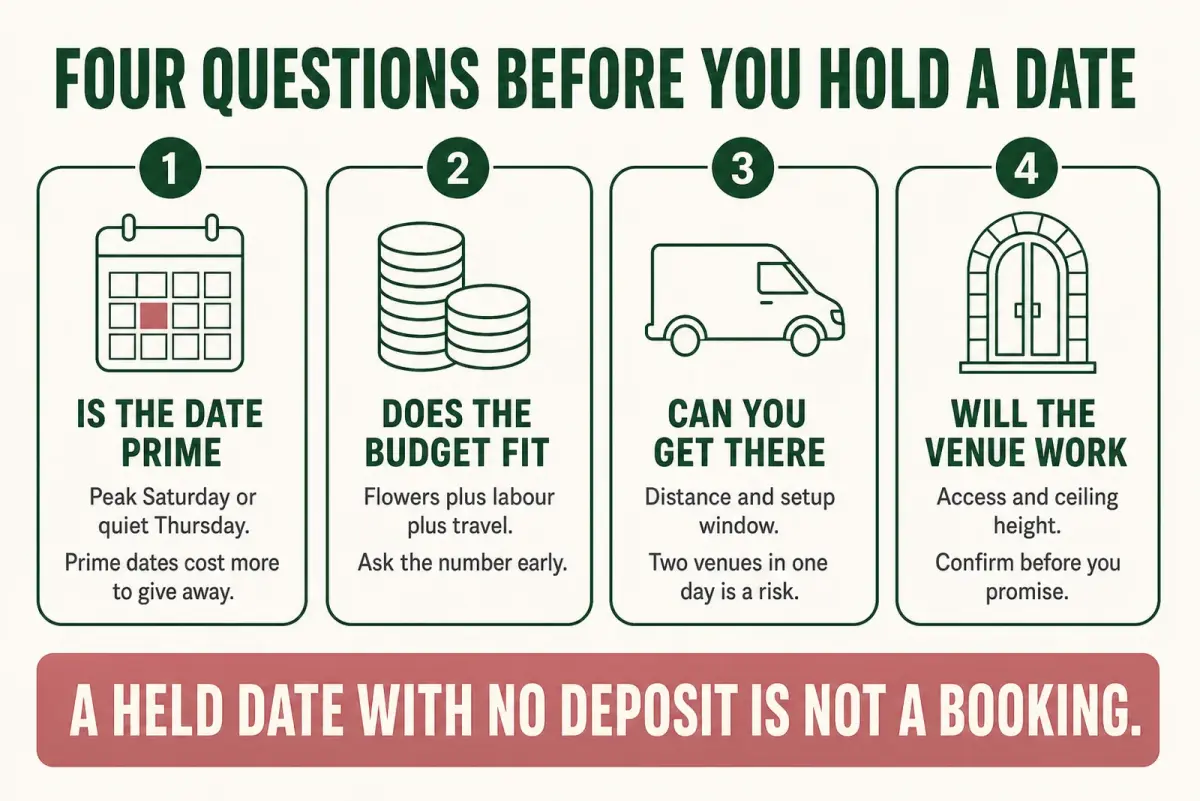
Run the filter in this order. The budget question is uncomfortable to ask early and expensive to ask late.
- Is it a prime date? A June Saturday and a Tuesday in February are not the same asset.
- Has the couple named a budget? And does it survive contact with what they are describing?
- Can you physically get there? Loading, driving, setting up inside the venue's window, getting home.
- Will the venue allow what you are planning? Ask specifically about fixings to walls, beams and doorways.
Three and four get forgotten until you are standing in a car park.
A couple buying flowers at this scale for the first time does not know how much to set aside, so ask for their number early.
Imagine two enquiries for the same June Saturday. One names a figure that covers your morning; the other only says they love the look of an arch. Take the first and the second becomes a polite referral. Take the second and you learn that in May.
Turning down a peak Saturday is arithmetic rather than arrogance, but only once your prime Saturdays reliably fill.
Early on they will not, so take the work, photograph it properly and let it buy the next enquiry. The filter earns its keep the season demand outruns your prime dates, when yes to the wrong June wedding costs you the right one.
Contracts, deposits and the 14 day clock hiding in an off premises booking
Wedding bookings are often agreed in a couple's kitchen or at a venue viewing, which means they are agreed away from your business premises. That detail carries legal consequences.

A booking signed at a kitchen table is not a booking signed in your shop, and the rules treat them differently.
The Consumer Contracts (Information, Cancellation and Additional Charges) Regulations 2013 set the rules. Two provisions matter.
- Where a distance or off premises contract is a service contract, the cancellation period ends at the end of 14 days after the day on which the contract is entered into.
- The same regulations list contracts the cancellation rights do not apply to, including goods made to the consumer's specifications or clearly personalised, and goods which are liable to deteriorate or expire rapidly.
The perishability of flowers is an argument about your contract, not a substitute for having one.
Whether yours is a service contract, a contract for personalised perishable goods or a mixture turns on how it is written. Consult a solicitor on your standard terms. An hour of professional advice is cheap next to a contested deposit.
What the regulations do not do is tell you how to run a booking. They describe a consumer's cancellation position and require no particular deposit, schedule or system. That design is yours, and the version that saves arguments puts everything in writing before money moves.
Getting found by the couples who are still choosing
Couples book far enough ahead that your visibility has to exist before the enquiry does. Venues, real wedding photography and reviews do the work, in that order.
- Venues. A recommendation from a venue arrives pre-trusted and early, while the couple is still deciding. Introduce yourself to the coordinator, not the website.
- Photography. Ask the couple's professional photographer for a few images and written permission to use them. The portfolio then answers enquiries.
- Packages. Clear tiers make deciding easy for a couple who cannot picture what a budget buys.
When enquiries go quiet between peaks, keeping your presence alive is a scheduling problem, not a creative one. LocalBrandHub handles that end: a social calendar and post templates, a visibility score for how easily nearby customers find you, and your Google rating and review count at a glance. It does not run your wedding diary.
Frequently Asked Questions
What is the 3-5-8 rule for florists?
The 3-5-8 rule is a proportion habit passed around floristry teaching rather than a standard anyone polices. It describes working in odd numbers, staggering a piece's main heights in roughly a three to five to eight relationship. It is a note about how an arrangement sits in the eye, and says nothing about what to charge or which Saturday to spend building it.
Is a wedding florist business profitable?
It can be the strongest part of a florist's year when the tickets are large and booked well in advance. Profitability comes from two numbers rather than one: what you charge per date, and how many prime dates you fill. A full diary at the wrong price pays badly.
How much does a florist charge for wedding flowers?
We could not find an official UK statistic for wedding flower spend, so treat any average you see as somebody's survey, not a national figure. Price from your own costs instead: stems, conditioning and design hours, consultation time, setup, breakdown, travel, and the risk of replacing a variety that fails to arrive. Our wedding florist pricing guide sets out the method.
What is a normal floral budget for a wedding?
Normal varies so widely that the word stops being useful. Guest numbers, a ceremony and reception in two places, the height of the room, anything installed overhead and the season all move the figure by scale rather than by which flowers a couple prefers. Ask couples for their number in the first exchange.
Do I need a contract for wedding flowers?
Yes, in writing, even though the regulations do not require one: the date, the deliverables, the total price, the payment schedule, the cancellation terms and your substitution policy. Where a consumer service contract is agreed away from your premises, the cancellation period ends 14 days after the day the contract is entered into.
The Short Version
A wedding florist business is a diary with flowers attached. Everything above is downstream of the number of mornings and the price on each.
Key Takeaway
- Your ceiling is a number of dates, not a market size.
- Price the whole morning, not the stems, and check the quote survives VAT registration at £90,000 of turnover.
- Filter enquiries in a fixed order, budget first, once your prime dates fill.
- Know where your contract was signed. Off premises bookings can carry a cancellation period.
- Be visible before the enquiry exists. Venues, photography and reviews shape who gets asked.
Got twenty minutes this week? Do this: count next year's workable Saturdays and write the number where you will see it. Every pricing argument you are about to have starts there.
Weekly Action
- Mark next season's workable Saturdays on a calendar and count them
- Rebuild one recent quote from hours and travel rather than stem cost
- Write the four enquiry questions on a card by the phone
- Read your own booking terms and note what a solicitor should see
For restaurants, salons, and local businesses
Need help with your marketing?
We help UK businesses turn social media into real results, not busywork.
Start freeSources
Get More Marketing Tips
Practical marketing tips for UK business owners, straight to your inbox. No spam, unsubscribe anytime.
About the Author
Local Brand Hub
Empowering UK Businesses
Local Brand Hub provides comprehensive business management tools designed specifically for UK local businesses to streamline operations, automate marketing, and grow revenue.
More articlesRelated Articles
 Business Growth
Wedding Florist Contracts: The Clauses That Hold Up
What a UK wedding florist contract should say about deposits, cancellations and changes, with copyable clause wording and the law behind each one.
 Business Growth
Wedding Flower Packages: How to Build and Price Them
Wedding flower packages for UK florists: build three tiers couples can count, fix the right things, and publish a price that survives the wait.
 Business Growth
Wedding Florist Pricing: How to Quote the Whole Day
Wedding florist pricing for UK flower shops: build the quote from the day itself, cost the hours and the miles properly, and know when VAT changes it.