
What a UK wedding florist contract should say about deposits, cancellations and changes, with copyable clause wording and the law behind each one.
A wedding florist contract fixes the date, the venue, every item, the price, the payment stages and what happens if either side pulls out. The clauses couples contest are the money ones, and UK consumer law has plenty to say about those.
Most wedding contracts read beautifully until the week somebody needs them. Then plans change, or your van does, and two people go hunting for the paragraph that decides who keeps what. Go and look at yours: there is a fair chance it is one line long: the deposit is non refundable.
That line is the weakest thing in the document, and it fails exactly when you lean on it.
Related: read the full guide to Wedding Florist Pricing: What to Charge
What a wedding flower contract has to cover
Eight things are where wedding flower arguments start. A contract answering all eight in plain English beats a legalese one that answers six.
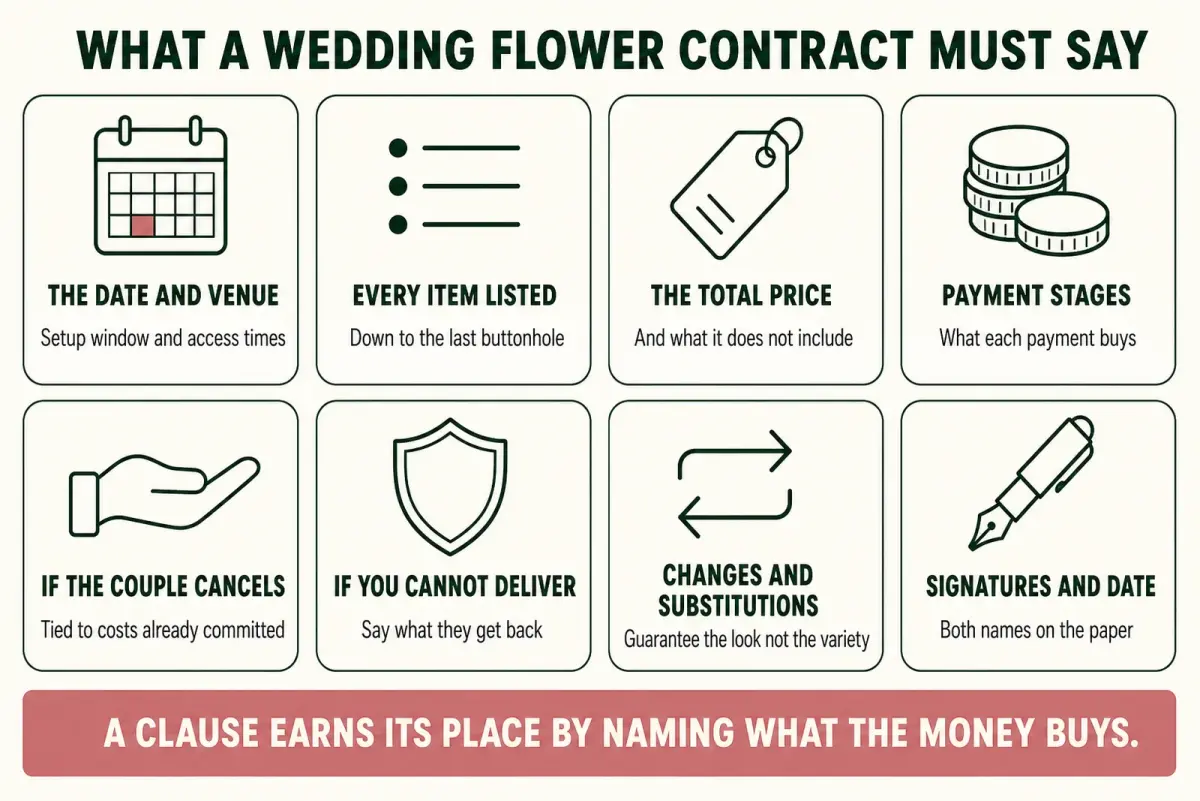
The clause map: eight questions to answer before anyone asks them.
- The date and venue, with setup window, access times and who unlocks the door.
- Every item listed, to the last buttonhole: unlisted means unpriced.
- The total price, and what it excludes, such as vases you lend.
- Payment stages, each saying what that money buys.
- If the couple cancels, tied to what you have committed.
- If you cannot deliver, the clause florists forget to write.
- Changes and substitutions, with the deadline the design locks.
- Signatures and the date, from both sides.
Before you paste any wording below: every square bracket is a placeholder, and so is every figure inside the clauses. Replace them all with your own verified terms, then have a solicitor read the finished document. It is a drafting start, not legal advice.
The deposit clause: name what the money buys
A booking deposit is a term of a consumer contract, and those get tested. Under the Consumer Rights Act 2015, an unfair term is not binding on the consumer, and a term is unfair if, contrary to the requirement of good faith, it causes a significant imbalance in the parties' rights and obligations to the detriment of the consumer. The words "non refundable" do not lift your terms out of that test.
The Act's list of terms that may be regarded as unfair describes that one line clause with uncomfortable accuracy: a term permitting the trader to retain sums paid where the consumer decides not to perform the contract, without the consumer receiving compensation of an equivalent amount where the trader is the party cancelling.
So read your own terms: what does the couple get if you pull out?
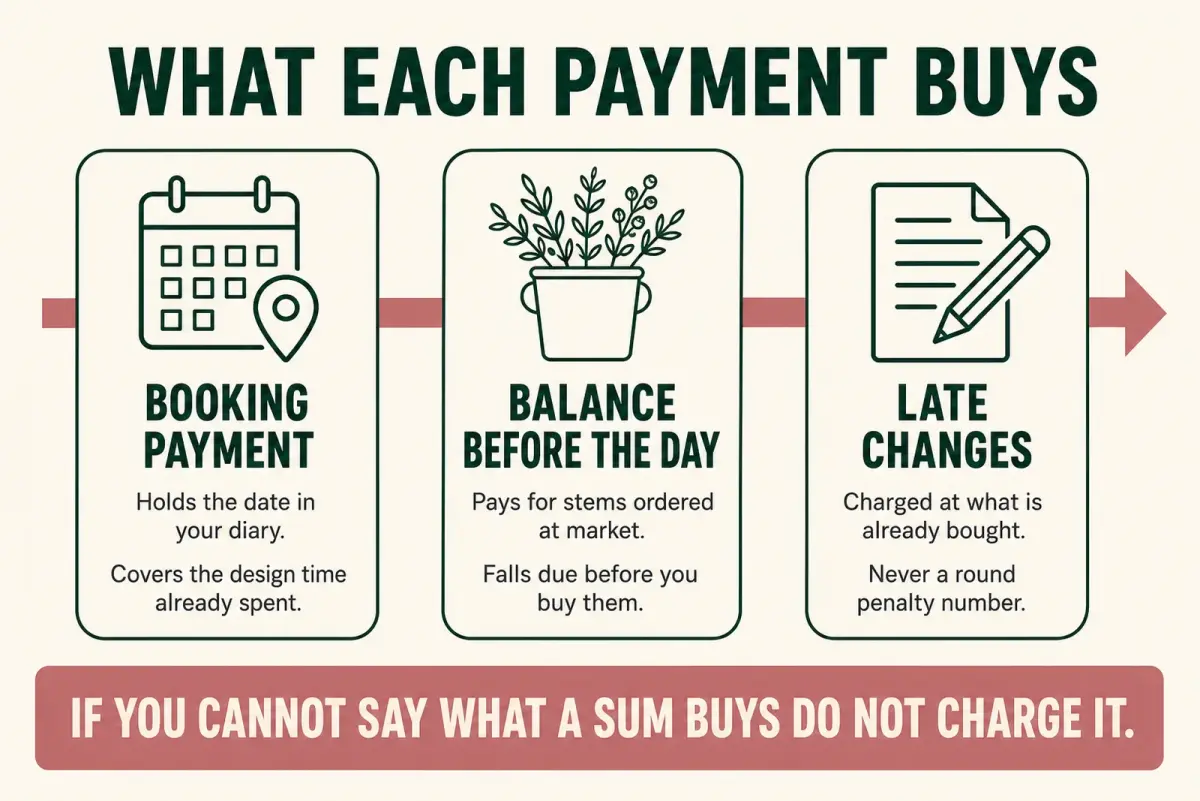
Each payment defensible on its own: what it buys, when it falls due.
Write it the other way round: say what the payment buys and what happens if you cancel, and the sum reads as a price, not a penalty.
Booking payment. A booking payment of [AMOUNT] is due on signing. It holds [DATE] in our diary and covers the consultation and design work already done. Once it is paid we will not take another wedding for that date. If we cancel for any reason other than [YOUR OWN SHORT LIST OF REASONS], we will refund everything you have paid within [NUMBER] days.
The cancellation clause: a ladder, not a wall
Couples cancel for reasons that have nothing to do with you, and your costs depend on how close the wedding is when they ring. A flat forfeit ignores that, and runs at another entry on the same list: a term requiring a disproportionately high sum in compensation, or payment for services which have not been supplied.
Notice what it measures: not whether your number is large, but whether it is proportionate to what you lost and already supplied. A ladder tracks that.
If you cancel. Cancel more than [NUMBER] weeks before the wedding and you owe the booking payment only. Cancel within [NUMBER] weeks and you also owe the cost of any flowers, sundries and hire items already ordered, plus [THE DESIGN OR SETUP WORK ALREADY COMPLETED]. We will show you the invoices for anything we charge on, and we will not charge for work we have not done.
That last promise costs you nothing, and it is what makes the clause credible. Keep the ordering invoices: a charge with a receipt behind it is hard to argue with.
Where the booking is signed changes what you owe
Where a booking is agreed can change what the couple is entitled to, and few templates mention it. Part 3 of the Consumer Contracts (Information, Cancellation and Additional Charges) Regulations 2013 applies to distance and off premises contracts between a trader and a consumer, subject to exclusions in regulations 6 and 28.
Kitchen tables, venue viewings, wedding fairs and email threads are not your shop counter.
Where those rules bite and the booking is a service contract, the cancellation period ends 14 days after the day the contract is entered into. If you never give the couple the required information about that right, the period ends 12 months after the day it would otherwise have ended.
A silent template is not a safe template: it leaves that window open for a year. Whether your booking is a service contract or something regulation 28 takes out of scope turns on your terms, so put them to a solicitor. An hour costs less than one contested wedding.
Substitutions, late changes and getting it signed
Flowers are grown, not manufactured. A named variety can fail at market on the Thursday for reasons neither you nor your supplier controls, so promising varieties by name is a promise you cannot keep.
Substitutions. Flowers are a natural product and availability varies. We guarantee the colour palette, style, scale and overall look agreed in your proposal. If a variety is unavailable or arrives in poor condition, we will substitute a flower of similar colour, form and size, and tell you when we do.
Changes need a deadline too. A table count that shifts a fortnight out is ordinary; a redesign in the wedding week is not, because the stems are bought. Put the lock date in writing and quote later changes at cost.
Picture a florist agreeing in March to swap six table centres for nine the week before an August wedding, with no clause saying who pays for the extra stems. Two sentences in March prevent that 8pm phone call.
Send the contract with the proposal, so the terms arrive as part of the design, not a change of tone. Hold the date only once it is signed and paid.
A held date with no signature is a favour, not a booking, and favours do not pay for the Saturday you turned other couples away.
Frequently Asked Questions
How much deposit should a wedding florist take?
There is no official UK figure, so treat any percentage you see quoted as somebody's habit, not a standard. Work from what the payment covers, the design time spent and the prime date you can no longer sell, then write that into the clause.
Do couples get a fourteen day cooling off period on wedding flowers?
It depends where the booking was agreed. Those rules apply to distance and off premises contracts, subject to exclusions, and for a service contract the period ends 14 days after it is entered into. So have your standard terms checked by a solicitor.
The Short Version
A contract is not a defence against couples. It is where two people write down what the money buys while everyone is happy.
Key Takeaway
Settle it in one afternoon:
- Rewrite the booking payment and cancellation clauses so each says what the money buys.
- Add the substitution and change deadline wording.
- Pay a solicitor for an hour on the finished document, then reuse it.
Getting in front of couples still choosing runs on a calendar, not a contract. LocalBrandHub handles that end: a social calendar and post templates, seasonal campaigns, a visibility score for how easily nearby customers find you, and your Google rating and review count at a glance. It does not hold your contracts or run your booking diary.
Related: read the full guide to Wedding Flower Packages and Upsells
For restaurants, salons, and local businesses
Need help with your marketing?
We help UK businesses turn social media into real results, not busywork.
Start freeSources
- Consumer Rights Act, section 62 (legislation.gov.uk)
- Consumer Rights Act, Schedule 2 Part 1 (legislation.gov.uk)
- Consumer Contracts (Information, Cancellation and Additional Charges) Regulations, regulation 30 (legislation.gov.uk)
- Consumer Contracts (Information, Cancellation and Additional Charges) Regulations, regulation 31 (legislation.gov.uk)
- Consumer Contracts (Information, Cancellation and Additional Charges) Regulations, regulation 27 (legislation.gov.uk)
Get More Marketing Tips
Practical marketing tips for UK business owners, straight to your inbox. No spam, unsubscribe anytime.
About the Author
Local Brand Hub
Empowering UK Businesses
Local Brand Hub provides comprehensive business management tools designed specifically for UK local businesses to streamline operations, automate marketing, and grow revenue.
More articlesRelated Articles
 Business Growth
How to Build a Wedding Florist Business: A UK Guide
A UK guide to the wedding florist business: count the prime dates you can actually sell, price them properly, filter enquiries and protect them.
 Business Growth
Wedding Flower Packages: How to Build and Price Them
Wedding flower packages for UK florists: build three tiers couples can count, fix the right things, and publish a price that survives the wait.
 Business Growth
Wedding Florist Pricing: How to Quote the Whole Day
Wedding florist pricing for UK flower shops: build the quote from the day itself, cost the hours and the miles properly, and know when VAT changes it.