
Wedding florist pricing for UK flower shops: build the quote from the day itself, cost the hours and the miles properly, and know when VAT changes it.
Wedding florist pricing works when the quote is built from the day rather than from the stems. Cost the consultation, the bench hours, the miles to the venue, the hours you spend installing and the trip back to clear up, then add materials and margin. The flowers are the short part of the job.
The couple were delighted. You got home at half past eleven with a van full of wet chicken wire, and somewhere between those two facts sits a number you decided eight months earlier.
Weddings are the job you price blind. A funeral tribute is a known quantity by the third one. A wedding is a bespoke build, a road trip, a ladder and a venue coordinator you have never met, priced before any of it exists.
The fix is not a bigger multiplier. It is quoting a different thing.
Why a quote built on flower cost goes wrong
Because flower cost is the one input you can price accurately before the job exists, while the hours decide whether it paid. The quote drifts toward the half you can count, and the half carrying your margin gets a round number stuck on the end.
None of that is carelessness. It is the shape of the information: your wholesaler publishes a list. Nobody publishes what your Saturday is worth.
So you quote the part you can count, and then you work the part you cannot: the drive, the ladder, the ceremony that moved indoors at ten past eight, the Sunday trip back for the urns.
Picture two quotes for the same marquee, one priced off a stem list and one priced off the schedule. The stem list wins the booking and loses the Saturday.
What should a wedding flower quote cover?
Six things, and only one of them is stems: consultation and admin, flowers and sundries, conditioning and bench time, the road, the hours on site, and the return to break down. Miss any of the five that are not flowers and you have not discounted the wedding, you have donated to it.
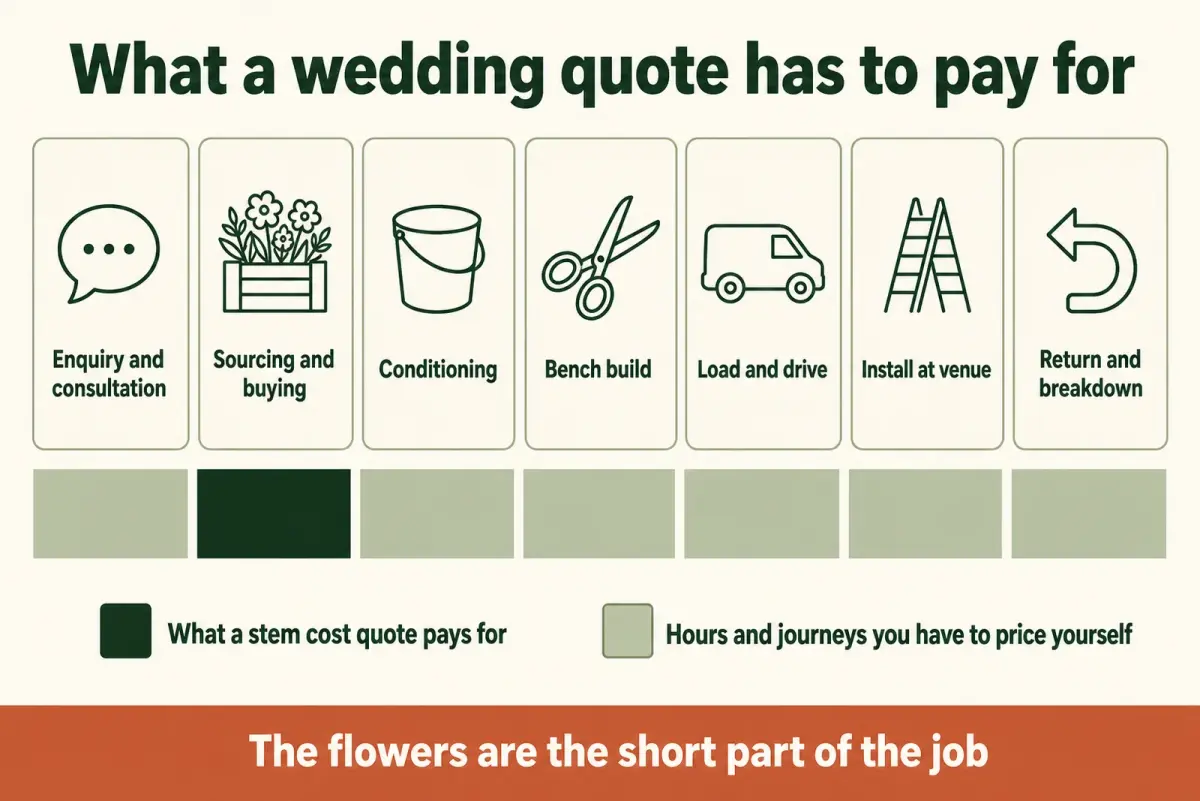
A flower cost quote pays for one stage out of seven. The rest is hours and journeys you price yourself.
Those five behave differently, which is why one multiplier cannot hold them all. Bench time scales with the number of pieces, not the price of the stems. The road is the same distance whatever the order.
Say the flowers for a small ceremony come to £180. The van, the site visit and the Sunday return can easily outweigh them.
Breakdown is a second journey at the worst hour of the weekend, and none of it gets cheaper because the couple chose British stems over peonies.
How do you put a price on the hours?
Time one wedding properly, then reuse those timings. Your schedule repeats more than you think. The rate you attach to the hours is a decision you make once, deliberately, rather than a number that emerges afterwards.
The figure you want is on a stopwatch. Reconstructed eight months later, the ninety minutes spent waiting for someone to unlock a side door has quietly gone missing.
Then the rate. GOV.UK's National Minimum Wage and National Living Wage rates table says that from April 2026 the minimum hourly rate is £12.71 for workers aged 21 and over, and that the rates change on 1 April every year.
It covers less than it sounds like. It is a legal floor for a helper you take on as a worker, at the rate for their age, whatever was agreed in the car park. It is not a floor for a self employed friend who invoices you for the morning, nor for you, since an owner's drawings are not wages. For your own hours it is a yardstick, not a rule.
A stopwatch is the cheapest piece of pricing software you will ever own.
If a quote will not clear that published rate for your own hours once materials are paid, you are the cheapest labour on the job. That can be a real choice in a first season. It should never be an accident in a fifth.
Three timings do most of the work:
- the bench hours a full set of pieces takes
- the door to door time of a delivery and install
- the admin hours between first enquiry and final invoice
Imagine a marquee wedding an hour away. Two consultations, a day and a half on the bench, a five o'clock Saturday start, four hours on site with one helper, a Sunday return to strip the arch: near forty of your own hours, four hours of somebody else's, and a hundred and twenty miles of driving. Decide your own hours are worth £25 and that is £1,000. Add about £51 for the helper's four hours at the April 2026 minimum rate, about £66 for the miles at the HMRC flat rate, and £600 of materials.
Total: £1,717, and that is before shop overheads, before margin, and before VAT if you are registered. The flowers are barely a third of it.
What do the miles actually cost?
Less than the hours they eat up. HMRC's simplified expenses guidance for the self employed sets a flat rate of 55p a mile for cars and goods vehicles for the first 10,000 business miles in the 2026 to 2027 tax year, and 25p a mile after that.
It is a deduction rate for a tax return rather than a price list, and it applies only if you use simplified expenses and have not claimed the vehicle as a capital allowance. Borrow it anyway: somebody else has already argued about that figure.
What it does not include is you. A hundred mile round trip is a hundred mile cost plus three hours of a Saturday you cannot sell elsewhere.
Distance is a time cost wearing a fuel cost's coat.
Price the journey and the time separately, or far bookings keep looking better on paper than they feel in the van.
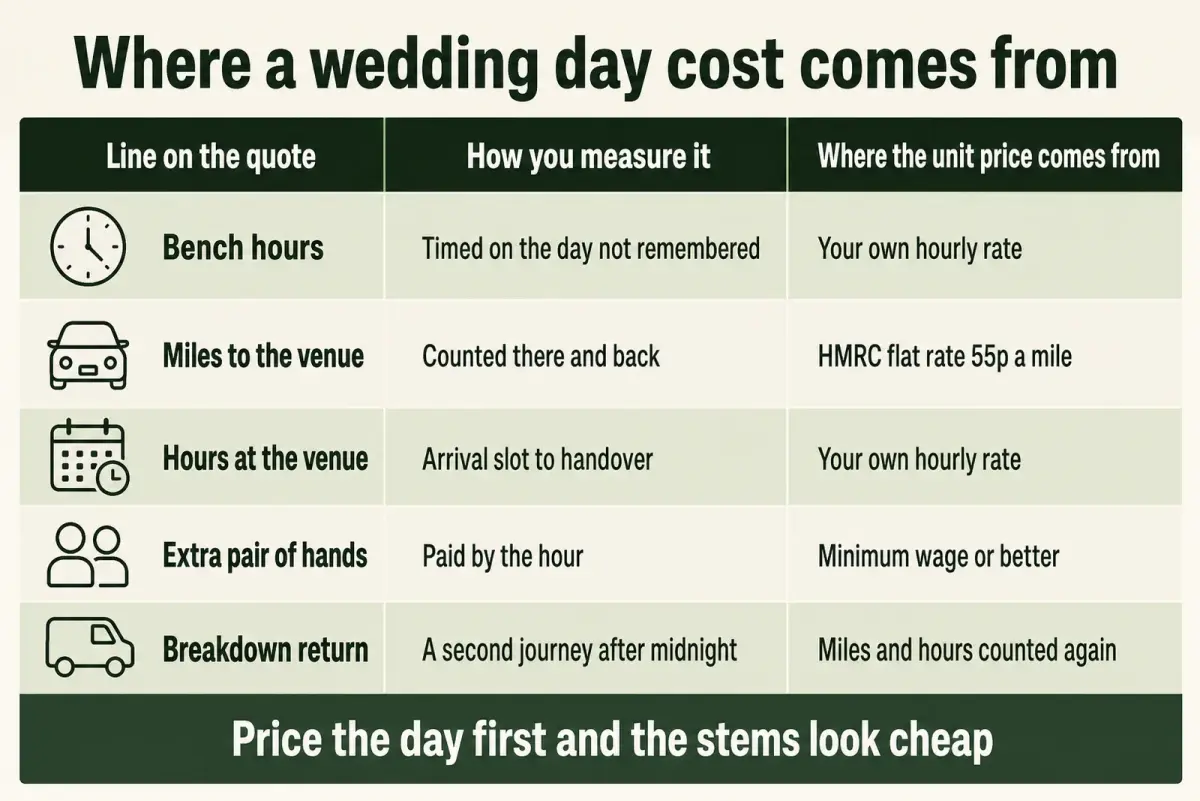
Each line in this table has a unit you can measure and a rate you can point at.
When does VAT change the price of a wedding?
When your turnover crosses the threshold. GOV.UK states that you must register for VAT if your total taxable turnover for the last 12 months goes over £90,000, or if you expect your taxable turnover to go over £90,000 in the next 30 days.
Wedding work can carry a small florist over that line quietly, because it arrives in lumps rather than in daily takings. VAT is a UK wide tax administered by HMRC, and the test runs on your total taxable turnover for the last 12 months rather than on your tax year.
The threshold does not care that your turnover arrived in four Saturdays.
The standard rate of VAT is 20%, and it applies to most goods and services.
Decide your answer before the letter arrives. Once you are registered, a standard rated wedding either goes up by the tax, which the couple simply pays, or it stays at the price you quoted and the tax comes out of it. One is a price rise to justify. The other is a pay cut you chose by not choosing.
Do rules like the 3:5:8 rule help you price?
No, and it is worth knowing why. Two rules of thumb do the rounds: a 3:5:8 grouping rule for arrangements, and the idea that flowers should be some tidy share of the wedding budget. One describes a look and the other a budget split. Neither contains a figure from your business.
A rule with no inputs from your workroom cannot produce an output about your workroom. What it does tell you is what your customer expects, which is worth plenty in the consultation and nothing in the costing.
Suppose a couple arrives having budgeted a tenth of the wedding for flowers. Their tenth describes their spending, not your bench.
The markup multiplier you inherited from shop work has the same flaw, and it is the more expensive one because it feels rigorous. Multiplying materials works on the counter, where the flowers are a far bigger share of the job than they are at a wedding. A wedding inverts that ratio. Set your materials markup by what the shop needs, and florist pricing formula covers that, then price the day on its own.
What should your minimum wedding spend be?
At least what a delivery and install day costs you before any flowers, plus what you need that day to earn. Those costs are fixed by the day rather than by the size of the order.
A consultation runs the same length for two bouquets as for twenty. The drive is the same drive. Loading, the access window and the trip back on Sunday barely shrink when the order does. Small weddings are not small jobs, they are full days with less on the invoice.
Say a day out of the shop costs you six hours, forty miles and a helper before a stem is cut. Call that your floor, whatever the order size.
Publish the figure. A minimum produced at the quote stage reads as a judgement about the couple in front of you. A minimum that was on your website all along reads as how you work.

Rebuild one past wedding this way and you have your minimum, your hourly rate and your next quote.
Presenting the number is its own craft (wedding flower packages), and deposits belong in wedding florist contracts.
Frequently Asked Questions
How much should a florist charge for wedding flowers?
Enough to cover the whole day with a margin on top, built from your own inputs: materials, every hour from consultation to breakdown, the mileage both ways, anyone you pay to help, and overheads. A published price is someone else's van.
What markup do wedding florists use?
A shop markup is sized for counter work, where the flowers are a far bigger share of the job than they are at a wedding. Mark materials up at your usual rate, then quote the day as its own line, built from timings and mileage.
Should I charge separately for delivery and setup?
Charge for them regardless; whether the couple sees them itemised is a presentation choice. HMRC's simplified expenses flat rate for the self employed, 55p a mile for the first 10,000 business miles in the 2026 to 2027 tax year, is a tax deduction figure rather than a price, but it gives you somewhere to start. Never let a delivery charge stand in for install hours.
Do I have to charge VAT on wedding flowers?
Only once you are VAT registered. You must register if your total taxable turnover for the last 12 months goes over £90,000, or if you expect to pass it in the next 30 days. Standard rated supplies then carry VAT at 20%. Wedding income arrives in lumps, so watch the rolling twelve month total.
Should I charge for a wedding consultation?
If consultations are eating days you cannot bill, yes, and a fee redeemable against the booking is the gentlest version, since it costs a couple who goes on to book nothing at all. The money is not the point; the afternoons are. Treat it as a diary decision, not a revenue one.
Where to start this week
Rebuilding one wedding beats rewriting a whole price list, because a single real job already carries the timings, the miles and the materials the method runs on. You supply one number: the rate you want your own hours to earn.
Weekly action
- Write down the real timings of the last wedding you delivered
- Count the miles you drove for it, breakdown trip included
- Set the hourly rate you want your own time to earn
- Rebuild that quote from the day up and compare it with what you charged
- Decide your minimum spend and publish it
Finding the couples is a different job from pricing them: marketing to engaged couples covers it. Staying visible is what LocalBrandHub is built for, with a free social post generator and a month view calendar.
Key takeaways
Key Takeaway
Wedding florist pricing is a forecast of hours and journeys wearing a flower quote's clothes.
- Quote the day, not the stems: consultation, bench, road, install, breakdown.
- Time one wedding and reuse the timings, because a schedule rebuilt from memory loses the hours you most need to price.
- Price miles and hours separately, since the hours are the expensive half.
- Watch the rolling twelve month total and decide your tax answer before the letter arrives.
- Publish a minimum spend, because a small wedding still costs you a whole day.
For restaurants, salons, and local businesses
Need help with your marketing?
We help UK businesses turn social media into real results, not busywork.
Start freeSources
Get More Marketing Tips
Practical marketing tips for UK business owners, straight to your inbox. No spam, unsubscribe anytime.
About the Author
Local Brand Hub
Empowering UK Businesses
Local Brand Hub provides comprehensive business management tools designed specifically for UK local businesses to streamline operations, automate marketing, and grow revenue.
More articlesRelated Articles
 Business Growth
Wedding Flower Packages: How to Build and Price Them
Wedding flower packages for UK florists: build three tiers couples can count, fix the right things, and publish a price that survives the wait.
 Business Growth
Wedding Florist Contracts: The Clauses That Hold Up
What a UK wedding florist contract should say about deposits, cancellations and changes, with copyable clause wording and the law behind each one.
 Business Growth
How to Build a Wedding Florist Business: A UK Guide
A UK guide to the wedding florist business: count the prime dates you can actually sell, price them properly, filter enquiries and protect them.