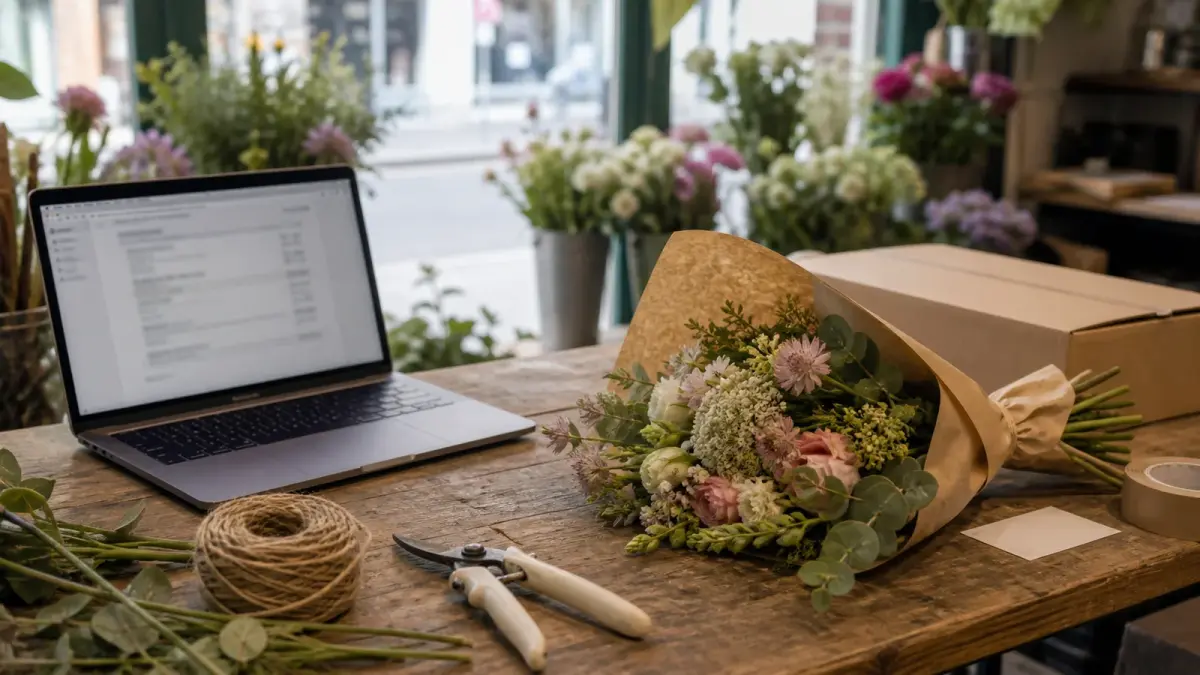
Pricing flowers online vs in store: what a delivered order really costs, what your checkout has to show before the order, and how to set both prices.
A counter sale and a delivered order are two different products wearing the same flowers. Cost the run, the packaging and the fees, then recover them through a delivery charge or a different online range. Price each channel off what it actually costs to fulfil, never off the other one.
Half four on a Tuesday, and the last drop of the day is a hand tied going out to a village, ordered through your website before you had finished sweeping up. Over the counter that bouquet was a two minute sale. As a delivered order it is a box, a label, a card fee and twenty minutes of you in the van. Same stems, different job, and only one of those jobs ever got priced.
It is tempting to stop at "online costs more, so charge more". That is half an answer. The other half is that your two prices are judged by different people against different things, and the law has firm opinions about one of them.
Why a delivered order is a different product
The counter sale ends when the customer walks out with the wrap under their arm. The online order is where the second job starts, and the second job has a cost sheet of its own.
| What the sale carries | Over the counter | Delivered order |
|---|---|---|
| Flowers, sundries and labour | Yes | Yes |
| Packaging built to survive a van | No | Yes |
| The delivery run itself | No | Yes |
| Card or platform fees | Sometimes | Almost always |
| Order admin and delivery notes | Minimal | Every order |
| Risk of it arriving damaged | None | Yours |
The delivery run is the easiest line to leave blank, and it is the only one with a published number already attached to it. HMRC's approved mileage rate for cars and vans is 55p per mile for the first 10,000 business miles a year from 6 April 2026, and 25p a mile above that.
That is a tax rule rather than a measurement of your van. It exists so an employer can reimburse business mileage without a tax charge, and it stands in for fuel, wear, insurance and depreciation together. Which makes it a defensible opening figure for a run, and a far better one than the blank you are working with. Swap it for your own numbers as soon as you have them.
What that looks like on one drop.
Imagine a village run of six miles there and back. At that rate the vehicle side is a little over three pounds. Add twenty minutes of somebody's time, plus a box and wrap that survives a roundabout, and the fuel turns out to be the small part of the bill.
The bouquet is the cheap part of a delivered order. Over the counter you sell flowers. Online you sell flowers plus a courier service you happen to be performing yourself.
If you have never put a number on your own hour, the florist pricing formula is where to start, because every channel figure below is built on top of it.
Cost one run before you price anything
You cannot price a channel you have never costed, and costing one is arithmetic, not a system to build.
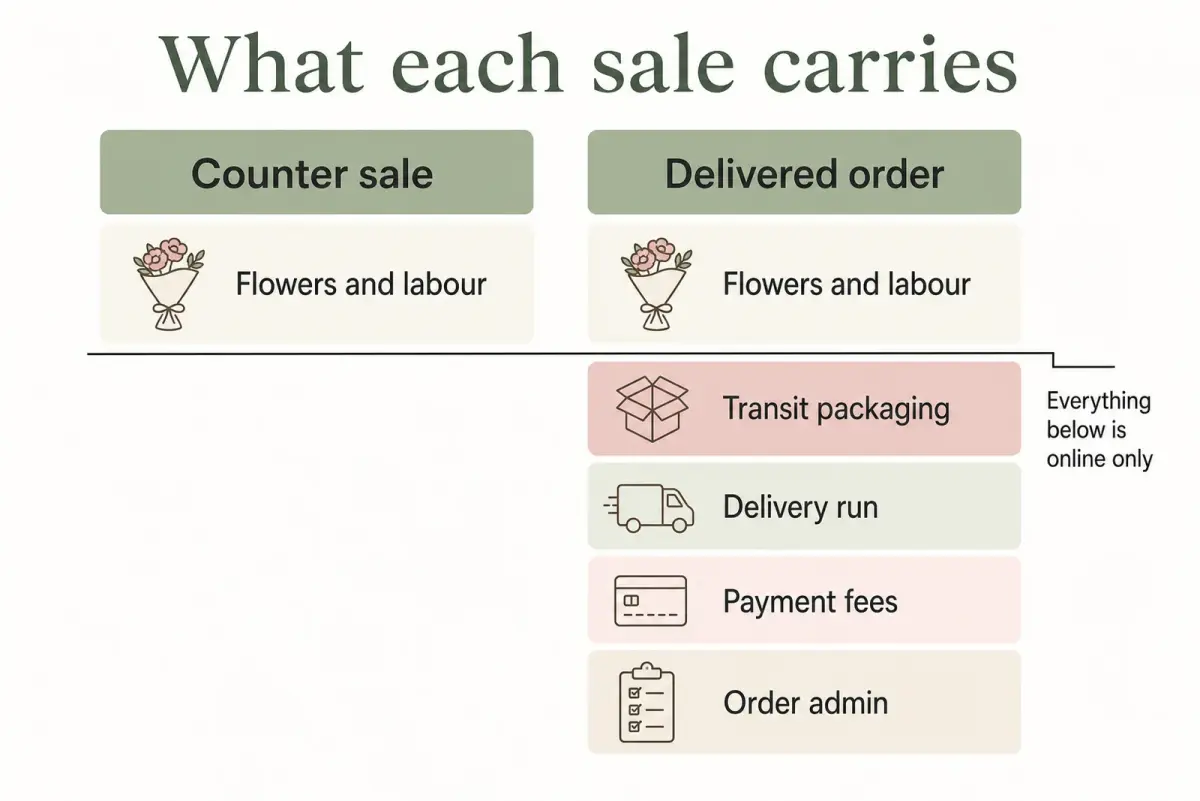
A counter sale stops at the wrap. Everything below that line belongs only to the delivered order.
Take one ordinary delivered order and total four things:
- The run. Miles there and back for a typical drop, at a rate per mile you can defend.
- The time. How long the run takes door to door, valued at what you would pay somebody else to do it.
- The transit kit. Box, aqua pack, wrap, card, label. The bits that never touch a counter sale.
- The fees. The card charge on the payment, plus any commission if the order came through somebody else's shopfront.
Add those four and you have the number the counter sale never had to earn. Compare it with what you charge for delivery. Any gap will look trivial on one order and anything but across a year of them. Do a Saturday run and a midweek run separately, because averaging them hides whichever one is losing.
What your checkout has to show before the order
Selling at a distance puts your price under rules the counter never applies. Before an order is placed you must give the customer the price including all taxes, and the delivery arrangements, costs and how long the goods will take to arrive.
Read that as a duty about what the customer is told, not about what software you buy. Nothing there requires a particular platform or postcode calculator. It requires that the person clicking buy already knows the total and the delivery cost. A flat fee on the product page satisfies it, and so does a distance band, as long as the bands are visible before the order rather than after.
Why this matters: the duty is that the customer knows the delivery cost before the order goes through, not that it lands on any particular screen. Meet it at step three of checkout if you like. The customer who abandons the basket there was not lost to price, they were lost to surprise, and the product page is where you avoid both.
The "including all taxes" half is the quieter of the two, and the easier one to get wrong. If your shop is VAT registered you usually charge the standard rate of 20% on most goods and services, and the price a consumer sees is the one with that already inside it.
Which makes the headline price smaller than it looks.
A £45 delivered price is not £45 of your money. At the standard rate it is £37.50, and the flowers, the box and the run all come out of that. Price the online range off the net figure and a delivered order stops looking as generous as it did on the confirmation email.
If your shop front is newer than your pricing, setting up the online shop properly and getting these lines onto the product page are one afternoon's work.
The refund rule that quietly favours your online channel
Distance selling normally carries a change of mind cancellation right. For flowers, it does not bite.
GOV.UK's guidance on accepting returns lists perishable items, giving flowers as its example, among the goods you only have to refund if they are faulty.
Read that precisely, because the narrowness is the useful part. It removes the buyer's remorse refund and nothing else. Goods that turn up faulty, damaged or not what was ordered are untouched by it, so a bouquet that arrives crushed is still yours to put right, exactly as it would be over the counter.
So the online price does not need a returns buffer for changed minds the way an online clothing shop's does. It does need a replacement budget for transit damage, because that is the failure this channel actually has.
Price the risk you have, not the one the ecommerce advice assumes you have. Nobody sends flowers back because they went off the colour. They ring because the box arrived on its side.
How much should a florist charge for delivery?
Enough that the run pays for itself and leaves something behind. There are three honest shapes, and you only need one.
- A flat local fee. One number, everything inside a radius you have actually driven. Simplest to state on a product page, which matters more than it sounds.
- Distance bands. Priced off the run, not off how far away the postcode feels. Two or three bands is plenty to start with; five turns into a customer service problem.
- Free above a minimum spend. Legitimate, but only if the run's cost really is inside those bouquet prices rather than inside your optimism.
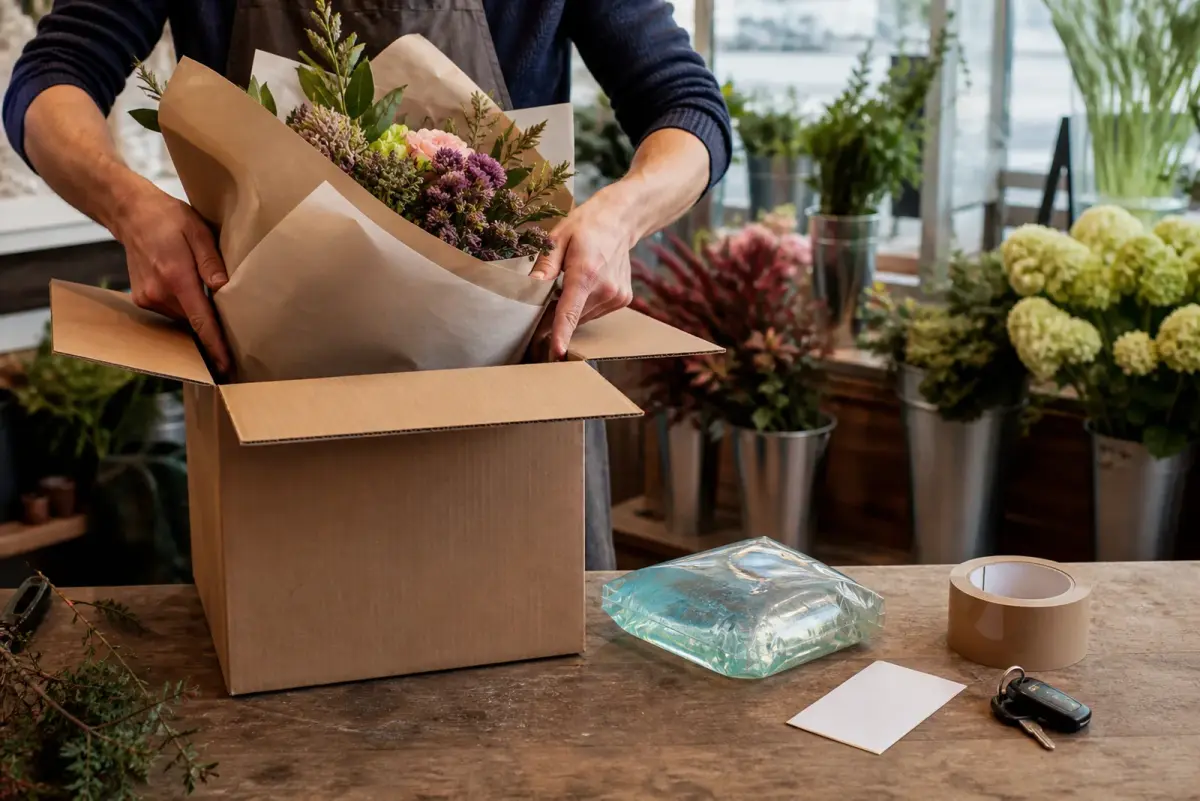
The transit kit is a cost line, not a courtesy.
There is a fourth option nobody picks on purpose: free delivery, uncosted, absorbed. That is not a pricing strategy, it is a subsidy you are paying to strangers.
A minimum order is the partner to whichever shape you pick, and it is not a way of squeezing customers. It is the point below which a run costs more than the order earns. Work out the run cost, decide what a delivery has to leave behind, and set the minimum where that arithmetic stops being negative. It moves when fuel and wages move, so it is not a number you set once and inherit forever. If the bouquet prices underneath it have not been looked at in a while, flower bouquet pricing is the other half of this job.
Whichever shape you choose, it belongs on the product page, not the payment page.
Should you charge more online for the same bouquet?
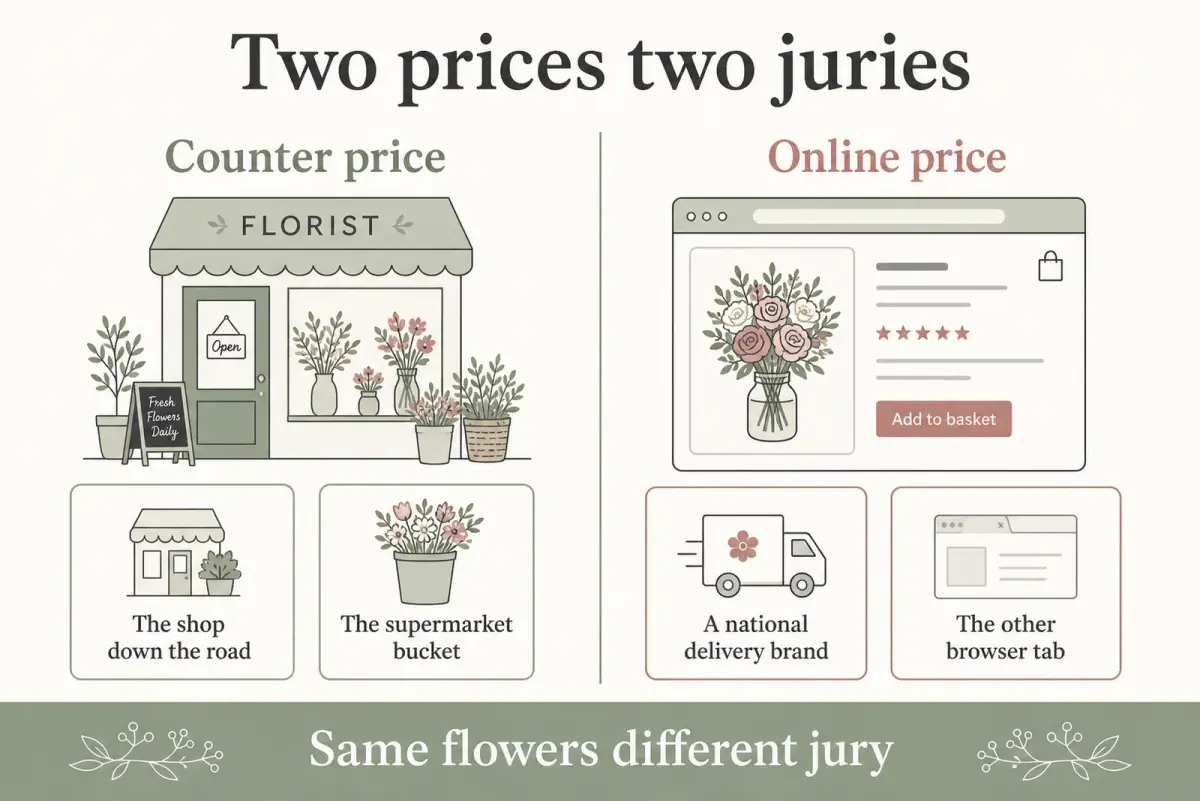
Two prices, two juries. Only one of them can see your window.
This is where the standard advice quietly fails. Put one price on the counter and a higher one online for an identical hand tied, and you have not priced a channel, you have published a penalty. The customer who has seen both has every reason to read it that way, because your own window told them what that bouquet costs.
Your counter price is judged against the shop down the road. Your online price is judged against whatever the customer has open in the other tab.
That other tab is likely to be a national delivery brand with a photography budget and a next day promise, which is a different jury asking a different question.
Different juries, different answer. The channel that has to survive that second comparison should not be selling the same item at a mark up. It should be selling a different one.
- Sizes that box well, so the arrangement arrives looking like the photograph.
- A stated delivery window, because that is what the other tab is promising.
- A card message and a signature stem or two the national brands cannot template.
The price difference then has a reason the customer can see, and a visible reason is the only kind of price gap anybody forgives.
That also puts you on ground a national brand cannot stand on. They are ten warehouses away. You are ten minutes away and you know which street the roadworks are on. Recurring orders lean the same way, which is why a flower subscription is an easier thing to sell on that closeness than a stem for stem match against a courier.
The channel pricing mistakes that cost the most
- One price, two channels. The counter number applied online, with the run silently absorbed.
- Delivery first seen at checkout. It may still clear the disclosure duty, and it still loses baskets.
- A minimum order set by feel. Set once, years ago, and never moved since.
- Commission ignored. An order through somebody else's marketplace is not the margin of one through your own shop.
- Pricing off a competitor's screen. Their cost base is not yours, and you cannot see it anyway.
Frequently Asked Questions
Should florists charge more for flowers online than in store?
Usually yes, but not by repricing the same bouquet. A delivered order carries packaging, a run, fees and admin the counter sale does not, so the money has to come from somewhere. The cleanest routes are a stated delivery charge, or an online range built for delivery and priced on its own terms. Charging more for an identical item sitting cheaper in your own window is the version that reads as a penalty.
How much should a florist charge for flower delivery?
Enough to cover the vehicle, the driver's time, the transit packaging and the payment fee, with something left over. Cost one typical run end to end before picking a number, then choose a flat local fee or two or three distance bands. Whatever you land on has to be visible before the order goes through, and the product page is a safer place for it than the payment screen.
What is a good minimum order for flower delivery?
The level at which a delivery reliably covers its own cost and still leaves a margin. That depends on your radius, your wages and your fuel, not on what the shop in the next town charges. Cost one run, decide what a delivered order has to earn, set the minimum there, and revisit it whenever fuel or wages move.
Do I have to show delivery costs before checkout?
Yes. Before the order is placed you must give the price including all taxes and the delivery arrangements, costs and timescales. That is about information reaching the customer, not about any particular website setup: a flat fee on the product page does the job, and so do visible distance bands.
Do I have to refund a customer who changes their mind about flowers?
Not for a change of mind. Perishable goods, with flowers named as the example, sit among the items you only have to refund if they are faulty. Damaged, wrong or not as described is a different matter, and those rights are unaffected, so budget for transit failures rather than remorse.
Are online flower orders less profitable than counter sales?
They are if you price them as counter sales. Once the run, the packaging and the fees are recovered, a delivered order earns whatever margin you built on top of them, and it reaches customers who were never walking past your window. The unprofitable version is the one where the price came off the counter and the costs came out of your evening.
What to do this week
Key Takeaway
None of this needs a platform. It starts with a pen and one delivered order.
- Cost one typical delivery run end to end and write the number down
- Compare it with what you currently charge for delivery
- Close the gap through the charge or through the online price
- Check the minimum order still covers a run at the fuel and wages you actually pay
- Open your own product page on a phone and confirm the total and the delivery cost are both visible before anyone clicks buy
If you only have half an hour, do the first two. Knowing the gap is most of the work, and a number on paper is much harder to ignore than a suspicion.
If the part that slips is keeping prices and offers up to date everywhere customers look, that is the job LocalBrandHub does for florists: a products and offers list you can update in minutes, and a visibility score telling you how easily nearby customers find you.
Pricing flowers online vs in store is not a mark up decision. It is a decision about which of your two shops you are pricing, and whether that shop's costs have ever been counted.
For restaurants, salons, and local businesses
Need help with your marketing?
We help UK businesses turn social media into real results, not busywork.
Start freeSources
Get More Marketing Tips
Practical marketing tips for UK business owners, straight to your inbox. No spam, unsubscribe anytime.
About the Author
Local Brand Hub
Empowering UK Businesses
Local Brand Hub provides comprehensive business management tools designed specifically for UK local businesses to streamline operations, automate marketing, and grow revenue.
More articlesRelated Articles
 Business Growth
Wedding Flower Packages: How to Build and Price Them
Wedding flower packages for UK florists: build three tiers couples can count, fix the right things, and publish a price that survives the wait.
 Business Growth
Wedding Florist Pricing: How to Quote the Whole Day
Wedding florist pricing for UK flower shops: build the quote from the day itself, cost the hours and the miles properly, and know when VAT changes it.
 Business Growth
Best Website Builder for Florists: A UK Comparison
The best website builder for florists, compared for UK flower shops: Squarespace, Shopify, Wix and WordPress weighed up on galleries, ordering and budget.