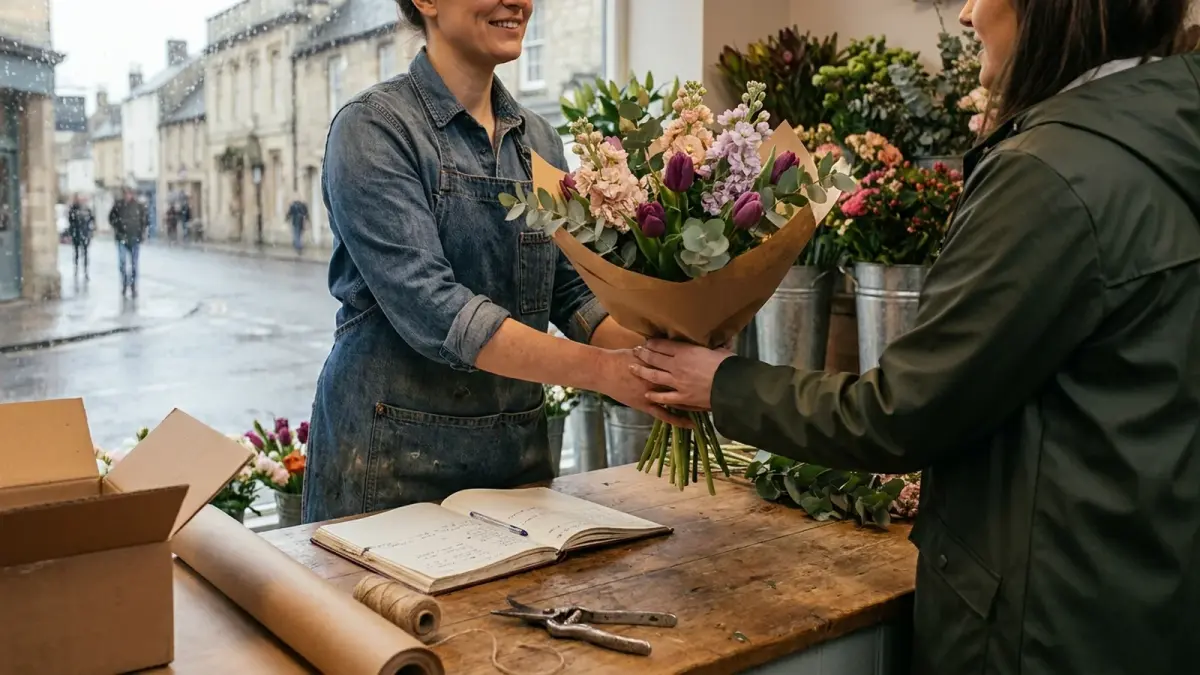
Florist customer retention starts with an occasion diary, not a loyalty card. What to write down, what UK rules let you send, and which lever first.
Florist customer retention is the work of holding your customers' dates and earning permission to use them. Flowers are bought for an occasion, so the next order arrives when a birthday, an anniversary or a memorial comes round again. Record those dates at the counter, ask properly, and reach people before the day.
You wrapped it beautifully, wrote the card by hand, and never heard from them again. That is not a failure of craft, it is the shape of the trade. Retention here is not a question of better flowers. It is being the florist nobody thinks to replace, and everything else you have been told is scaffolding around that one job.
What you'll learn
- Why happy florist customers vanish without complaining
- The four fields to capture at the counter
- What UK rules let you send, and what a list costs
- Which lever to pull first, and where loyalty cards sit
- How to count whether any of it worked
Why florist customers leave without ever complaining
Some customers leave because you let them down, and those you can usually name. Most of the ones you never saw again had no complaint to make at all. The bouquet was good, the delivery landed, and then nothing reminded them of you for eleven months. When something finally did, they typed "florist near me" into a phone like a stranger.
A coffee shop loses customers who stopped enjoying the coffee. A florist loses customers who ran out of occasions. Yours are dormant rather than disappointed, and no amount of better product wins back someone for whom the product was never the issue. It is also why a discount is the wrong tool for the job it usually gets given: nobody moves their mother's birthday to catch a promotion, so price can win the order once the date arrives but it cannot make the date arrive sooner.
Search this topic and you will be handed loyalty schemes. The permission rules underneath them, the ones that decide what you are actually allowed to send, are the rest of this article.
The occasion diary is the whole system
A florist's customer list is not a mailing list. It is a calendar with names on it. Four things are worth capturing while the customer is still in front of you:
- The date of the occasion, not the date they paid you.
- The relationship. A note about a wife's birthday cannot read like one about a mother's grave.
- What they chose, including the colours they refused.
- How you asked to stay in touch, in their words and yours.
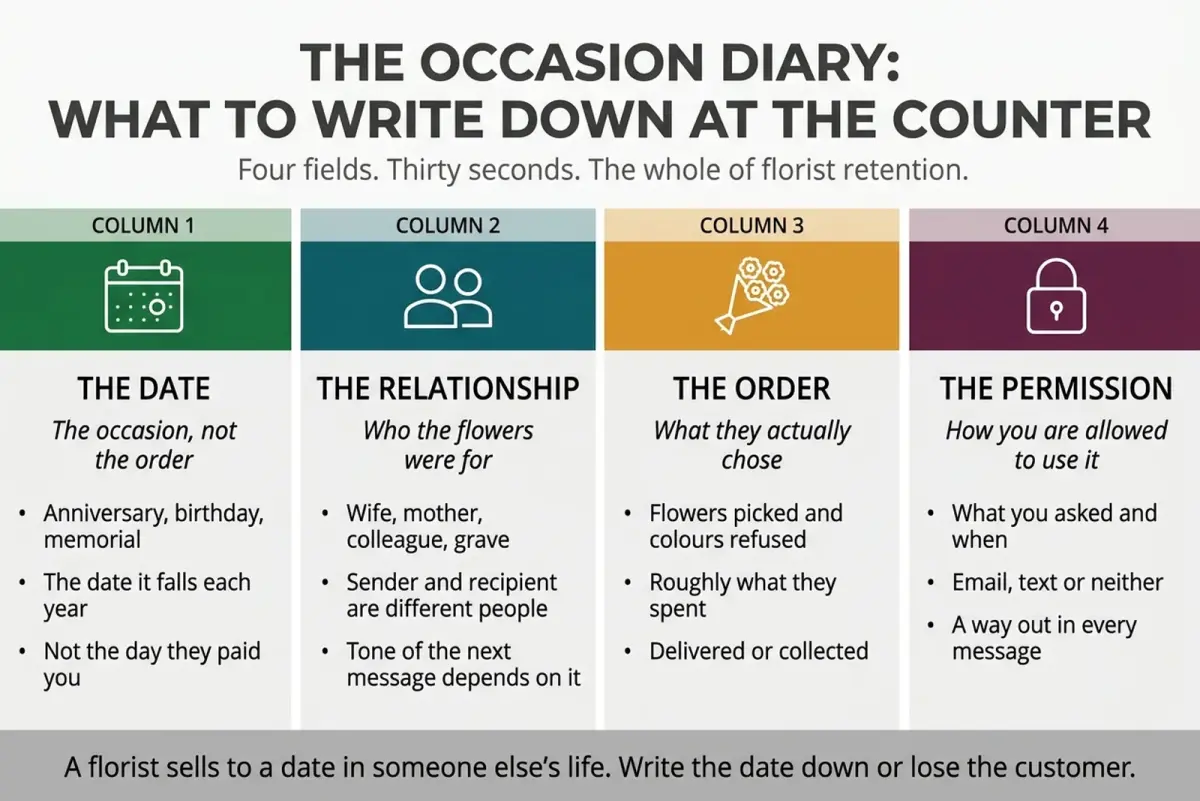
Four fields, thirty seconds at the counter, and the rest of retention becomes possible.
Why paper still wins
A diary and a pen beat the half configured system you never finished setting up, for one reason: the diary still gets written in on the day the shop is heaving. Wording and timing belong to florist reminder marketing.
Picture a customer ordering lilies in October for a mother's funeral. Written down properly, that is not a sale, it is a date. Next October you send one quiet line offering the same arrangement, and the shop that remembered becomes the only one worth ringing. Illustrative, not a case study.
A stamp card can reward a customer for coming back. It cannot tell them when to.
What you are allowed to send, and what the list costs you
Other people's anniversaries, written down in your book, are personal data. Once you use them to sell, two rules apply.
Permission comes first
Under PECR you must not send marketing emails or texts to individuals without their specific consent, with a limited exception known as the soft opt in for your own previous customers who bought or negotiated to buy a similar product or service, provided you gave them a simple way to opt out both when you first collected their details and in every message since (Information Commissioner's Office).
Read that twice, because the opt-out is the half people forget. A customer who buys a bouquet and says yes to a note next year is covered, provided you gave them that way out at the counter as well as in the message itself. An address copied out of an old enquiry book, where nobody was ever offered a way out, is not covered, however warm the conversation felt at the time. So ask out loud, write down what you asked, and put a real way out in every message you send.
The fee may not be yours to pay
Better news than florists expect: the ICO says you do not need to pay the data protection fee if you are processing personal data only for one or more of a listed set of purposes, one of which is advertising, marketing and public relations (ICO exemptions). Run the ICO self assessment rather than taking this article's word for it, because stepping outside those purposes brings the fee back into view. It runs across three tiers, from £52 to £3,763 a year, and tier 1, which covers organisations with no more than 10 staff or turnover up to £632,000, costs £52 (ICO).
Why this matters: being outside the fee is not being outside the rules. Where the diary lives may change what you owe the ICO. It changes nothing at all about what you are allowed to send the people in it.
Which retention lever to pull first
Order matters more than effort, because these levers are not independent. Reminders sent by a shop that misses delivery slots do not build loyalty, they schedule disappointment.
| Order | Lever | Why it sits there |
|---|---|---|
| 1 | A repeatable shop | Same vase life, wrap, delivery window |
| 2 | The occasion diary | Nothing above works without a date |
| 3 | A reminder before the date | Acts before your customer searches |
| 4 | A subscription | For the customer buying for themselves |
| 5 | The win-back | One honest message to a date that passed |
Rule of thumb, not a ranking: the order reflects what depends on what, not measured return per lever.
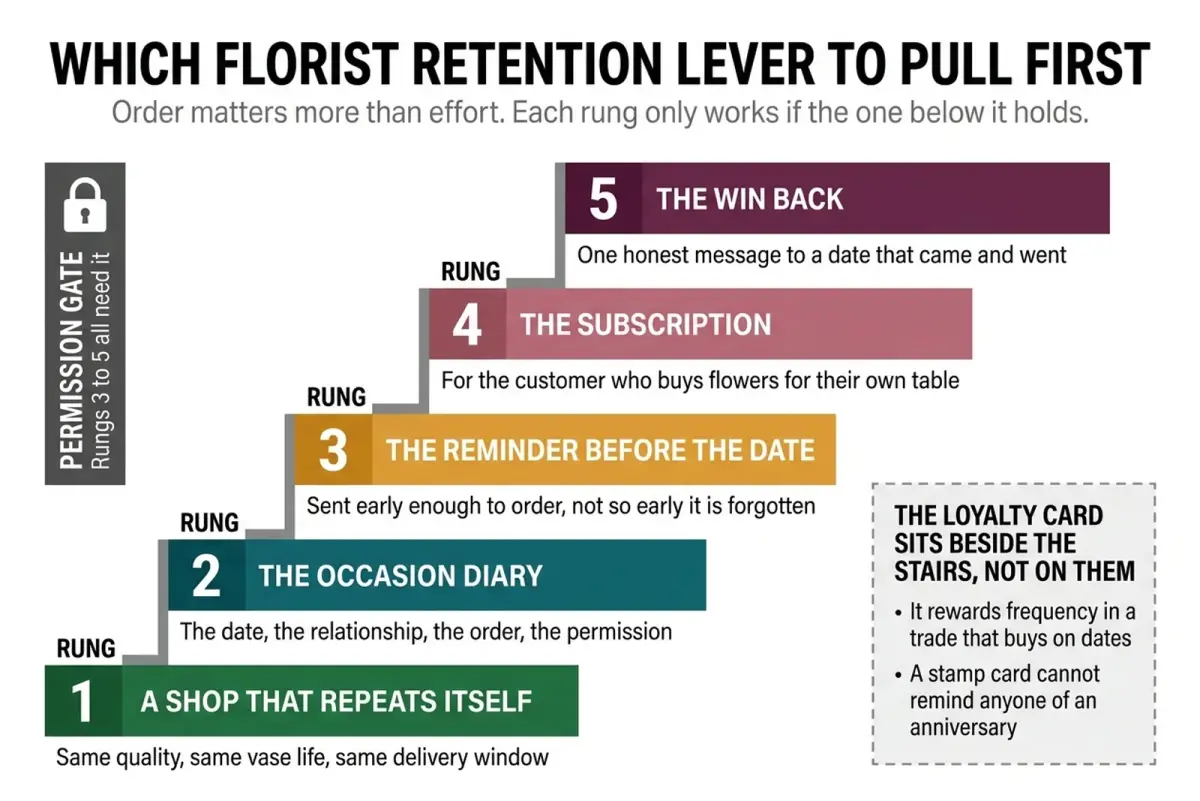
Each rung only works if the one below it holds, and the top three all depend on permission.
How far ahead to send it
A week to ten days is a starting number to test, not a finding. Send it, watch what comes back, and move it.
Imagine a shop sending its anniversary note ten days out and finding most replies arrive on the day itself. That is a signal to try five days, not proof that reminders fail.
The loyalty programme sits beside this staircase rather than on it. Rewarding frequency suits the weekly self buyer and the office account, and does little for the man who orders twice a year and means it both times.
Subscriptions, and the rule change the government has signalled
Subscriptions stop depending on your memory, because the customer has already agreed to the next order. They also serve a different person: the one buying flowers for their own kitchen table, not the specialist wedding work and not the gift buyer. Setting one up is covered in starting a flower subscription business.
In its April 2026 response to the consultation on implementing the new subscription contracts regime under the Digital Markets, Competition and Consumers Act, the government said it will legislate when parliamentary time allows and anticipates that the regime will commence in spring 2027 (Department for Business and Trade). Detail is still being settled, so treat none of this as a compliance checklist. Two design choices cost nothing at all:
- Tell subscribers in advance when the next payment is due.
- Make stopping as easy as starting, in one reply rather than one phone call.
What is the three-five-eight rule for florists?
The three-five-eight rule is a design idea, not a retention one. Where the phrase turns up it is about proportion in an arrangement, counts of focal, secondary and filler stems, and the versions in circulation do not agree with each other. Either way, nothing in it tells you when a customer is next due flowers.
So if you came looking for a retention formula wearing that name, there is not one, and the eight C's are no better: the lists that circulate do not agree on the words behind the label. The date in someone's diary is not a formula, which is exactly why no formula will find it for you.
How to tell whether retention is working
One number tells you more than any dashboard, and you can count it by hand on a wet afternoon. Take every customer who ordered for a dated occasion in 2025, then count how many ordered again in 2026 for that same occasion.
Say last February you took forty Valentine's orders and this February eleven of those names came back. Whether eleven is good is beside the point. It is your baseline, and next February's count is the honest verdict on the reminder you sent. Numbers invented for the example.
Count it before you change a lever, then count it again next season. The expensive mistake is pouring every spare hour into finding new customers while the diary sits empty behind the till.
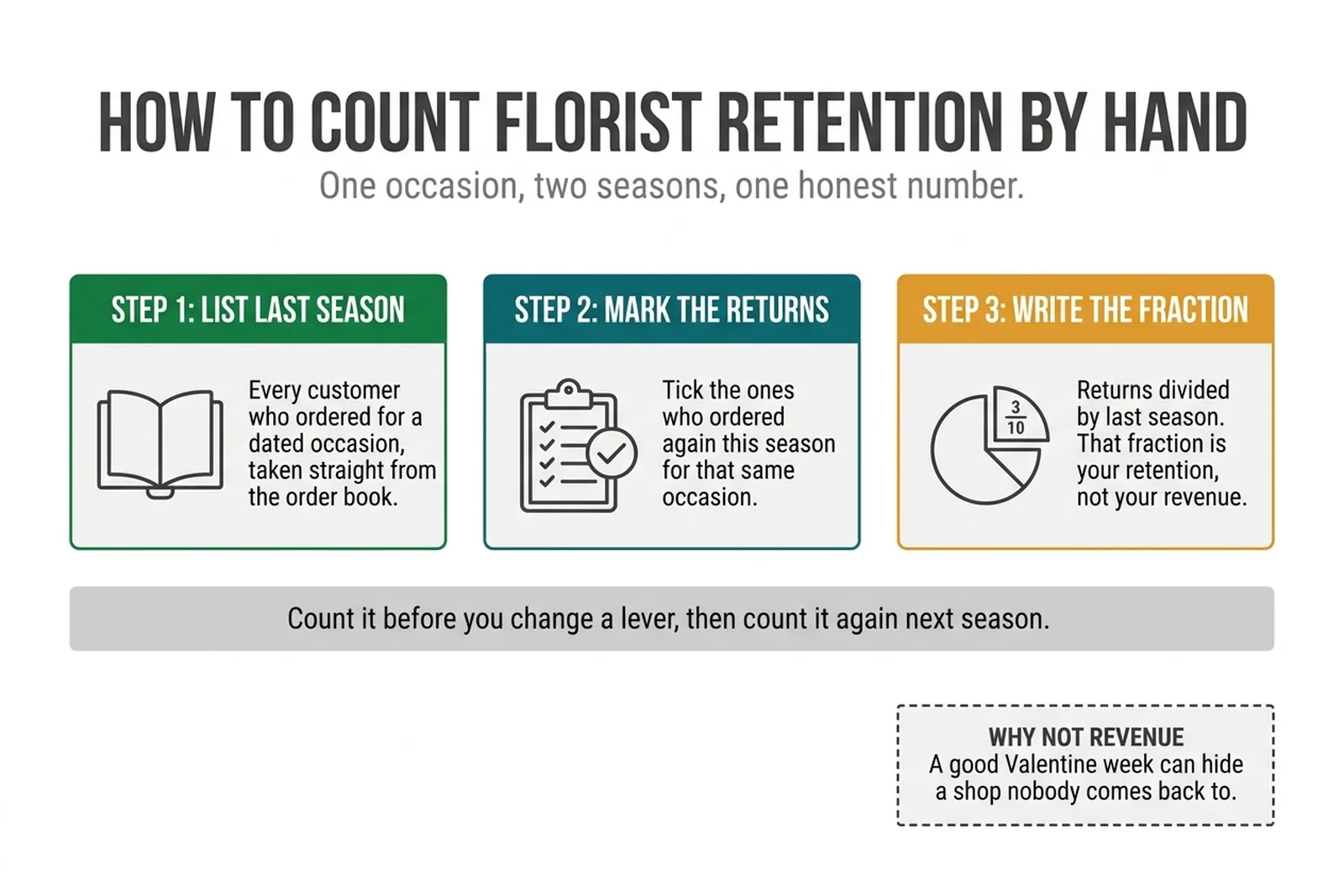
Counting by hand beats a dashboard you never open, and a good Valentine week can hide a shop nobody returns to.
Frequently asked questions
Why do florist customers not come back?
Some did have a complaint, and those you can usually name. Most simply had nothing to bring them back: flowers are bought for an occasion rather than out of habit, so a happy customer can go eleven months without a reason to return. They are dormant rather than dissatisfied, and search again when the next date arrives.
How do florists get repeat customers?
By recording the occasion behind each order and reaching the customer before that date returns. Loyalty cards and win-back offers work better once the diary exists, because neither can tell you when someone next needs flowers. A subscription can, but only for the customer willing to commit to one.
Is a loyalty card worth it for a flower shop?
Worth having, rarely worth building first. A stamp card rewards frequency, and most florist customers buy on dates instead. It earns its keep with the weekly self buyer and the office account, who do come often enough to fill one.
Can I text past customers about their anniversary?
Only within the rules. The ICO says you must not send marketing emails or texts to individuals without specific consent, with a limited exception, the soft opt in, for your own previous customers who bought or negotiated to buy a similar product and were given a simple way to opt out from the start and in every message since.
Do I need to pay the ICO fee to keep a customer list?
Often not. The ICO says no fee is payable where personal data is processed only for one or more listed purposes, one of which is advertising, marketing and public relations. Run the ICO self assessment for your own shop, and remember that being outside the fee is not being outside the rules.
Where to start this week
Key Takeaway
If you only have half an hour this week, do this:
- Start with the last fortnight of the order book and write, beside each name, the date the flowers were for.
- Ask the next customer whether they want a note before that date next year, and record what they said.
- Add one line to every message telling people how to stop them.
- Diarise a check for next season and count how many names came back.
Half an hour a week is a starting point, not a prescription. Stretch it to an afternoon if the order book is deep, and adjust once you can see what comes back.
For the seasonal pushes that fill the window and the feed, LocalBrandHub helps florists get a month planned in an afternoon: see the ready made campaign library and social calendar. Your diary stays yours, in your handwriting.
So ask yourself: how many of the occasions in your 2025 order book could you name without looking? Every one you cannot is a customer waiting for a competitor to remember first.
For restaurants, salons, and local businesses
Need help with your marketing?
We help UK businesses turn social media into real results, not busywork.
Start freeSources
Get More Marketing Tips
Practical marketing tips for UK business owners, straight to your inbox. No spam, unsubscribe anytime.
About the Author
Local Brand Hub
Empowering UK Businesses
Local Brand Hub provides comprehensive business management tools designed specifically for UK local businesses to streamline operations, automate marketing, and grow revenue.
More articlesRelated Articles
 Marketing Tips
Email Marketing for Florists: A UK Flower Shop Guide
Email marketing for florists that drives repeat orders and peak-day pre-sales: a UK guide to building a list and sending emails customers actually open.
 Business Growth
Wedding Florist Contracts: The Clauses That Hold Up
What a UK wedding florist contract should say about deposits, cancellations and changes, with copyable clause wording and the law behind each one.
 Business Growth
Wedding Flower Packages: How to Build and Price Them
Wedding flower packages for UK florists: build three tiers couples can count, fix the right things, and publish a price that survives the wait.