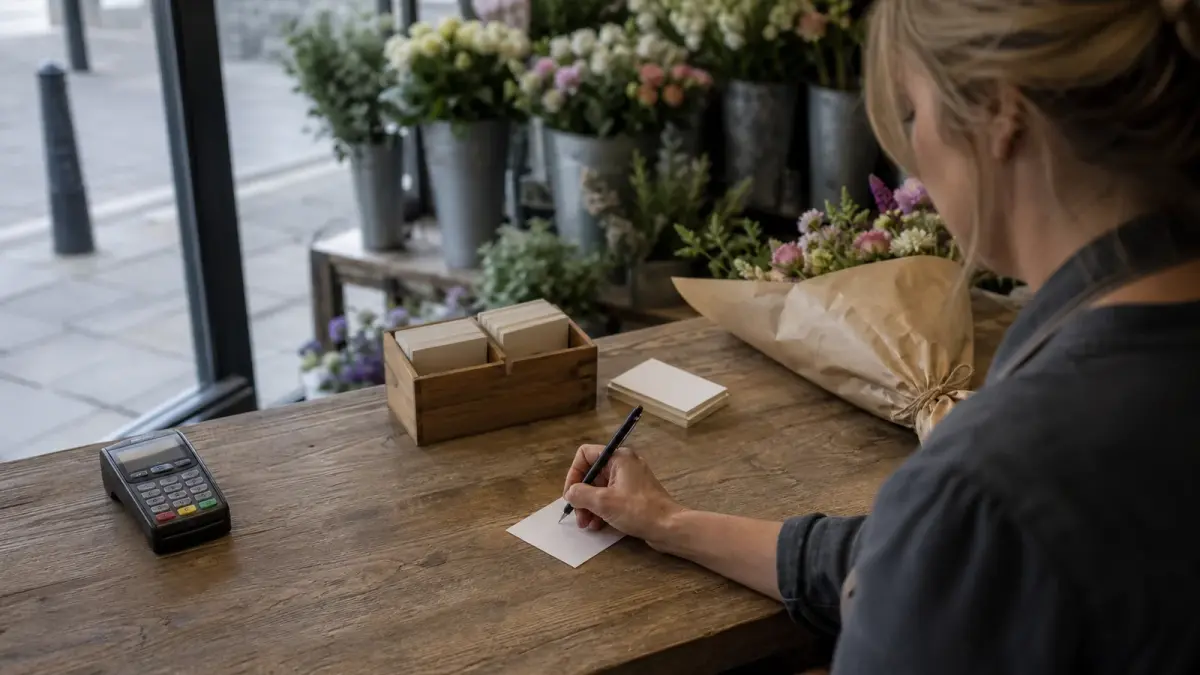
Flower buying runs on occasions, not habits. How UK florists pick a loyalty programme that fits, word the reward honestly and take details lawfully.
A florist loyalty programme rewards customers for coming back, but flower buying runs on occasions rather than habits, so a stamp card borrowed from a coffee shop asks for a frequency your customers may simply not have. The scheme that earns its keep is built around the dates your customers already buy for.
Somewhere in your town there is a loyalty card with three stamps on it, in a drawer, belonging to a man who buys flowers twice a year and both times in a hurry. He bought in February for his wife and in March for his mother, and the card wanted ten purchases before it gave anything back.
He is not disloyal. He is a normal flower customer, and the card was not badly designed. It was designed for a different trade.
Why a coffee shop stamp card stalls in a flower shop
Because it rewards frequency, and frequency is the one thing a date driven customer has no reason to give. A coffee customer can visit eleven times in a fortnight without changing their life. A flower customer's next purchase is attached to a date that has not arrived yet, so a card paying out on the tenth visit is a promise the calendar will not keep.
A coffee shop sells a habit. A florist sells an occasion, and occasions do not respond to being nagged.
That sounds like bad news for loyalty and it is the opposite. Your customers' buying is not random, it is scheduled by birthdays, anniversaries and Mother's Day rather than by lunchtimes. Look at what you learn in ninety seconds at the counter: who is buying, what they chose, who it is for, and the date it has to land. A stamp card records none of it.
Which loyalty programme shape fits your shop?
There are two, and the real choice is whether you hold customer details at all. A counter card records nothing and rewards repeat visits. An occasion scheme records a name and a date and rewards you for remembering it. Points, tiers and a regulars' perk are variations on those two, not separate species.
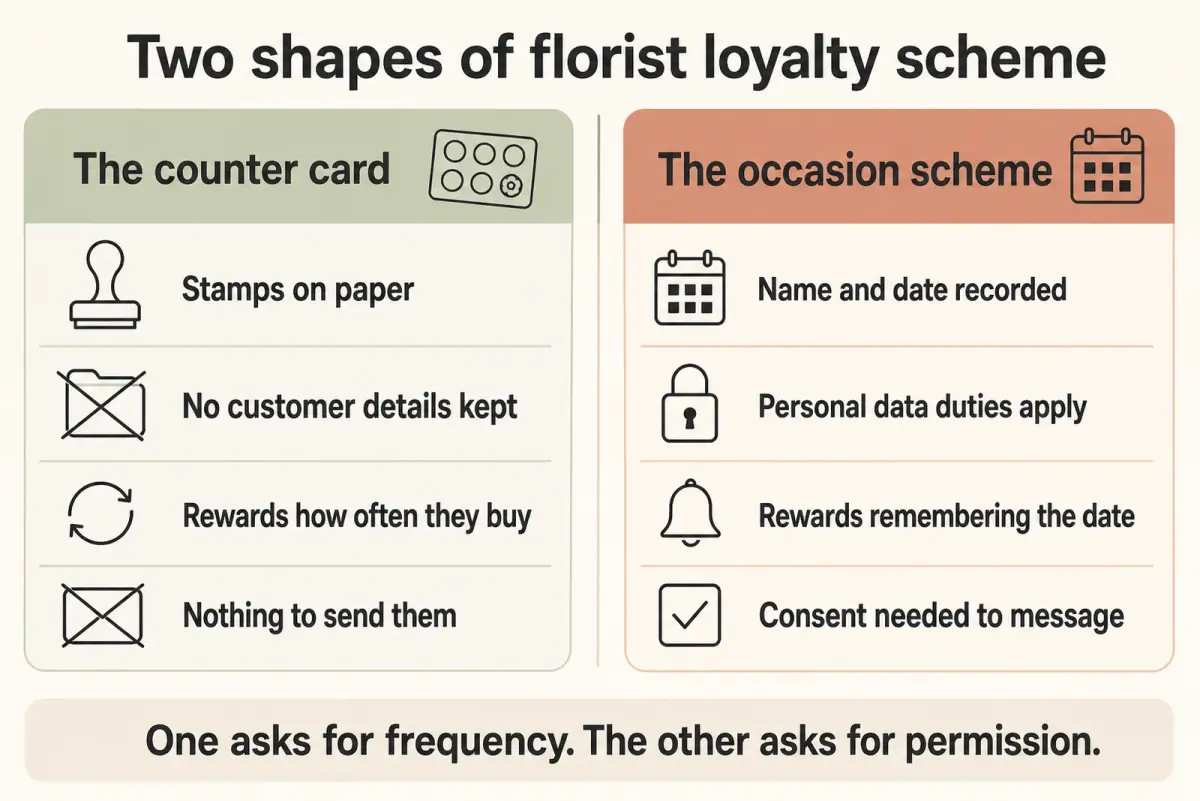
One asks your customers for frequency they may not have. The other asks only for permission.
The familiar formats, sorted by which shape they really are:
- Stamp card. Buy a set number, get one free. Records nothing, understood instantly, rewards frequency.
- Points on spend. Rewards value rather than visit count, so it has to hold details.
- Regulars' perk. A standing benefit for members, such as first refusal on a delivery slot.
- Tiers. Better perks for bigger accounts. Sensible for corporate work, overcomplicated over a counter.
- Occasion list. You keep the date, and the reward is a member price when they order for it.
Count your own weekly regulars honestly. If offices or a hotel reception nearby give you real weekly trade, a card is honest work. If your busiest weeks are the ones the calendar chose, it is decoration.
Imagine two customers on one Tuesday. The first collects a desk arrangement every Friday for the same reception and would fill a card by autumn. The second has bought twice, both for the same anniversary, and will still be on stamp two in four years.
What does an occasion scheme owe your customers?
More than a stamp card does, because writing down a name and a date means you are holding personal information. Two things follow: a data protection fee to check, and a rule about what you may send them.
ICO guidance states that under the Data Protection (Charges and Information) Regulations, organisations, including sole traders, that use personal information need to pay a data protection fee to the Information Commissioner's Office unless they are exempt. Check your own use against the ICO's published exemptions.
Then the messages. ICO guidance on the PECR electronic mail marketing rules states you must not send marketing emails or texts to individuals without specific consent. The exception is an existing customer who bought, or negotiated to buy, a similar product or service from you in the past, and to whom you gave a simple way to opt out both when you first collected their details and in every message you have sent.
In counter terms: ask, and write down what they said. A tick on the order pad tells you later whether a reminder was invited. Then keep the fields to the job. Our rule of thumb is that a reminder list needs four things:
- the customer's name
- one contact route, the one they said they wanted
- the date
- what they bought last time
Not the recipient's address or the card message, which belong on the order. Move only those four into a spreadsheet or an email tool, and check its current account and data settings first.
How should you word the reward?
So the condition sits where the offer sits. Free carries a legal meaning, and a reward that needs nine full price purchases behind it or a minimum spend on the day is a conditional offer rather than a gift.
The word carries a legal test. Paragraph 23 of Schedule 20 to the Digital Markets, Competition and Consumers Act treats it as unfair in all circumstances to describe a product as gratis, free, without charge or similar if the consumer has to pay anything other than the unavoidable cost of responding to the commercial practice and of collecting or paying for delivery of the item.
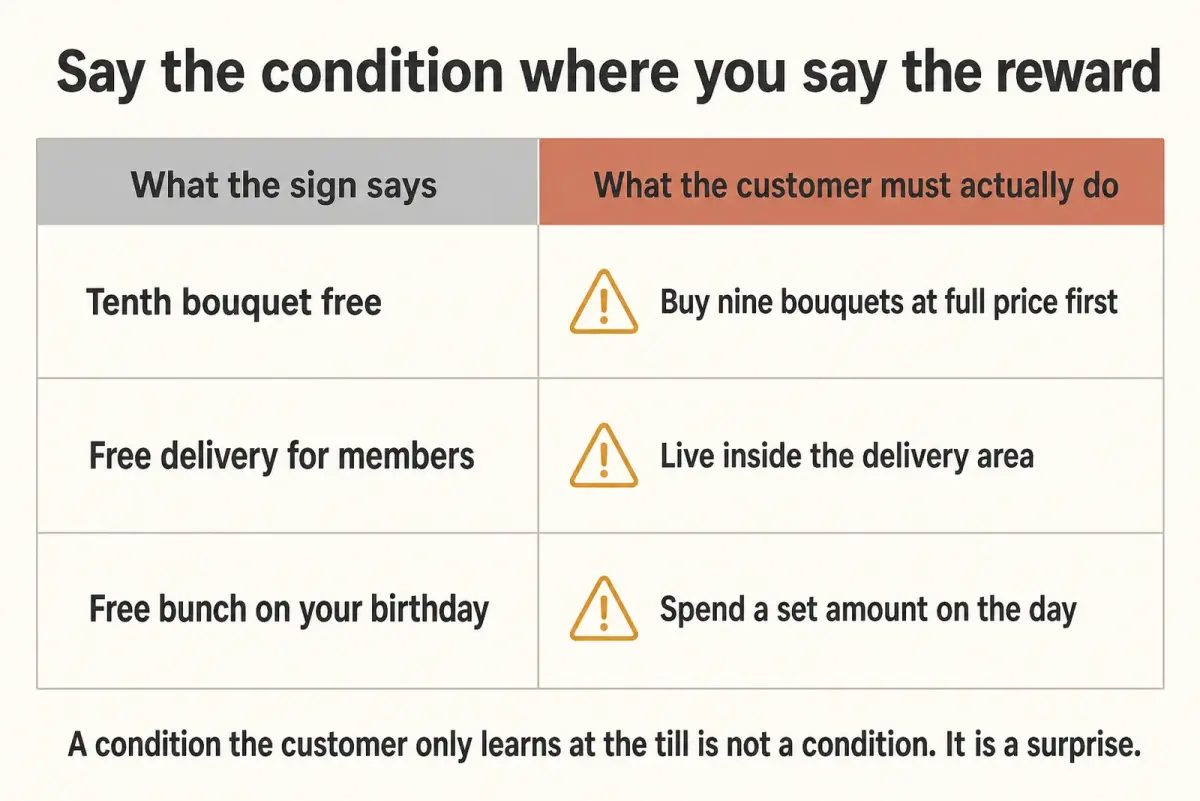
The trouble is not the reward on the left. It starts when the right hand column only appears at the till.
Free is not a tone of voice. It is a description, and a description has to be accurate.
So if the reward has strings, print the strings, and our house rule is to print them in the same size as the promise. Then size the reward against your own numbers: it has to feel worth having and still leave the purchases behind it profitable, which is a margin question first.
How do you launch it and keep it running?
By asking every customer, in one sentence, at the moment they are happiest with you, which is while you are wrapping.
The line matters less than the habit, but it should say what will arrive. Something like: would you like me to note the date, and I will send a reminder nearer the time, which you can stop whenever you like. Promise only what you will do.
Pick a lead time you can deliver on and treat your first choice as an experiment rather than a rule. Too early is noise. Too late reminds someone of a date they have already missed.
Then make it visible where people already look: the counter, the order confirmation, the window before a big date. Planning those posts is what LocalBrandHub is built for, with a social calendar and ready made seasonal campaigns. The scheme itself stays with you.
How do you know whether it is working?
Count the two numbers the scheme itself produces: how many customers joined, and how many claimed a reward. The gap between them is the finding, but it cannot say why: out of reach and not worth having look identical in a count. Ask the members who never claimed.
Be honest about what your records can answer. A stamp card cannot tell you whether members spend more than everyone else, because it never recorded what anybody spent. That answer needs the sale sitting beside the name in your till, a bigger decision than a loyalty card.
Judge it across a full run of your selling occasions. A date driven scheme looks asleep in November and busy in February for reasons unrelated to your design.
A loyalty scheme is not a discount you hand out. It is a promise to remember something, and remembering is the cheapest thing in your shop.
Frequently Asked Questions
What is a good loyalty programme for a florist?
The one that matches how your customers buy. Real weekly trade from offices nearby makes a stamp card cheap and honest. Customers who appear two or three times a year for named occasions are better served by a scheme that remembers those dates.
Do I need to register with the ICO to run a florist loyalty scheme?
It depends on whether you keep customer details. A paper card carrying nothing but stamps holds none. Once you record names, contact details and dates, ICO guidance states that organisations, including sole traders, that use personal information need to pay a data protection fee unless they are exempt.
Can I text or email customers about their loyalty rewards?
Only with the right permission. ICO guidance on the PECR electronic mail marketing rules states you must not send marketing emails or texts to individuals without specific consent, unless they are an existing customer who bought a similar product or service from you and you gave them a simple way to opt out both when you collected their details and in every message.
Are loyalty cards worth it for florists?
They are cheap and instantly understood. The catch is that a card rewards frequency, so for someone who buys twice a year the reward sits out of reach. Cards suit counter regulars, not occasional buyers.
How should I word a free bouquet offer?
Put the condition next to the promise. Our house rule is to print it in the same size. Paragraph 23 of Schedule 20 to the Digital Markets, Competition and Consumers Act treats describing a product as gratis, free, without charge or similar as unfair in all circumstances if the consumer has to pay anything other than the unavoidable cost of responding and of collecting or paying for delivery of the item.
Where to start this week
Key Takeaway
Read the next fortnight of orders as dates rather than sales. That tells you in an afternoon which shop you are running, and the answer picks your scheme.
- Read a fortnight of orders as dates, not sales
- Pick the card or the diary, not both
- Write the reward and its condition on the same card
- Ask every customer while you wrap, and note what they said
The florist down the road sells the same flowers at roughly the same price. What they are almost certainly not selling is a shop that remembers the date without being asked.
For restaurants, salons, and local businesses
Need help with your marketing?
We help UK businesses turn social media into real results, not busywork.
Start freeSources
Get More Marketing Tips
Practical marketing tips for UK business owners, straight to your inbox. No spam, unsubscribe anytime.
About the Author
Local Brand Hub
Empowering UK Businesses
Local Brand Hub provides comprehensive business management tools designed specifically for UK local businesses to streamline operations, automate marketing, and grow revenue.
More articlesRelated Articles
 Marketing Tips
Email Marketing for Florists: A UK Flower Shop Guide
Email marketing for florists that drives repeat orders and peak-day pre-sales: a UK guide to building a list and sending emails customers actually open.
 Marketing Tips
Wedding Flower Consultation: The Florist's Question Sheet
How to run a wedding flower consultation that ends in a quotable list of pieces, with a copyable question sheet to send couples before you meet.
 Marketing Tips
Florist Pre Orders: Run One Round Without the Panic
Florist pre orders for UK flower shops: when to open the round, what the order page has to settle, how to date the cut off, and how to fill the list.