A subscription sells a delivery round, not a bouquet. How UK florists build tiers, price the drop, handle the cancellation rules and see VAT coming.
A flower subscription business sells a standing order for fresh flowers: the customer signs up once, receives a bunch on a set schedule and pays automatically each cycle. It pays when the price covers the cost of every drop, not just the first, and when subscribers stay long enough to repay the effort of winning them.
Here is the part the sales pages skip. When somebody subscribes you have not made a sale. You have agreed to run a delivery round, on a wet Friday in February, for a person who has already paid and is therefore already owed. Every good thing a subscription does for you comes out of that commitment, and so does everything that goes wrong.
Is a flower subscription business actually profitable?
It can be, and no article can tell you, because the answer lives in your delivery round rather than in the industry. The sign-up is the cheap part. Everything after it has a stem cost, a making time and a van in it, repeating on a schedule you have promised to keep.
Work one tier through on your own numbers. Five figures, and you already have four: stems and foliage, wrap and packaging, the minutes it takes to make, and the fuel and driving time for the round it goes out on. The fifth is the honest one, which is how many drops share that round, because the van cost only divides down when the round is full.
A round with four drops on it is not a subscription business. It is a favour with a direct debit attached.
Two shops sell the identical bunch at the identical price. One drops twelve boxes down three streets in under an hour. The other drives forty miles for the same twelve. Same revenue, one business.
This is why the same bunch at the same price is profitable in one town and quietly ruinous in the next. Density does the work, not the flowers, which is worth remembering against what florist profit margins look like.
What should a flower subscription tier look like?
Three decisions, and no more: how often it arrives, how big it is, and how long they are committing for. Each combination you offer is another delivery round to plan, so a tidy range of three beats a clever range of nine.
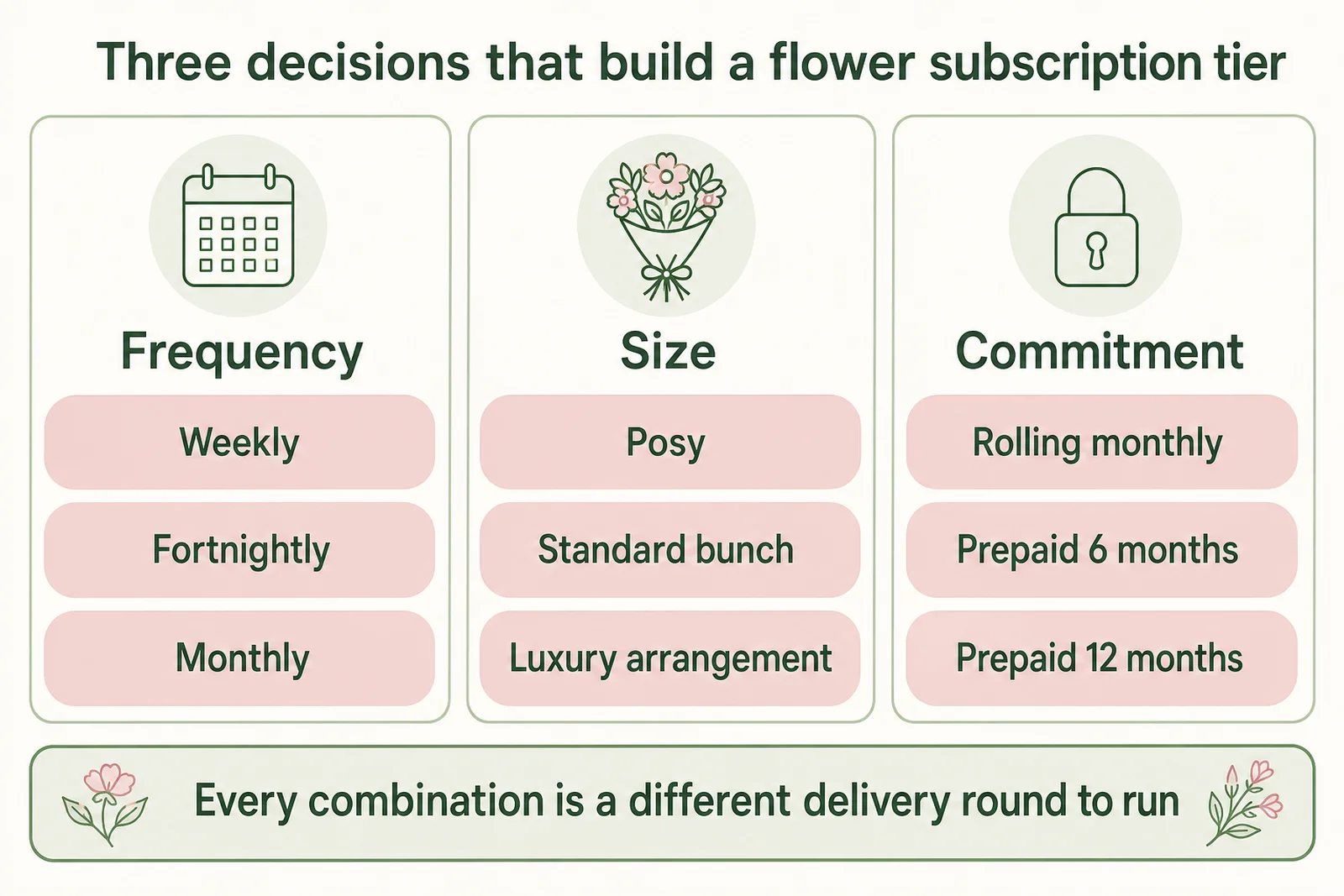
Each cell in that grid is a different round to drive, not a different line on a menu.
- Frequency. Weekly, fortnightly or monthly. This one decides your week.
- Size. Posy, standard bunch, luxury arrangement. Keep the steps visibly different or nobody trades up.
- Commitment. Rolling monthly for the household, prepaid 6 or 12 months for the gift buyer. Different customer, different reason.
Launching with one option? Start with a monthly standard bunch, because one round a month is the version you can still run in wedding season. Treat that cadence as a starting experiment and move it once you can see which weeks your round has room in. Reception contracts are a different animal, covered in office flower subscriptions.
Imagine a shop opening with three frequencies, in three sizes, rolling or prepaid. Eighteen possible subscriptions, and by March three delivery days serving a handful of people each. Profitable on paper, none of it worth the diesel.
How should you price a flower subscription?
Price the drop, not the sign-up. Every delivery has to carry its own flowers, wrap, making time and mileage, because unlike a one-off you cannot absorb it once and move on. Then leave headroom for VAT: a growing subscriber base is turnover heading towards the registration threshold.
Imagine a bunch that costs eight pounds in stems, a pound in wrap and fifteen minutes to make, going out on a round whose driving hour and fuel split ten ways. The price has to clear all of that, pay you for the fifteen minutes, and still leave room for the day VAT arrives. The figures are invented. The order you put them in is not.
The tax part catches people out. HMRC's VAT Notice 701/38 states that seeds, plants and cut flowers which are bought for their ornamental effect are generally standard-rated for VAT. Subscription income is ordinary taxable turnover, and GOV.UK states that you must register if your total taxable turnover for the last 12 months goes over 90,000 pounds.
Why this matters: counter trade is a guess, but a subscriber base is arithmetic: tier price times headcount times the cycles in a year. That will not date the threshold on its own, because your counter takings count towards it too. It is simply the part of the total you can see coming rather than discover.
So decide now, while the base is small, whether the advertised price still works once VAT sits inside it. Raising the price on hundreds of people who already agreed to it is a harder conversation than setting it two pounds higher today.
What do the UK rules actually ask of a flower subscription?
Two different things, because your subscription is two things at once. The order is sold at a distance and carries a cancellation right you must tell people about. The flowers inside it are perishable goods, which GOV.UK treats differently on refunds. The two are easy to get backwards.
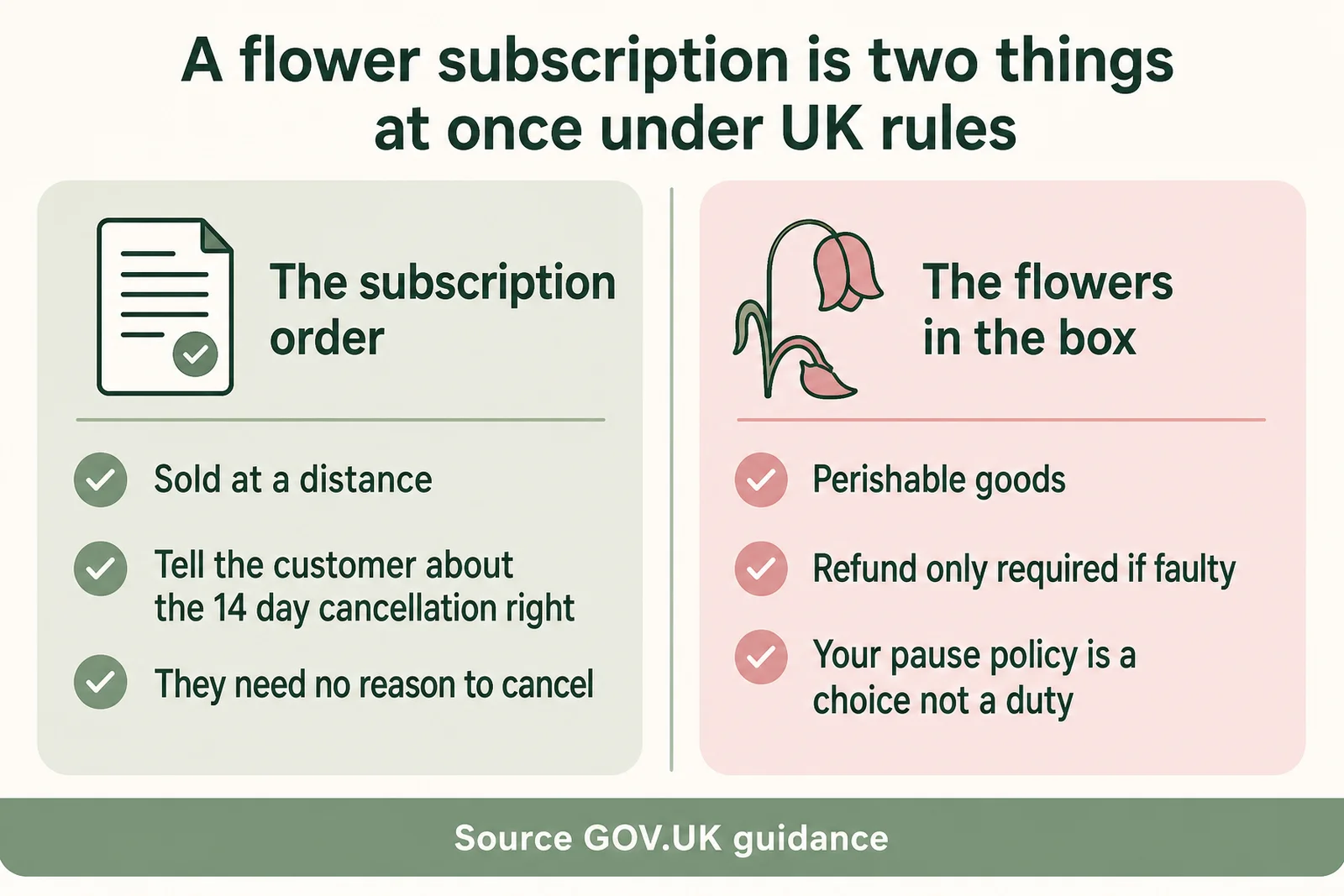
One column is a duty. The other column is your choice, and it is worth knowing which is which.
The order. GOV.UK's distance selling guidance states that you must tell the customer they can cancel their order up to 14 days after their order is delivered, and that they do not need to give a reason. The guidance sets the telling, not the format. Doing it at sign-up, in writing they can keep, is our recommendation rather than the rule.
The flowers. GOV.UK's guidance on accepting returns and giving refunds lists perishable items, for example frozen food or flowers, among the items where you only have to offer a refund if they are faulty.
Read those two together and the mix-up stands out. It is easy to write a generous box-by-box refund promise you never owed, then bury the cancellation terms in a footer nobody reads. The generosity is optional. The telling is not.
Do not assume the milkman exception covers you. The exceptions list on that same GOV.UK page includes food and drink supplied regularly (like milkmen). Flowers are not food and drink, so a weekly flower round is not obviously the same case. Get your terms looked at properly rather than borrowing a milk float's paperwork.
How do you keep subscribers past the third box?
By being boring on the dates and interesting in the wrap. Reliability is what they signed up for, variety is what keeps the box from reading as a repeat bill, and easy pausing is what stops a fortnight in Spain becoming a cancellation.
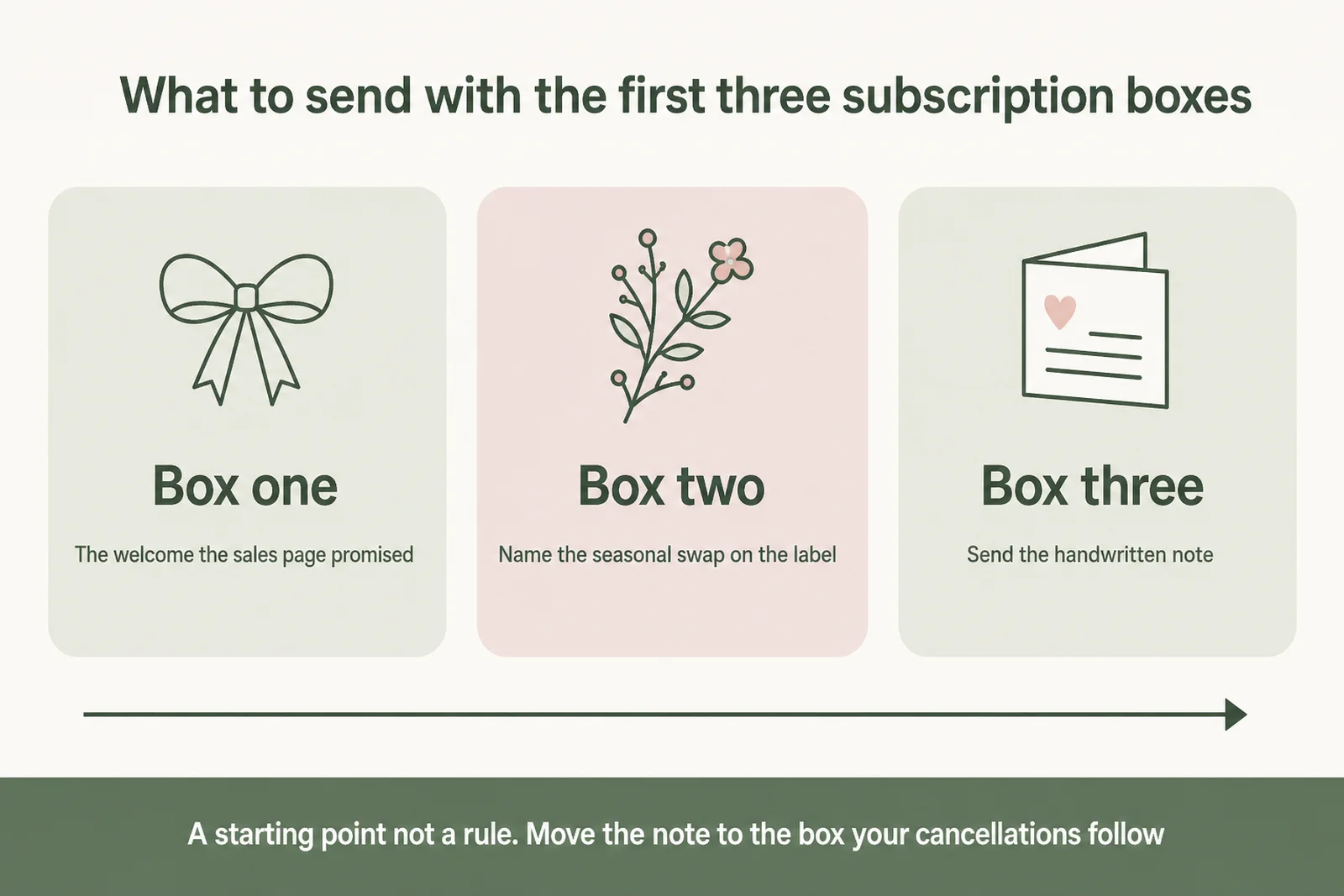
Box three is the one to watch, and the one to move if your own cancellations cluster elsewhere.
Make pause and skip a button rather than a phone call. For a customer who would otherwise have to explain herself to a human being, cancelling is usually the quicker exit.
Picture a subscriber off to Spain for a fortnight. If pausing takes two taps, you lose two drops. If it takes a phone call she keeps forgetting to make, you lose her.
Vary the flowers by season and say so. Nobody signs up for the same gerberas forty times over, and the seasonal swap is a free story every month, and the easiest thing to build reminder marketing around.
Then watch the third box. Box one is exciting, box two confirms it, and by box three a subscription has become either furniture or a line on a bank statement somebody is squinting at. Box three earns the handwritten note. That is a starting point rather than a law, so move it to whichever box your own cancellations cluster after.
Listing the tiers properly and putting the launch offer in front of the customers you already have is the sort of job LocalBrandHub is built for.
Frequently Asked Questions
Is a flower subscription business profitable?
Nobody can tell you from the outside, because the answer lives in your round rather than in the industry. Cost one tier out: stems and foliage, wrap and box, the minutes it takes to make, and the fuel and driving time for the whole round divided by the drops on it. A subscription that only clears on a full van loses money the moment the round thins out.
How much should a flower subscription cost?
Enough to cover the flowers, the wrap, your making time and the delivery for that drop, with room left for the VAT you may one day have to charge. There is no correct national figure. A rural round of eleven miles between drops and a dense town round of six streets have different economics for the identical bunch.
Do I have to let flower subscription customers cancel?
You have to tell them about their cancellation right. GOV.UK's distance selling guidance states that you must tell the customer they can cancel their order up to 14 days after their order is delivered, without giving a reason. GOV.UK's returns guidance separately lists perishable items, for example frozen food or flowers, among the items you only have to refund if faulty.
Do I need to charge VAT on a flower subscription?
Not until you are registered, and subscription income counts towards getting there. HMRC's VAT Notice 701/38 states that seeds, plants and cut flowers bought for their ornamental effect are generally standard-rated, and GOV.UK states that you must register once taxable turnover for the last 12 months goes over 90,000 pounds.
How do I get my first flower subscription customers?
Ask the people who already buy from you every few weeks, by name, at the counter. They have proved they want flowers regularly, so the sign-up formalises a habit rather than starting one. Offices on your route are the second call, because they add drops to a round you already drive.
Where to start this week
An hour is enough to start a flower subscription properly. Spend it on the first three lines below.
- Pick ONE tier. Monthly, standard bunch, rolling
- Cost that box out honestly, mileage included, and price above it
- Map the round onto streets you already drive
- Check the price still works once VAT sits inside it
- Write the cancellation information the rules ask for
- Decide your own pause, skip and refund policy, and say it plainly
Key takeaways
Key Takeaway
A flower subscription is a delivery round you have promised to run. It pays when the round is dense, the price carries every drop, and the terms say what the rules ask.
- Price the drop, not the sign-up. Density beats volume, so ten subscribers on three streets beat ten across a county.
- Three decisions build a tier: frequency, size, commitment. Start with one.
- Tell them about the cancellation right, then choose your own refund generosity. And watch the VAT threshold arrive, because a subscriber base is income you can add up in advance.
Pick one tier this week and offer it out loud to ten regulars by name. A subscription business is not launched. It is asked for.
For restaurants, salons, and local businesses
Need help with your marketing?
We help UK businesses turn social media into real results, not busywork.
Start freeSources
- GOV.UK - Online and distance selling for businesses (Right to cancel)
- GOV.UK - Accepting returns and giving refunds: the law (When you do not have to offer a refund)
- GOV.UK - Register for VAT (If you exceeded the threshold in the last 12 months)
- HMRC - Seeds and plants that can be zero-rated (VAT Notice 701/38), paragraph 2.1
Get More Marketing Tips
Practical marketing tips for UK business owners, straight to your inbox. No spam, unsubscribe anytime.
About the Author
Local Brand Hub
Empowering UK Businesses
Local Brand Hub provides comprehensive business management tools designed specifically for UK local businesses to streamline operations, automate marketing, and grow revenue.
More articlesRelated Articles
 Business Growth
Best Website Builder for Florists: A UK Comparison
The best website builder for florists, compared for UK flower shops: Squarespace, Shopify, Wix and WordPress weighed up on galleries, ordering and budget.
 Marketing Tips
Florist Pre Orders: Run One Round Without the Panic
Florist pre orders for UK flower shops: when to open the round, what the order page has to settle, how to date the cut off, and how to fill the list.
 Marketing Tips
Christmas Flower Sales: The Florist's December Plan
Christmas flower sales for florists: set your festive range, workshop and pre-order dates, price against current stock costs, and pick your December hours.