
Office flower subscriptions are a delivery round, not a bouquet. How UK florists set the cadence, price the route and deal with last week's flowers.
An office flower subscription is a standing weekly or fortnightly delivery of fresh arrangements to a workplace, invoiced on business terms. For the florist it is a delivery round rather than a product: the cadence, the delivery day and how tightly the drops cluster decide whether it earns anything.
The flowers you set on that reception desk on Tuesday will be properly looked at by roughly four people, and you could name them: the office manager who approved you, two couriers waiting on a signature, and whoever shifts the vase to reach the visitor book.
Nobody falls in love with a Tuesday delivery.
None of that is an argument against office work. It is the argument for building it like a milk round rather than a shop window: the building will barely notice you for fifty weeks and pay you anyway, which is a different relationship entirely, and a steadier one.
Winning the account is its own craft, covered in Corporate Florist: Winning Accounts That Actually Pay. This is what you deliver after the yes.
Related: Corporate Florist Pricing Explained
What is an office flower subscription?
A standing order for fresh flowers in a workplace: a reception arrangement each week, or a set of reception, boardroom and desk pieces, delivered on an agreed day for a fixed recurring price. You normally take the previous delivery away too, and that swap is what separates it from a flower box.
Three shapes cover nearly all of it: a single reception piece in a container you own, a set of four or five across a floor, or a larger display changed fortnightly with a tidy in between.
You are not posting flowers to a customer. You are entering a building on a schedule, putting something down and picking something up. That is where office subscriptions go wrong, not in the design.
An office subscription is not a bouquet with a payment plan. It is a cleaning contract that happens to be beautiful.
Why the round decides the money, not the arrangement
Two accounts at the same weekly price can be worth wildly different amounts, because the expensive part of an office subscription is the journey rather than the stems. Route density, not stem choice, turns standing orders into a morning that pays for itself.
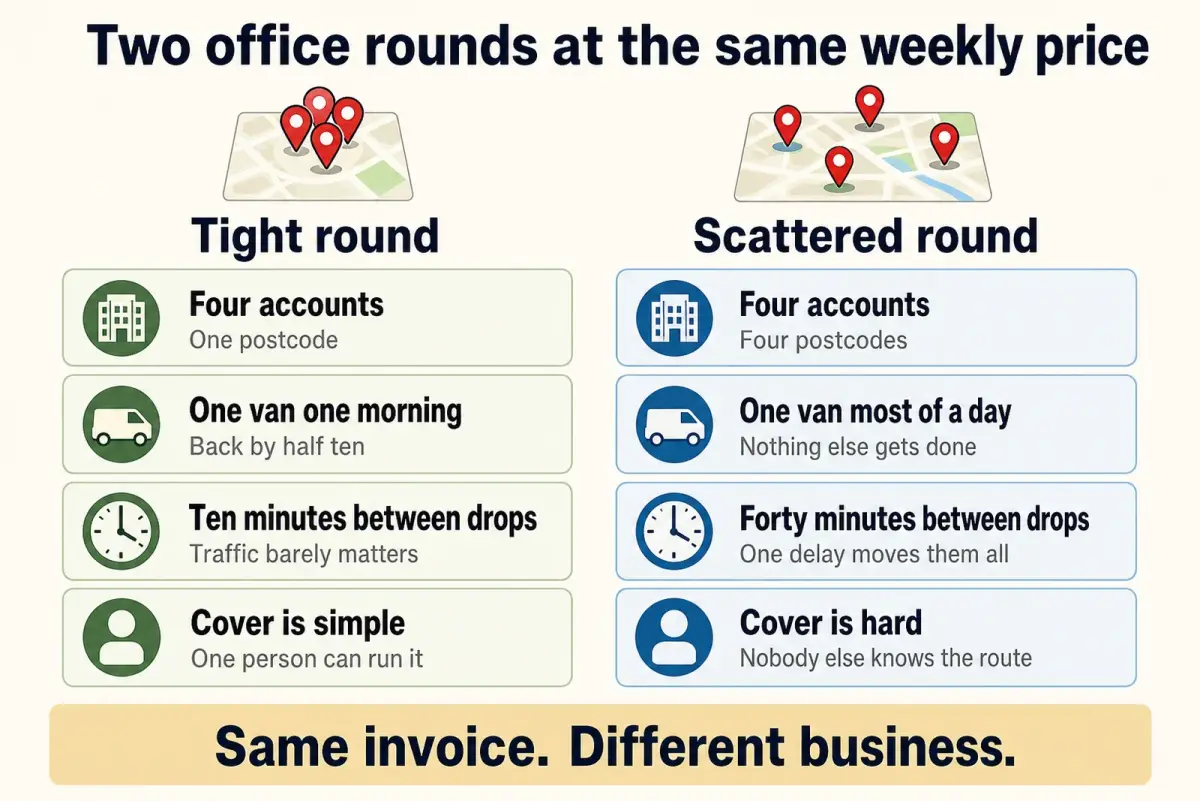
Same invoice, different business. The scattered round can cost a working morning, every week of the contract.
The arrangement is what they look at. The route is what you sell.
Treat that as a model of the work rather than a measurement of it: it earns its keep by predicting failures that never reach a costing sheet. Sign a fifth account across town and you have bought an hour a week for as long as it lasts: across fifty deliveries, more than a working week of somebody's time, never invoiced.
So map your prospects before you quote, and price the round rather than the arrangement. Four costs belong in a weekly figure and are easy to leave out:
- The journey. Not fuel. A trained person's time, and the drop itself is the short part of it.
- Cover. Somebody runs this round when you are ill, and will be slower at it.
- Containers. The vases are yours and they live in other people's receptions: twenty accounts means forty in circulation, because one is always out while the other is refilled, plus chips, losses and the one a cleaner put in a cupboard.
- The bad week. The February when your usual stems are unavailable and it has to look the same anyway.
Recurring revenue also makes turnover legible in advance, which counter trade rarely does. GOV.UK says you must register for VAT if your total taxable turnover for the last 12 months goes over £90,000, or if you expect it to go over £90,000 in the next 30 days. The test looks at the whole business rather than the subscription line, and standing orders are the part of a florist's income you can honestly forecast. Better seen six months out than met in an accountant's email.
Which day should you deliver?
Pick the day the building is actually busy, and ask rather than guess. The delivery day is part of the offer: a reception display works on the people who walk past it, and the modern office is not equally full all week.
The Office for National Statistics reported that more than a quarter (28%) of working adults in Great Britain hybrid worked between January and March 2025, meaning they both worked from home and travelled to work within the same seven days.
That is a share of workers across Great Britain, not a headcount for your client's third floor, so it describes the problem rather than answering it. What it justifies is two questions on every pitch:
- which day is the building at its fullest
- when do visitors and client meetings come in
Picture two accounts on one street paying the same money. One is a serviced office whose tenants come in for a Tuesday all hands; the other an accountancy whose partners are in on Thursdays for client work. Delivering both on Monday suits exactly one person, and it is you.
Cadence deserves the same honesty. Fortnightly is truthful only if the stems hold a fortnight in a room heated to twenty two degrees with the blinds open. Start from what the flowers can do, and treat your first season as an experiment.
What happens to last week's flowers?
The dying arrangement you carry out of somebody else's building is a waste question rather than a tidiness one. GOV.UK's business waste rules put duties on the client whose premises it leaves and on whoever transports it, so settle where your round sits early.
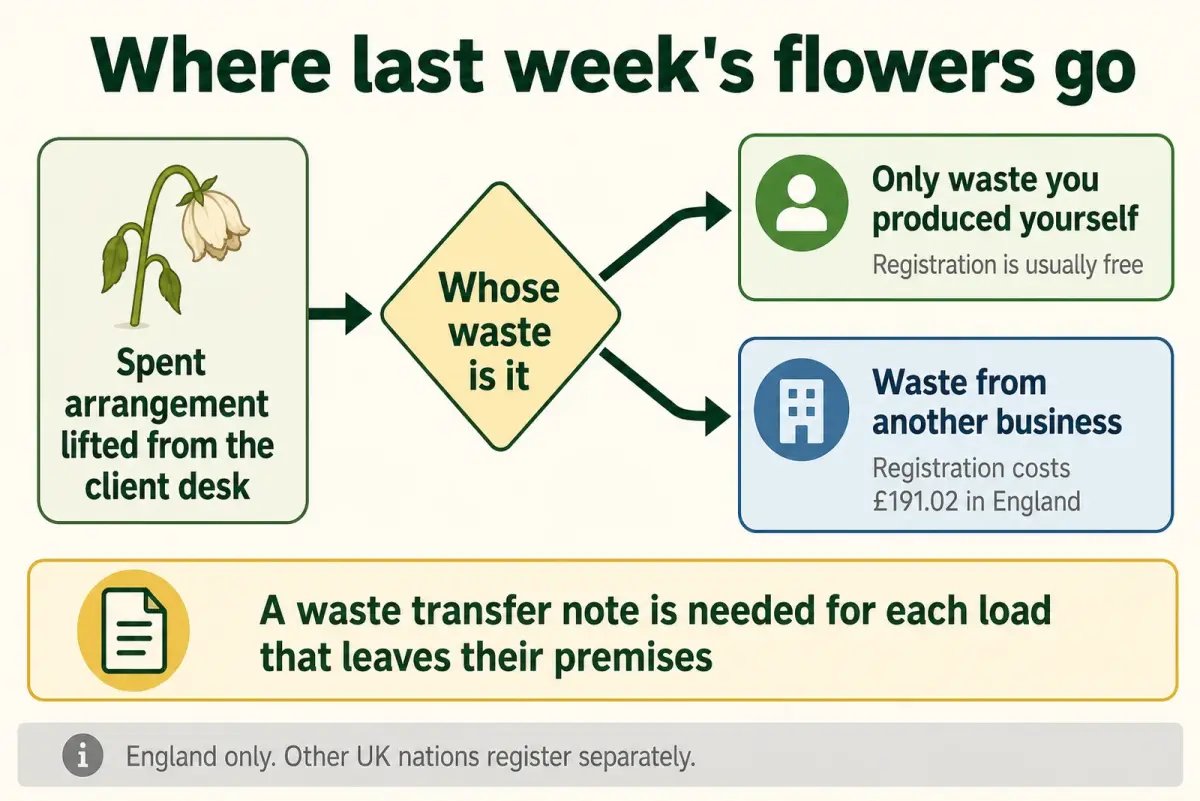
The question nobody asks until a facilities manager asks it first.
Two rules sit either side of that swap:
- Theirs. GOV.UK's guidance on disposing of business or commercial waste says a business must complete a waste transfer note for each load of waste that leaves its premises, and must check if its waste carrier is registered to dispose of waste. On your Tuesday round the premises are the client's, which is why a facilities manager may one day ask you for paperwork you have never produced.
- Yours. In England, GOV.UK's waste carrier registration service says registration is usually free if you only transport waste you produce yourself, and costs £191.02 otherwise. Scotland, Wales and Northern Ireland run their own registration schemes, so treat that as the England figure and check the one you trade under.
Whether spent flowers lifted from a client's desk are your waste or theirs is exactly what those rules turn on, and neither page settles it for a florist's round. Ask the Environment Agency or your council, and get an answer you can point at.
A cheaper design, worth knowing before you promise removal to twenty accounts: leave the spent arrangement for the client's own collection, and take back only the container.
Why office accounts end, and what to do about it
Bad deliveries can lose an account, but that is rarely how these endings arrive. They usually show up at a budget review, an office move or a change of office manager, and the first sign is silence rather than a complaint.
The person who approved you has no strong feelings about ranunculus. They have a supplier list, a spending line, and a meeting where somebody senior asks what all of this is for. Your defence is not a prettier arrangement; it is being a name they can attach to a reason.
- Ask when the budget is set, and be visible in the fortnight before it.
- When your contact leaves, introduce yourself to whoever inherits the desk.
- Put a line in with the delivery once a month: what is in the vase, and why it suits the season.
Retention goes further in Florist Customer Retention; a doorstep offer for consumers is a different animal, covered in How to Start a Flower Subscription Business.
Dull flowers rarely lose an account. Being forgotten does.
Frequently asked questions
Are office flower subscriptions worth it for a florist?
They are worth it when the drops cluster. A subscription's value is the route it sits on, not its weekly price: a scattered round eats a morning for the invoice a tight one earns in an hour.
What do I do with the flowers I take away?
Decide it deliberately, because it is a waste question with rules attached. GOV.UK says a business must complete a waste transfer note for each load of waste leaving its premises and must check its waste carrier is registered. In England, waste carrier registration is usually free if you only transport waste you produce yourself and costs £191.02 otherwise. Ask the Environment Agency where your round sits.
How do I compete with national flower subscription brands for an office account?
Do not compete on the box. A national brand posts flowers to a building; you walk into it, take the dead ones out and answer the phone when the boardroom booking moves. Sell the swap and the named contact, because neither one fits in a parcel.
Do I need to charge VAT on office flower subscriptions?
It depends on whether your business is VAT registered, which is a question about your whole turnover rather than your subscriptions. GOV.UK says you must register if your total taxable turnover for the last 12 months goes over £90,000, or if you expect it to go over £90,000 in the next 30 days.
What to do this week
- Put every office prospect on one map, and find the mornings that already exist.
- Ring the Environment Agency or your council, and settle your removal policy.
- Count your containers, and price their replacement into the weekly figure.
- Ask your next prospect which day their building is fullest, before you offer a day.
Then put your subscription options where people can find them. Keeping products and offers current takes minutes in LocalBrandHub.
Key takeaways
Key Takeaway
- An office flower subscription is a delivery round, and the round is what you are pricing.
- Route density decides the margin: two accounts at one price rarely earn the same.
- Ask which day the building is full, then deliver into it.
- The flowers you take away carry GOV.UK duties. Settle that first.
For restaurants, salons, and local businesses
Need help with your marketing?
We help UK businesses turn social media into real results, not busywork.
Start freeSources
Get More Marketing Tips
Practical marketing tips for UK business owners, straight to your inbox. No spam, unsubscribe anytime.
About the Author
Local Brand Hub
Empowering UK Businesses
Local Brand Hub provides comprehensive business management tools designed specifically for UK local businesses to streamline operations, automate marketing, and grow revenue.
More articlesRelated Articles
 Business Growth
Best Website Builder for Florists: A UK Comparison
The best website builder for florists, compared for UK flower shops: Squarespace, Shopify, Wix and WordPress weighed up on galleries, ordering and budget.
 Marketing Tips
Florist Pre Orders: Run One Round Without the Panic
Florist pre orders for UK flower shops: when to open the round, what the order page has to settle, how to date the cut off, and how to fill the list.
 Marketing Tips
Christmas Flower Sales: The Florist's December Plan
Christmas flower sales for florists: set your festive range, workshop and pre-order dates, price against current stock costs, and pick your December hours.