
Corporate florist work is a supply job, not a gift order. How UK florists win business flower accounts, set payment terms and check a client pays.
A corporate florist supplies businesses rather than individuals: weekly reception and desk arrangements, hospitality displays, event flowers and business gifting. The work is recurring, invoiced on terms and won on reliability, which makes it steadier than counter trade and a different sale entirely.
The woman who buys your office flowers has never once described them to a friend. She approved a supplier, put a line in a budget, and went back to chasing the fire alarm test. That is not a slight on your work; it is the whole opportunity, and it is the easiest thing in this trade to pitch straight past.
Counter trade asks you to be delightful forty times a day. A business account asks you to turn up at eight on a Tuesday with the same thing you brought last Tuesday, and to invoice in a way that clears finance without a phone call.
What does a corporate florist actually do?
Much the same floristry, sold on supply terms. Reception and desk arrangements refreshed weekly, displays for hotels, bars and restaurants, flowers for launches and awards evenings, and gifting sent on a company's behalf. The design is familiar. The delivery promise and the invoice are the new part.
Five kinds of work sit under the label, and they do not behave alike:
- Office subscriptions. A standing weekly arrangement for a reception, boardroom or desks.
- Hospitality contracts. Hotels, bars and restaurants, with scale and a watchful manager.
- Corporate events. Launches, conferences and awards nights, paid as one job.
- Business gifting. Flowers a company sends its clients or staff, often at no notice.
- Retail displays. Other local businesses who want their own space to look alive.
Three of them recur and two do not, which is the sorting that matters when you plan a week.
Picture a shop with two hotel accounts and one awards night in October. The hotels pay the rent; the awards night pays for the van. Confusing the two is how a good autumn becomes a thin January.
Why a corporate account is a facilities purchase
The buyer is purchasing upkeep, not a present. Office flowers sit in the same mental drawer as the coffee order and the window cleaner: approved once, renewed largely by inertia, reviewed when budgets tighten. That changes what wins the account and what quietly loses it.
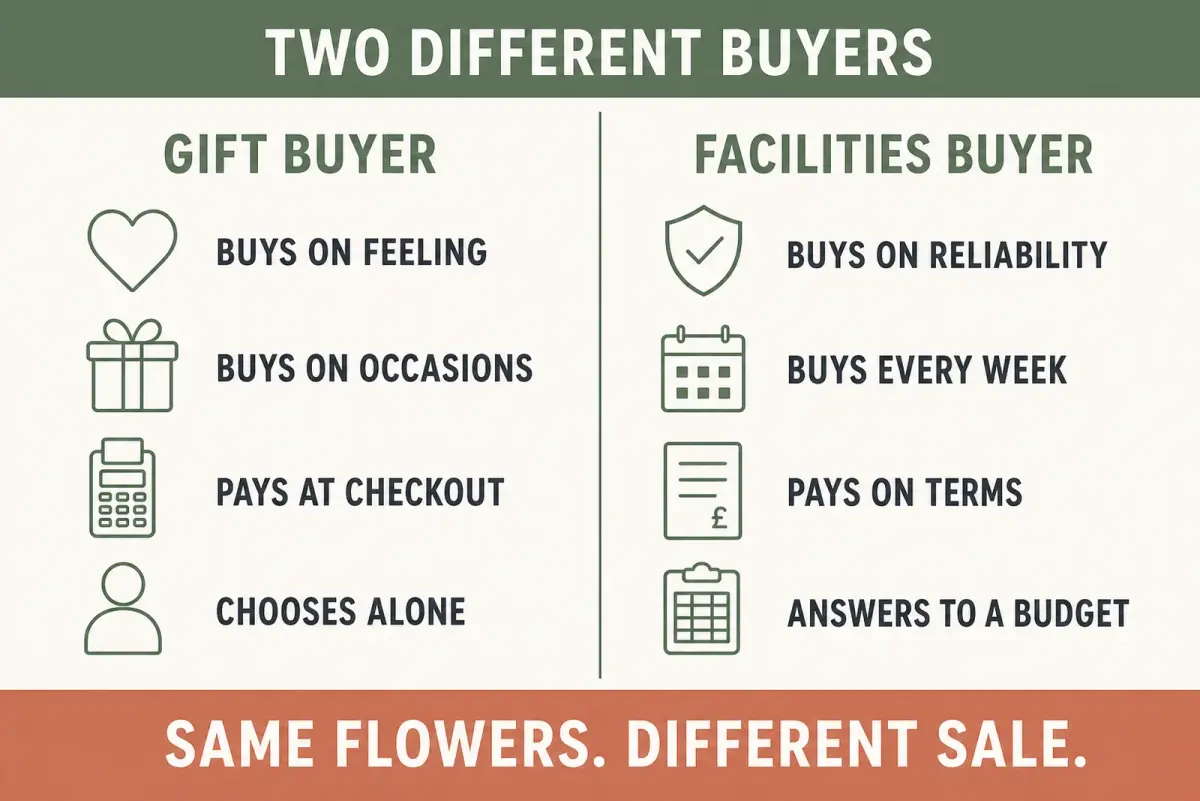
Same flowers, different sale. The gift buyer chooses; the facilities buyer approves and then stops thinking about it.
Imagine two calls on the same Monday. One asks for something beautiful for a retirement. The other asks whether you can still make Tuesdays. Only one of those callers is buying a supplier.
Nobody ever cancelled the window cleaner because the mop lacked flair. They cancelled because the invoices were awkward, or he missed a fortnight in March, or somebody drew a line through that row of the spreadsheet. Flowers go the same three ways. That is a model of the buyer rather than a measurement of one, and it earns its keep by predicting failures that are never about design.
So what wins the account is dull and specific:
- a fixed delivery day and window
- a named person who answers the phone
- a plan for the fortnight you are in Crete
- an invoice carrying whatever reference their system wants, on the same date each month
A gift buyer chooses you. A facilities buyer approves you and then forgets about you, and being forgettable in that particular way is the product.
How do florists get corporate clients?
By reaching whoever owns the budget line at a moment when the supplier list is actually open. A move, a refit, a new reception, a new office manager or a supplier who let them down all reopen it. Cold approaches work, and they work far better when something has recently changed, because you arrive while the decision is still open instead of asking somebody to reopen it.
Your buyer is rarely who you pictured: an office manager or facilities coordinator, a hotel's front of house lead, or for events the marketing team. Trigger events are then the cheapest targeting a florist has, because you can see them from the pavement. Scaffolding, a new sign, an announced move: each says somebody is already re-deciding what the entrance looks like.
Picture the week a firm moves into a refurbished floor. Somebody is choosing the coffee, the plants and the cleaning that week, and the flowers are decided in the same conversation.
A wedding portfolio is the wrong document here. One page is enough:
- what arrives, on which day, inside which delivery window
- the weekly price, and what changes it
- who covers when you are ill
- the notice either side gives to stop
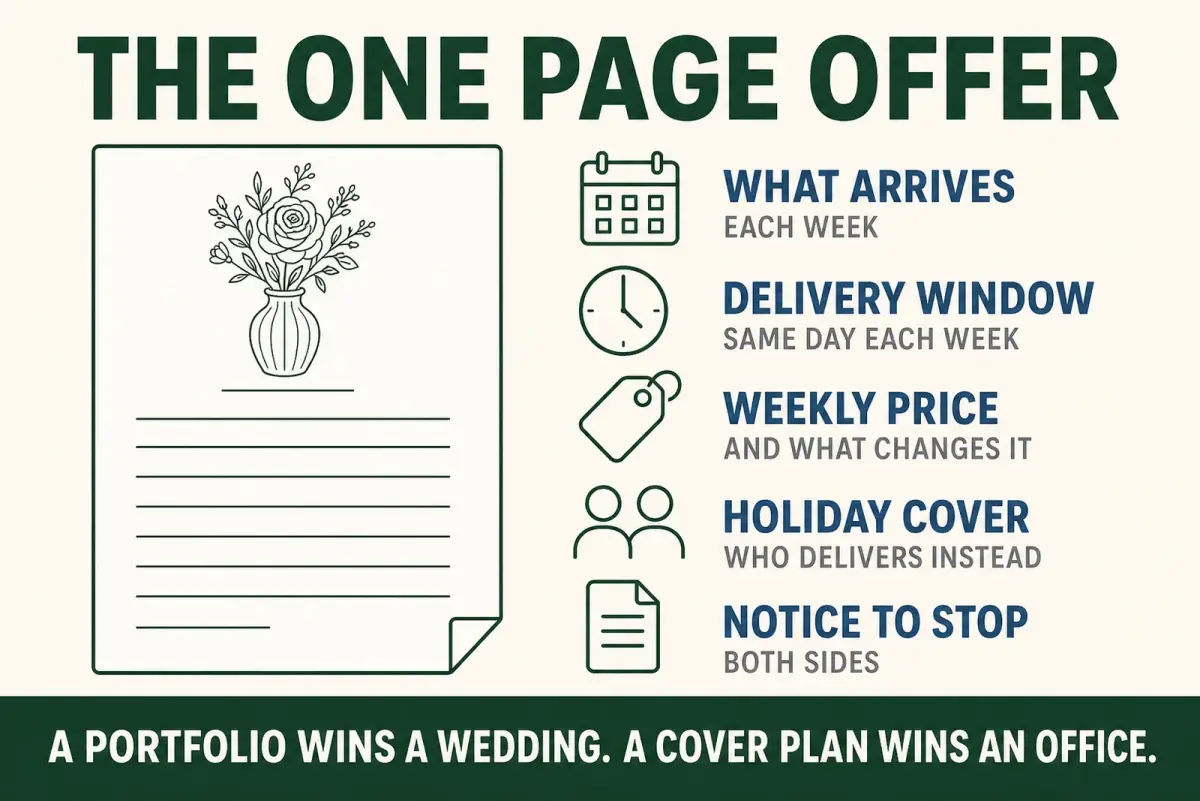
The whole pitch on one sheet. A portfolio wins a wedding; a cover plan wins an office.
What should the terms cover before you deliver?
Your terms have to name the delivery day and window, what happens when a stem fails early, who calls whom and the notice on both sides. Above all they have to name when you get paid, because payment timing is not boilerplate. UK law sets a default, and the default is later than the one in your head.
GOV.UK's guidance on late commercial payments says that where a payment date is agreed it must usually be within 30 days for public authorities or 60 days for business transactions, and that where no date is agreed the law treats the payment as late 30 days after the customer gets the invoice, or after you deliver, if that is later.
Read those as where the law lands when nobody decides, not as advice: nothing stops you proposing 14 days on a weekly account. Silence has a legal answer, and it is not next Friday.
What can you charge when a business pays late?
You can charge interest and a fixed recovery sum, both set in law, on top of the money itself. They are worth writing into the terms even if you never invoke them, because the sentence is unremarkable to a finance department and unwelcome to a company that was planning to sit on you.
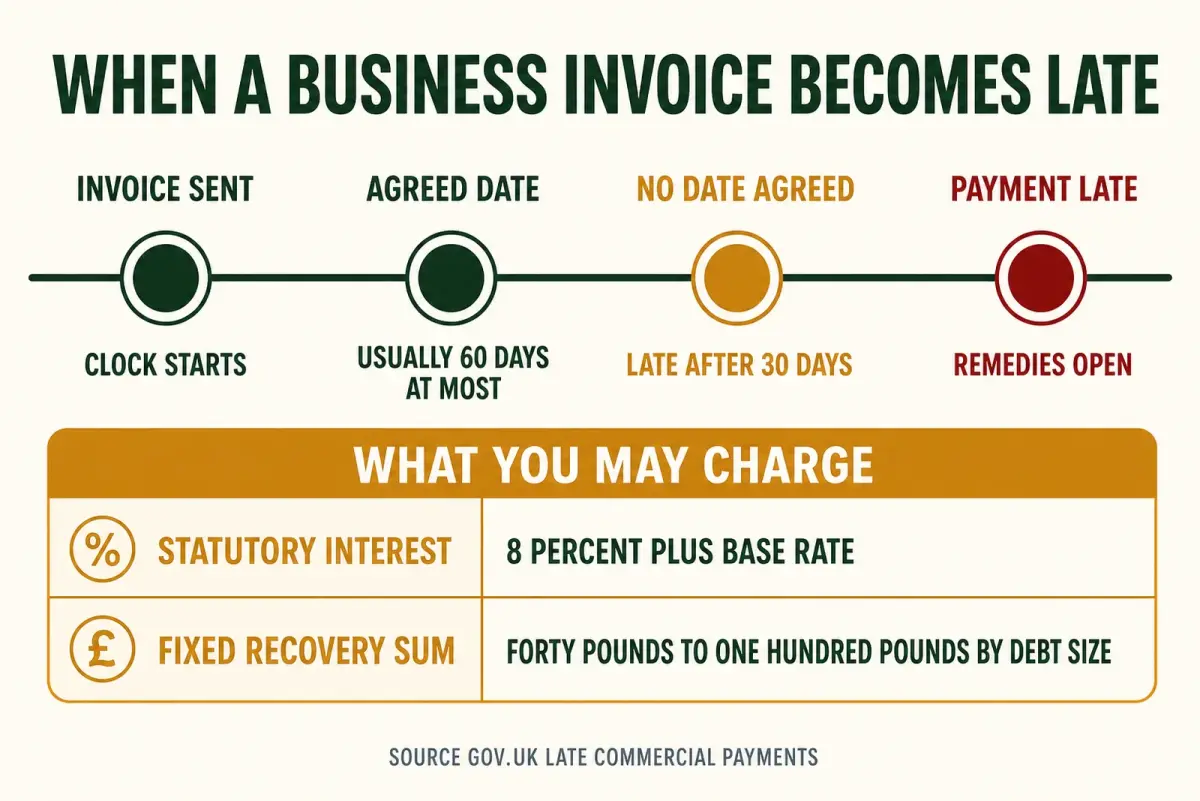
The GOV.UK rules as a timeline: where the default sits, and what becomes chargeable once it passes.
- Statutory interest. GOV.UK says the interest you can charge a business that is late paying for goods or a service is statutory interest, which is 8% plus the Bank of England base rate for business to business transactions, and that you cannot claim it where the contract sets a different rate.
- A fixed recovery sum. On top of interest you can charge a fixed sum for the cost of recovering the payment, set by late payment legislation at £40, £70 or £100 depending on the size of the debt, chargeable once for each payment.
Say an event invoice runs a month past its date. The interest is small change. The fixed sum is what makes the chasing worth the stamp.
Those are rights rather than a strategy. Interest is a rate, so on a small weekly invoice it comes to pennies, while the recovery sum is a flat £40 on any debt under £1,000. On the accounts a florist actually runs, the flat sum is the half that matters. Whether to invoke either on a client three days past the date is a relationship call, not a legal one.
Related: Corporate Florist Pricing Explained
How do you check a corporate client will pay?
Look a genuinely large company up before you sign anything: its payment record sits on a free GOV.UK service. A size test decides who has a report at all, so for a smaller client the check is older and simpler: ask who approves the invoice and when the payment run goes.
GOV.UK's Check when large businesses pay their suppliers service lets anyone search reports giving the average time a large business takes to pay its suppliers and the proportion of payments it does not pay on time. A large business there means a company or limited liability partnership with at least two of £54 million in turnover, £27 million on its balance sheet and 250 employees, and it must publish its reports at least twice a year.
Ten minutes on a free government website will not tell you whether a big client can pay. It tells you whether they do.
Who does that actually help? The hotel group, the national law firm, the developer wanting flowers in three receptions: they file, and ten minutes tells you whether you are about to become somebody's free credit facility. The accountancy above the bakery files nothing, and that absence says nothing about them.
For everyone else, ask what the report would have answered:
- who approves this invoice
- what day the payment run leaves
- whether they need a purchase order number, and who issues it
Picture two prospects worth the same weekly value. One is a serviced office whose manager says invoices go out on the 25th with a PO number. The other is an agency founder who waves a hand and says just send it over. Only one of them is money.
What corporate work does to your own numbers
It changes the shape of your turnover before it changes the size. Accounts arrive as steady monthly totals instead of seasonal spikes, which makes forecasting possible and makes the registration threshold something you watch approaching rather than trip over after a good February.
GOV.UK's Register for VAT guidance says you must register if your total taxable turnover for the last 12 months goes over £90,000, the VAT threshold, or if you expect to go over it in the next 30 days.
Steady money is not only nicer money. It is money you can see coming.
Rolling is the word that catches florists out: a strong Valentine's Day and a strong Mother's Day can land inside the same twelve months as a full year of ordinary trade.
Imagine a shop with £62,000 of taxable turnover from the counter, funerals and a few weddings. Add a handful of small accounts billing £150 a week between them and the rolling twelve month total sits close to £70,000. Two more of that size and the threshold stops being theoretical.
Nobody browses their way to a flower contract, but a buyer who has your name will look you up before they ring it. LocalBrandHub is where we keep that side tidy: a social calendar, a products and offers page you can keep genuinely current, and a visibility score that tells you how easily a nearby buyer finds you.
Frequently asked questions
What does a corporate florist do?
Supplies businesses rather than only individuals: weekly reception and desk arrangements, hotel and restaurant displays, event flowers and gifting sent on a company's behalf. The delivery promise, the invoice and the named contact are the new part, and what the buyer is shopping for.
How do florists get corporate clients?
By reaching whoever owns the budget line, usually an office or facilities manager, at a moment when the supplier list is genuinely open. A move, a refit, a new office manager or a supplier who let them down all reopen it, which is why a cold approach lands far better just after something has changed.
What payment terms should a corporate florist ask for?
Ask on purpose. GOV.UK guidance on late commercial payments says an agreed payment date must usually be within 30 days for public authorities or 60 days for business transactions, and that with no date agreed the payment is late 30 days after the customer gets the invoice or after you deliver, whichever is later. A fallback, not a target.
Can I charge a business for paying an invoice late?
GOV.UK says you can charge statutory interest of 8% plus the Bank of England base rate on a late business to business payment, unless the contract sets a different rate, plus a fixed recovery sum of £40, £70 or £100 by size of debt, once per payment. On a small account the fixed sum is the real money.
What flowers do corporate clients want?
Something that still looks deliberate on Thursday afternoon. A reception display is judged across a week rather than in a moment, so longevity and a shape that survives a cleaner moving it beat novelty. A hotel bar and an accountancy waiting room want opposite things from the same budget, so ask what the space is for first.
Key takeaways: corporate florist
Key Takeaway
Corporate florist work is the same craft sold into a different buying situation, and five things decide whether an account is worth keeping.
- You are selling upkeep, not a gift. Reliability, a named contact and a cover plan beat a portfolio.
- Time the approach to a change. A move, a refit or a new office manager reopens the supplier list.
- Decide the payment terms yourself. The legal fallback is later than it looks.
- Check the big ones before you sign. Large companies publish how quickly they pay, and the search is free.
- Watch the rolling twelve months. Steady accounts make the registration threshold visible early.
For restaurants, salons, and local businesses
Need help with your marketing?
We help UK businesses turn social media into real results, not busywork.
Start freeSources
- GOV.UK: Late commercial payments, charging interest and debt recovery
- GOV.UK: Late commercial payments, claim debt recovery costs on late payments
- GOV.UK: Late commercial payments, when a payment becomes late
- GOV.UK: Check when large businesses pay their suppliers
- GOV.UK: Register for VAT, when to register
Get More Marketing Tips
Practical marketing tips for UK business owners, straight to your inbox. No spam, unsubscribe anytime.
About the Author
Local Brand Hub
Empowering UK Businesses
Local Brand Hub provides comprehensive business management tools designed specifically for UK local businesses to streamline operations, automate marketing, and grow revenue.
More articlesRelated Articles
 Business Growth
How Florists Compete with Bloom and Wild (and Interflora)
How florists compete with Bloom and Wild starts by reading its delivery pages. What the post cannot carry, where Interflora fits, the result you can win.
 Business Growth
Florist Marketing Plan: A Simple Template for UK Shops
A florist marketing plan you'll actually use: a simple UK template and seasonal calendar to plan your flower shop's marketing around the peaks.
 Business Growth
Florist Marketing: How to Out-Local the Flower Chains
Florist marketing for UK flower shops: the three inputs Google says local results rest on, which tasks feed them, and why peak days start weeks early.