
Corporate florist pricing for UK flower shops: build a weekly ladder in net figures, quote businesses the right number, and put real terms behind it.
Corporate florist pricing works best as a fixed weekly ladder quoted net of tax, with delivery, account admin and cover for a failed drop built into every rung. Flowers by Flourish, a London florist, publishes office displays from a £30.00 display up to a £120.00 display. Quote a business the net figure.
The email is four lines long. Could you send us a price for the flowers in reception? No budget, no brief, and a finance address in the signature block.
That last detail changes your arithmetic, and it is the easiest thing in that email to miss. You are not quoting a bouquet. You are quoting fifty two Tuesdays, a van that has to turn up on the worst morning of February, and an invoice that will sit in somebody's approval queue.
What do corporate florists actually charge?
There is no single going rate, but the published end of the market shows you the shape. Flowers by Flourish, a London florist, sells office flowers as a ladder of weekly displays running from a £30.00 display up to a £120.00 display, each price labelled as excluding VAT.
Two things there matter more than the numbers.
- The ladder. A buyer who has emailed you for a price has already decided to have flowers. What they are deciding is how expensive reception should look, against a budget line somebody else set. A ladder lets them choose without a negotiation, and lets you build one recipe per rung instead of improvising weekly.
- The labelling. Those two letters after the price are the tell that you have crossed out of shop pricing into business to business pricing.
Plenty of corporate florists publish nothing and answer every enquiry instead. Fair enough for bespoke installation work. For a weekly reception vase it puts a task between the buyer and the only thing they came to find out: whether you fit the budget line somebody handed them. Consider publishing a ladder anyway. A page with numbers on it can be compared while you are out on the van; a contact form cannot.
Why the number you quote a business is not the number you quote a person
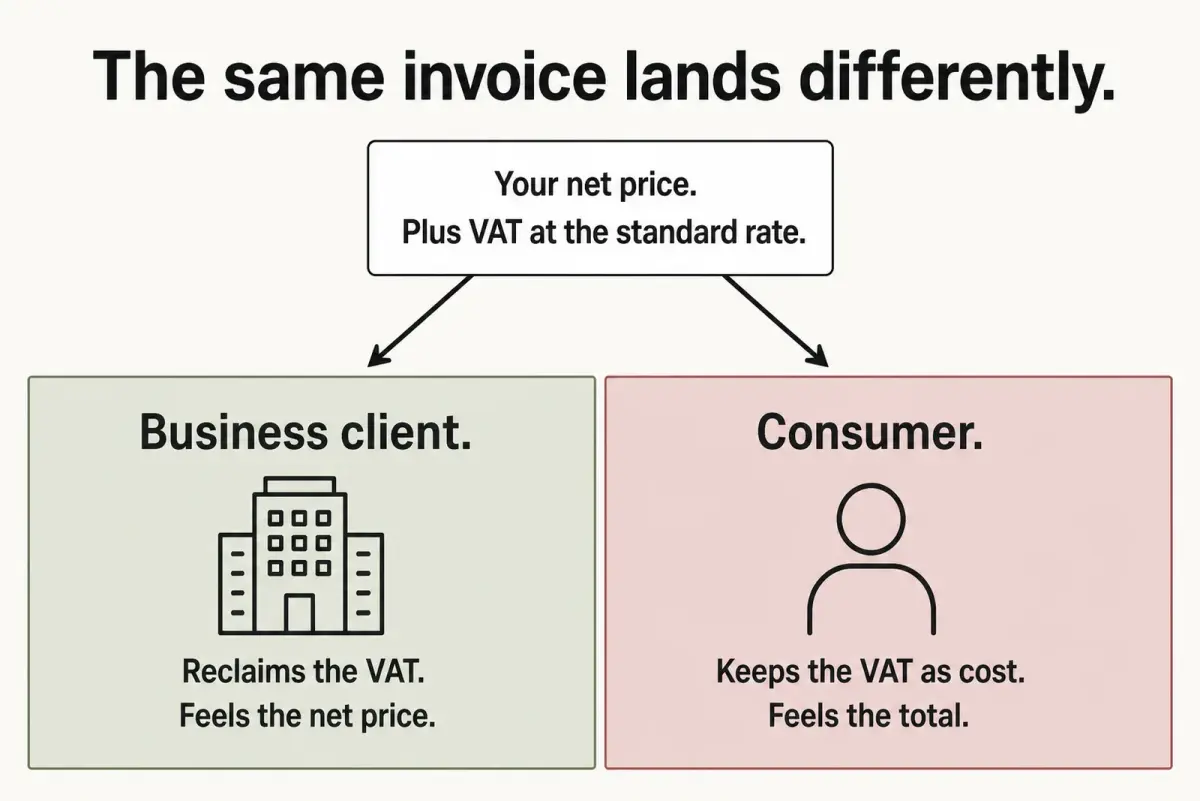
The same invoice, two different numbers felt by the two buyers.
Because the two buyers feel different halves of the same invoice. The standard rate of VAT is 20% and applies to most goods and services. GOV.UK also states that you can reclaim VAT on items you buy for use in your business if you are VAT registered.
The consequence for your quote is direct. For a client that is registered and buying the flowers for its business, the tax on your invoice is a cash flow entry rather than a cost, and the number their budget carries is the net one underneath. That route runs through the registration, not the flowers, so a consumer at your counter carries the whole figure. Which is why a shop price is a total and a corporate price is not.
A consumer buys flowers. A business buys the flowers still being there next Tuesday.
Say you quote an office £60 a week and show it as one all in figure, while the florist down the road quotes £50 plus tax. At the standard rate your prices are identical. Theirs looks a fifth cheaper on the page.
Not a loophole, just a convention that signals you have priced business work before.
Two conditions decide whether it applies. It holds where the buyer is registered and buying for its own business. It does not hold for a client that is not registered, or where the flowers are not a business purchase, and there the total is exactly what they feel. Ask, once, at account setup.
What a weekly price has to cover before it is a price
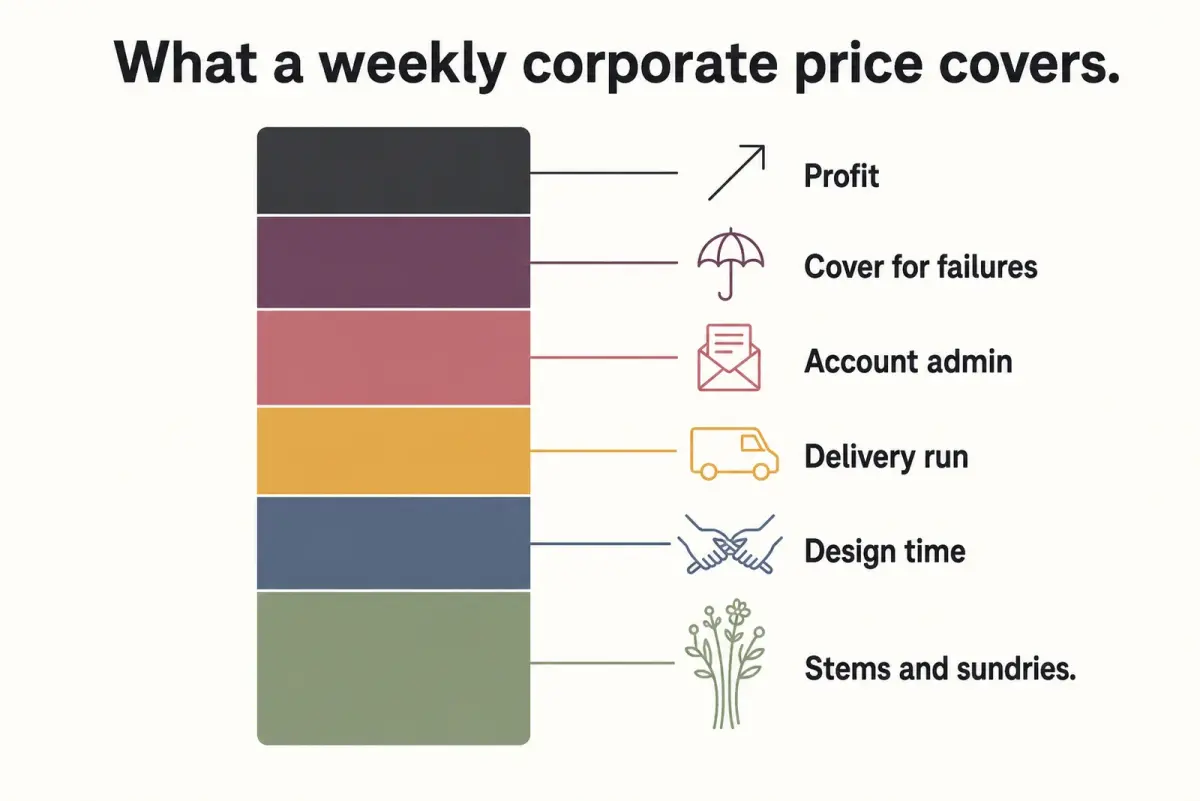
Stems are the base of the stack, not the stack.
A weekly price has to cover six things, and stems are only the first: stems and sundries, design time, the delivery run, account admin, cover for the week something goes wrong, and profit. A price built on the first alone is a shop price wearing a contract.
Three of them decide whether an account is worth having.
- The delivery run. Whether the display is a £30 one or a £90 one, it is the same drive, the same parking, the same walk through reception.
- Account admin. Someone raises the invoice, chases the purchase order number and swaps the vase that came back chipped. None of it is floristry. All of it is time you agreed to sell.
- Cover for failures. A business that finds a dead arrangement on a Monday remembers it for a year, so the price has to fund the spare bucket of stems and the second trip.
The drive and the admin do not scale with the size of the order at all, and the cover barely does, which is why the bottom rung needs the most careful arithmetic and why one small account a long way out is worth declining politely.
Underneath all of it the supply market moves. Defra reports that the value of UK ornamental imports increased by 6.4% to £1.6 billion between 2024 and 2025. Read it as a national trade figure rather than your wholesaler's list: a value can move because volume moved as much as because prices did. What it does tell you is that the market you buy in does not sit still from one year to the next, which is an argument for a review month in the agreement rather than a number to pass on.
How to build your ladder
Cost the bottom rung properly, then let the higher rungs carry more flowers rather than more service. Three or four rungs is plenty, and each one is a recipe you can make in your sleep rather than a fresh design brief.
Build the bottom rung in this order:
- The round, because it is fixed whatever you put in the vase.
- Bench time for one arrangement.
- Stems and sundries.
- Your admin allowance.
- Your margin.
What comes out is the floor of your ladder, and if it looks embarrassing, that is information rather than a reason to shave it. Run it once on real timings before you publish anything.
Imagine a round of four accounts within twenty minutes of the shop.
- The drive, the swaps and the vase washing take two and a half hours door to door, so roughly forty minutes sits on each account.
- Decide your own time is worth £24 an hour and that is about £16 of driving time inside every weekly price, before a stem is bought and before the van itself.
- Add fifteen minutes on the bench, £14 of flowers and sundries and a little admin, and the bottom rung cannot sensibly start below the mid thirties.
Put a second account in the same building and the round time barely changes, so the second is worth far more than the first. Hence pricing a multi site client as one account.
The higher rungs are easier. Hold the service constant, raise the stem spend and the size, and let the flowers do the work. A buyer moving up a rung should see obviously more flower, not a mysteriously bigger number.
What payment terms should a corporate florist set?
Write the terms down before the first delivery. GOV.UK guidance says the interest you can charge if another business is late paying for goods or a service is statutory interest, which is 8% plus the Bank of England base rate for business to business transactions.
Read the current guidance before you rely on it, especially if your contract already sets a rate. It is a position between businesses in the UK, not one against a consumer, and it is no substitute for terms you both agreed.
Retail ends when the card clears. Corporate ends when somebody in finance runs the payment file, which can be a month after you drove out there in the dark. So do the unglamorous things:
- Agree payment terms in the contract rather than discovering theirs.
- Ask for the purchase order number at setup, because an invoice without one can sit for weeks without anybody being difficult.
- Invoice monthly, on a fixed date, for a fixed rung, so nobody has to check the amount.
- Name the person who approves it while everyone is still pleased with each other.
A price is not a price until it has terms behind it. Until then it is a hope with a number attached.
Where corporate pricing goes wrong

The round is the cost. The vase is only the visible part of it.
Four failures turn a corporate account thin, and not one of them is really a pricing error. Each is a service being given away and called a price.
- Pricing the vase, not the round. The drive is the same for the cheapest rung and the dearest.
- Quoting a total to a finance team. It reads as retail, and it makes you look dearer than a rival charging the same.
- No review month. Your buying costs move; a price agreed two winters ago does not.
- Free extras that became the service. The birthday arrangement you threw in once is expected quarterly now.
Frequently asked questions
How much should a florist charge a business for weekly flowers?
Build a ladder of fixed weekly prices rather than hunting for one going rate. The one published ladder here runs across a spread of fixed levels rather than a single figure, and that is the shape to copy. Set your rungs from your round time, bench time, stem spend and admin, then let the higher rungs carry more flowers rather than more service.
Should corporate flower prices be quoted with or without VAT?
Quote a registered business the net figure and show the tax on its own line, because GOV.UK states that you can reclaim VAT on items you buy for use in your business if you are VAT registered. For that buyer the tax is a cash flow entry, so the net number is the one their budget carries. A consumer has no such route, which is why counter prices are shown as totals.
How much should a florist charge per hour for corporate work?
There is no rate to copy, and any figure you find belongs to somebody else's overheads. Decide what your own hour needs to earn, then time one full round door to door. Price that measured time into every rung. The hour you do not price is the hour the account eats.
What is the average profit margin for a florist?
Treat every margin percentage you meet with suspicion until you can see who measured it, over what sample and in which country. Your own accounts hold the only figure that governs your decisions. Divide one client's annual profit after flowers, driving, bench time and admin by what you billed it, and price the next client from that.
Can I charge interest if a business pays a flower invoice late?
GOV.UK guidance says the interest you can charge if another business is late paying for goods or a service is statutory interest, which is 8% plus the Bank of England base rate for business to business transactions. That is a position between businesses in the UK rather than a consumer one, and it works best as something your terms reference rather than something you spring on a client in month three.
What to do this week
Corporate florist pricing is not a bigger number than retail. It is a different object: a recurring service, priced in net figures, with terms behind it.
- Time one delivery round door to door, including the vase wash and the invoice.
- Set three or four fixed weekly rungs and cost the bottom one honestly.
- Show business buyers net figures with the tax on its own line.
- Put a review month and payment terms in every corporate agreement.
- Ask each new account for a purchase order number at setup.
For more details on turning a priced ladder into a signed agreement, read our full guide to corporate flower contracts.
Ask yourself: does your bottom rung pay for the drive, or only for the flowers?
If you only have thirty minutes: time the round. When a corporate account quietly loses money, the driving nobody costed is the first place to look.
Winning the enquiries that turn into accounts like these is a marketing job rather than a pricing one, and it is the part LocalBrandHub helps florists with: social posts and ready made seasonal campaigns.
Key takeaways: corporate florist pricing
Key Takeaway
- Price the round, not the vase. Delivery and admin do not scale with the order.
- Publish a ladder. Three or four fixed weekly rungs beat one negotiable figure.
- Quote businesses net. A VAT registered business buying for its business reclaims the tax; a consumer has no registration to reclaim through.
- Write the terms down. Payment date, purchase order number, approver, review month.
- Cost the bottom rung hardest. It carries the same drive as the top one.
For restaurants, salons, and local businesses
Need help with your marketing?
We help UK businesses turn social media into real results, not busywork.
Start freeSources
Get More Marketing Tips
Practical marketing tips for UK business owners, straight to your inbox. No spam, unsubscribe anytime.
About the Author
Local Brand Hub
Empowering UK Businesses
Local Brand Hub provides comprehensive business management tools designed specifically for UK local businesses to streamline operations, automate marketing, and grow revenue.
More articlesRelated Articles
 Business Growth
Wedding Flower Packages: How to Build and Price Them
Wedding flower packages for UK florists: build three tiers couples can count, fix the right things, and publish a price that survives the wait.
 Business Growth
Wedding Florist Pricing: How to Quote the Whole Day
Wedding florist pricing for UK flower shops: build the quote from the day itself, cost the hours and the miles properly, and know when VAT changes it.
 Business Growth
Wedding Florist Contracts: The Clauses That Hold Up
What a UK wedding florist contract should say about deposits, cancellations and changes, with copyable clause wording and the law behind each one.