
Event floristry is a site business, not scaled up bench work. How UK florists price the install hours, brief a crew and set a payment date that holds.
An event floristry business designs, delivers and installs flowers for dated occasions: launches, conferences, awards nights, parties and openings. The work is quoted as a whole job rather than by the stem, because so much of what you sell is planning, labour and site access. The flowers are the least risky part of it.
At six in the morning a ballroom is a car park with chandeliers. No chairs, no linen, a vacuum going somewhere behind you, and a man on a radio who has never heard of you asking whether you are the AV lot. Your stems are in a van two streets away because the loading bay had a beer delivery sitting in it, and the goods lift is spoken for until half seven.
Not one of those is a floristry problem. That is the bit missing from every guide that says event work is simply bigger arrangements. The design was finished on Thursday; everything still capable of going wrong is architecture, timing and other people.
Related: Corporate Florist Pricing Explained
What an event floristry business is actually selling
A promise about a building on a particular day. The client is buying a room that looks a certain way at a certain hour, and the flowers are the visible surface of a job made mostly of access, labour and timing. It is why the same arrangement behaves like two different products depending on where it has to exist.
Sold over your counter, an arrangement is a clean transaction: the customer comes to you, pays, carries it out, and your risk ends at the door. Sold into an event, the identical piece has to travel, survive a service lift, hold up under a heat lamp all day, then be taken away again by somebody who is still you.
A wedding florist is judged on the aisle. An event florist is judged on the loading bay.
So this is not floristry at scale. It is contracting, with flowers as the finish. That is not a warning off: a local shop with one van can run a contracting job perfectly well. What it cannot do is run one by accident.
Picture two enquiries on the same Tuesday. One wants forty tables dressed for an awards dinner in a room you have never seen. The other wants forty hand ties for a conference goody bag, collected from the shop. Same stem count, same margin, and only one of them can go wrong at midnight in a building you cannot get into.
Why the venue visit is the pricing meeting
Because nearly everything that sets the price lives in the building and almost none of it reaches the brief. Parking, lift, doors, ceiling height, the install window, water, power, and how it all leaves again at midnight. A florist quoting from a floor plan is quoting for a room they have imagined.
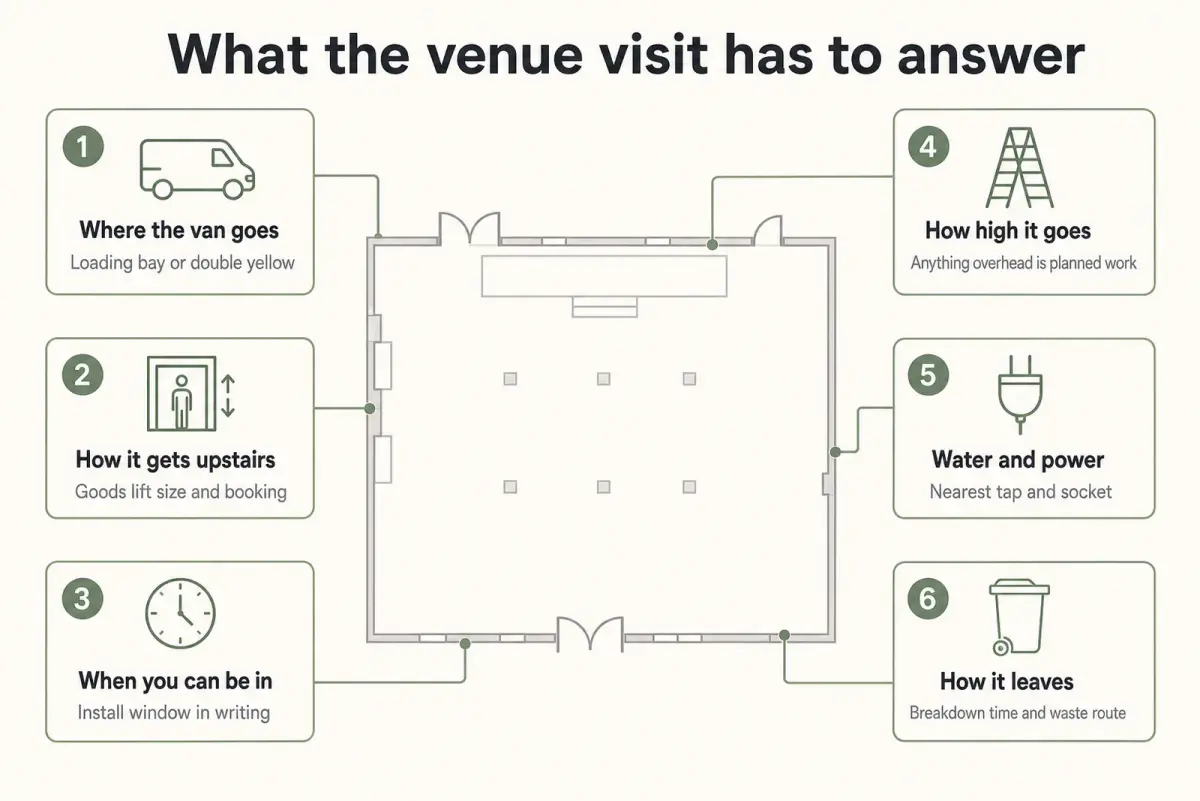
Six answers to leave the building with. Each one is a line in the quote, and each one is a reason the day runs late if you guessed it.
Walk it with a tape measure and a phone camera, asking the questions a caterer would ask rather than the ones a florist asks:
- Where does the van stop, for how long, and who else wants that bay at seven.
- Which lift, how deep, and who books it. A frame that fits on paper can still refuse to turn a corner.
- What time can you be in the room, in writing, from whoever controls the room rather than whoever booked you.
- Where is the nearest tap, and the nearest socket, and whose extension lead is that.
- How does it leave, and at what hour, and where does the green waste go.
Then look up. Once a piece needs a ladder to build, treat it as planned work rather than decoration, whatever the legal threshold turns out to be in your case.
Regulation 4 of the Work at Height Regulations requires every employer to ensure that work at height is properly planned, appropriately supervised and carried out in a manner which is so far as is reasonably practicable safe, and that the planning includes selecting the work equipment. The duty is written on employers, and Northern Ireland has its own version of the rules, so check which applies to you. Read it for what it describes rather than for who it names.
How the tall thing gets built is decided at the venue visit, with a tape measure. Not at seven in the morning, with a banqueting chair and an optimist.
What belongs in an event quote that never appears in a shop order
Every hour the job takes, not only the hours at the bench. Design and quoting, buying and conditioning, the build, loading, travel, the install, standby if they want you in the room, then breakdown and getting rid of everything you brought in. Clients picture one of those. You are paid for all of them or for none of them.
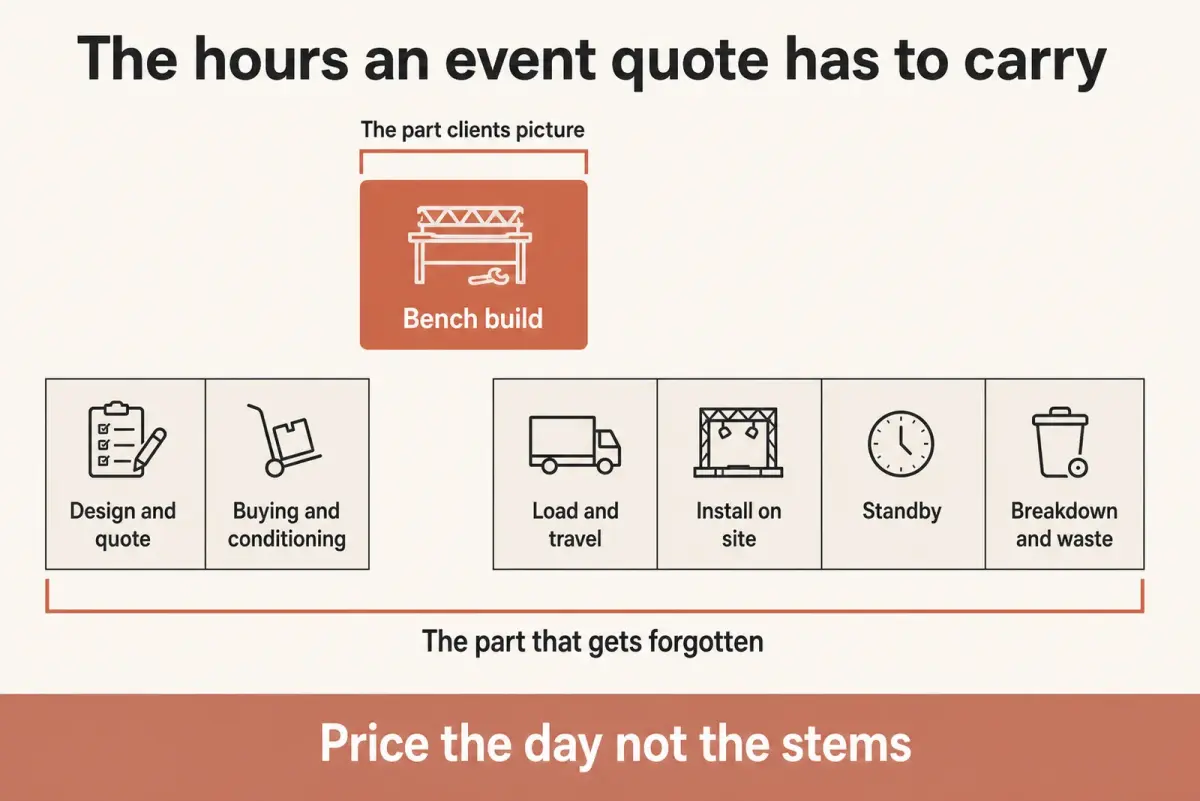
The bench is the part that looks like floristry. The other six segments are where an event job wins or loses.
Write them out in the order they happen and quote each one:
- design, quoting and the client meetings
- buying, collection and conditioning
- the bench build itself
- loading, travel and parking
- the install on site
- standby hours, if they want you in the room
- breakdown, the trip back, and disposal
Flowers are close to a pass through cost here. You mark them up, certainly, but stems are the visible, comparable part of a quote. What is not comparable, and what nobody else in that room is selling, is a person who will still be there at half past eleven taking down an arch by torchlight.
Give the labour its own line rather than burying it, because a hidden hour is an hour the client feels free to add to. Two changes to the top table, a late request for the entrance, and the goodwill you quoted has spent itself before the doors open.
The morning you stop being one person with a van
The first event you cannot physically install alone changes more about the business than the first event you win. Paid help can make you an employer, and GOV.UK attaches a hard duty to that word with a daily penalty behind it.
GOV.UK states that you must get Employers' Liability insurance as soon as you become an employer, that the policy must cover you for at least £5 million and come from an authorised insurer, and that you can be fined £2,500 every day you are not properly insured.
The crew is not an overhead you bolt on when a job gets big. It is the thing that decides which jobs you are allowed to quote for at all.
Whether the friend who helped you carry urns on Saturday makes you an employer is a question for your insurer and for the exemptions GOV.UK sets out, not for a florist's guess in a van. Ask it in June, when the answer is administrative. Asking it in December, after somebody has gone over on a wet loading bay, is a different conversation entirely.
Before the first crewed install, three answers are worth having on paper:
- who is coming, in what capacity, and paid how
- what cover you hold, and whether it names them
- what the venue wants to see before it lets any of you through the door
Getting paid for a party everyone has already forgotten
A single event invoice is easy to lose in a way a standing account is not, because nobody in that accounts department is expecting you. Set the payment date yourself, in the quote. Leave it out and the law fills the gap, and the law is in no hurry.
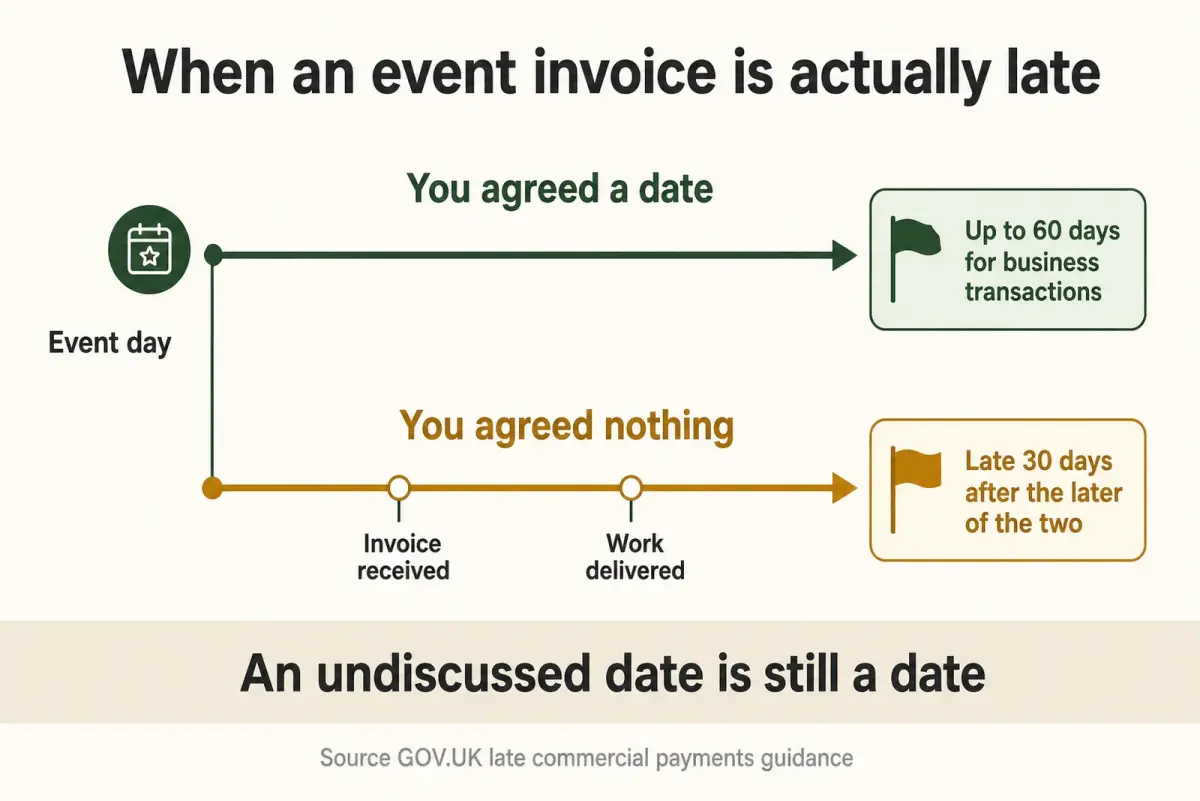
Two timelines from the same event day. One you wrote. The other was written for you.
An undiscussed payment date is still a payment date. It is simply somebody else's.
GOV.UK guidance on late commercial payments says that if you agree a payment date it must usually be within 60 days for business transactions, and that if you do not agree a payment date, the law treats the payment as late 30 days after either the customer gets the invoice or you deliver the service, whichever is later.
Three lines in the quote do most of the work here:
- the payment date, stated as a date rather than as a habit
- a deposit before you buy stock, and what it covers
- who the invoice goes to, with whatever reference their system wants on it
Read 60 days as the outer edge of what an agreed date usually is, not as a target. Nothing stops you writing 14 days on the quote, or asking for the balance on the night. That guidance settles only what happens when the two of you never discussed it. Interest and recovery costs on a late business payment are worth knowing too, and they sit in the guide to working as a corporate florist.
The threshold that arrives before your year end
Event income is lumpy, so the figure that matters is a rolling one rather than an annual one. GOV.UK states that you must register for VAT if your total taxable turnover for the last 12 months goes over £90,000, or if you expect your taxable turnover to go over £90,000 in the next 30 days.
Counter trade creeps. An event book jumps, and it jumps in autumn.
Two autumn contracts, a Christmas season and a launch nobody saw coming can move a rolling twelve month total a long way in a single quarter, and none of it feels like a big year while it is happening. That is an observation about lumpy income rather than a measurement of anybody's books, and the practical version is small: keep that rolling total somewhere you actually look, and check it after every large contract you sign. That second test catches people out precisely because it looks forward 30 days instead of back a year.
Where event florists quietly lose money
Almost never on flowers. Event jobs leak in the same five places, and all five sit in the hours, the access and the paperwork around the design rather than in the buying.
- Quoting the stems and absorbing the hours. The unglamorous end is where the hours go.
- Agreeing an install window before measuring the route. A lift that fits your frames on paper and not in life costs you the morning.
- Free changes. A change absorbed without repricing sets the price of the next one at zero.
- Unpriced breakdown. Everything you carried in has to leave again, and the van, the hour and the disposal are all real.
- Losing the photographs. The best marketing a florist ever gets, and it exists for one evening.
That last one is the cheapest to fix and the easiest to let slide. Shoot the room before the guests arrive, ask the organiser in advance whether you may use the pictures, then get them off the camera roll while the job is still fresh. Turning one night's work into a season of posts is exactly the chore LocalBrandHub is built for: templates for the posts and a calendar to sit them in.
Frequently asked questions
What is an event floristry business?
A florist business that designs, delivers and installs flowers for dated occasions: corporate launches, conferences, awards nights, parties and openings. The work is one off, priced as a whole job, and delivered into somebody else's building on somebody else's timetable, which makes access, labour and breakdown matter as much as the flowers.
How do florists price event work?
By the whole job rather than by the stem. Flowers, design time, conditioning, the build, travel, the install, any standby hours, breakdown and disposal all belong in the quote, with the labour on its own line rather than hidden inside a flower price. Hidden hours are the ones clients feel free to add to.
Is event floristry a profitable business?
It can be, and the profit sits in the hours rather than the stems, because flowers are the comparable part of a quote and your time on site is not. The jobs that lose money are almost always the ones where install, changes and breakdown were absorbed rather than priced.
Do I need insurance for event floristry?
One kind of cover stops being a choice the moment you become an employer. GOV.UK states you must get Employers' Liability insurance as soon as you become an employer, that the policy must cover at least £5 million and come from an authorised insurer, and that you can be fined £2,500 every day you are not properly insured. Whether casual install help makes you an employer is a question for your insurer and the published exemptions, and venues ask what cover you hold too.
What is the difference between event and wedding floristry?
Both are dated, installed and unrepeatable, but the buyer differs. An event client is usually a business or an organiser working to a brand and a budget line, with shorter notice and tighter venue rules, while a wedding is a couple's personal project planned over months. The floristry overlaps heavily; the paperwork and the install do not.
When should I register for VAT as an event florist?
GOV.UK states that you must register if your total taxable turnover for the last 12 months goes over £90,000, or if you expect it to go over £90,000 in the next 30 days. Event income arrives in lumps, so track the rolling twelve month figure rather than waiting for a year end.
Key takeaways: event floristry business
Key Takeaway
An event floristry business is a site business with flowers on the end of it, and five things decide whether the big jobs pay.
- You are selling a building on a day. Access, timing and labour carry the risk, not the stems.
- The venue visit is the pricing meeting. Van, lift, window, height, water and waste route.
- Give the hours their own line. Design, build, install, standby, breakdown and disposal.
- Crew can make you an employer. From that moment employers' liability cover is a legal duty with a daily penalty attached.
- Set the payment date yourself. With nothing agreed, nothing is late until 30 days after delivery or the invoice landing.
The design is the part you can finish on Thursday. The money is decided in the building.
For restaurants, salons, and local businesses
Need help with your marketing?
We help UK businesses turn social media into real results, not busywork.
Start freeSources
Get More Marketing Tips
Practical marketing tips for UK business owners, straight to your inbox. No spam, unsubscribe anytime.
About the Author
Local Brand Hub
Empowering UK Businesses
Local Brand Hub provides comprehensive business management tools designed specifically for UK local businesses to streamline operations, automate marketing, and grow revenue.
More articlesRelated Articles
 Business Growth
How Florists Compete with Bloom and Wild (and Interflora)
How florists compete with Bloom and Wild starts by reading its delivery pages. What the post cannot carry, where Interflora fits, the result you can win.
 Business Growth
Florist Marketing Plan: A Simple Template for UK Shops
A florist marketing plan you'll actually use: a simple UK template and seasonal calendar to plan your flower shop's marketing around the peaks.
 Business Growth
Florist Marketing: How to Out-Local the Flower Chains
Florist marketing for UK flower shops: the three inputs Google says local results rest on, which tasks feed them, and why peak days start weeks early.