
The florist pricing formula in full, plus how to derive your own multiplier from your own invoices, cost your bench time and put the tax in its place.
The florist pricing formula is materials plus bench time plus a share of your overheads, with margin on top. A markup multiple is that same sum compressed into one number, which is why a multiple borrowed from another shop prices somebody else's wastage, rent and hours rather than yours.
Somebody, somewhere, told you to multiply by three.
A course, a forum thread, or the florist who trained you. Whoever it was, they were describing their shop: their wholesaler, their bin, their rent, their hands. You inherited the answer and never saw the working. Then the energy contract renewed, the wholesaler's list moved, and the three carried on regardless.
That is the trouble with pricing by multiple. It works beautifully right up until the day it stops, and then it tells you nothing about why.
What is the florist pricing formula?
Price equals materials at their true landed cost, plus your bench time at a rate you have chosen, plus a share of the overheads that run whether or not the shop takes a penny, plus margin. The shortcut you were taught is a compression of those four numbers.
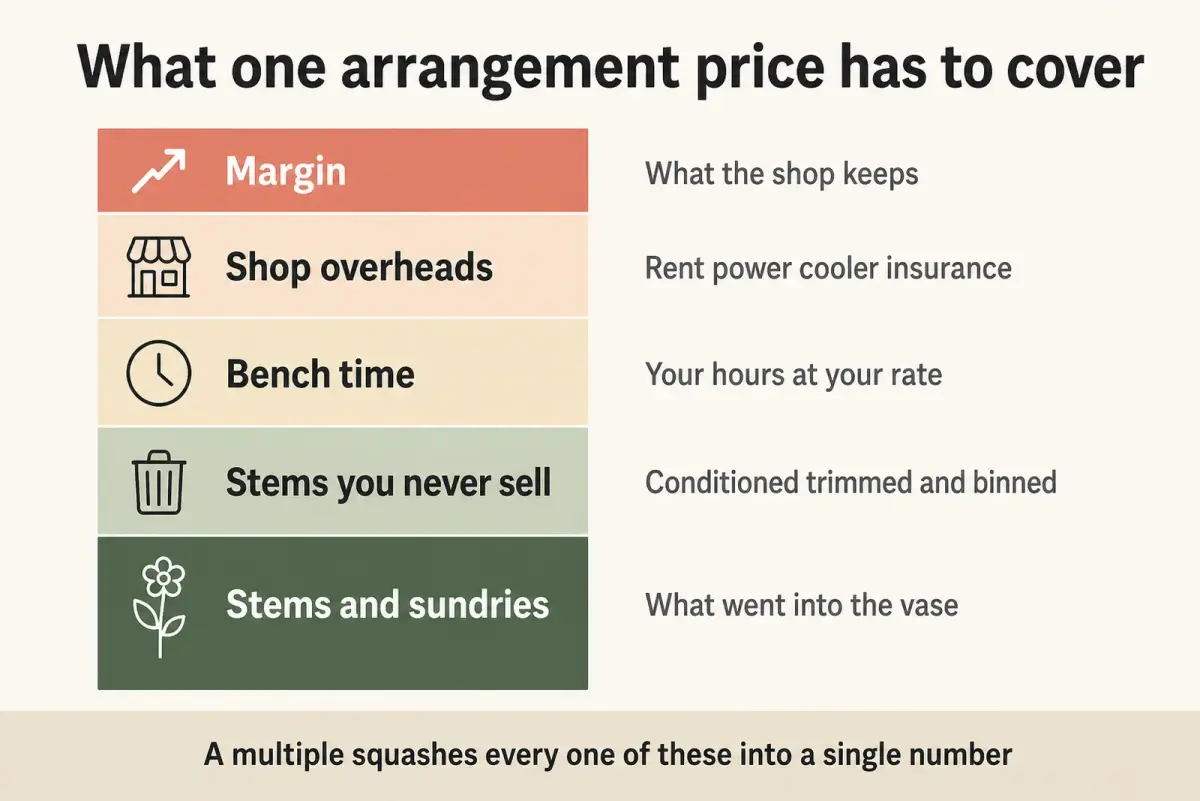
Stems are the bottom band, not the bar.
The four lines, in the order they are usually got wrong:
- Materials. Everything you bought to make the piece possible, not only what leaves in the customer's hands: every stem, the foliage, the vase or the wrap, ribbon, wire, tape, the little card, and the stems you conditioned and then binned.
- Bench time. The minutes from picking up the first stem to setting the finished piece down, at an hourly figure you can defend out loud.
- Overheads. Rent, power, the cooler that hums all night, insurance, the van, the shop phone.
- Margin. What is left for the business rather than for you.
The bin belongs inside that first line, which is where a formula quietly loses it. Write the four on a card by the bench and they still fit on one line. The reason to keep them apart is diagnostic rather than mathematical.
Imagine a bouquet whose stems cost £9. A multiple says charge £27 and stops talking. The four lines tell you whether £27 also covers the twenty minutes and the rent, and if it does not, which of them is short.
What is the 3-5-8 rule for florists?
It is shorthand for putting different multiples on different parts of an arrangement, with the heaviest one on fresh flowers, because fresh flowers are the part you throw away. The reasoning is sound. The numbers in it are somebody else's.
You will meet it in more than one version, and the versions disagree with each other. That is the tell. Nobody is publishing a formula derived from your shop, because nobody else has your delivery notes.
What the rule gets right is the shape of the problem:
- Hard goods sit in a cupboard until they sell, so almost nothing is lost to time.
- Fresh stems are bought speculatively, conditioned, trimmed, and some go in the bin having earned nothing.
- The stems that do sell therefore have to carry the stems that did not.
A bigger multiple on flowers than on vases is a sensible answer to that difference. What no rule can tell you is the size of your bin.
Picture two shops applying an identical multiple. One bins a tenth of its stems, the other a third. Same formula, same prices, and only one of them is actually being paid for the difference.
A multiple is four numbers wearing one coat. Borrow one and you are quoting somebody else's rent and somebody else's bin.
Treat whichever version reaches you as an opening position, then earn the right to change it.
Where should your multiplier actually come from?
One quarter of your own trading will tell you. Divide what you took for made arrangements by what you spent on fresh stock in the same period, and you have the multiple your shop is actually achieving, bin included, whatever the card by the bench says.
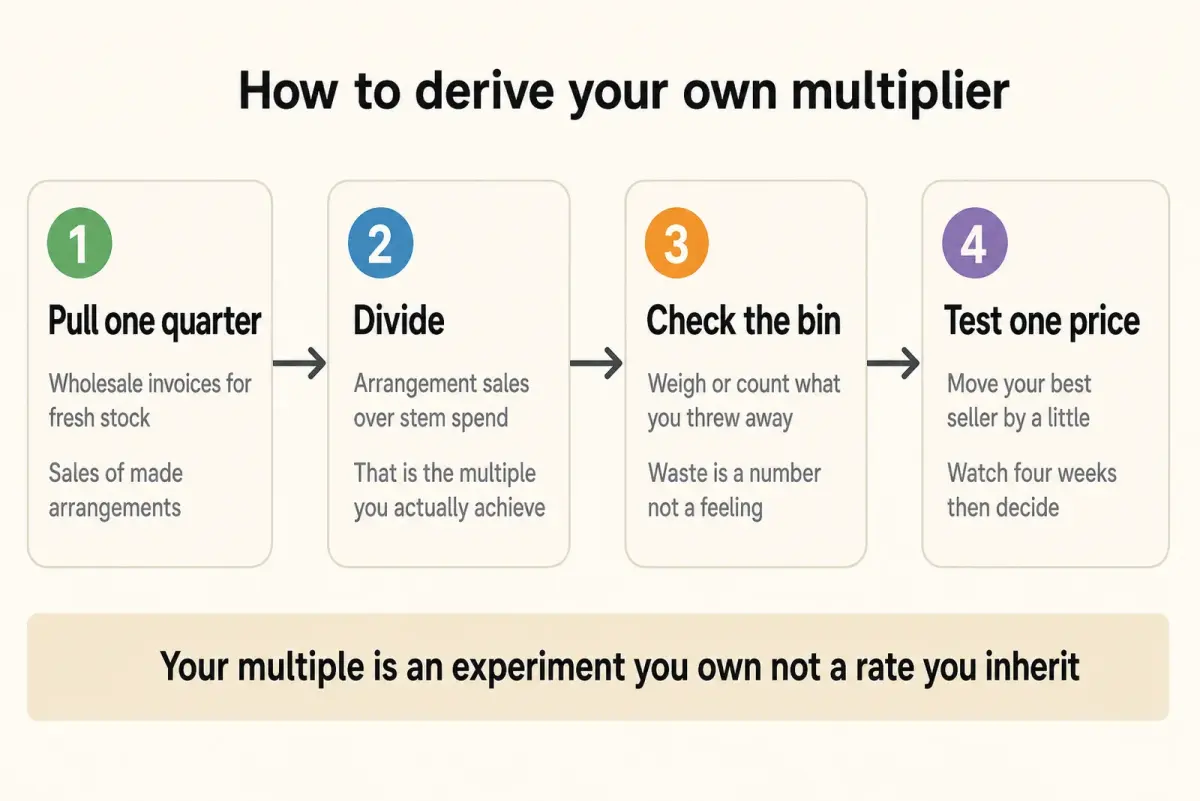
Four steps, one quarter of paperwork, a number that is genuinely yours.
The raw material already exists, because you almost certainly have to keep it anyway. GOV.UK states that a self employed sole trader must keep records of their business income and expenses for their tax return.
Whatever form your records take, they already contain the arithmetic below. Nobody has to buy anything to run it.
Say a quarter of wholesale invoices for fresh stock comes to £6,000, and arrangements built from that stock took £19,200 across the counter. You are achieving 3.2 times your stem spend, whether or not anybody chose it, and that number already carries everything you threw away.
Then work through the parts that number is hiding:
- How much stock never reached a customer. Weigh the bin for a fortnight if you have never done it, or a month if your weeks swing hard. Wastage is a number rather than a feeling, and the feeling costs nothing to believe.
- What the multiple is silently funding. Rent and power do not appear anywhere in that division, yet the multiple has to cover them.
- Whether it survives being poked. Move your best selling bouquet by a pound and watch a month of sales before you decide anything. A month is a starting length rather than a rule, so stretch it if your trade is lumpy.
That last one matters most. An experiment you ran is evidence. A multiple you were handed is a rumour.
Related: Florist Profit Margins Explained
What should you charge for your own time?
Bench time is the line that gets skipped, and it is the line that decides whether the shop pays a wage. Price the minutes, not the impression of effort.
Two numbers in your pricing are set by somebody other than you, and this is the first. From 1 April 2026 the National Living Wage for workers aged 21 and over is £12.71 per hour, and the rate for 18 to 20 year olds is £10.85. If you employ anyone in either bracket, those are floors under the cost of their hours, and your accountant can give you the loaded figure rather than the headline one.
If it is just you on the bench, nothing out there sets your hourly number. You do. That freedom is exactly why the hours quietly become the part the customer gets free.
Bands beat a stopwatch:
- Quick. A posy or a small gift wrap.
- Standard. The everyday hand tie you could make with your eyes shut.
- Elaborate. Sympathy work, installations, anything with a framework.
Time three real pieces, round each to a band, and apply the band in a second.
A tribute that eats three times the bench time of a posy should carry three times the labour charge. A single flat labour figure underpays whatever takes longest at the bench.
Both of those figures took effect in April 2026, and both replaced lower ones. Which is the argument for bands: three numbers on a card are quick to lift when the floor under them moves. A labour rate you set from an older figure is not cautious. It is out of date.
Where does VAT belong in the formula?
Outside it until you cross the threshold, and underneath everything afterwards. GOV.UK says you must register if your total taxable turnover for the last 12 months goes over £90,000, and that the standard rate of VAT is 20% and applies to most goods and services.
The trap is arithmetic rather than legal. Before that point, the number on the label is the number your formula produced. After it, part of that same label is tax rather than takings, so a shop still running the formula on shelf figures has quietly handed over a slice of its own margin.
The rolling twelve month wording is what catches florists out, because it is not a tidy financial year.
A strong Valentine's Day, a busy May of weddings and a good Christmas can carry a shop over between one month and the next. Look at the last twelve months, not the last accounts.
A worked example: one hand tie, end to end
Here is the formula doing an honest day's work on a standard hand tie. The figures below are invented for the illustration; the order you put them in is the part to copy.
- Stems and foliage come to £8 at your landed cost, and the wrap, ribbon and card add £3.
- The bench takes twenty minutes on this imaginary piece, and at the rate you settled on earlier that is another £7.
- Your overhead share, taken from a quarter of rent, power and insurance divided by the arrangements you actually made in that quarter, is £4.
- That is £22 gone before the shop has earned a penny. Add the margin the business needs and you land near £30.
Run a flat three times on the £8 of stems instead and you get £24. Charge that, and you built the piece for two pounds.
Four lines produce a different number, yes, but they also tell you which line was doing the damage. That is the entire reason to keep them apart.
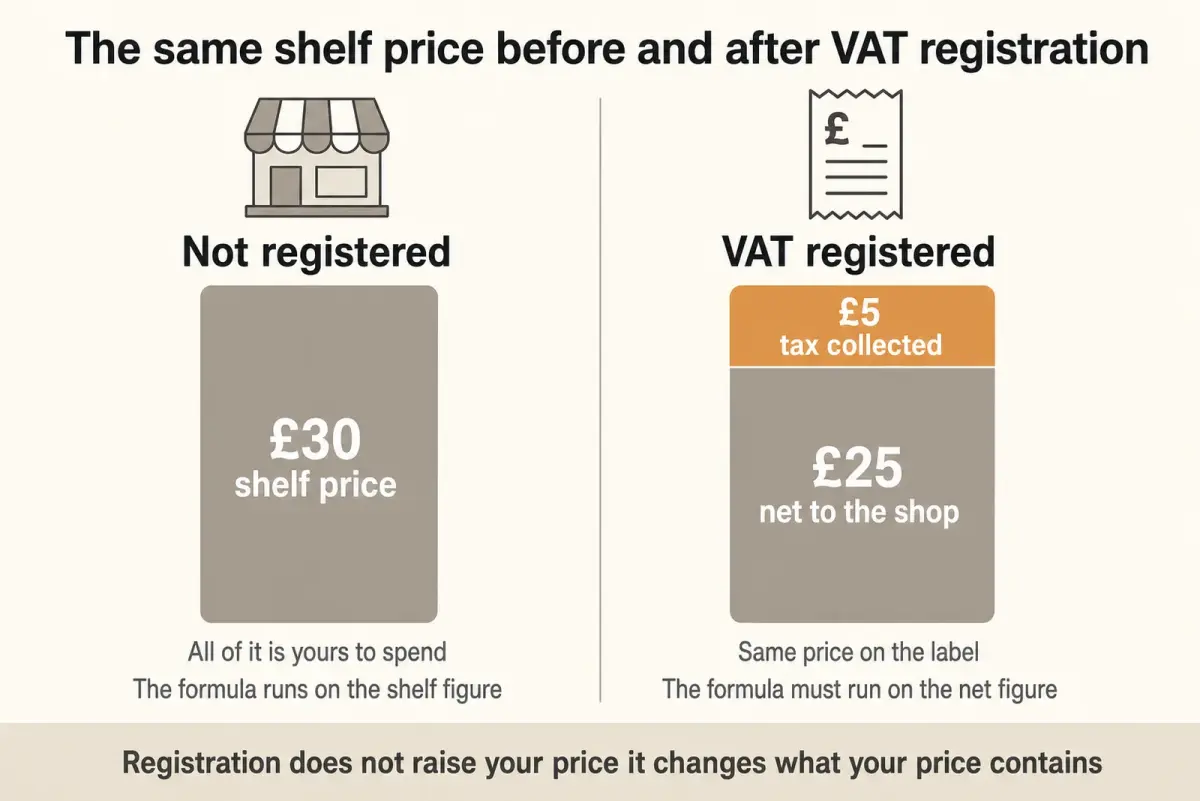
The label does not change. What sits behind it does.
Once you are registered, run the whole thing again in net figures. The label can stay where it is; only part of it is now yours.
What is the profit margin for a florist?
Your own accounts decide it, and nothing else does. A published florist margin belongs to a sample of shops that are not yours, measured in a year that has already gone.
Markup against margin is the distinction worth learning, because the two describe the same shop in very different registers.
Say your stems are a third of the shelf price. That is a markup of three times on the stems, which sounds handsome, and a margin over stems of two thirds, which sounds handsomer still. Both sentences describe the identical bouquet. Out of that two thirds you have yet to pay for time, rent, power, the van and yourself.
That is how a florist can be busy, apply a respectable multiple and still finish the month short.
Work out one real figure this quarter: take what the shop took, subtract stems, sundries, wages, your own hours at your chosen rate and the overheads, then read what remains as a percentage. It may well be smaller than the internet promised. It will at least be yours.
How do you price money bouquets?
Keep the cash out of the formula. Price the flowers, the wrap and the folding time as you would any hand tie, then pass the banknotes through at face value on their own line.
A money bouquet is an ordinary arrangement with an unusual component, and the component is worth exactly what it says on it. Multiply the cash and you are charging a customer a premium for their own money, which is the sort of thing that gets screenshotted.
Imagine £150 of notes folded into a hand tie whose flowers and wrap cost £12. The customer pays the £150 back at face value, plus the price of that arrangement and the half hour of folding. Nobody pays the £450 a three times multiple would have produced.
What you can price is the fiddle. Folding notes into fans takes real minutes, the technique took real practice, and the thing has to survive being carried across a car park. Time one, band it, and charge for the skill.
Related: Flower Bouquet Pricing: A UK Guide
Where the formula breaks
Four things break a pricing formula, and not one of them is the multiple:
- Sundries nobody counted. Wire, tape, cellophane, the card. Trivial one at a time, a line item by the quarter.
- A labour rate set once. The figure you chose when you opened is not the figure that pays you now.
- Shelf figures after registration. The formula has to run net, or the tax comes out of your margin.
- No review date. Wholesale lists move. A price agreed two winters ago is a price from two winters ago.
Imagine sundries running at 80p an arrangement across two hundred arrangements in a quarter. That is £160 of margin already spent by the time you notice, and it never lands on a single invoice.
Put a recurring note in the diary for the first week of April, because that is when the rates above took effect, and a second one roughly six months later, on whatever date suits your trading. Twenty minutes with the paperwork twice a year is the entire maintenance schedule.
Frequently asked questions
What is the florist pricing formula?
Materials at what they actually cost you, plus bench time at a rate you have chosen, plus a share of the overheads that run whether or not you sell, plus margin. A markup multiple is the same sum squashed into one number applied to the stems. Both produce a price. Only the long version tells you which line failed when the price stops paying.
What is the 3-5-8 rule for florists?
It is shorthand for applying different multiples to different parts of an arrangement, with the heaviest on fresh flowers, since fresh flowers are what gets thrown away. The logic is reasonable and the numbers are somebody else's. Use whichever version reaches you as an opening position, then replace it with the multiple your own invoices support.
How much should a florist charge for a bouquet?
There is no going rate to copy. Cost one bouquet stem by stem, add the minutes it genuinely takes at the rate you need your own time to earn, add your overhead share and your margin, then hold the answer next to your current shelf price. The gap between the two is the useful part.
Do I have to add VAT to my flower prices?
Only once you are registered. GOV.UK says you must register if your total taxable turnover for the last 12 months goes over £90,000, and the standard rate of VAT is 20% and applies to most goods and services. Registration does not change your label by itself. It changes what the label contains.
How often should I redo my pricing formula?
Twice a year is a sensible default, with an extra look whenever the wholesaler's list jumps or the energy contract renews. The current statutory wage rates took effect in April 2026, so anchoring one of the two reviews to April keeps the labour line honest.
What to do this week
The formula is not the hard part. Filling it in with your own numbers is.
- Pull one quarter of wholesale invoices and one quarter of arrangement sales, and divide.
- Weigh or count the bin for a fortnight and write the number down.
- Time a posy, a hand tie and a tribute, and set three labour bands.
- Check your rolling twelve month turnover against the registration threshold.
- Diary a twenty minute price review for April and one other month of your choosing.
If you only have thirty minutes: do the division. Arrangement sales over fresh stock spend, one quarter. If the answer surprises you, the direction of the surprise tells you what to fix first.
Could you explain to a customer why your best selling bouquet costs what it costs? Filling the shop is the other half of the job, and the half LocalBrandHub works on with florists: a social post generator and a library of ready made seasonal campaigns.
For restaurants, salons, and local businesses
Need help with your marketing?
We help UK businesses turn social media into real results, not busywork.
Start freeKey Takeaway
Key takeaways: florist pricing formula
- Keep the four numbers apart. Materials, time, overheads, margin. One multiple hides which of them moved.
- Derive your multiple. A quarter of invoices over a quarter of arrangement sales beats any rule of thumb.
- Measure the bin. Wastage is what the multiple is really funding, and a guess costs nothing to believe.
- Price the minutes. The statutory floor rose in April 2026, so a labour line set years ago is already behind.
- Run it net once registered. Cross £90,000 of taxable turnover in a rolling year and part of your shelf price becomes tax rather than takings.
Sources
Get More Marketing Tips
Practical marketing tips for UK business owners, straight to your inbox. No spam, unsubscribe anytime.
About the Author
Local Brand Hub
Empowering UK Businesses
Local Brand Hub provides comprehensive business management tools designed specifically for UK local businesses to streamline operations, automate marketing, and grow revenue.
More articlesRelated Articles
 Business Growth
Wedding Flower Packages: How to Build and Price Them
Wedding flower packages for UK florists: build three tiers couples can count, fix the right things, and publish a price that survives the wait.
 Business Growth
Wedding Florist Pricing: How to Quote the Whole Day
Wedding florist pricing for UK flower shops: build the quote from the day itself, cost the hours and the miles properly, and know when VAT changes it.
 Business Growth
Florist Branding: A Brand That Travels With Flowers
Florist branding for UK flower shops: how to pick a name you can keep, get it right on Google, and make it travel on every bouquet you send out.