
What gross and net margin mean for a UK flower shop, why the stems in the bin ruin both, and how to work out your own figures for one real month.
Gross margin is what is left of a sale after the flowers and sundries that went into it. Net margin is what is left after everything else: wages, rent, rates, the van, the cooler and tax. Knowing the first roughly and the second not at all is the position this article is written for.
Turnover is what walked through the door. Margin is what stayed. That is why a shop can have its best February on record and still find the bank account as tired as it looked in January.
Both numbers come out of paperwork you already keep, and the quickest way to work out gross margin leaves out the part that hurts. If you want a price for the bouquet in front of you rather than a verdict on last month, the florist pricing formula does that job.
What is a good profit margin for a florist?
A good gross margin covers your wages, your premises, your van and your cooler with something left over. That test is set by your rent and your rota, not by a percentage lifted from another shop.
Benchmark margins are quoted freely online. Before you measure yourself against one, ask which UK businesses it counted and in which year.
A figure that cannot answer that cannot know your rent or your rota either. That is why we are not adding another: a benchmark gives you something to feel bad against instead of something to measure.
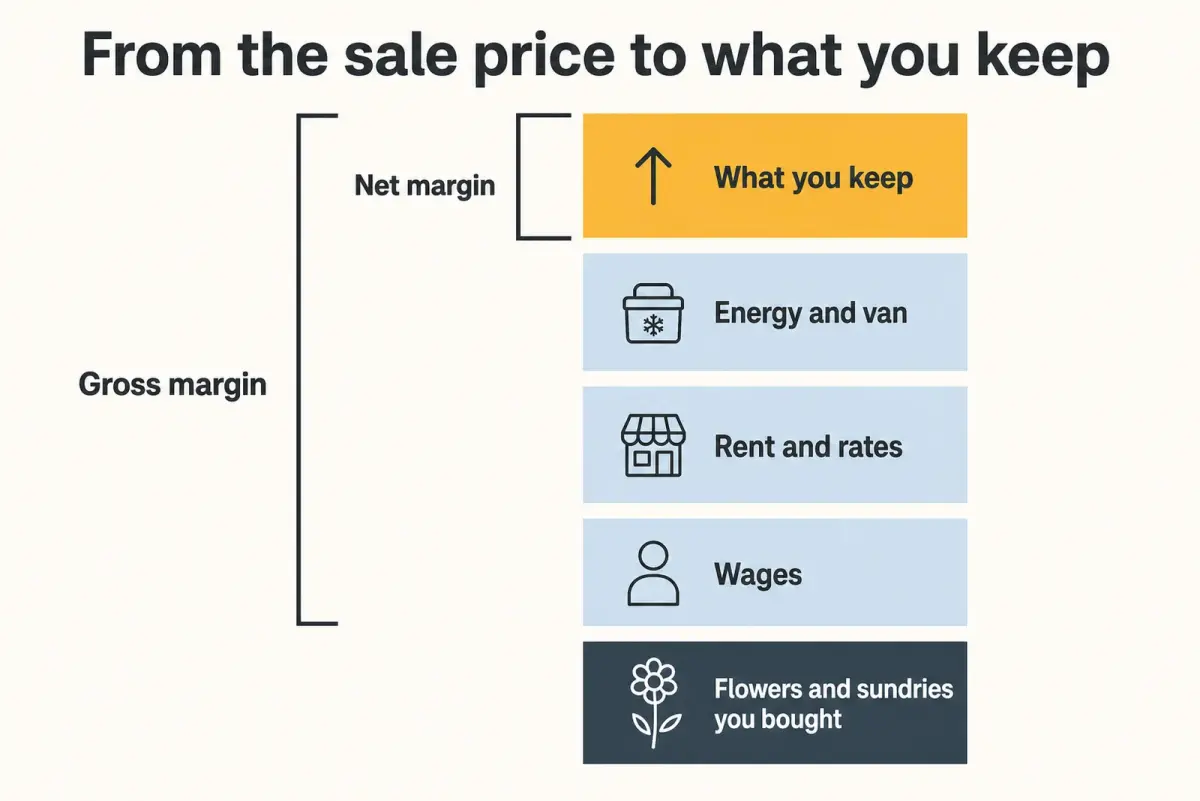
Gross margin tests the price you charged against the flowers you bought. Net margin tests whether the whole shop pays for itself.
The margin your books are hiding
Gross margin is takings minus the cost of goods sold, and the usual way to cost the goods is to add up the stems that went into the arrangements that sold. Sensible enough, and it is exactly why the number flatters.
You did not buy the stems that sold. You bought a delivery. Some went into a bouquet, some went into the bin on Thursday, and the wholesaler charged the same for both.
A stem that wilted in the bucket is not a rounding error outside your cost of sales. It is stock you paid for and threw away, and it belongs in the number.
Imagine a shop that bought £1,000 of fresh stock in a week and took £3,200 for made arrangements. Counted on the stems that reached a customer, gross margin reads 75%. Counted on the whole delivery, which is what left the bank, it reads 69%. Same week, same till roll, and the bin is the entire gap. These figures are invented.
Six points is not a rounding difference by the end of a year, and in that week the bin took all six. Which is why wastage is not a housekeeping problem filed away from margin. Wastage is margin, already spent.
How to work out both margins for one month
Both margins come off one month of paperwork: takings, every stock invoice, and every other cost. Two divisions give you the pair. Use a finished month, never the one you are still trading.
- Takings. Everything you sold that month, before any costs.
- Stock bought. Every wholesale invoice, plus foam, wrap, ribbon and card. Not the portion you think reached a customer.
- Gross profit. Takings minus line two, over takings, is your gross margin.
- Everything else. Wages including your own, rent, rates, energy, insurance, van, card fees, software, phone, accountant.
- Net profit. Gross profit minus line four, over takings, is your net margin.
Carry that shop through. Its gross profit of £2,200 has to cover that week's share of wages, rent, rates, energy, insurance and the van, and what survives is a net margin of 6%. The gross margin looked like a business. The net margin is the business.
Costed on the whole delivery, gross margin lands below whatever the multiple on the bench card implied, because that multiple only knew the stems that sold. Net margin then lands below gross by the width of the shop: the rota, the rent, the cooler, the van.
The wage floor sitting under your net margin
Three of the costs in that gap are set somewhere other than your shop, and wages are the heaviest. From 1 April 2026 the National Living Wage for workers aged 21 and over is £12.71 per hour.
If you employ anyone near that rate, it is a floor under your labour cost rather than a target you negotiate. Your accountant can give you the loaded cost of an hour instead of the headline one. Your own hours belong in the same line even when you never formally pay yourself. Your accounts will not show them that way, which is exactly why the stricter number is worth keeping beside them. A net margin that works only while the owner works free is a subsidy, not a margin.
What registering for VAT does to your margin
A UK business must register for VAT once its total taxable turnover for the last 12 months goes over £90,000, and the standard rate of VAT is 20%, applying to most goods and services.
The trap is arithmetic rather than legal. If your shelf prices do not move when you register, part of what used to be takings is tax you collect for someone else, and your net margin absorbs it. Ask your accountant which of your sales are standard rated well before you are near the threshold.
The multiplier on your business rates bill
Business rates can change without you selling a single stem differently. For the 2026 to 2027 tax year in England, a property eligible for the retail, hospitality and leisure multipliers uses a multiplier of 38.2 pence where its rateable value is below £51,000, against 43.2 pence at the same rateable value for a business that is not retail, leisure or hospitality.
Those multipliers replace the retail, hospitality and leisure rates relief offered for the 2025 to 2026 billing year, and a council may use a different multiplier for a shop. The rules differ in Scotland, Wales and Northern Ireland. So the job is small: find the multiplier printed on your bill and ring the council if it looks wrong for a shop.
Where florist margin actually leaks
Four leaks sit in the distance between the margin a florist expects and the one the accounts report: wastage, underpricing, unpaid delivery and habitual discounting. None of them is dramatic, which is why they last.
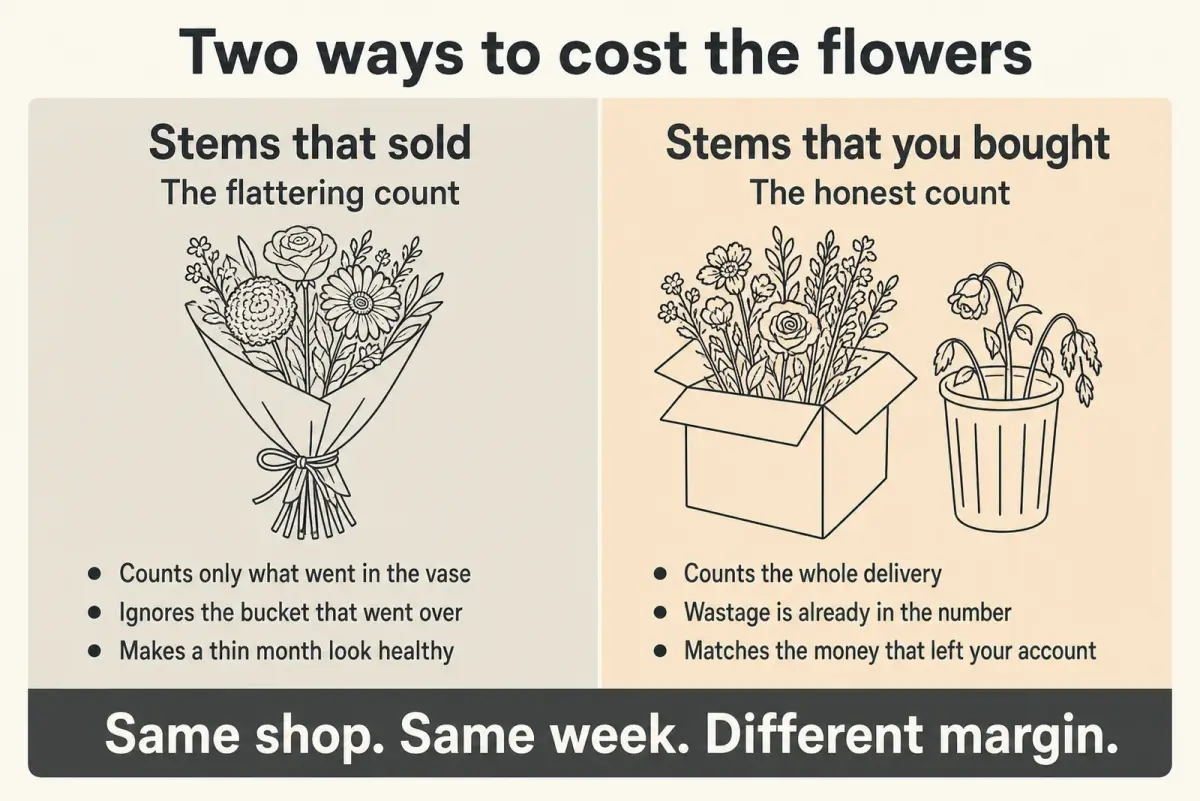
The same week costed two ways. Only one of them matches the money that left the account.
- Wastage. Stock you binned is margin you already bought.
- Underpricing. A price set by what feels sayable rather than what the arrangement cost. Pricing flowers online versus in store is the version worth checking first, because an online order carries costs a counter sale does not.
- Delivery. Driver time, fuel and the box cost something on every drop. Free delivery is not marketing spend unless you decided how much margin it may eat.
- Discounting. A tenner off comes off turnover and lands, pound for pound, on profit, because the flowers were bought before you waved it.
Take that shop again. A £10 goodwill discount comes off profit pound for pound: the stems were bought and the rent was owed before you gave it. The rule of thumb says a 6% net margin means £167 of fresh sales to replace it, but that divides by the wrong margin, because the rent and the rota do not rise when you sell one more bouquet. Earning £10 of new margin is nearer £15 of sales at that shop's 69%. These figures are invented.
You will not fix all four this week. Finding out which one is costing you most is a smaller and far more useful job.
What to do this week
- Pull last month's wholesale invoices and add them up in full.
- Work out gross margin on the whole spend, not the stems that sold.
- Add up every other cost for the same month and get your net margin.
- Find the multiplier printed on your business rates bill.
- Diarise a repeat after the quarter ends.
If you don't have time for all five, do the second one: the distance between the margin you assumed and the margin your invoices support is one division, and the most useful number here.
Margin decides what a sale is worth. Getting enough of them through the door is a different job, and LocalBrandHub handles that side for florists with seasonal campaigns, a social calendar and a visibility score.
Frequently asked questions
How often should a florist check their profit margins?
Once a quarter is a sensible starting rhythm, with an extra look whenever the wholesaler's list jumps or the statutory wage rates change in April. Adjust it once you see how much your months vary.
What is the typical profit margin for florists in the UK?
Ask any percentage you find online which UK businesses it counted and in which year. Work out your gross margin on the stock you bought and your net margin after every cost, and the answer is about your shop. How much florists make covers the earnings side.
What is the 3-5-8 rule in floristry?
It is one of several markup shorthands circulating in the trade, applying different multiples to different parts of an arrangement, and versions differ from shop to shop. No multiple can tell you your margin, because it knows nothing about your wastage, your wages or your rent.
Why is my flower shop busy but not profitable?
Because busy measures turnover and profit is decided by margin. A shop taking plenty on thin margins can keep less than a quieter one on healthy margins. The usual suspects are wastage, underpricing, unpaid delivery and discounting.
Does registering for VAT change my margin?
It changes what your shelf price contains. A business must register for VAT once total taxable turnover for the last 12 months goes over £90,000, and the standard rate is 20% and applies to most goods and services. If the label does not move, takings become tax.
For restaurants, salons, and local businesses
Need help with your marketing?
We help UK businesses turn social media into real results, not busywork.
Start freeKey Takeaway
Key takeaways: florist profit margins
- Cost the delivery, not the bouquet. Margin worked out on the stems that sold leaves the bin outside the sum.
- Two margins, two questions. Gross margin tests your pricing. Net margin tests your shop.
- The gap is the business. Wages, premises, energy and the van live in it and move on their own.
- Statutory costs shift under you. The National Living Wage for staff aged 21 and over is £12.71 an hour from April 2026, so a margin judged on last year's rota is out of date.
- One month beats any benchmark. Your invoices answer what a borrowed percentage only pretends to.
Sources
Get More Marketing Tips
Practical marketing tips for UK business owners, straight to your inbox. No spam, unsubscribe anytime.
About the Author
Local Brand Hub
Empowering UK Businesses
Local Brand Hub provides comprehensive business management tools designed specifically for UK local businesses to streamline operations, automate marketing, and grow revenue.
More articlesRelated Articles
 Business Growth
Wedding Flower Packages: How to Build and Price Them
Wedding flower packages for UK florists: build three tiers couples can count, fix the right things, and publish a price that survives the wait.
 Business Growth
Wedding Florist Pricing: How to Quote the Whole Day
Wedding florist pricing for UK flower shops: build the quote from the day itself, cost the hours and the miles properly, and know when VAT changes it.
 Business Growth
Florist Branding: A Brand That Travels With Flowers
Florist branding for UK flower shops: how to pick a name you can keep, get it right on Google, and make it travel on every bouquet you send out.