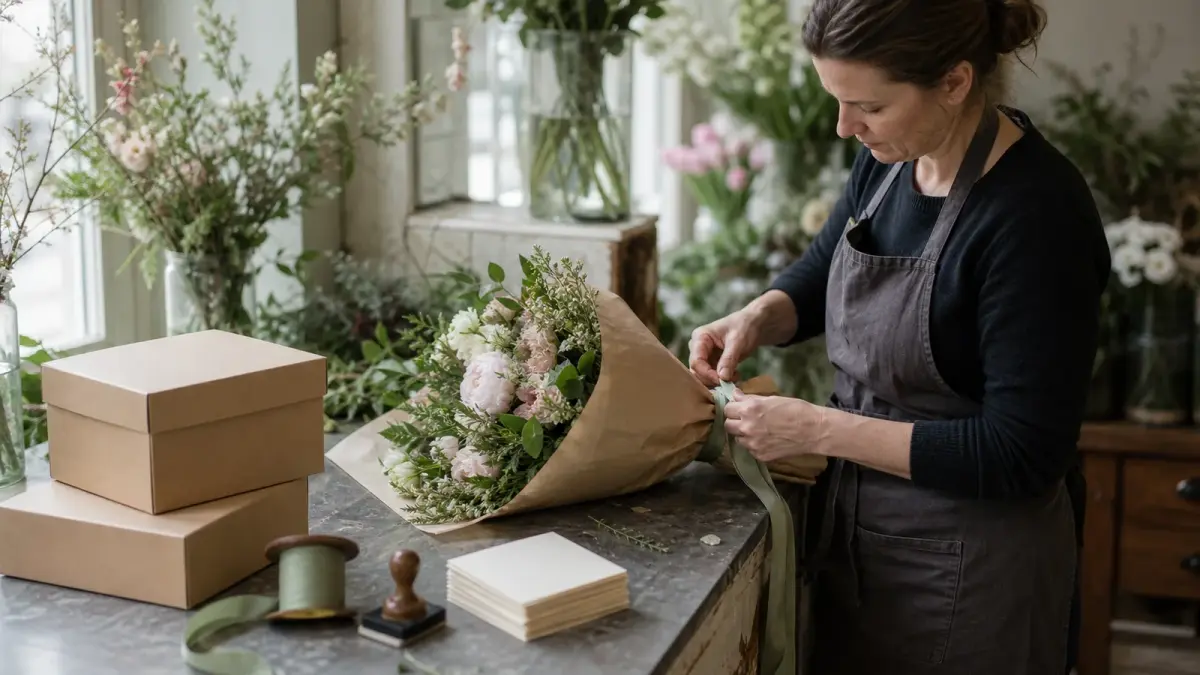
Florist branding for UK flower shops: how to pick a name you can keep, get it right on Google, and make it travel on every bouquet you send out.
Florist branding is the set of decisions that make your flower shop recognisable: the name, the look, the voice, and the surfaces they land on. For an independent florist who delivers, most of those surfaces leave the building, so the brand a new customer meets is often the one wrapped around a bouquet on somebody else's kitchen table.
Guides to florist branding are illustrated with a shopfront. Yours gets seen in a stranger's kitchen.
Much of what you sell is a gift, so the person unwrapping it never chose you and never scrolled your grid. For as long as the flowers last, that person keeps your marketing on their kitchen table, and if the wrap is plain and the card unsigned it tells them nothing about where the flowers came from. So every decision below gets one test: does it survive the journey?
Related: Flower Shop Name Ideas
What does florist branding actually include?
Five elements and the surfaces they land on: your name, your logo, your colours, your typefaces and your voice, used the same way everywhere a customer meets you. The elements are the easy half. Choosing which surfaces matter is the half that changes what you buy.
Split your surfaces into two piles.
Pile one, people who came looking. The shopfront sign, the website, the Google profile, the Instagram grid. That audience already wants a florist, so your job is to look like the right one.
Pile two, people who were handed you. The wrap, the ribbon, the care card, the message card, the box, the delivery note. Nobody here went looking for a florist.
A brand that only works on the first pile is a shop recognisable to people already standing outside it.
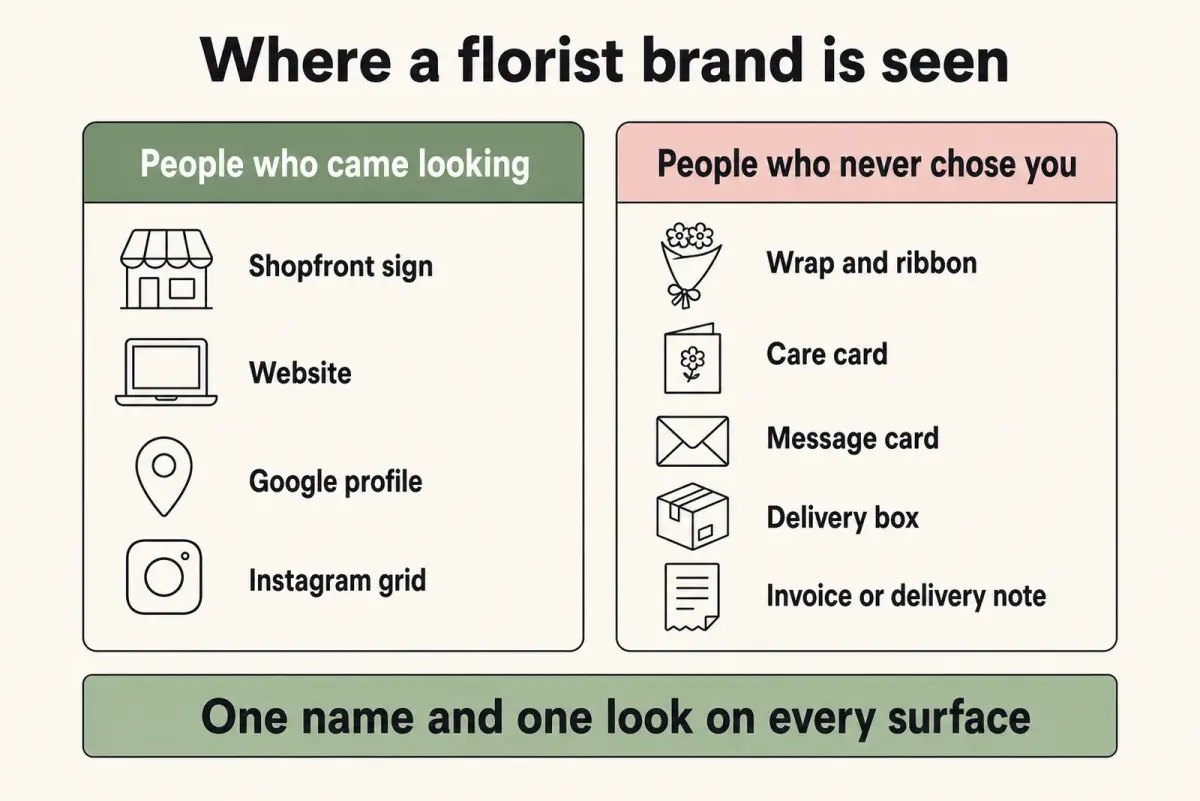
Two piles, one brand: surfaces customers seek out, and surfaces that arrive uninvited.
Who meets your brand without ever visiting you?
A gift order has two people in it and only one of them is your customer. The sender chose you. The recipient got you, and the recipient keeps your branding on a table for as long as the flowers last.
Imagine an order placed by a man in Leeds for his mother in Cornwall. He compared three florists at lunchtime and will have forgotten all three by Thursday. She keeps the bouquet on the kitchen table for a fortnight, tells friends where it came from if she can work that out, and is the one who might order a funeral tribute next spring.
So brand the outbound pile first, and brand it cheaply.
- The wrap. One paper and one ribbon colour, every order, all year. It is the surface that goes out most often, so it is the one worth settling first.
- The care card. Your name, how to order again, and how to keep the flowers alive. The third is the easy one to print and the first two are the easy ones to forget.
- The message card. Your handwriting is brand whether you meant it to be or not. One pen, one layout.
- The paperwork. GOV.UK tells sole traders they must include their own name and their business name, if they have one, on official paperwork, for example invoices and letters. It carries your name anyway, so let it carry your look.
Your window sells to somebody already standing outside it. Your wrapping sells to somebody who has never heard of you.
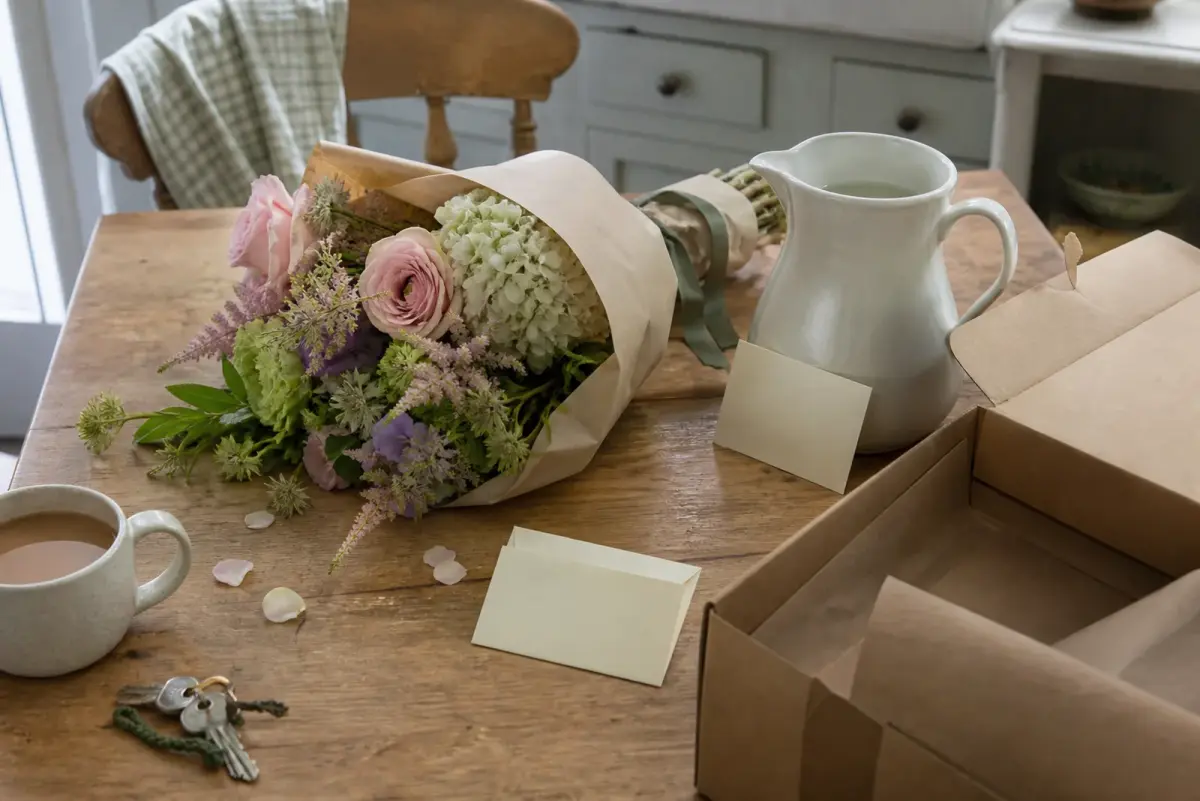
The recipient's view: wrap, card and box are the whole brand for someone who never chose you.
How do you choose a florist name you can keep?
Pick a name that still fits when you move premises or change what you sell most of, then check it before anything is painted, printed or signwritten. It is the element customers say out loud, and the one both the law and Google have opinions about.
GOV.UK is blunt about what a sole trader cannot be called. Sole trader names must not include 'limited', 'Ltd', 'limited liability partnership', 'LLP', 'public limited company' or 'plc', must not be offensive, and must not be too similar to another company's trademarked name, because you may have to change it if someone makes a complaint.
Read the last one twice: a name you are made to change is a rebrand you did not budget for, and it lands on the sign, the van, the wrap and the cards at once.
If the name is doing real work for you, the Intellectual Property Office publishes the registration fee: £205 to register a single trade mark in one class, and £60 for each additional class. Whether that is worth paying turns on how much of your trade travels on the name rather than on your face and your flowers.
Three cheap tests before you commit, none official.
- The phone test. Say it to somebody and ask them to spell it back. If they cannot spell it, neither can the person trying to type you into Google.
- The move test. Would it survive new premises, a wedding heavy year, or dropping the product it names?
- The register test. Search the name with 'florist' and your county, then search the trade mark register. Finding nothing proves little; finding a near twin two towns over is a decision better made now than after the van is signwritten.
For generating and stress testing options, flower shop name ideas does the legwork.
What should your flower shop be called on Google?
The same thing it is called on your door. Google's guidelines ask for the name you already use out in the world, and treat a stuffed name as a risk to the profile itself.
Google says your name should reflect your business's real-world name, as used consistently on your shopfront, website, stationery and as known to customers. The listing is meant to match the sign, and the sign is meant to match the cards.
Google is equally clear about the other direction: including unnecessary information in your business name is not permitted, and could result in suspension of your Business Profile.
The name field holds the name. So 'Petal and Stem' is a name, while 'Petal and Stem Florist Flower Delivery Manchester Same Day' is a suspension risk wearing a name badge. Where you deliver, when you open and what you are belong in the other parts of the profile.
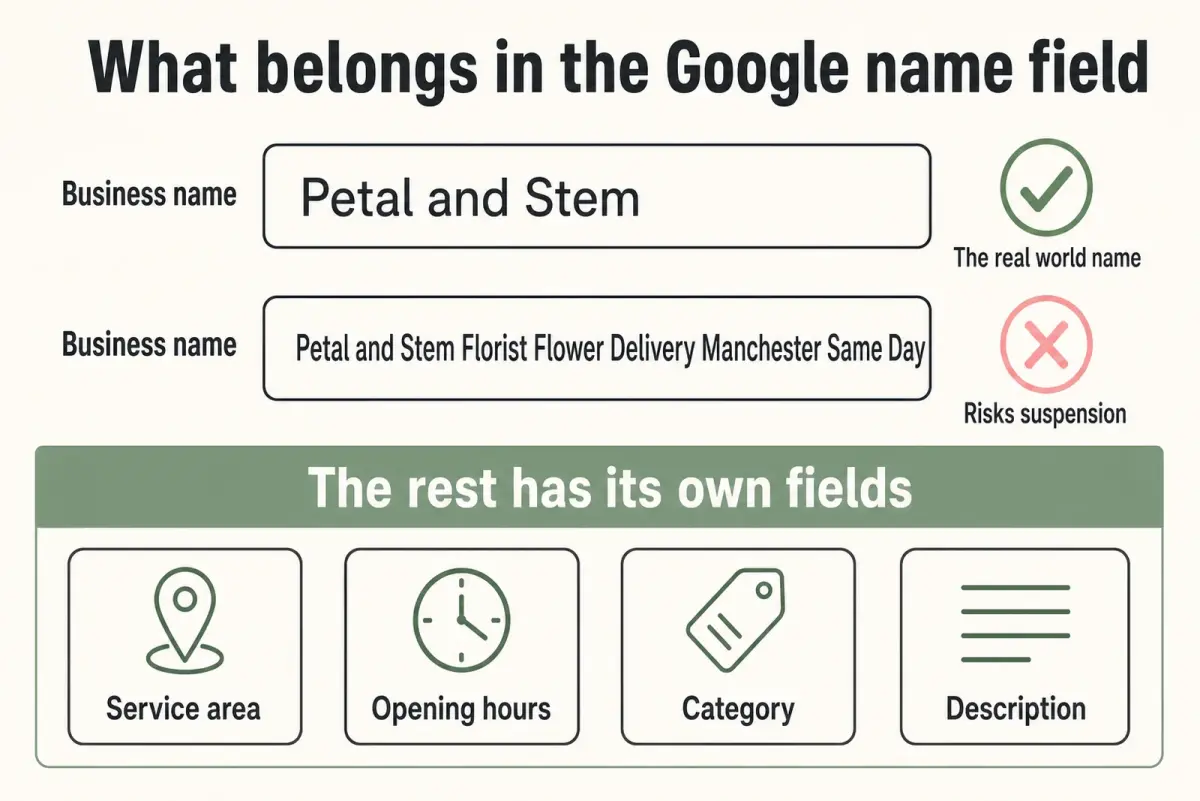
The name field takes the name. The delivery area, the hours and the category each have a field of their own.
If you rebrand, move the door and the listing in the same week. Two versions of you on the internet is a puzzle you are handing to a stranger who only wanted to send flowers. More on the listing in florist local SEO.
Design a look that survives kraft paper
Your logo will spend most of its working life small, single colour and printed on something brown. Commission it for that, not for the top of a website.
One colour, small. A rubber stamp, a printed ribbon and a kraft box are one colour surfaces, so a mark that only sings in four colours at full width has nowhere to go on any of them. Ask for a one colour version when you commission it. Our florist logo guide covers what to brief and which files to ask for.
Behind the flowers, not in front of them. Your palette shares every photograph with stems you did not choose. A colour that argues with peonies in June and dahlias in September is one you will abandon by spring, which is why muted tones tend to outlast bright ones here. Choose against your actual buying rather than a mood board, and see florist brand colours for narrowing it down.
Voice is a visual decision on a card. Settle how you sign off a message card and how you answer a funeral enquiry, and the two hardest pieces of your voice are done; the rest is copying yourself. Keeping that look and those words going out week after week is the dull half of branding, and on the social side it is what LocalBrandHub's post templates and calendar are there to handle.
What does florist branding cost?
The decisions that do the most work are free, and they set the price of everything after them. One name, one wrap, one palette, one voice, repeated until people recognise them: none of that carries an invoice, and all of it limits what a designer can usefully sell you later. The paid half is a logo you can stamp, a sign that matches it, and cards that do not feel like a receipt, which is where florist business cards usually starts the spending.
Frequently Asked Questions
What is florist branding?
Your name, logo, colours, typefaces and voice, applied consistently to every surface a customer meets, from the shopfront sign to the ribbon on a hand tie. For an independent shop the surfaces that travel out with orders do the heaviest work, because they reach people who never went looking for a florist.
Do I need a trade mark for my flower shop name?
No. Registering is optional, not a condition of trading under the name. Consider it when the name itself carries the business, for example when you sell beyond your delivery radius. The Intellectual Property Office publishes the cost: £205 for one class, plus £60 for each additional class.
What should my florist business be called on Google?
Whatever it is called in the real world. Google asks that the name reflect the business's real-world name as used consistently on your shopfront, website and stationery. Adding delivery terms or a town to the name field is not permitted and risks suspension of the profile.
What is the 3-5-8 rule for florists?
A floral design convention about proportion, not a branding rule: the versions you will see quoted talk about odd numbers and staggered heights inside an arrangement. It shapes the vase, not the card, and the card is where a customer finds out who you are.
How do I brand my flower shop on a budget?
Spend the free decisions first: one name, one wrap and ribbon, two or three colours, one voice. Then put your name and a way to reorder on every care card. A stamp and a consistent paper get used on every order. A logo you commission and then print on nothing does not.
Where to start this week
Branding is not a project with an end date. It is a set of defaults you stop renegotiating, and the cheap ones get set this week.
Key Takeaway
Weekly Action
- Choose one wrap and one ribbon colour and use them on every order this week
- Put your shop name and a way to reorder on the care card
- Read your Google profile name out loud and delete everything that is not the name
- Say your business name down the phone and ask for it back, spelled
Ask the recipient's question. If the paper came off in a stranger's kitchen and nobody could say where the flowers came from, that is where your branding work starts.
For restaurants, salons, and local businesses
Need help with your marketing?
We help UK businesses turn social media into real results, not busywork.
Start freeSources
Get More Marketing Tips
Practical marketing tips for UK business owners, straight to your inbox. No spam, unsubscribe anytime.
About the Author
Local Brand Hub
Empowering UK Businesses
Local Brand Hub provides comprehensive business management tools designed specifically for UK local businesses to streamline operations, automate marketing, and grow revenue.
More articlesRelated Articles
 Business Growth
Flower Shop Name Ideas You Can Actually Own
Flower shop name ideas across six styles, plus the UK checks that decide which one you can keep: Companies House rules, trade marks, domains and handles.
 Business Growth
How Much Do Florists Make? UK Salary & Profit Guide
How much do florists make in the UK? A realistic guide to florist salaries, shop profit margins, and how to make a florist business pay.
 Business Growth
Florist Business Plan: A Simple UK Template & Guide
A florist business plan made simple: a UK template and step-by-step guide to the sections that matter, so you can plan a flower shop without the jargon.