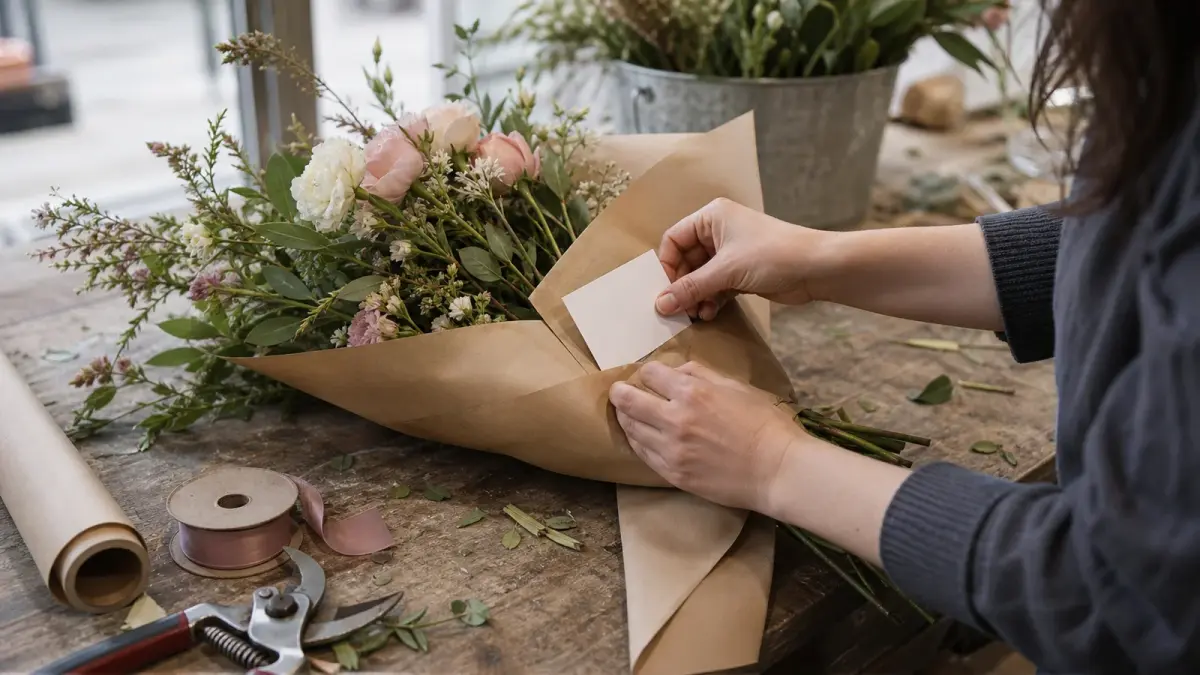
What to put on a florist business card, what UK law actually asks of yours, how to handle the QR code, and a card spec you can copy straight to a printer.
A florist business card needs five things: your shop name, what you actually make, one phone number, where to find you online, and a link worth scanning. Write it for the person most likely to read it, who is usually not your customer but the stranger holding the bouquet they were sent.
Florist business cards are one of the few pieces of marketing that arrive at a stranger's door on purpose. Most trades hand a card to the person who paid. Yours goes folded into the wrap, to someone who did not choose you and could not name your shop.
That difference decides everything else on the card, and it is why the templates on sale look so interchangeable. A template knows what a business card looks like, not what yours has to survive.
Who is your florist business card actually for?
Two people read a florist business card: the customer who bought the flowers, and the stranger they were sent to. Only one of them knows you.
The buyer already has your number. They found you, rang you, described their mother's favourite colours and paid. A card in their hand is a reminder, a modest job.
The recipient is the interesting one. They are holding your best work at its best moment, they have no idea who made it, and the card is the only thing in that bouquet carrying your name.
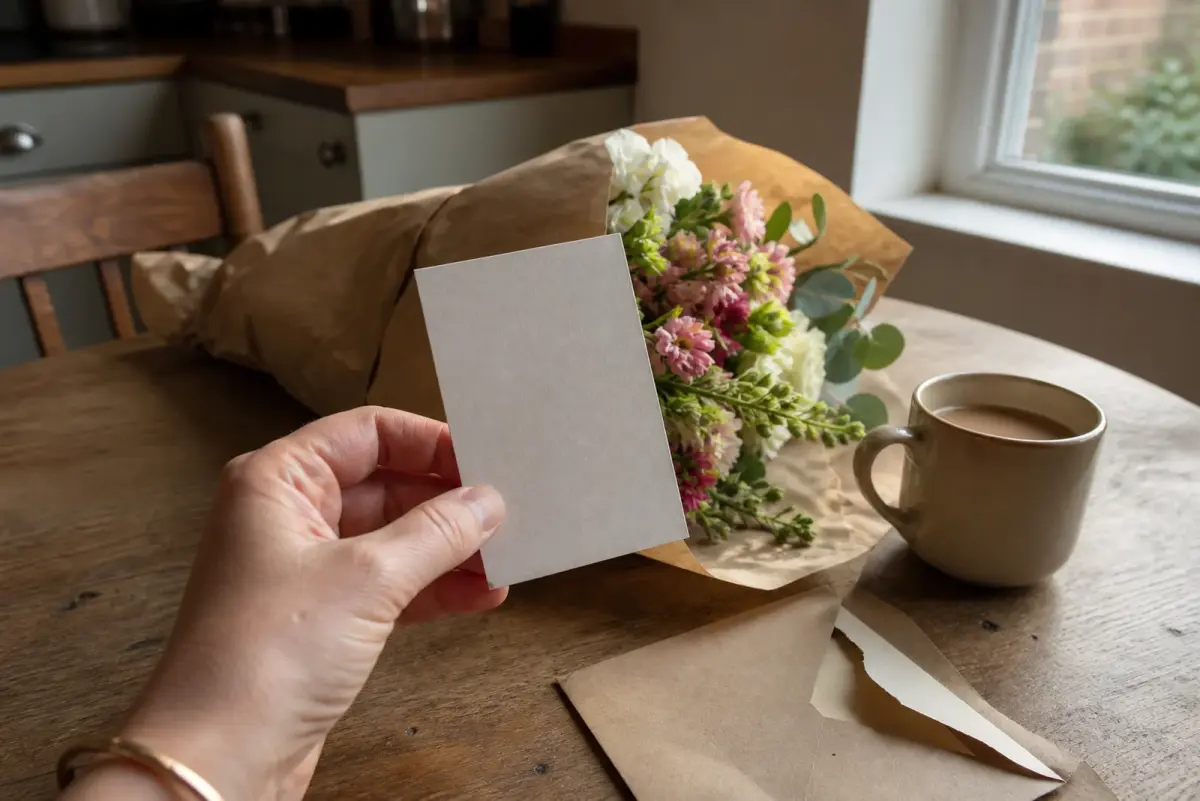
The card in the wrap is read by someone who did not choose you, in a good mood, phone in hand.
Write for the stranger and the buyer still gets a usable card. It rarely works the other way round. "Bespoke floral design" gives a recipient nothing to act on, while "wedding, funeral and weekly flowers, delivered across [your town]" says what you would say if you were standing there.
Your card is not a contact detail. It is an introduction you are not present for.
What should a florist business card include?
Five lines, each with a job. A line without one is stealing space from the four that have.
- Your shop name. Big enough to read at arm's length, where the card gets held.
- What you actually make. Not your sector, your work: weddings, funerals, weekly office flowers, workshops. Four words beats a service list.
- One phone number. The one someone answers. Two numbers hand a stranger a decision you have no reason to give them.
- Where to find you online. A website, or the social account you genuinely post on. A dead handle is worse than none.
- A reason to turn the card over. Order online, book a consultation, see the wedding gallery. One reason, not three.
The spec to copy to your printer. Every square bracket is a placeholder: replace all of them with details you have checked this week, and delete any line you cannot fill honestly. Print is not editable.
FRONT
[Shop name]
[What you make, four words maximum]
[One phone number, the one that gets answered]
[yourshop.co.uk]
[@yourhandle]

BACK
[One line telling them what to do next]
[QR code pointing at the page that does it]
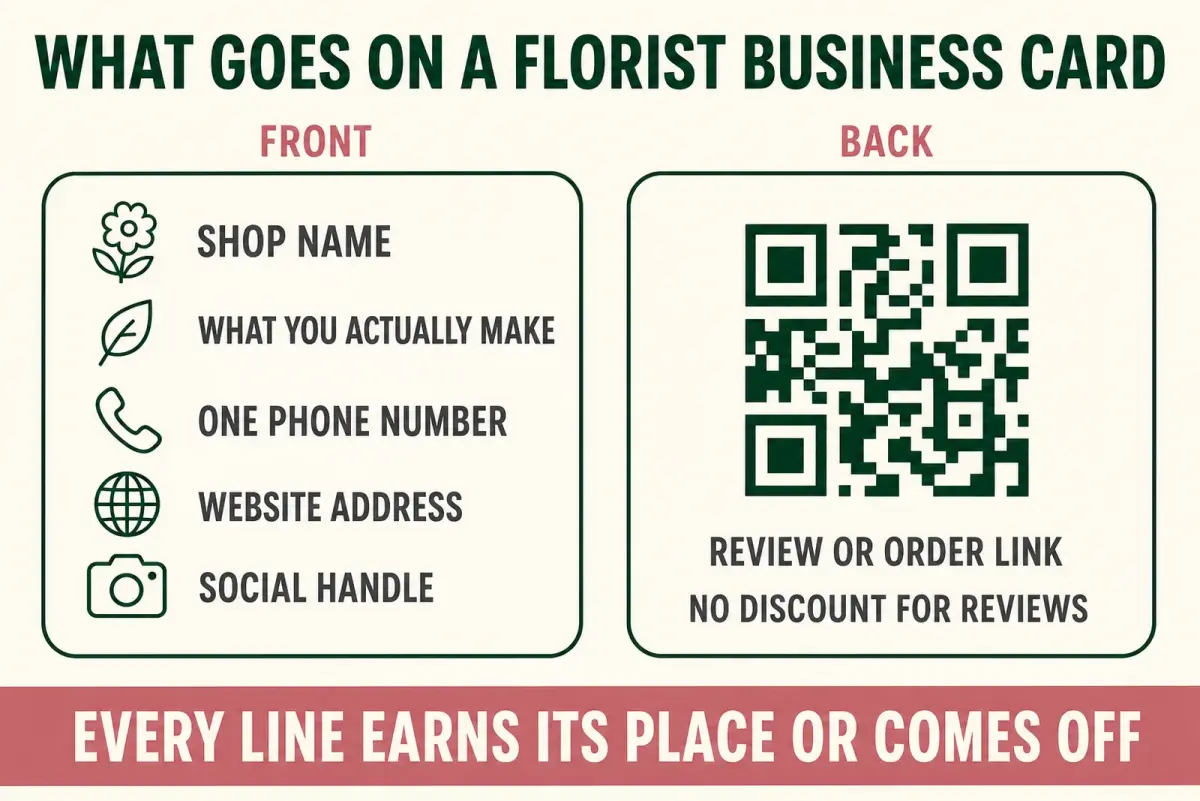
Front and back have different jobs. The front says who made this. The back gives them one thing to do about it.
Notice what is missing: your address, your opening hours, six services, and "quality flowers for all occasions". Hours and addresses change, and your website carries them better.
Related: Florist Logo Design Ideas
What do you have to put on a business card by law in the UK?
The legal list is short. What is on it depends on how the business is set up.
If you trade as a limited company. GOV.UK states that a limited company must include its company name on all company documents, publicity and letters. The page does not name business cards, but a card printed to promote the shop is publicity on any ordinary reading of the word, so put the registered company name on it and stop thinking about it.
The longer list belongs somewhere else. GOV.UK states that on business letters, order forms and websites a limited company must show its registered number, its registered office address, where the company is registered (England and Wales, Scotland or Northern Ireland), and the fact that it is a limited company. Letters, order forms and websites. Cards are not on that list, so a company number on yours is your decision rather than the rule's.
If you are a sole trader. GOV.UK states that you must include your name and business name, if you have one, on official paperwork, for example invoices and letters. The duty is written about official paperwork and gives invoices and letters as its examples, so it does not settle the card either way. The rule beside it does follow you onto the card, because it governs the name itself: GOV.UK states that sole trader names must not include limited, Ltd, limited liability partnership, LLP, public limited company or plc.
Why this matters: "Ltd" typeset after a shop name looks established and costs nothing to add at the printer. If you are not a company, it is not yours to use, and print runs the whole batch before anyone notices. If you are structured as something else, a partnership say, check the GOV.UK page for that structure instead.
Related: Flower Shop Name Ideas
Should a florist business card have a QR code?
Yes, provided the code goes somewhere that does a job for whoever is scanning it.
A review link is the obvious candidate and it is properly supported. Google Business Profile Help states that to leave reviews you can ask customers to visit a Google link or scan a QR code.
Use your own link. Take it from your Business Profile rather than a free generator routing through a domain you do not control. Scan the printed proof yourself before approving the run, and ask for a professional printed proof rather than a screen mock up.
Point it at the right person. A review code inside a gift bouquet asks a stranger to review a shop they never bought from. Send the card in the wrap to your shop or gallery, and save the review link for the card you hand over yourself, after a wedding or funeral you know went well.
One line the card must never carry.
Google's prohibited and restricted content policy states that Google does not allow merchants or users to offer incentives, such as payment, discounts, free goods or services, in exchange for posting any review or the revision or removal of a negative review.
Money off in return for a review is a policy breach ordered in bulk, sitting in a box under the counter where nobody can quietly delete it.
Getting found by people who never received a bouquet is a separate job: florist local SEO.
What is the most common mistake on a florist business card?
One mistake sits underneath the rest: ordering the card before deciding what it is supposed to make happen next. Everything else here follows from it.
- No next step. A card that only announces you is a card with nothing to do.
- A big first run. Numbers, handles and domains can all move inside a first year. Print the smallest batch the printer will sell you.
- Six services in tiny type. Few people read a card twice. Say the one thing you want to be rung about.
- A handle you abandoned. Sending a warm stranger to an account last posted on two summers ago undoes the flowers.
- Stock that cannot cope with damp. Speak to your printer about what the stock does when it gets wet, and hold a sample under a tap before you commit.
The damp one is specific to this trade: a card that behaves impeccably in an estate agent's window can arrive blotched from a bouquet.
Frequently Asked Questions
How much should I pay for 500 business cards?
There is no honest single figure, because printers quote on quantity, stock, finish and turnaround, and a number printed here would be stale before you ordered. What you can control is the comparison. Write one spec (size, stock weight, finish, one side or two, turnaround), send that identical spec to three printers, and read the quotes side by side. A rush turnaround quietly undoes a cheap price.
What are some good slogans for a floral business?
Most florists do not need one. A line saying what you make and who for beats a slogan nobody remembers: "Weddings, funerals and Friday flowers, delivered across [your town]", or "Arranged here every morning, not boxed in a warehouse". Treat both as placeholders, and print the second only if it is true of your shop. One test before you commit: could the florist two streets away print the same words? If they could, the line is doing little for you.
What is the 3-5-8 rule for florists?
Nothing to do with business cards. It is a proportion convention from floral design rather than a rule about print: odd numbers, and the main heights of an arrangement staggered roughly three to five to eight. It surfaces in card searches only because florists and card buyers type the same words.
What are people using now instead of business cards?
Phone to phone contact sharing and QR links, both of which need the other person present and holding a phone. A card folded into a bouquet needs neither, and arrives when the flowers do. Use the digital version at wedding fairs and the printed one on deliveries.
What size are florist business cards in the UK?
The standard UK business card is 85mm by 55mm. Ask your printer for its artwork template and bleed specification, and keep your name and number clear of the trim edge so a millimetre of drift does not cost you a digit.
The Short Version
Design the card for the stranger in the kitchen, not the buyer who has your number.
Key Takeaway
- Five lines, each with a job, and nothing else on the card.
- The legal ask is narrow. A company carries its name on publicity; the registered number list is written for letters, order forms and websites.
- A sole trader name may not wear Ltd.
- Aim the QR code at the right person, and never trade a discount for a review.
- Print small until the details settle.
Weekly Action
- Write your five lines out and delete anything failing the "what job does this do" test
- Check the number, domain and handle are all live today
- Decide which card gets the review link and which gets the shop link
- Order the smallest run your printer offers
Once the cards are out, the contacts and reviews they earn need working, and that is the part that slips in a busy week. Florist customer retention covers what happens after the card lands, and LocalBrandHub helps you manage and respond to your own reviews so a good delivery does not end in silence.
For restaurants, salons, and local businesses
Need help with your marketing?
We help UK businesses turn social media into real results, not busywork.
Start freeSources
Get More Marketing Tips
Practical marketing tips for UK business owners, straight to your inbox. No spam, unsubscribe anytime.
About the Author
Local Brand Hub
Empowering UK Businesses
Local Brand Hub provides comprehensive business management tools designed specifically for UK local businesses to streamline operations, automate marketing, and grow revenue.
More articlesRelated Articles
 Marketing Tips
Wedding Flower Consultation: The Florist's Question Sheet
How to run a wedding flower consultation that ends in a quotable list of pieces, with a copyable question sheet to send couples before you meet.
 Marketing Tips
Florist Pre Orders: Run One Round Without the Panic
Florist pre orders for UK flower shops: when to open the round, what the order page has to settle, how to date the cut off, and how to fill the list.
 Marketing Tips
Christmas Flower Sales: The Florist's December Plan
Christmas flower sales for florists: set your festive range, workshop and pre-order dates, price against current stock costs, and pick your December hours.