Florist logo design that survives real life: four styles judged at label size, five files to ask for before you pay, and what registering the mark costs.
Your logo is the small, repeatable mark that goes on your ribbon, your labels, your van and your Google profile, so it has to survive being shrunk, printed in one colour and cropped square. Style matters less than reproduction. Get the files and the rights in writing, and the mark is properly yours.
Almost every guide to logo design for florists is written from the designer's side of the desk, where the mark is presented full width on a clean white screen and everybody nods. Nobody nods at half past six on a Tuesday in February, when the stamp is drying wrong and the tag says nothing legible at all.
What you'll learn
- Why the reduction test settles most logo arguments
- Four flower shop logo styles, and what each one gives up
- How to brief a template tool, a freelancer or a studio
- The five files to ask for before you pay
- What registration costs, and when a logo makes claims
What the mark actually has to survive
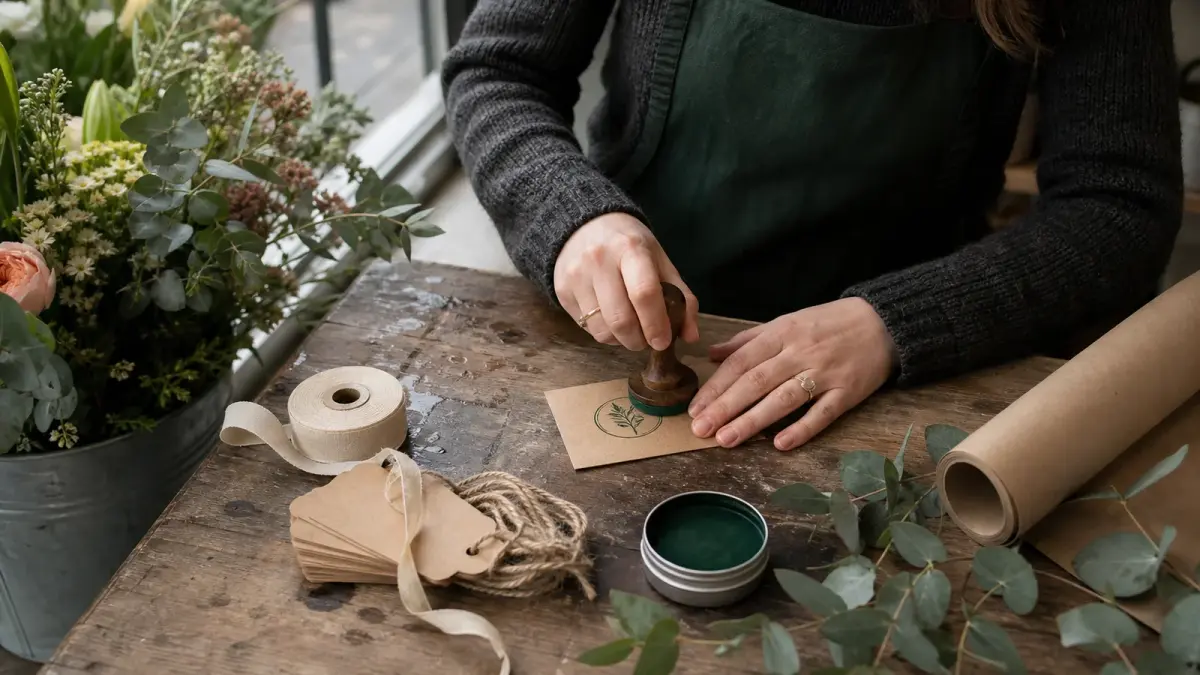
Your logo does not live on your website. It lives on a gift tag held in cold hands at a front door, on a small circle beside your name in a search result, on a rubber stamp pressed into kraft card before the shop opens, and on a van door cut in one colour of vinyl. None of those surfaces flatter it.
So test it where it lives.
The reduction test: print the mark about 25 mm wide, in black only, on the cheapest paper in the shop. What survives is your real logo.
Say the print comes back with the shop name closed into a grey bar, the stem reduced to a blob, and only the initial still doing its job. That is not a printing fault to fix later. It is the mark telling you which part of itself is load bearing, in the week when a hundred Mother's Day tags depend on the answer.
The test also ends arguments without anyone's taste being on trial. Colour, typeface and the rest of your florist branding can be revisited later; legibility at small size cannot be bolted on afterwards.
Florist logo ideas: four styles and what each gives up
There are four shapes to choose between, and each one charges you for what it gives.
- Wordmark. The shop name set in one distinctive typeface. Cheapest to make and hardest to hide behind, because it is only as good as the name doing the work.
- Monogram. Two or three initials locked into a compact shape. Of the four it survives stamps, wax seals and embossing best, because there is least detail to fill in, and it tells a stranger nothing about flowers.
- Icon and name. A plain botanical mark beside the name, drawn so the icon can travel alone on a label while the full lockup goes on the sign. The most flexible option, and the easiest to over detail.
- Badge. Name and icon inside a ring or crest. It looks long established and sits beautifully on a stamp, and it is the style most likely to fill in when it shrinks, because a ring, lettering and an icon are all competing for the same few millimetres, so draw the stripped back version at the same time.
A thought experiment. Two shops, the same budget. One commissions a detailed peony inside a crest; the other asks for a wordmark plus a single leaf that can stand alone. A year on, the first is still buying printed stickers because the crest goes muddy on ribbon. The difference was not money or taste. It was whether anyone tested the mark small.
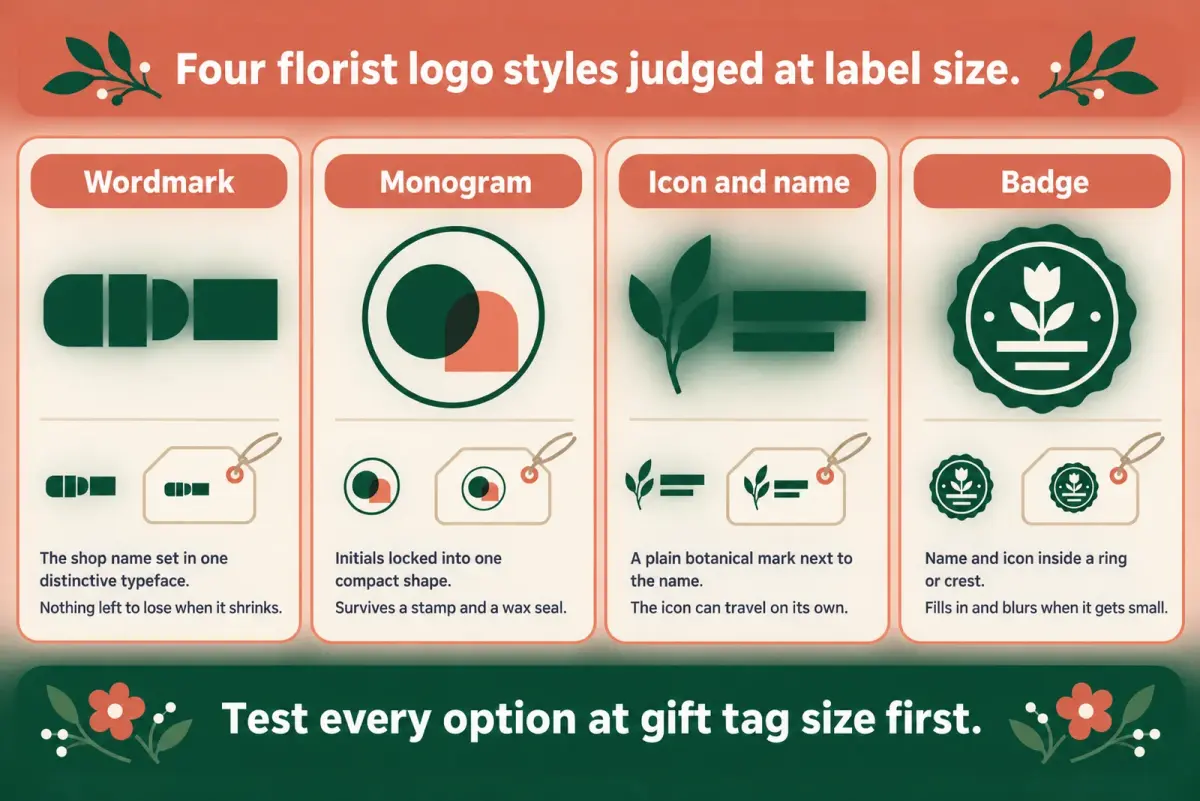
Each style shown twice: once at presentation size, once at the size customers actually meet it.
Three routes to getting one drawn
Three routes lead to a finished mark, and the difference that matters is not price. It is exclusivity, and the brief you hand over.
- Template tool. A florist logo maker gets you something usable in an afternoon for very little. Ask one question first: are these elements exclusive to you? A mark other shops can pick off the same shelf identifies a category rather than a business.
- Freelance designer. Custom work at a fixed fee agreed up front. The brief is what you are really buying, so put the small size test and the file list into it before you agree a price.
- Branding studio. A full identity, palette, typefaces and usage rules. Worth it across several sites or a wholesale line, and heavy going for one shop.
Whichever route you take, brief the constraint rather than the mood. Imagine the same freelancer opening two briefs on the same morning: one asks for something elegant and botanical, the other asks for a mark that still reads at 25 mm in black on kraft card. The second brief gets a usable logo; the first gets three rounds of revisions and a bill for them.
Which files should you ask for?
A logo is not a picture, it is a set of files. Ask for all five before the final payment, not eighteen months later when a specialist sign maker needs artwork and nobody can find it.
- Vector master file. SVG or EPS, the version that scales to a shop sign or a van without softening.
- Transparent background PNG. For laying the mark over photographs and window graphics.
- One colour version. Solid black and solid white, for stamps, foil, embroidery and printed ribbon.
- Square crop. For your profile pictures and social avatars. Google's own Business Profile help lists JPG or PNG format, a file between 10 KB and 5 MB, and a recommended resolution of 720 px by 720 px with a minimum of 250 px, for the photos you upload to a Business Profile.
- A written handover. One plain sentence confirming the rights in the design pass to your business, signed by whoever drew it.
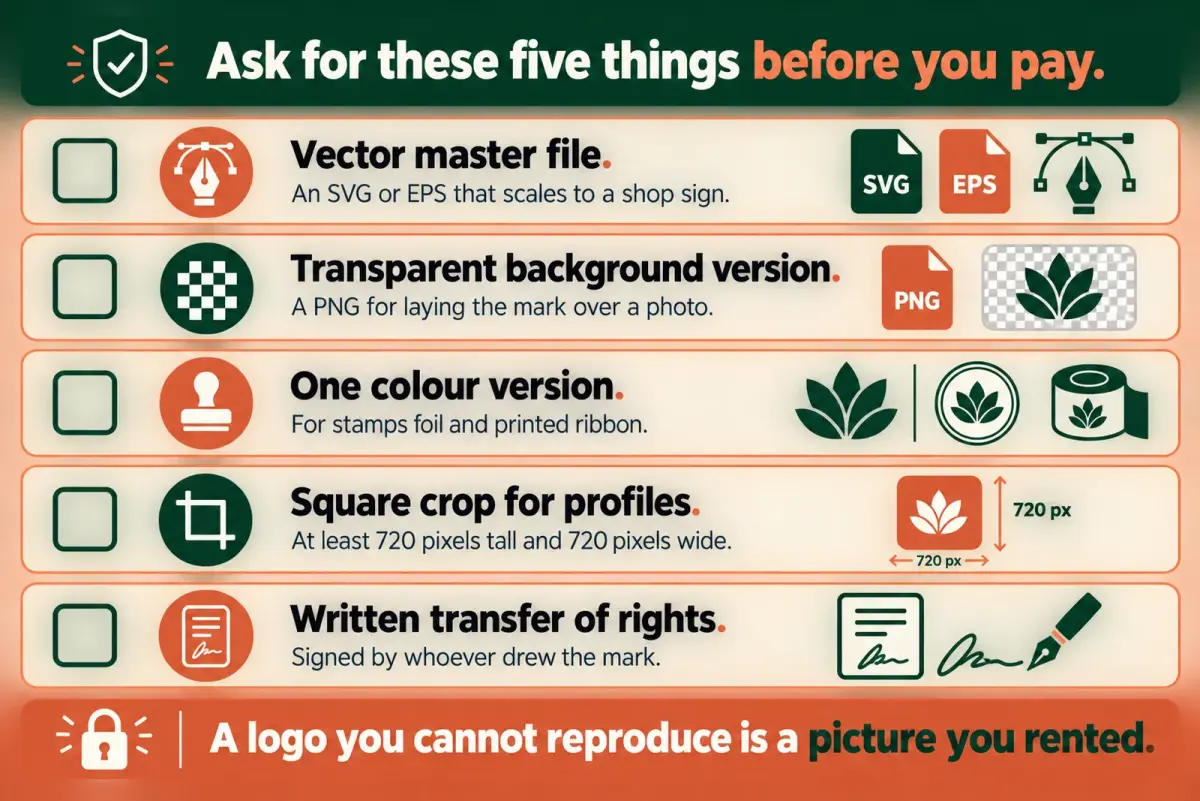
The list to paste into your brief, whichever route you take.
Keep all five in one folder with the artwork you already send to printers for your florist business cards, and the next supplier who asks gets the right file first time.
What you own, and what registration costs
The written handover is easy to skip and expensive to skip: paying an invoice and owning a design are two different questions, and only paperwork answers the second. Sort it while everyone is cheerful and the invoice is unpaid.
Registering the mark
Registration is a choice, not a chore. GOV.UK currently puts the cost at £205 to register a single trade mark in one class, and £60 for each additional class, so check the fee page on the day you file. That formal right is worth more to a shop with a delivery area and a wedding book than to a stall trading for one summer. Classes are where it gets fiddly, so consult a trade mark attorney if yours look ambiguous.
One detail is made for logos. GOV.UK says that where you have several versions of your trade mark, for example different colours of your logo, you may be able to make a series application, which covers up to 6 variations and costs less than registering them all separately. Worth knowing before your designer sends five colourways.
Related: The wider florist branding system
When a logo starts making claims
A logo makes promises, and some promises are regulated. The Competition and Markets Authority's guidance on environmental claims says businesses should consider carefully whether the visual symbols they use create a misleading effect, and that there should be a direct and verifiable link between those symbols and the meaning consumers are likely to draw from them.
A leaf in a flower shop's mark is not automatically an eco claim; what it sits beside is what decides. Put it next to a recycling style arrow or inside a certification shaped ring and it reads as a statement rather than decoration, and the question becomes whether the link between symbol and meaning is direct and verifiable. If your stems come from a Dutch auction three times a week, a logo whispering about locally grown is doing work your supply chain cannot back.
Why this matters: a symbol you cannot back is the part of a logo that gets more expensive the better it works, because it reaches every tag, van and invoice long before anybody asks you to prove it.
Marks that belong to someone else
Membership marks are stricter still, because they are not yours. The British Florist Association's terms say membership and use of the BFA logo only apply to a shop or studio approved by its membership department, and that it is not permitted to use the logo in connection with any other business or shop outside of the membership.
Any other network badge or competition mark on your window deserves the same check. Marks like these are granted rather than bought, so read the terms you agreed to and find out what happens to your right to use one when the membership lapses.
Frequently asked questions
How do I make a logo for my flower shop?
Decide the style first (wordmark, monogram, icon and name, or badge), then pick a route: template tool, freelancer or branding studio. Whichever you choose, write the small size test into the brief and ask for the file set before you pay.
How much does a florist logo cost?
Design costs run from almost nothing for a template you customise yourself to a per job quote from a freelancer or studio, and quotes vary too widely for a published figure to help. Registration is separate and public: GOV.UK currently puts it at £205 for one class, plus £60 for each additional class.
What makes a good flower shop logo?
It stays legible when shrunk, printed in one colour and cropped square, and it looks like the shop it belongs to. Detailed illustration is fine, as long as a simplified small version is drawn alongside it.
What file formats do I need for a florist logo?
A vector master (SVG or EPS) for signage, a transparent PNG for overlays, a one colour version for stamps and ribbon, and a square crop for profiles. For the photos you upload to a Business Profile, Google's help lists JPG or PNG, between 10 KB and 5 MB, and a recommended 720 px by 720 px.
Can I register my florist logo as a trade mark?
You can apply to the Intellectual Property Office. GOV.UK says a series application may cover up to 6 variations of a mark, for example different colours of your logo, for less than registering them separately. Check what your chosen classes cover before you pay.
Where to start this week
Start with the cheapest test in this article: one afternoon, a printer and the mark you already have.
Weekly action
- Print your current logo at 25 mm wide in black only
- Pick the style you are actually competing in
- Write the brief around the constraint, not the mood
- Collect all five files in one folder, including the written handover
- Set the square crop as your Google and social picture
Once the mark is settled, the work is repetition rather than design. Putting it in front of local customers week after week is what LocalBrandHub is built for, with a free social post generator and a month view calendar.
Key takeaways
Key Takeaway
A florist logo earns its keep at the size nobody designs for: on a tag, in one colour, on cheap paper.
- Judge it small. Gift tag size, one colour, cheap paper.
- Four styles, four trade offs. Wordmark, monogram, icon and name, badge.
- Brief the constraint, not the mood.
- Five files or it is not delivered, including the written handover.
- Watch what the mark implies: symbols and badges carry rules.
For restaurants, salons, and local businesses
Need help with your marketing?
We help UK businesses turn social media into real results, not busywork.
Start freeSources
Get More Marketing Tips
Practical marketing tips for UK business owners, straight to your inbox. No spam, unsubscribe anytime.
About the Author
Local Brand Hub
Empowering UK Businesses
Local Brand Hub provides comprehensive business management tools designed specifically for UK local businesses to streamline operations, automate marketing, and grow revenue.
More articlesRelated Articles
 Marketing Tips
Florist Brand Colours: Choosing a Palette That Lasts
How to choose florist brand colours: four palettes with hex codes, the job each colour does, and the two tests that decide whether yours works.
 Marketing Tips
Florist Business Cards: What to Put on One That Works
What to put on a florist business card, what UK law actually asks of yours, how to handle the QR code, and a card spec you can copy straight to a printer.
 Business Growth
Flower Shop Name Ideas You Can Actually Own
Flower shop name ideas across six styles, plus the UK checks that decide which one you can keep: Companies House rules, trade marks, domains and handles.