
Florist pricing for UK flower shops: what a bouquet price has to cover, how to cost your bench time and delivery run, and when VAT changes the number.
Florist pricing has to cover six things, and stems are only the first: flowers and sundries, wastage, bench time, the delivery round, shop overheads and profit. Cost all six from your own shop, then check what you currently charge against the answer. A markup multiplier is a starting point, not a method.
Someone comes in at ten past four and asks for something nice, about the same as the last one. You say a number out loud, then wrap it, drive it across town and spend the evening wondering whether that number was right.
It probably was not, and not because you are bad at sums. It is because the number came from the only part of the job with a price tag already attached: the flowers.
How much does a florist charge for a bouquet?
There is no going rate, and the shops that do publish figures are publishing a price built on their own costs, not yours. Flowers by Flourish, a London florist, states on its office flowers page that it sells the flowers in its single variety bouquets at between £1.50 and £4.00 per stem depending on the variety.
Read that twice for what it does not tell you. One shop, one city, one rent, one van, one buying relationship. Lift the number and you inherit a stranger's costs.
A published price is one shop's arithmetic, not a market rate.
What it does tell you is the shape of the thing. A published flower price is a per stem price and it moves with the variety. The bouquet is everything after the stems: the conditioning, the minutes at the bench, the paper, the card rewritten because the message came through wrong.
So the useful question is not what other florists charge. It is what your bouquet costs you to sell.
What a bouquet price has to cover before it is a price
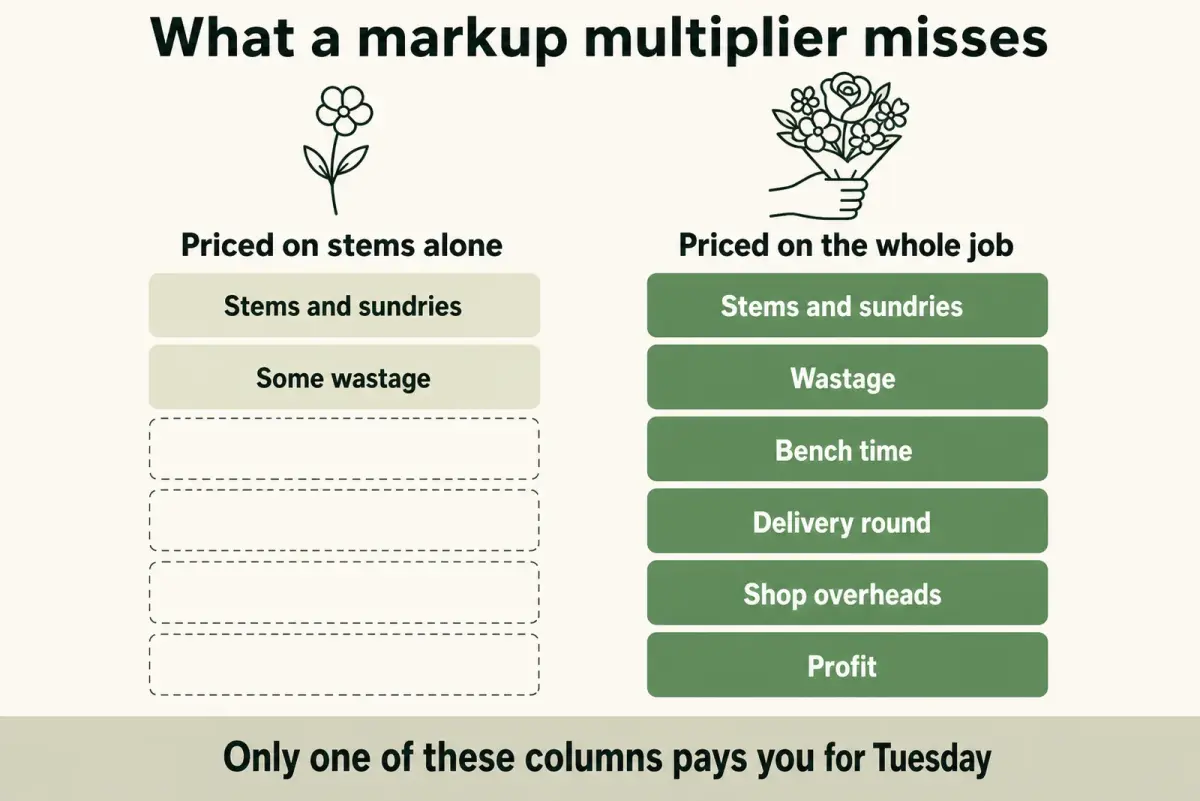
A multiplier moves with the stems. Four of these six do not move with the stems at all.
Six things: flowers and sundries, wastage, bench time, the delivery round, shop overheads and profit. A price built on the first alone is a stem cost in a bouquet's clothes.
You probably met pricing as a multiplier. Take the wholesale cost of the flowers, times it by something the trade agrees on, done. It is fast, it repeats well, and it has one problem.
A multiplier scales with stem cost and nothing else. Your hour does not get cheaper when you buy cheaper flowers. The drive across town is the same drive whether the bouquet on the passenger seat is small or enormous. The rent is the rent in the quiet week of February.
A markup multiplier is somebody else's overheads with a decimal point in it.
The multiplier prices the stems properly, catches some of the wastage that rides with them, and leaves the other four to a proxy. On a cheap, fiddly, delivered arrangement it misses, and always in the same direction.
Wastage hides best, because nothing itemises it. The stems trimmed off, the ones that blew in the window, the bucket that did not sell by Sunday. You know roughly what goes in the bin each week. Now try to find it in a price.
How much should a florist charge per hour?
Start from what the same hour costs when somebody else works it. GOV.UK's National Minimum Wage and National Living Wage rates table states that from April 2026 the minimum hourly rate is £12.71 for workers aged 21 and over.
Be exact about what that number is, because it is easy to over claim. It is the legal floor for employing a person, a duty to workers rather than a rule about what a self employed owner may earn. Nothing in it says a skilled florist's hour is worth that, and nothing in it stops you pricing yours higher.
You cannot mark up an hour you never counted.
That number is still a hard reference point. If you ever hire, that is the least an hour at your bench can cost, before the employer's costs on top. A shop whose prices do not clear it cannot hire without going backwards: the first person you take on is paid out of a price that never counted them.
Imagine a hand tie that takes twenty minutes to build and five to wrap and card. Call it half an hour, because the phone rings.
- Decide your bench hour is worth £30, a number you choose rather than find.
- That puts £15 of labour in one bouquet, before a single stem is bought.
- Sell it for £35, before any VAT, and the flowers, the wrap, the rent and the profit are fighting over what is left.
Guess that time low and the guess is where your money goes. Florist profit margins covers what should be left once labour is in.
What should you charge for delivery?
Charge for the round, not the drop. GOV.UK's simplified expenses guidance for the self employed puts the flat rate for cars and goods vehicles at 55p a mile for the first 10,000 miles.
That rate is a tax simplification rather than a measurement of what your van costs, so sanity check a delivery charge against it, never price from it. Your real cost sits in the insurance, the tyres and the morning it would not start.
The mileage is only part of it anyway. No mileage rate contains a driver, and twenty minutes across town and back is twenty minutes you are not at the bench, on the clock rate you just set.
Price the distance alone and the awkward drops are the ones that lose you money; a free delivery threshold is a discount you fund yourself. The channel differences sit in pricing flowers online versus in store.
When does VAT change what you charge?
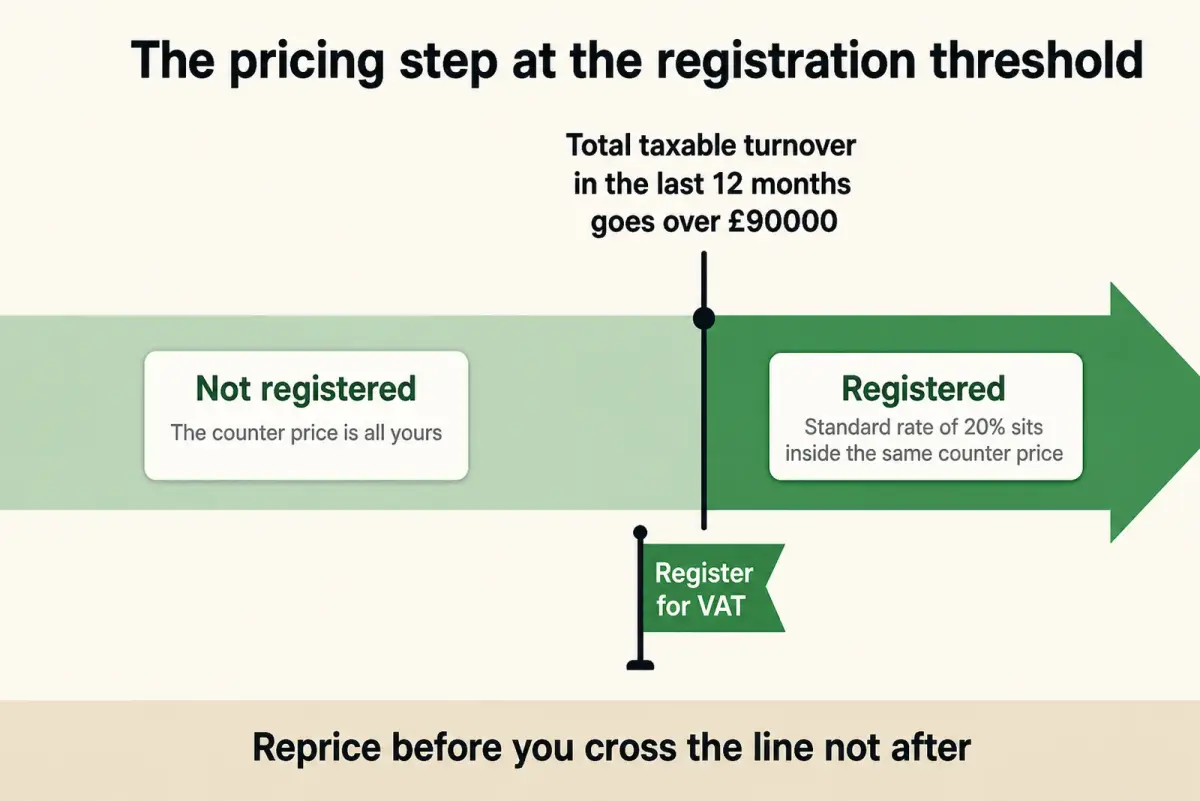
Nothing about the counter price changes by itself on the day you register.
GOV.UK's Register for VAT guidance states that you must register for VAT if your total taxable turnover for the last 12 months goes over £90,000, the VAT threshold. GOV.UK also states that the standard rate of VAT is 20% and applies to most goods and services, so check with HMRC where your own lines sit before you reprice.
Here is the part that catches shops out. If a sale is standard rated and the shelf price stays where it was, the tax comes out of the money you were keeping. Twenty per cent added to a net price is one sixth of the total it produces, so a sixth of an unchanged counter price stops being yours. It does not bite in the month you register. It bites a quarter later, when the shop is as busy as ever and the bank is not.
Registration is not paperwork. It is a price rise you either make or absorb.
The other half is how the price is shown. The Competition and Markets Authority's price transparency guidance states that in an invitation to purchase a trader must give the consumer the total price of the product. So the shelf edge, the website and any priced window card carry the whole number, not a net price with a surprise at the till.
Which is why a growing shop models this before it crosses the line. Flower bouquet pricing covers retail price points that survive the step.
Frequently asked questions
How much does a florist charge for a bouquet?
There is no going rate. The published example here sells single variety stems at between £1.50 and £4.00 each depending on variety, which is one shop's price rather than a benchmark. Price yours from your own stems, time, delivery, overheads and margin.
How much should a florist charge per hour?
Start from the legal floor for employing somebody, £12.71 an hour from April 2026 for workers aged 21 and over, then price your own skilled time above it. The rate matters less than picking one and timing a real bouquet against it.
What is the 3-5-8 rule in floristry?
The 3-5-8 rule is a design convention rather than a pricing method, a way of grouping stems in odd numbers that is meant to make an arrangement read as balanced. It turns up on pricing pages because it sounds like a formula, but a formula it is not, and it says nothing about your rent, wages or van.
How much do 12 roses cost?
At the shop quoted above, single variety stems sell at between £1.50 and £4.00 each, so multiply by twelve for what the flowers in a dozen come to there. That leaves out conditioning, bench time, the wrap and the drive, all of which a florist still has to cover.
Do florists have to charge VAT on flowers?
Only once you are registered, and registration follows once total taxable turnover for the last 12 months goes over £90,000. The standard rate is 20% and applies to most goods and services, so ask HMRC where your lines sit.
What to do this week
Florist pricing is not a bigger number. It is a costed one.
- Time three real bouquets, bench to wrap, on your phone timer.
- Set the rate your bench time has to earn and write it on the wall.
- Recost your best seller from stems, wastage, time, delivery, overheads and the profit you want.
- Compare that figure to today's price, then change the price or the recipe.
- Diary a repricing date rather than waiting for the next wholesale shock.
If you only have thirty minutes: time one bouquet and price that time. The recost and the comparison both wait on it.
Winning customers who will happily pay a costed price is a marketing job rather than a pricing one, and it is the part LocalBrandHub helps florists with: social posts and ready made seasonal campaigns. Wedding florist pricing takes the same method into event work.
For restaurants, salons, and local businesses
Need help with your marketing?
We help UK businesses turn social media into real results, not busywork.
Start freeKey Takeaway
Key takeaways: florist pricing
- Price the job, not the stems. Six things go into a bouquet price and flowers are one of them.
- A multiplier scales with stem cost alone. Your hour, your van and your rent do not.
- Set an hourly rate deliberately. The floor for employing someone is £12.71 from April 2026 for workers aged 21 and over.
- Model VAT before the threshold, which is £90,000 of taxable turnover in the last 12 months.
- Reprice on a date, not on a shock. Costs move whether or not your list does.
Sources
Get More Marketing Tips
Practical marketing tips for UK business owners, straight to your inbox. No spam, unsubscribe anytime.
About the Author
Local Brand Hub
Empowering UK Businesses
Local Brand Hub provides comprehensive business management tools designed specifically for UK local businesses to streamline operations, automate marketing, and grow revenue.
More articlesRelated Articles
 Business Growth
Wedding Flower Packages: How to Build and Price Them
Wedding flower packages for UK florists: build three tiers couples can count, fix the right things, and publish a price that survives the wait.
 Business Growth
Wedding Florist Pricing: How to Quote the Whole Day
Wedding florist pricing for UK flower shops: build the quote from the day itself, cost the hours and the miles properly, and know when VAT changes it.
 Business Growth
Florist Branding: A Brand That Travels With Flowers
Florist branding for UK flower shops: how to pick a name you can keep, get it right on Google, and make it travel on every bouquet you send out.