
Flower bouquet pricing for UK florists: cost the bouquet you make most, set three prices with deliberate gaps, and handle VAT before it eats the range.
Flower bouquet pricing works as a range rather than a single sum. Cost the bouquet you make most often, then set a smaller and a larger price around it with gaps you chose on purpose. Customers compare the three and pick one, so the distance between your prices sells as hard as the prices do.
Walk past your own window and read your bouquet prices the way a stranger does. You will not see a costing method. You will see two or three numbers sitting next to each other, and you will pick one of them before you have really thought about it.
That comparison is the actual product. Cost one bouquet with real care, let the prices either side of it happen by accident, and the most persuasive part of the range ends up being the part nobody designed.
Why one bouquet price is never the decision
A single price asks a customer one question: yes or no. Three prices ask a much easier one: which. Only the second question can end in a bigger sale.
So the range matters more than any number inside it. Your prices are a menu whether or not you meant to write one, and the gaps between them are already doing work:
- Too close, and the small one insults the middle one. A posy priced two pounds under your everyday hand tie makes the hand tie look greedy rather than generous.
- Too far, and the top rung goes cold. Once the jump stops feeling like more flowers and starts feeling like a different decision, people stop making it.
- Not shown at all, and the customer has to ask. Plenty will not, and you never find out they were in.
Why this matters: the tier you sell most of is the tier your costing has to be right about. If that number came from rounding rather than costing, so does your week.
Cost the bouquet you make most often
Pick the piece that leaves the shop more than any other. That is your reference bouquet, and it is the only one you need to cost properly, because the other two are built from it.
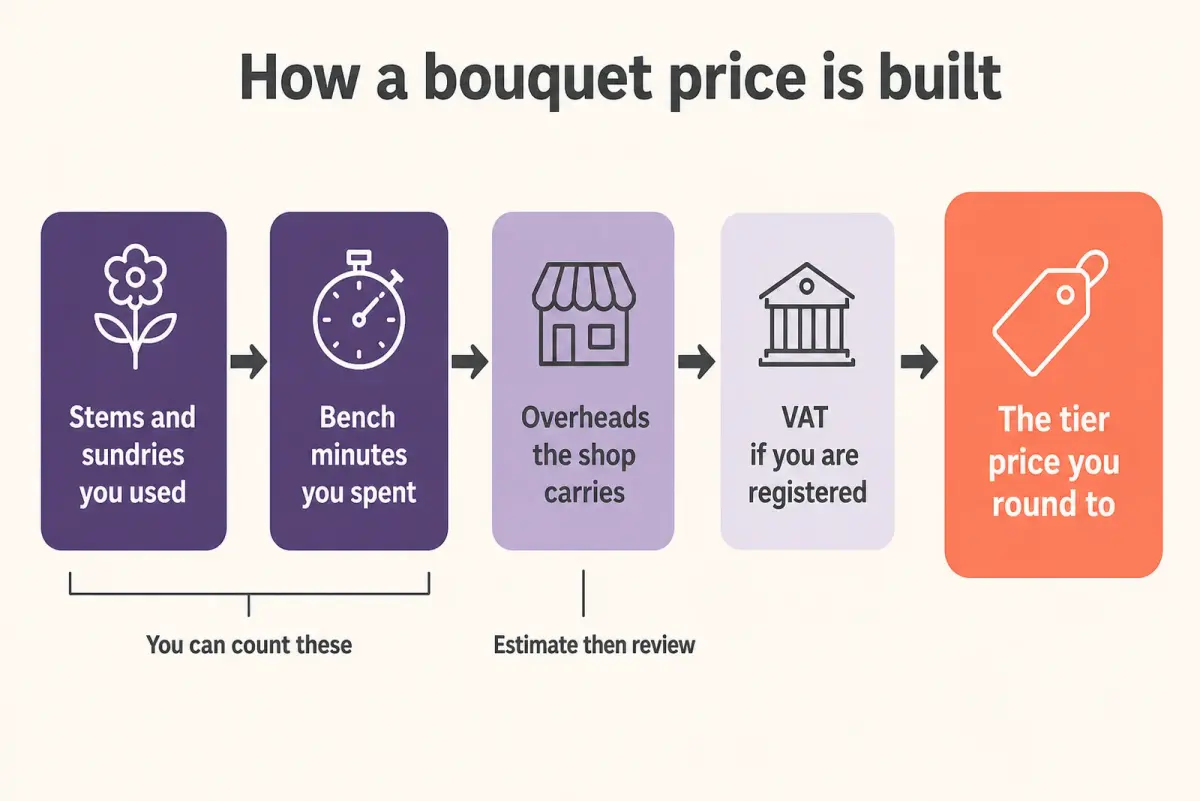
The first two blocks are countable facts about one bouquet. The rest are decisions.
Count everything that went in, including what never reaches the customer:
- Every stem and all the foliage.
- The wrap, the ribbon, the little card, the flower food.
- The stems you conditioned and then binned.
Then time yourself building it once, with a timer running rather than a memory of how long it feels.
Say your everyday hand tie takes £11 of stems and sundries and eighteen minutes at the bench. At a bench rate of £18 an hour that is roughly £5 of labour, so £16 of direct cost before the shop has paid a penny of rent. Add your overhead share and the margin the business needs and you land near £34, which rounds to £35.
The multiplier that pricing guides argue about is the least knowable number in that sum. Your stem cost is on an invoice. Your bench minutes are on a timer. The multiple is everything else compressed into one figure, and everything else belongs to your shop.
How far apart should the three prices sit?
The reference bouquet is now the middle rung. The other two are the same method run again with more or fewer stems, not numbers plucked to look tidy.
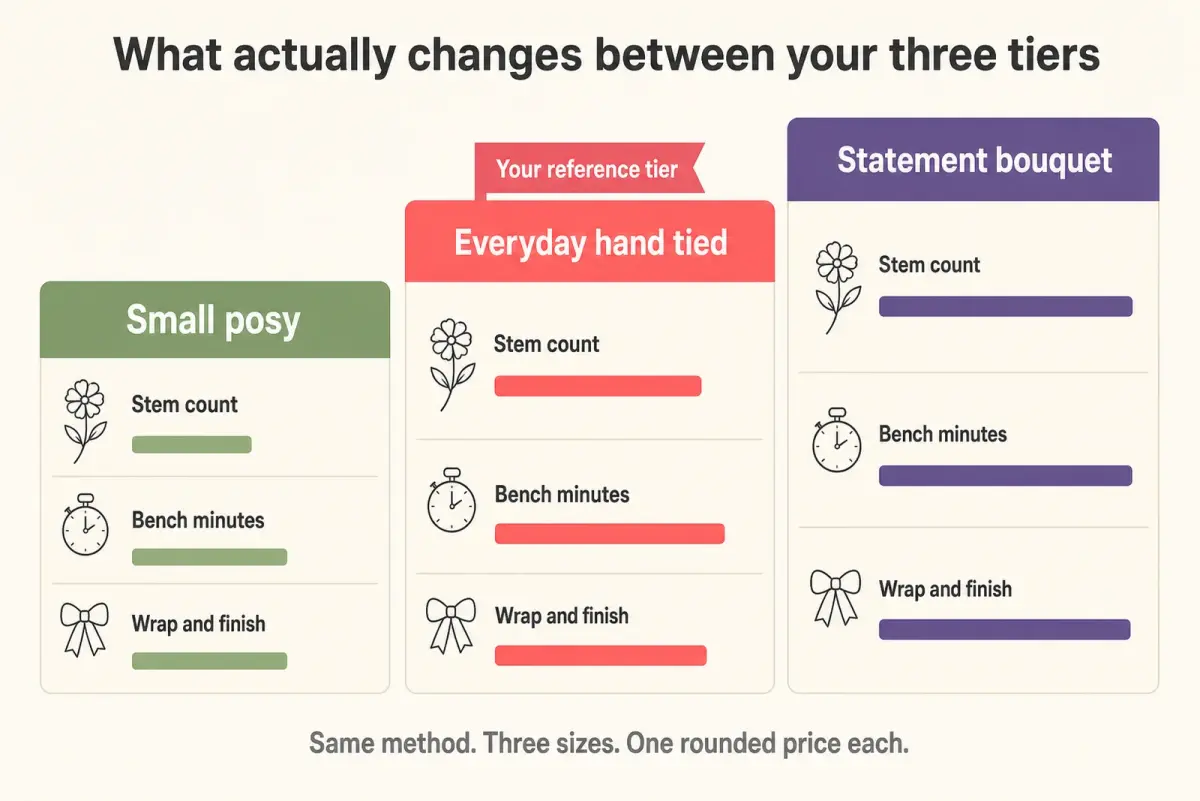
Three sizes, one method, one rounded price each.
Two invented ladders built around the same middle price, to show what the gaps do on their own:
| Tier | Flat ladder | Ladder with a job for each rung |
|---|---|---|
| Small posy | £30 | £25 |
| Everyday hand tied | £35 | £35 |
| Statement bouquet | £40 | £60 |
The left one says the same thing three times. The right one says easy gift, ordinary Tuesday, and today matters. Treat both as a rule of thumb for the shape of a ladder rather than a price list to copy, since neither was costed from your invoices.
Pick the gaps deliberately, then let your own till settle the argument. Count which tier actually sells across a full month before you move anything, and treat a month as a starting length rather than a rule: trade that swings hard around Mother's Day needs longer.
The gaps between your prices are selling something. The only question is whether you chose what.
What VAT does to a ladder you already set
VAT is the part of bouquet pricing that arrives without warning, and once you are registered for it, it takes the same proportion out of every rung at once. HMRC guidance states that seeds, plants and cut flowers which are bought for their ornamental effect are generally standard rated for VAT, and the standard rate of VAT is 20% and applies to most goods and services.
Below the registration threshold none of that touches you. HMRC states that the current UK VAT registration threshold for taxable supplies is £90,000, and it is measured on turnover rather than on profit, so a shop can cross it in a strong wedding year without once feeling richer.
Cross it with a £35 bouquet on the shelf and the label can stay exactly where it is, but about £29 of that £35 is now the shop's and the rest is not. Nothing about the ladder changed except what it brings in.
Rerun the costing on net figures while registration is still on the horizon rather than the week it lands. Whether the ladder then goes up, stays put or gets rebuilt is a commercial decision. It should be a decision.
Related: Florist Profit Margins Explained
Check the ladder, then diary the next move
A national average bouquet price, wherever you find one quoted, describes somebody else's sample of somebody else's shops, so the only market check worth having is the one you run yourself. Read the online price lists of the five florists nearest you, note where each of their tiers sits, and you have a local picture worth more than any national average.
Use it to place your ladder in the street, never to copy a number outright. A rival's price describes their rent, their wholesaler and their bin. None of those are yours.
Then put the review in the diary. From April 2026 the UK National Living Wage, the statutory minimum hourly rate for workers aged 21 and over, is £12.71 per hour. If anyone else works your bench, that rate floors the cost of their hours before employer costs go on top, and it changed in April, which is as good a peg for an annual review as you will find.
If it is only ever you at the bench, no invoice ever arrives for your hours. That is exactly why bench time is the line that quietly goes free.
An April review and one other date of your choosing is the entire maintenance schedule.
Frequently asked questions
How much does a florist charge for a bouquet?
Whatever their own costs and their own street will carry, which is why another shop's figure tells you so little about yours. Cost the bouquet you make most often, stem by stem and minute by minute, then place a smaller and a larger price either side of it. The three numbers together are the answer, and no one of them is.
How much does a bouquet cost in the UK?
Any national figure quoted online is somebody's sample of somebody's shops, chosen by whoever built the sample. Half an hour reading the price lists of the five florists nearest you produces a local range worth far more to you than a national average.
What is the 3:5:8 rule for flowers?
Those three numbers turn up in two unrelated places. In design they describe proportion, the rough relationship between the heights or masses within an arrangement. In pricing they get used as different multiples on different parts of a piece. The versions in circulation disagree with each other, which is the clue that they are conventions rather than measurements.
Should I show bouquet prices or quote on request?
Show them. A customer who cannot see a price has to ask a stranger what things cost, and plenty of people simply will not. Published tiers also force the costing to have happened, because you cannot publish a number you have never stood behind. Keep quoting for genuinely bespoke work and let the ladder handle everyday bouquets.
How much should I charge for a dozen roses?
Cost it exactly like any other hand tied bouquet, using the invoice in front of you rather than the one from three months ago. Roses are heavily exposed to peak week wholesale movement, so a dozen priced from quiet season stock will underprice the same dozen built from peak season stock unless you recost it.
What to do this week
- Photograph your own shop window and read the prices as a stranger would.
- Cost your best selling bouquet properly, stems counted and bench time timed.
- Write down the gaps between your three tiers and say out loud why each one is that size.
- Read the published price lists of the five florists nearest you.
- Check your taxable turnover against the registration threshold.
- Update your public price list the same day you change a tier.
Twenty minutes is enough for this one: time yourself making your everyday bouquet. An underpriced range very often starts with that number guessed low.
Could you say out loud why your middle bouquet costs what it costs, without reaching for the word roughly? Once the ladder changes, every place the public can still see the old prices has to change with it, and that is the housekeeping forgotten by the third busy Saturday. Keeping your product and offer listings current is part of what LocalBrandHub does for florists.
Key takeaways: flower bouquet pricing
Key Takeaway
- Price the range. Three numbers side by side is what the customer actually reads.
- Cost the middle rung. The bouquet you make most often is the reference the others are built from.
- Choose the gaps. Too close gives no reason to trade up, too far strands the top tier.
- Watch for the threshold. Crossing £90,000 of taxable turnover takes the same proportion out of what every rung brings in.
- Book the April review. The statutory wage floor under bench time moved in April 2026, so April is the natural place to put the check.
For restaurants, salons, and local businesses
Need help with your marketing?
We help UK businesses turn social media into real results, not busywork.
Start freeSources
Get More Marketing Tips
Practical marketing tips for UK business owners, straight to your inbox. No spam, unsubscribe anytime.
About the Author
Local Brand Hub
Empowering UK Businesses
Local Brand Hub provides comprehensive business management tools designed specifically for UK local businesses to streamline operations, automate marketing, and grow revenue.
More articlesRelated Articles
 Business Growth
Wedding Flower Packages: How to Build and Price Them
Wedding flower packages for UK florists: build three tiers couples can count, fix the right things, and publish a price that survives the wait.
 Business Growth
Wedding Florist Pricing: How to Quote the Whole Day
Wedding florist pricing for UK flower shops: build the quote from the day itself, cost the hours and the miles properly, and know when VAT changes it.
 Business Growth
Best Website Builder for Florists: A UK Comparison
The best website builder for florists, compared for UK flower shops: Squarespace, Shopify, Wix and WordPress weighed up on galleries, ordering and budget.