
Florist reminder marketing counts as direct marketing, so the date and the permission come together. How to ask, time the nudge and word it.
Florist reminder marketing means recording the occasions your customers buy for and messaging them before each one so they reorder. That message counts as direct marketing, so the date and the permission get collected together at the counter. The reminder itself names your last order day, not the occasion.
One of your customers bought an anniversary bouquet last spring, said it was the best thing his wife had been given in years, and has not thought about flowers since. He will think about them again at half past five on the day itself, in a supermarket, next to the carrier bags.
That sale is not lost to the florist across the road. It is lost to a diary nobody kept.
The repair is unglamorous: names, dates and permissions, kept on cards if you like. The difficulty is never the sending. It is the twelve seconds at the counter when the date either gets written down or does not.
If you are certain you already know your regulars' dates, try listing five of them before you read on.
Is a reminder text really marketing?
Yes, and the answer decides everything that follows. The ICO defines direct marketing as the communication, by whatever means, of advertising or marketing material which is directed to particular individuals. Telling one named customer their anniversary is close and you could make something like last time is precisely that.
It is easy to file a reminder under thoughtfulness rather than advertising, which is how the permission step gets skipped. A customer who never asked to hear from you is under no obligation to read it that way.
A reminder is a kindness with a price list attached. That is not a criticism of it. It is the reason the rules apply.
ICO guidance on electronic mail marketing states you must not send marketing emails or texts to individuals without specific consent, unless the limited soft opt in exemption in the Privacy and Electronic Communications Regulations applies. That holds across the UK, and it concerns messages to individuals. If your list also carries corporate accounts, check the ICO's guidance on marketing to businesses before assuming it covers them too.
None of which is a reason to drop the idea. It is a reason to move the programme one step earlier, to the counter.
How do you ask for the date and the permission at once?
In one sentence, while you are wrapping. Shall I note the date and send you a reminder nearer the time? You can stop it whenever you like. Then write down what they said, including the ones who say no.
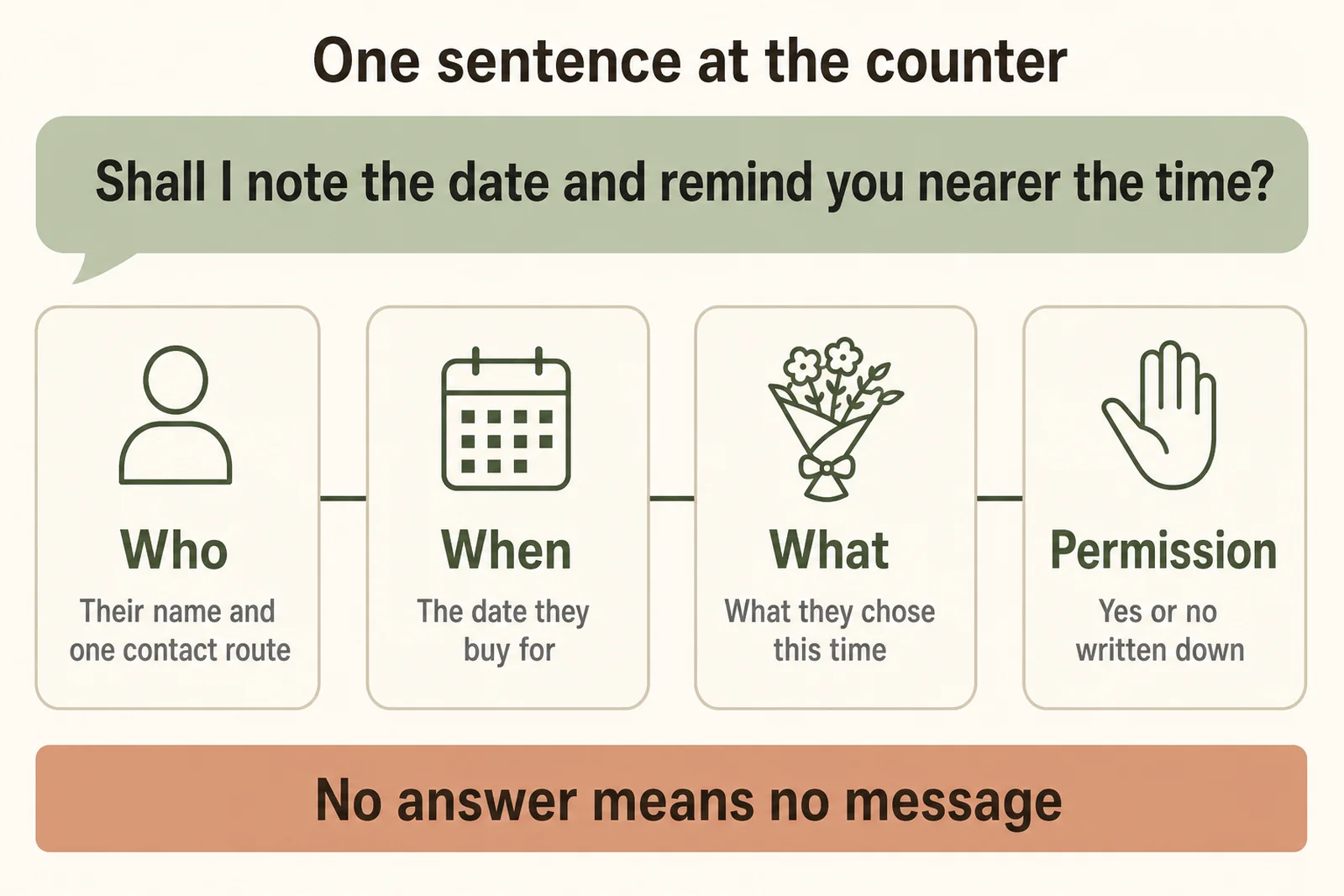
Four fields and one question. Everything else in this article is downstream of that question.
Silence is not a yes, and neither is a phone number written on an order pad.
Odds are you are leaning on the soft opt in, and it is narrower than it sounds. The ICO sets out five requirements: you obtained the person's contact details directly from them, in the course of a sale or negotiation of a sale of a product or service, you are marketing your own similar products and services, you provided an opportunity to refuse or opt out when you collected the details, and you give an opportunity to refuse or opt out in every subsequent communication.
Read that as a description of a decent counter habit and it stops being paperwork.
You are already selling them the flowers and you will be making the next lot. The only new moves are asking out loud, and offering the exit twice.
Buying a list is not the way round it. ICO guidance is blunt: there is no such thing as a third party marketing list that is compliant with the soft opt in. Every name has to be collected by you, from the customer, which is slow, and which is why the shop down the road cannot copy yours.
Keep the list to what the job needs, which is four columns and no more:
- The customer's name, as they gave it
- One contact route, the one they chose
- The date they buy for
- What they bought last time
Recipient addresses and the words on the card stay on the order, not on the marketing list. Moving those four columns into an email or messaging tool means uploading them alone, leaving the rest behind, and checking the tool's current account settings and data use terms first. The plain English overview of data protection for a small business is on gov.uk.
Why this matters: the four columns are the whole asset. A shop that loses its supplier can find another by Thursday. A shop that loses the list of who buys what and when is starting again from the door.
When should the reminder land?
Count backwards from your workroom, not from the occasion. Two dates matter: the day the flowers are needed, and the last day you can still take the order. The second is the one we would name, and it costs you one occasion to find out whether that beats naming the first.
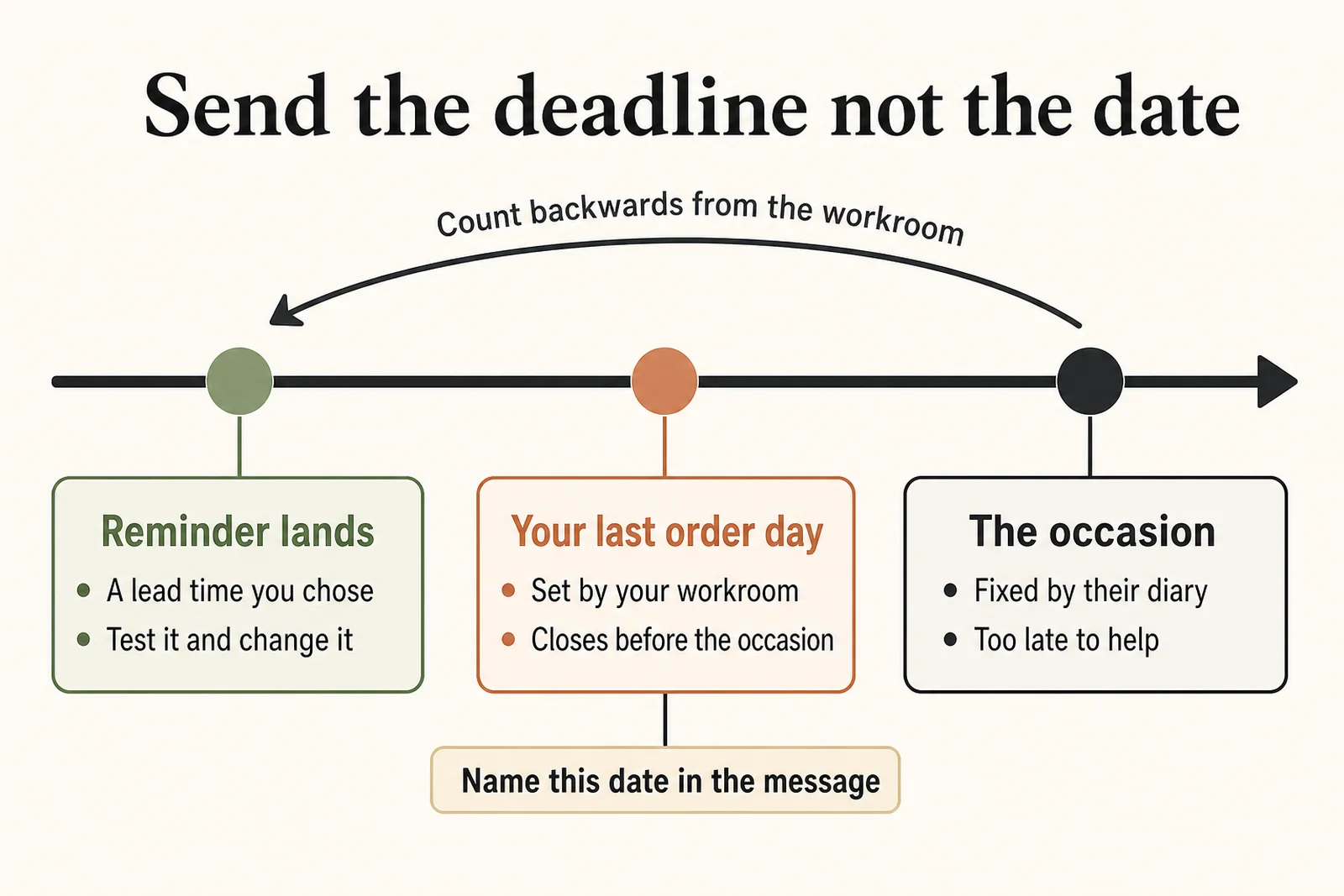
The middle marker is the one to name. The occasion is only the reason it exists.
Our money is on the closing door rather than the date in the diary. One occasion will tell you whether we are wrong.
A week ahead is a reasonable starting experiment for a hand tie you can make in a morning. It is not a rule, and anyone quoting an exact optimum has not measured your shop. Treat your first lead time as a setting rather than a finding: a large arrangement needs longer, a full delivery round longer still, and a supermarket at half past five is competition you beat by being early.
Two messages are where we would start:
- The nudge, at your chosen lead time, naming the closing date
- The last call, the day before you close orders
Each one carries the way out, every time.
Imagine a shop that stops taking Valentine's orders two days before the 14th, because those two days are spent making. Its reminder does not lead with the occasion. It leads with the closing date, because that is the date the shop controls and the one the customer does not know.
A reminder you can copy
Short, personal, and pointed at the deadline. Every square bracket is a placeholder for something you can check in your own order records. Replace all of them before you send, and delete any line you cannot fill in honestly.
Hi [CUSTOMER FIRST NAME], it is [YOUR SHOP NAME].
[OCCASION] is coming up on [DATE], and the last day I can take an order for it is [YOUR ORDER CUT OFF DATE].
Last time you chose [WHAT THEY ORDERED]. I can do something close to that, or something completely different.
Reply to this message or call [YOUR PHONE NUMBER].
[YOUR OPT OUT WORDING] and I will not send these again.
Filled in, that second line reads something like: your anniversary is coming up on the 14th, and the last day I can take an order for it is the 11th.
Nothing in it is clever, which is the point. It names them, names the occasion, names the deadline, and offers a decision with two doors. What it never does is describe the flowers, because you cannot know in February what will be good in the bucket that week.
Two warnings before you paste it anywhere:
- Fill every bracket from your own records, or cut the line. Anything you invent goes out in your name to every customer on the list.
- Use your sending tool's own opt out wording, then send yourself a test and click the thing before a customer sees it.
How do you know it worked?
Two numbers per occasion are enough: how many customers you reminded, and how many of them ordered. Neither number tells you whether those customers would have ordered anyway, so read the pair as a direction and not as proof.
Imagine you remind forty customers before Mothering Sunday and nineteen of them order. That is a number worth having, and it still cannot tell you how many of the nineteen already had the date in their phone.
What the count cannot answer
A list of names, dates and last orders answers questions about names, dates and last orders. What an order was worth, or cost you to make, lives in your till and your buying book, and joining those up is a far bigger decision than starting a list.
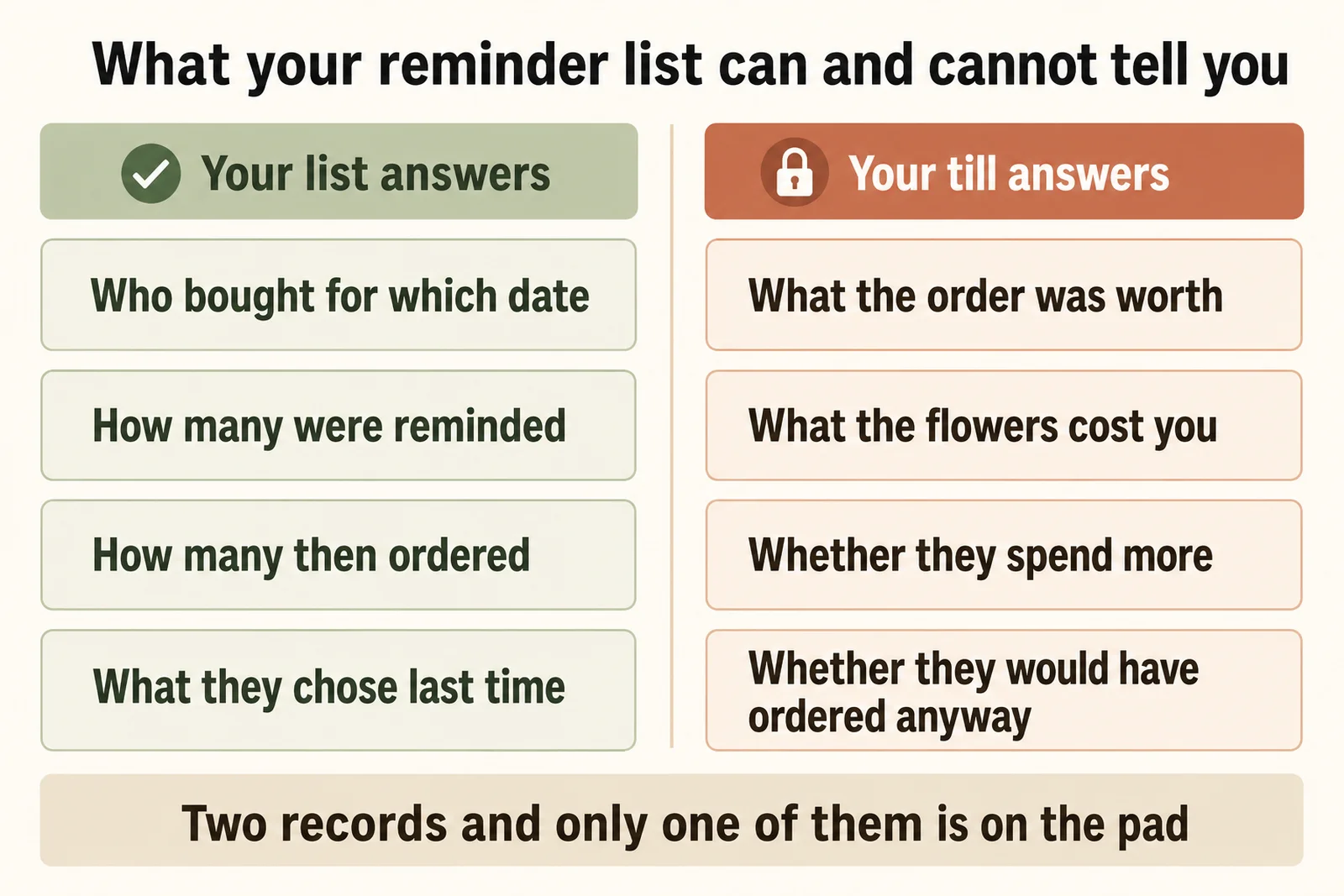
Four questions on the left you can answer this afternoon. Four on the right that need a different record entirely.
Reminded and ordered are two columns you own. Would have ordered anyway is not.
For a fairer comparison, leave a small handful of customers unreminded for one season and see what they do. With numbers that small it is a hint rather than a proof, and it costs you sales you chose not to chase, which is the price of finding out rather than assuming.
Judge it over a full circuit of the calendar. A reminder list can look like nothing for months and then do all its work in one week in February. Planning the posts and offers around those weeks is the part LocalBrandHub is built for, with a social calendar and ready made seasonal campaigns. The names and dates stay where they belong, with you.
Frequently Asked Questions
What is reminder marketing for florists?
Recording the occasions your customers buy for, then messaging them before each one so they can reorder. The list is a name, one contact route, the date, and the last thing they bought. It works when the customer already wants the flowers and has only lost the date.
Do florists need permission to send reminders?
Yes. ICO guidance on the PECR electronic mail marketing rules states you must not send marketing emails or texts to individuals without specific consent, unless the limited soft opt in exemption applies. Ask at the counter, write the answer down, and give an easy way out in every message.
Can I buy a list of local anniversaries?
No. ICO guidance states there is no such thing as a third party marketing list that is compliant with the soft opt in. Reminder lists have to be built from your own customers, one conversation at a time, which is slow to start and very hard to copy.
When should a florist send an occasion reminder?
Count backwards from your own last order day rather than from the occasion. A week ahead suits a hand tie you can make in a morning; a large arrangement or a full delivery round needs longer. Treat your first lead time as an experiment and move it.
What should a florist reminder say?
Their name, the occasion, your order deadline, what they chose last time, one easy way to reply and a clear opt out. Keep the flowers vague and the date exact: you cannot promise a stem you have not bought yet, but you can promise the last day you can take the order.
Where to start this week
Key Takeaway
Start by making the ask routine. Say the sentence at every wrap for a fortnight, then read the pad and count the dates you now have.
- Ask while you wrap
- Write down every answer, the no included
- Put your cut off dates on the workroom wall
- Send one nudge, one last call, each with the way out
- Count reminded against ordered
The shop down the road sells the same roses at roughly the same price. What it is almost certainly not selling is a florist who knows the date before the customer remembers it.
For restaurants, salons, and local businesses
Need help with your marketing?
We help UK businesses turn social media into real results, not busywork.
Start freeSources
Get More Marketing Tips
Practical marketing tips for UK business owners, straight to your inbox. No spam, unsubscribe anytime.
About the Author
Local Brand Hub
Empowering UK Businesses
Local Brand Hub provides comprehensive business management tools designed specifically for UK local businesses to streamline operations, automate marketing, and grow revenue.
More articlesRelated Articles
 Marketing Tips
Email Marketing for Florists: A UK Flower Shop Guide
Email marketing for florists that drives repeat orders and peak-day pre-sales: a UK guide to building a list and sending emails customers actually open.
 Marketing Tips
Wedding Flower Consultation: The Florist's Question Sheet
How to run a wedding flower consultation that ends in a quotable list of pieces, with a copyable question sheet to send couples before you meet.
 Marketing Tips
Florist Pre Orders: Run One Round Without the Panic
Florist pre orders for UK flower shops: when to open the round, what the order page has to settle, how to date the cut off, and how to fill the list.