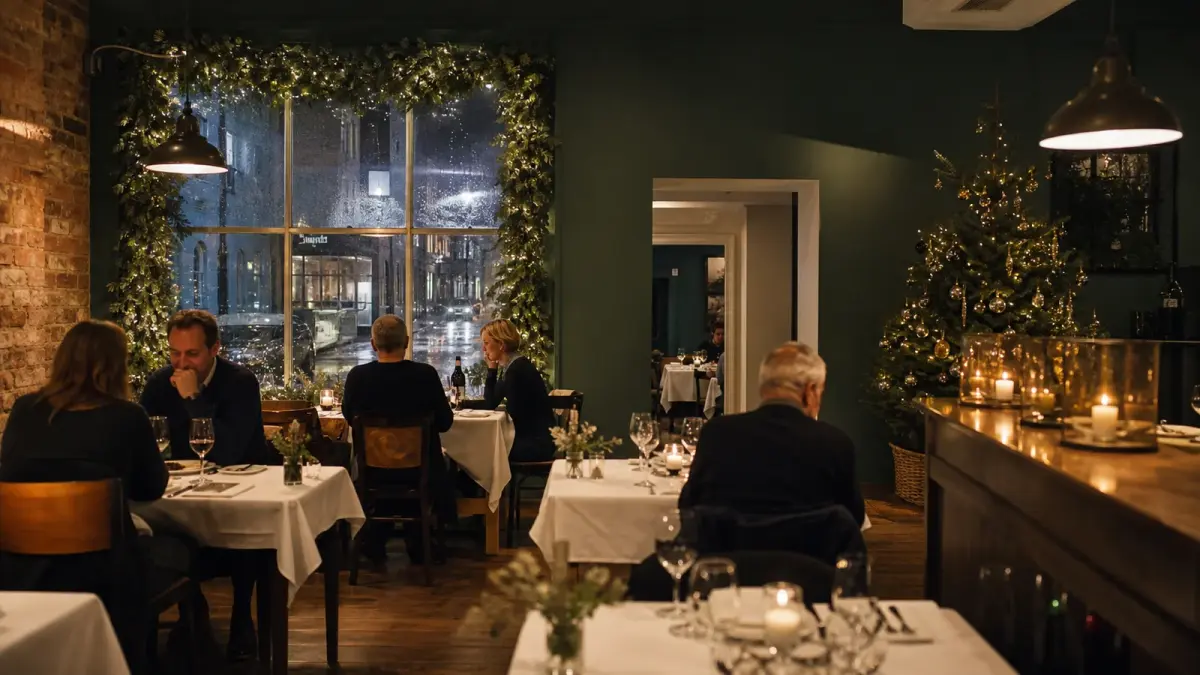
Restaurant decor Christmas planning for UK venues. Pick two or three anchor points, shoot the photos early, and keep every escape route clear.
Restaurant decor Christmas plans fail for three reasons: the photographs arrive after the bookings are gone, the garlands creep across escape routes, and the budget goes on tinsel instead of the two or three anchor points guests actually see. Fix those and a small budget looks generous.
Here is the December most operators recognise. Somebody gives up a Sunday to the decorations, the room looks lovely by Tuesday, and the first decent photograph appears online mid month. By then the office party that would have filled a quiet Thursday has been eating somewhere else for a fortnight.
Your decorations have two audiences and only one is in the building. The first is a stranger on a phone, weeks out, comparing your room with four others. The second is a waiter carrying three plates, a couple who cannot see each other over your centrepiece, and whoever walks your escape routes. Suppliers sell you the first audience. The second one costs you money.
What makes restaurant Christmas decor work?
Concentration. Two or three anchor points dressed generously beat a thin festive layer over every surface, because the photograph that sells your room is one frame, not a tour.
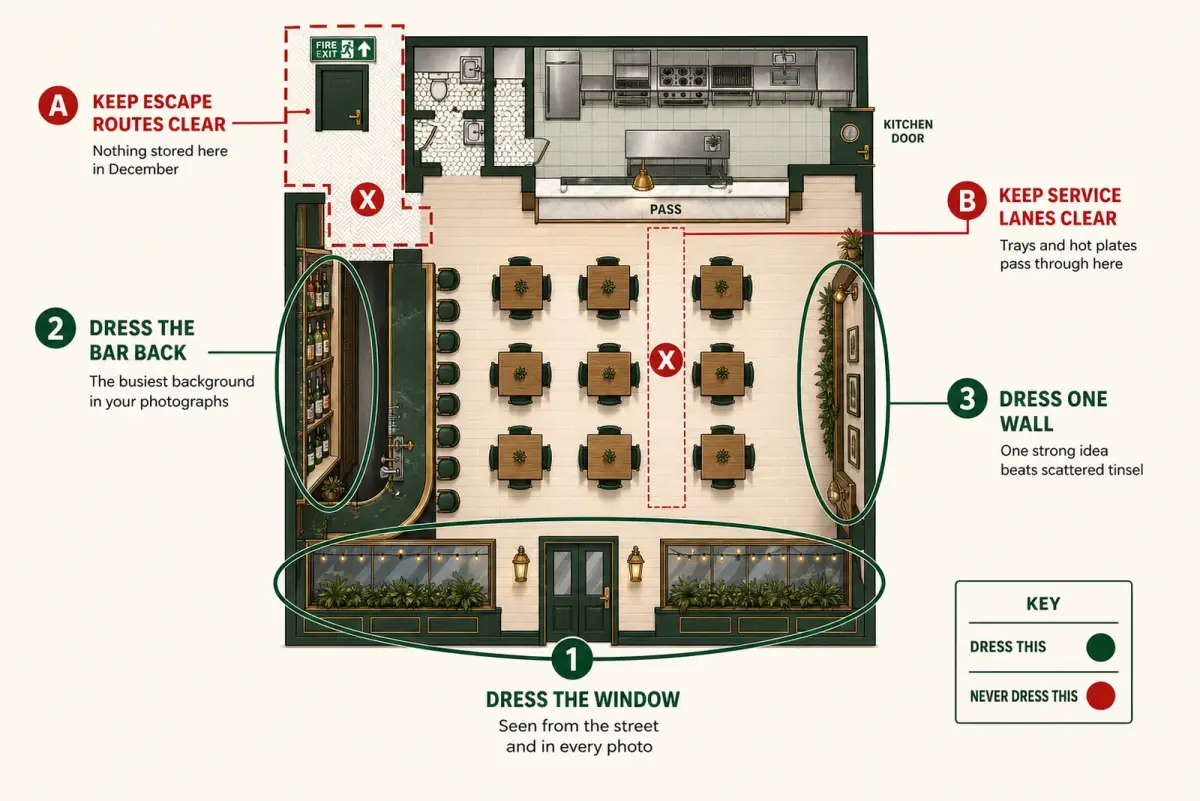
Three places to dress, two to leave alone. The red zones turn a lovely room into an expensive conversation.
- The window and the entrance. What the street sees of your room, and the shot that ends up on your listing.
- The back of the bar. The busiest backdrop in the building. Shoot anything across the bar and it is in the frame, dressed or not.
- One feature wall. Somewhere deliberate to stand. One considered corner gives a guest somewhere obvious to point a camera; a room with a bit of everything gives them nowhere in particular.
Two areas stay bare however much is left in the box: escape routes and the lanes your staff run.
What colours will be popular for Christmas 2026?
Nobody can honestly tell you, and we would be wary of any guide that names the colour of Christmas 2026 with a straight face. Forecasts are built for retailers shipping stock, not for a room whose walls and lighting were fixed years ago.
The answerable version is which colours work in your room:
- Start with what the room already is. Dark green walls take brass, amber light and foliage. A pale room carries white, silver and glass. Fighting your own paintwork photographs badly.
- Pick one metal and commit. Brass or silver, not both. Mixed metals are the tell that a room was accumulated rather than designed.
- Cap it at three colours. Two from the room, one festive accent.
Traditional red and green still works, chiefly in rooms already warm and wooden. In a pale minimalist dining room it reads as a garden centre, which is how a restaurant looks cheaper in December than in June.
How do you decorate a restaurant table for Christmas dinner?
Low, light and quick to reset. A restaurant table is a working surface that gets stripped and reset between sittings, which rules out most of what looks best at home.
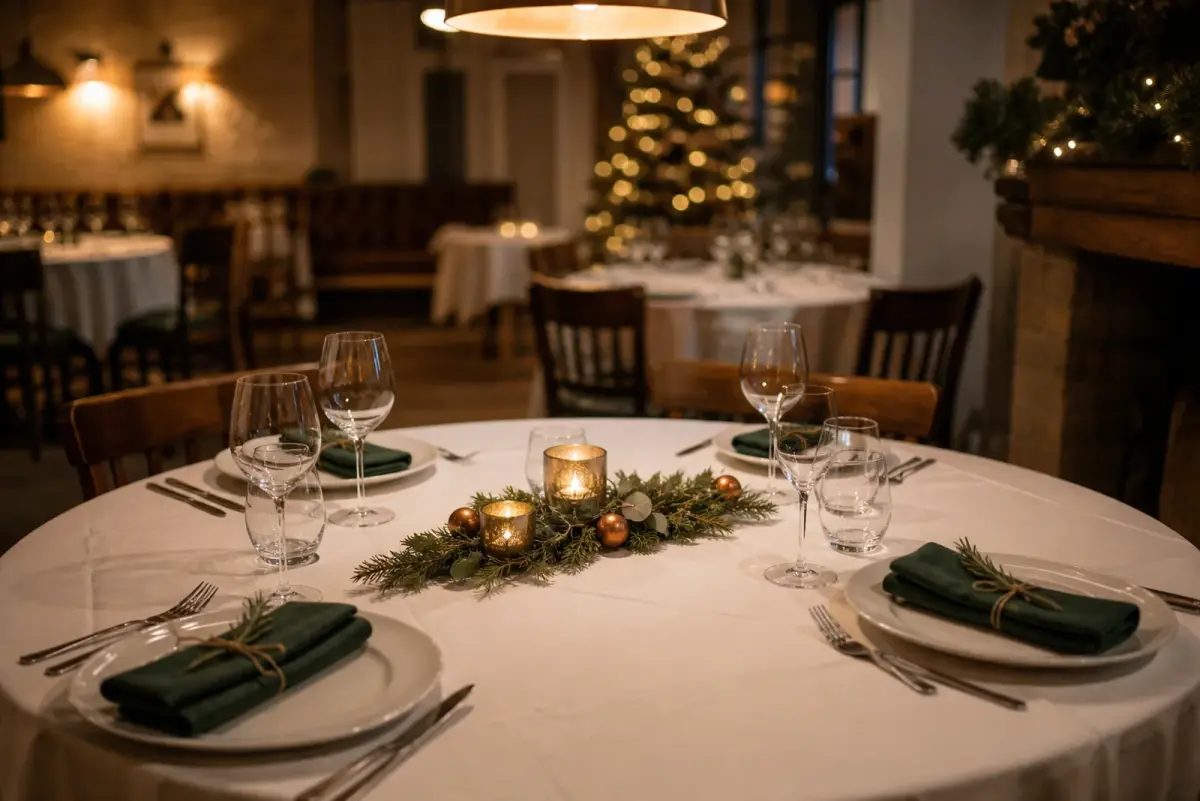
Low enough to talk across, narrow enough to land a plate beside, light enough for one person to lift.
Run every centrepiece through four tests before you buy forty:
- Eye height. Sit down and look across. If you cannot see the person opposite, guests will move it themselves.
- Landing space. Measure your widest plate and leave that much clear beside every setting.
- One hand. Staff should lift it while holding something in the other.
- Reset time. Anything fiddly gets skipped when you are turning tables.
Imagine a forty cover room turning twice on a December Saturday. If resetting a table takes ninety seconds rather than fifteen, that is roughly twenty extra minutes of staff time on the night nobody has twenty minutes to spare. Illustrative figures, not measured ones.
Real candles do something LED tea lights cannot. They also put an open flame on a table of paper napkins, in a room full of people who have been drinking. Use holders that contain the flame, and brief staff on who snuffs them and when.
Does restaurant Christmas decor have to meet fire safety rules?
The fire safety duty here is written around your premises rather than your decorations. It is already sitting there in August, months before the first box comes down from the loft.
GOV.UK guidance states that in England and Wales the responsible person for non domestic premises must carry out and regularly review a fire risk assessment of the premises, and must keep a written record of it, with different rules applying in Scotland and Northern Ireland. The same guidance states that the assessment needs to consider emergency routes and exits, fire detection and warning systems, fire fighting equipment, an emergency fire evacuation plan and the needs of vulnerable people, among other things.
That is narrower than a lot of Christmas advice implies: no tinsel rule, no approved list of garlands. What the guidance asks is that the assessment covers your premises and is kept under review. Our reading, our judgement rather than something GOV.UK states, is that an assessment describing a room with no tree in the corner stops describing your room the day the tree arrives. Tell whoever carries yours out that the room has changed.
So the practical job is small and it is yours:
- Walk every escape route with the decorations up, at night, lights set as they will be in service.
- Check nothing hangs over, in front of or beside an exit sign.
- Check the storage. Boxes have a habit of spending December in a corridor.
- Check the cabling. An extension lead across a walkway is a trip hazard first.
Proportion is the argument for that hour: GOV.UK states that for failure to follow fire safety regulations in England and Wales, minor penalties can be up to £5,000 and major penalties can carry unlimited fines and up to 2 years in prison. That is the published range for fire safety failures generally rather than a tariff for decorations, and still a useful number to hold next to a box of garlands.
How much should a small restaurant spend on Christmas decor?
Breadth is where a small decor budget dies. Split it by lifespan rather than by room:
- Structural, bought once. The garland frame, the tree, the lights. Buy the best you can afford: you are amortising them over several Decembers, not one.
- Consumable, bought yearly. Greenery, ribbon, candles, napkins. Where the room gets its freshness, and the cheap part.
- Labour, always underestimated. Somebody puts it up, maintains it for six weeks and takes it down. It is payroll like any other shift.
Picture a thirty cover independent with a few hundred pounds. Spending the lot on one properly lit window garland reads as more generous than splitting it across a small tree, table scatter and two mediocre garlands. An illustration, not a benchmark.
One line catches people out when the plan moves outdoors. Under the permanent pavement licence process in England, which lets businesses place removable furniture such as tables and chairs outside cafes, bars and restaurants, GOV.UK guidance states that local authorities may charge up to £500 for first time applications and £350 for renewals, with licences granted for up to 2 years. The licence covers furniture on the highway rather than decorations, so an outdoor festive area is an early conversation with your council.
LocalBrandHub's ready made seasonal campaigns cover UK holidays and quiet spells on the Growth plan, and the social media calendar is free, so December can be planned before the tree goes up.
Frequently asked questions about restaurant Christmas decor
When should a restaurant put its Christmas decorations up?
Work backwards from the photographs, not forwards from the calendar. The pictures need to exist while people are still choosing where to hold their Christmas meal, and our reading is that for group bookings that choosing starts well before December. Treat any date you pick as a starting experiment, adjusted next year against your own diary.
What do I put in the middle of my dining table at Christmas?
Something low, narrow and liftable in one hand. A slim runner of greenery with two small candle holders clears eye height and leaves landing space for plates. Tall centrepieces photograph beautifully and end up on the windowsill by the second course.
Can I put festive tables and chairs outside on the pavement?
In England that sits inside the pavement licence regime rather than being a decorating decision. GOV.UK guidance on the permanent pavement licence process, covering removable furniture such as tables and chairs outside cafes, bars and restaurants, states that local authorities may charge up to £500 for first time applications and £350 for renewals, with licences granted for up to 2 years.
How do I make a small restaurant look Christmassy on a tight budget?
Spend on one anchor point instead of three. A single generous garland around the window, lit properly, beats the same money spread across tinsel, table scatter and a tired tree. Buy the structural piece once, then refresh it yearly with cheap consumables.
How do I stop the room looking tired between Christmas and New Year?
Plan the strip out when you plan the install. Choose pieces that read as winter rather than Christmas specifically, so removing the obviously Christmassy third still leaves a dressed room. Greenery, warm light and candles carry into January. Baubles and Santas do not.
Your first hour, this week
Key Takeaway
Start by seeing what a stranger sees. Stand in your doorway, photograph the room as it is today, and work from that frame.
- Take the doorway photograph and look at it on a phone, not a laptop.
- Name your two or three anchor points and write them down.
- Diarise the photography date, before your booking window closes.
- Book the install day and the strip out day together.
- Walk the escape routes after the install, at night, on service lighting.
Do that and the tinsel decision makes itself. Skip it and you will be photographing a lovely room in the third week of December, a fortnight after it mattered.
For restaurants, salons, and local businesses
Need help with your marketing?
We help UK businesses turn social media into real results, not busywork.
Start freeSources
Get More Marketing Tips
Practical marketing tips for UK business owners, straight to your inbox. No spam, unsubscribe anytime.
About the Author
Local Brand Hub
Empowering UK Businesses
Local Brand Hub provides comprehensive business management tools designed specifically for UK local businesses to streamline operations, automate marketing, and grow revenue.
More articlesRelated Articles
 Tutorials
Restaurant Soft Opening: Test Before You Launch
Plan a successful restaurant soft opening with invite lists, feedback forms, menu testing and staff training tips. A practical UK guide.
 Marketing Tips
Restaurant Interior Signage: Menu Boards & Upselling
Plan your restaurant interior signage strategy. Compare menu boards, wayfinding signs, hygiene displays and upselling signage with UK costs and rules.
 Marketing Tips
Restaurant Outdoor Signage: A-Boards & More
Choose the right restaurant outdoor signage for your UK venue. Compare A-boards, projecting signs, fascia options, costs and planning permission rules.