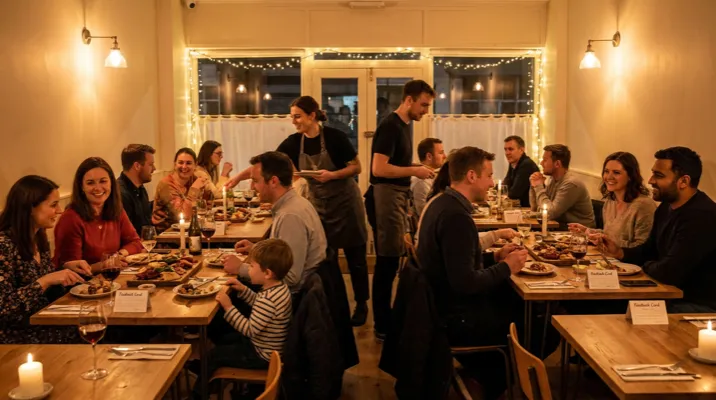
Plan a successful restaurant soft opening with invite lists, feedback forms, menu testing and staff training tips. A practical UK guide.
Your grand opening is in two weeks. The menu is set, the staff are trained on paper, and you're confident everything will run smoothly. It won't. Every restaurant discovers problems on opening night, unless they run a restaurant soft opening first and find them with a forgiving audience.
If you're planning a restaurant grand opening, a soft opening is the dress rehearsal that separates a smooth launch from a public disaster. It's not optional. It's how you protect the reputation you haven't built yet.
What You'll Learn
- What a restaurant soft opening actually involves and why it matters more than you think
- How to build an invite list that goes beyond friends and family
- What to test during your soft opening, and what most owners miss
- Feedback collection methods that produce actionable insights
- How to bridge the gap between soft opening and grand opening
What Is a Restaurant Soft Opening and Why It Matters
First, let's clarify what we're talking about. A restaurant soft opening is a framework that allows you to run a controlled, invitation-only trial of your restaurant before the official public launch. You open the doors to a limited number of guests, typically at a reduced menu or discounted price, to test your kitchen, service, and operations under real conditions.
The soft opening meaning for a restaurant is straightforward: it's your chance to find and fix problems before paying customers and food critics walk through the door.
According to UKHospitality, roughly 60 per cent of UK restaurants close within the first three years, and first impressions play a significant role in those early months. Your first public night shapes the reviews and word-of-mouth that follow you for months.
One poorly timed kitchen, one confused server, one dish that takes 45 minutes, and that's the story people tell.
A soft opening lets you make those mistakes in front of guests who are invested in your success rather than strangers judging your worth.
For example, a neighbourhood bistro might discover during their soft opening that their signature sharing board takes 25 minutes to plate, far too long when tables are waiting. They'd never spot that during staff training with empty plates.
With real orders coming in, real pressure building, the timing issue surfaces where it can be fixed. If you're thinking "we've done enough training, we'll be fine", that's what every restaurant owner thinks. Then the ticket printer jams during a full service on a quiet Wednesday night.
Warning
A negative review on opening night reaches hundreds of potential customers through Google and social media. A soft opening gives you a controlled environment to eliminate the mistakes that generate those reviews.
Related reading
How to open a restaurant: full checklist from concept to launch
Planning Your Soft Opening: Timeline and Invite List
So you understand why a soft opening matters. Now the question is how to structure one that actually gives you useful results rather than just a warm feeling.
When to Schedule Your Soft Opening
Hold your restaurant soft opening one to two weeks before your grand opening. This gives you enough time to implement changes based on feedback without losing momentum.
- Running it too early means your fixes might not stick
- Running it the night before means you've got no room to adjust
Most successful soft openings last two to four days rather than a single night. One effective approach is to run limited hours across multiple days: for instance, lunch service for the first two days, then dinner service on the third and fourth days. This staggered approach lets your team build confidence gradually.
For example, a new Indian restaurant might run a lunch-only soft opening on Monday and Tuesday for 20 guests each day, then a full dinner service on Thursday and Friday for 40 guests. By Thursday evening, the kitchen has already worked through two services and fixed the biggest bottlenecks.
Building Your Invite List
This is where most owners get it wrong. A friends-and-family-only list feels safe, but it limits the quality of feedback you receive.
If you're only inviting friends and family you'll always lose to competitors who use soft openings as a strategic marketing tool.
Your mates will tell you the food was "lovely." A local food blogger will tell you the lighting makes every dish look grey on camera.
Structure your invite list in tiers:
| Tier | Who to Invite | Why They Matter |
|---|---|---|
| Inner circle | Family, close friends, staff families | Forgiving audience for the roughest nights |
| Industry contacts | Fellow restaurateurs, suppliers, local chefs | Understand the challenges, give honest operational feedback |
| Local influencers | Food bloggers, community leaders, journalists | Generate early buzz before your marketing for new restaurants kicks in |
| Neighbours | Nearby residents and businesses | Build goodwill, reduce noise complaints, create regulars |
| Loyal future customers | Email subscribers, social media followers | First taste creates anticipation for the grand opening |
Note: This tier structure is a rule of thumb; adapt the mix based on your restaurant's location and concept.
Guest numbers
Aim for 30 to 50 guests per evening. More than that and you're running a full service before you're ready. Fewer than that and you won't stress-test your kitchen properly.
Don't post about your soft opening on social media before it happens because an uncontrolled crowd defeats the entire purpose of a soft launch restaurant event. Keep it invitation-only.
What About Pricing?
Common practice ranges from 30 to 50 per cent off full menu prices, with some restaurants offering a set percentage discount on all dishes. Others provide a complimentary meal in exchange for detailed feedback.
Whatever you choose, communicate tipping expectations clearly. Your staff are working just as hard as they will on a regular night. Budget between £500 and £2,000 for a successful restaurant soft opening across two to four evenings, depending on your covers and discount level.
What to Test During Your Soft Opening
With your invite list sorted and dates confirmed, the next step is deciding what you're actually measuring. A soft opening without clear testing objectives is just a free dinner party. Go in with a checklist. This is where you shift from hoping things work to knowing what needs fixing.
Kitchen Performance
- Ticket times: How long from order to plate? Track every dish.
- Station coordination: Are starters arriving before mains are ready? Is the pass organised?
- Menu weak spots: Which dishes get sent back? Which take too long? Which don't sell?
- Ingredient prep: Do you run out of anything? Is your par level accurate?
Front-of-House Service
- Seating flow: Does the reservation system work? Are table turns smooth?
- Staff knowledge: Can servers explain the menu confidently? Do they know allergen information as required by the Food Standards Agency?
- Technology: Does the POS system handle split bills? Do card machines work at every table?
- Pacing: Are courses arriving at the right intervals, or are guests waiting 20 minutes between starter and main?
Atmosphere and Operations
- Lighting and music: Too bright? Too loud? Test during actual service, not during an empty walkthrough.
- Temperature: Kitchens generate heat. Is the dining room comfortable when it's full?
- Toilet facilities: Clean, stocked, easy to find? Guests notice these details.
- Accessibility: Can wheelchair users navigate comfortably? Are pathways clear when the restaurant is full?
For example, a pizza restaurant running a restaurant soft opening might discover their wood-fired oven can handle 12 pizzas an hour but their menu promises a 15-minute ticket time at peak. The maths doesn't work when 40 guests are ordering. That's the kind of insight you only get under real conditions.
If you can't tell what your team's weak points are before opening night, that's usually a sign you need a more structured soft opening with specific metrics rather than a casual dinner for friends.
Soft Opening Testing Checklist
Use this checklist during each evening of your restaurant soft opening:
- Record ticket times for every dish ordered
- Note any dish that gets sent back or receives negative feedback
- Test POS system with split bills and card payments
- Check allergen information process with at least two tables
- Monitor dining room temperature at peak capacity
- Time the gap between courses for three tables
- Ask two staff members what they found hardest during service
- Count how many times a guest had to ask for something twice
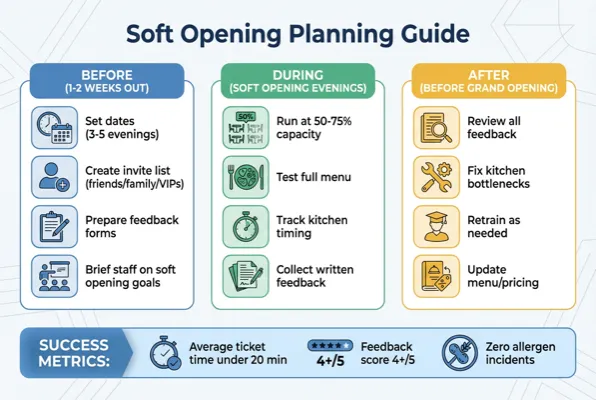
A structured timeline helps you make the most of each soft opening evening
Collecting Feedback That Actually Helps
Now that you know what to test, here's the part most owners get wrong. You've got your guests seated and the kitchen is running. But if you're not collecting structured feedback, you're wasting the entire exercise. Here's how to get insights you can actually act on rather than polite compliments that change nothing.
Structured Feedback Methods
The most effective approach combines multiple channels, since different guests prefer different methods. Reserved guests often prefer anonymous QR code feedback over face-to-face interactions.
Combine these methods:
- Printed feedback cards on each table with specific questions (not just "rate your experience 1-10")
- QR code surveys linking to a short online form, works well for younger guests
- Direct staff conversations during service, especially between courses
- Post-visit email surveys sent within 24 hours while the experience is fresh
For example, a seafood restaurant running their soft opening placed QR codes on table tents linking to a five-question survey. They offered a free cocktail on opening night for completed surveys. The response rate was high. That's actionable data from nearly every table.
Staff observations
Ask servers to note their own observations after each service too. They'll spot things guests won't mention: like a table that waited eight minutes before being greeted, or a dish that needed replating because the kitchen sent it cold.
What to Ask
Generic questions produce generic answers. Ask about specifics:
- Food: "Which dish was your favourite and why?" / "Was any dish under-seasoned or over-salted?"
- Timing: "Did you feel rushed or did you wait too long between courses?"
- Service: "Did your server explain the menu clearly?" / "Were drinks topped up without asking?"
- Atmosphere: "Was the noise level comfortable for conversation?" / "How was the lighting?"
- Value: "At full price, would you return?" / "What would you change about the menu pricing?"
The question "at full price, would you return?" is the most revealing one you can ask. It separates polite encouragement from genuine commercial viability. If you can't tell whether your feedback is genuine praise or polite encouragement, that's usually a sign your questions aren't specific enough.
What to Do With the Feedback
Collect all feedback within 24 hours of each soft opening night. Group comments by theme: if three separate guests mention slow drink service, that's a pattern, not a one-off.
Hold a team debrief after each night. Not a blame session. A factual review: what worked, what didn't, what we change tomorrow. If you're doing this at the end of a 12-hour shift, keep it to 15 minutes. Tired staff absorb nothing from long meetings.
Don't just collect feedback and file it away. That rarely produces results. The restaurants that benefit most from soft openings are the ones that make visible changes between each evening, even small ones like adjusting the music volume or changing the order dishes leave the pass.
Related reading
Restaurant events management: how to handle group feedback for any event
From Soft Opening to Grand Opening: Bridging the Gap
With that feedback collected, here's where it all comes together. Your soft opening is done. The data is in. The gap between your last soft opening night and your grand opening is where the real value appears, but only if you use it deliberately.
Soft Opening vs Grand Opening
The difference between a soft opening and a grand opening is purpose. A soft opening is a private testing phase. A grand opening is a public marketing event: one you can map out in advance using ready-made campaign templates for launches and local events. You need both, in that order.
| Aspect | Soft Opening | Grand Opening |
|---|---|---|
| Audience | Invited guests only | General public |
| Purpose | Testing and feedback | Publicity and buzz |
| Pricing | Discounted or free | Full price |
| Menu | Limited or trial | Full menu |
| Marketing | Minimal, word-of-mouth | Press, social media, promotions |
| Atmosphere | Relaxed, forgiving | Polished, high-energy |
| Duration | 2-4 nights | Single event or opening weekend |
Making the Transition
Between your last soft opening night and your grand opening, you have a window to implement changes. Use it ruthlessly.
Priority fixes (do immediately):
- Menu items that consistently received negative feedback: remove or rework them
- Service timing issues: adjust kitchen workflow and station assignments
- Technology problems: fix POS bugs, replace faulty equipment
Quick wins (do within days):
- Staff retraining on weak areas identified during service
- Adjust lighting, music volume, or temperature settings
- Restock anything you ran out of
Longer-term notes (track for later):
- Menu additions guests requested
- Pricing adjustments based on "would you return at full price?" responses
- Staffing level adjustments for different service periods
For example, a gastropub in Manchester discovered during their soft opening that tables near the kitchen door got uncomfortably warm during service. A simple fix, repositioning two tables and adding a draught excluder, took 30 minutes and eliminated the most common complaint before anyone paid full price.
Info
The reality for most independent restaurants: you won't fix everything. Pick the three changes that affect the most guests and nail those before opening night.
This sounds great in theory. In practice, when you're down two staff and the Saturday rush is coming, you focus on what matters most. A restaurant soft opening isn't about perfection. It's about removing the biggest surprises so your grand opening becomes a celebration rather than a crisis management exercise.
If You Only Have 30 Minutes a Week
All of this might sound like a lot of work on top of everything else. If you're reading this thinking "I don't have time for this", you're not alone. Planning a soft opening doesn't require weeks of preparation if you break it into manageable steps.
This week, plan your restaurant soft opening
- Day 1-2: Write your invite list using the tiered approach above: aim for 30-50 guests per night across 2-3 evenings
- Day 3-4: Create a simple feedback form (5-7 specific questions) and print cards or set up a free online survey
- Day 5-7: Brief your team on the soft opening objectives: what you're testing and why their observations matter
Your competitors don't have bigger budgets. They have better preparation. A structured restaurant soft opening costs you a few evenings of discounted food and gives you confidence that your grand opening won't be your worst night in business.
Frequently Asked Questions
How long should a restaurant soft opening last?
Most successful soft openings run two to four evenings over one to two weeks. This gives your team enough repetitions to identify patterns and improve between services. Don't just do one because a single night isn't enough. You need at least two services to see whether issues are one-offs or systemic problems.
Do you charge guests at a soft opening?
It varies. Some restaurants offer complimentary meals in exchange for feedback. Others discount by 30 to 50 per cent. A third option is charging full price for food but offering complimentary drinks. Be transparent with guests beforehand and communicate tipping expectations clearly.
Can anyone attend a restaurant soft opening?
Typically no. A restaurant soft opening is invitation-only by design. The controlled guest list is what makes it useful. You need a manageable number of diners to test operations. Some London restaurants use platforms like Soft Launch London to offer discounted meals, but these are closer to promotional events than true operational testing.
What is the difference between a soft opening and a friends and family night?
A friends and family night is one type of soft opening event, but a well-planned restaurant soft opening goes further. The soft opening concept is a framework that includes structured feedback collection, specific testing objectives, multiple evenings with different guest groups, and a clear plan for implementing changes. A friends and family night without these elements is just a free dinner.
Is a soft opening worth the effort for a small restaurant?
Yes, arguably more so than for large chains. Small restaurants have less margin for error and fewer resources to recover from a bad public launch. A restaurant soft opening costing a few hundred pounds in discounted food can prevent thousands in lost revenue from negative early reviews. If you're reading this thinking "I don't have time for this", you don't have time to recover from a botched opening either.
If you run a restaurant and want to see how Local Brand Hub can support your marketing, explore our restaurant marketing tools.
Key Takeaway
Key Takeaways
- A restaurant soft opening is a controlled, invitation-only trial run held one to two weeks before your grand opening
- Build your invite list in tiers (friends and family, industry contacts, local influencers, and neighbours), not just people who'll say everything was wonderful
- Test specific metrics: ticket times, staff knowledge, technology, pacing, and atmosphere under real conditions
- Collect feedback through multiple channels (cards, QR codes, staff conversations, and follow-up emails) with specific questions, not vague ratings
- Use the gap between soft opening and grand opening to fix the three biggest issues before the public arrives
- Typical discounts range from 30 to 50 per cent off menu prices, with some restaurants offering complimentary meals in exchange for detailed feedback
For restaurants, salons, and local businesses
Need help with your marketing?
We help UK businesses turn social media into real results, not busywork.
Start freeGet More Marketing Tips
Practical marketing tips for UK business owners, straight to your inbox. No spam, unsubscribe anytime.
About the Author
Local Brand Hub
Empowering UK Businesses
Local Brand Hub provides comprehensive business management tools designed specifically for UK local businesses to streamline operations, automate marketing, and grow revenue.
More articlesRelated Articles
 Tutorials
Restaurant Opening: UK Checklist and Timeline
Plan your restaurant opening with our 16-24 week UK timeline, essential checklist, licences guide, and biggest mistakes to avoid.
 Marketing Tips
Restaurant Grand Opening Marketing Strategy: The Timeline
A restaurant grand opening marketing strategy works backwards from the dates you cannot move: the three phases, the budget split, what each week owes.
 Marketing Tips
Future of Restaurants: UK Dining Trends for 2025-2026
Prepare your restaurant for 2025-2026 with trends shaping UK dining: AI ordering, nostalgia menus, and the 30/30/30 cost framework.