Florist win back campaigns start in the order book, not in a dormant customer report. Sort three lists, send lawfully, and know when to stop.
A florist win back campaign is a short, targeted message to past customers who have stopped ordering. For a flower shop the useful trigger is rarely months of silence. It is a date they bought for a year ago that has come round again without them, which turns one vague list into three specific ones.
Somewhere in last February's page of your order book there is a man who bought a hand tied bunch for his wife, paid on the card machine, wrote the message card badly and left. He has not been back. Plug that book into anything that scores loyalty by days since the last order and he comes out dormant, queued up for his ten per cent off.
He is not lapsed. He is between anniversaries, and his date is coming round again.
A florist does not really have lapsed customers. A florist has customers whose date came round without them. Sort your book by that idea and the campaign mostly writes itself.
What is a florist win back campaign?
A deliberate approach to someone who bought from you once, timed for a moment when buying again would make sense to them. Short, personal, usually no offer at all. What makes the florist version different is the trigger.
Win back advice is mostly written for a shop selling something people consume and replace: coffee, socks, dog food, software. Silence there means something is wrong. Flowers attach instead to fixed points in someone else's calendar, and between those points nothing is meant to happen. Picture a customer who has been quiet since March.
She is not drifting away. She is waiting for March.
So the question is not who has gone quiet. It is who had a date and let it pass.
How do you know which customers have actually lapsed?
Stop counting backwards from the calendar on the wall and read the previous year's book forwards. The dates are written down already, so the list has existed since you took the order.
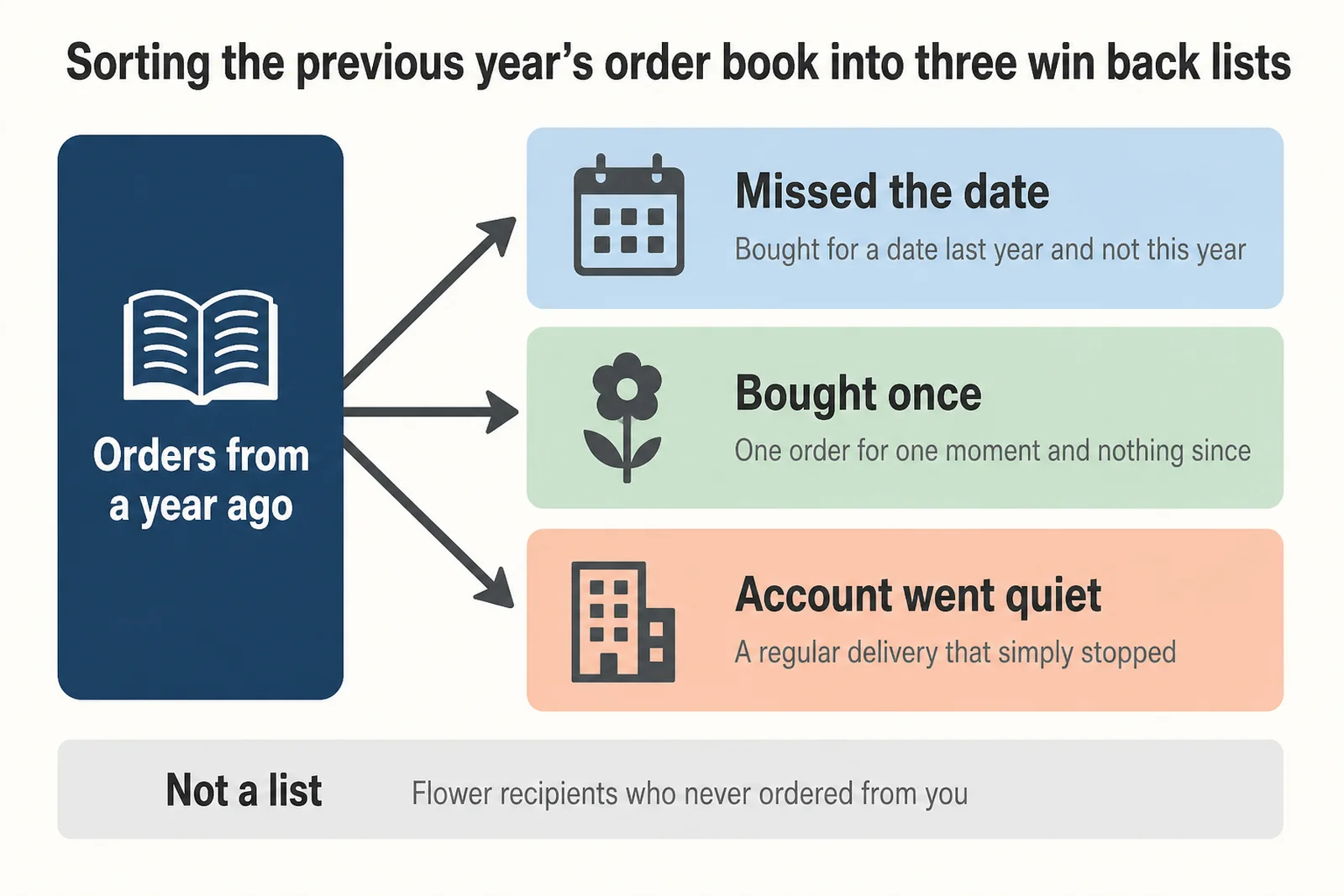
Three lists come out of one order book, and each one needs a different message.
Missed the date. A birthday, an anniversary, a Mother's Day or a funeral date ordered for a year ago, coming round again with nothing in the book. Work this list first, because the reason to write is already sitting in the diary and you do not have to invent one.
Bought once. One order, one moment, no repeating date. A leaver's bouquet, a new baby, an apology. No anniversary to lean on, so the reason to write has to come from your side of the counter.
The account that went quiet. A weekly reception arrangement or a restaurant's table flowers that stopped. One contact, real money, and usually a reason nobody told you.
Then one group that is not a list at all. A good share of the names in your book belong to recipients: the wife, the mother, the office manager who signed for the delivery. They never bought anything from you, and unless they have since asked to hear from you, they never gave you their details for marketing either.
Is it lawful to email a customer who stopped ordering?
Only with a lawful basis for that particular person, and a win back leans on this harder than any other message you send. ICO guidance on the PECR electronic mail marketing rules states you must not send marketing emails or texts to individuals without specific consent.
The one alternative is the existing customer exception. It covers someone who bought, or negotiated to buy, a similar product or service from you in the past, and it holds only if you gave them a simple way to opt out both when you first collected their details and in every message you have sent.
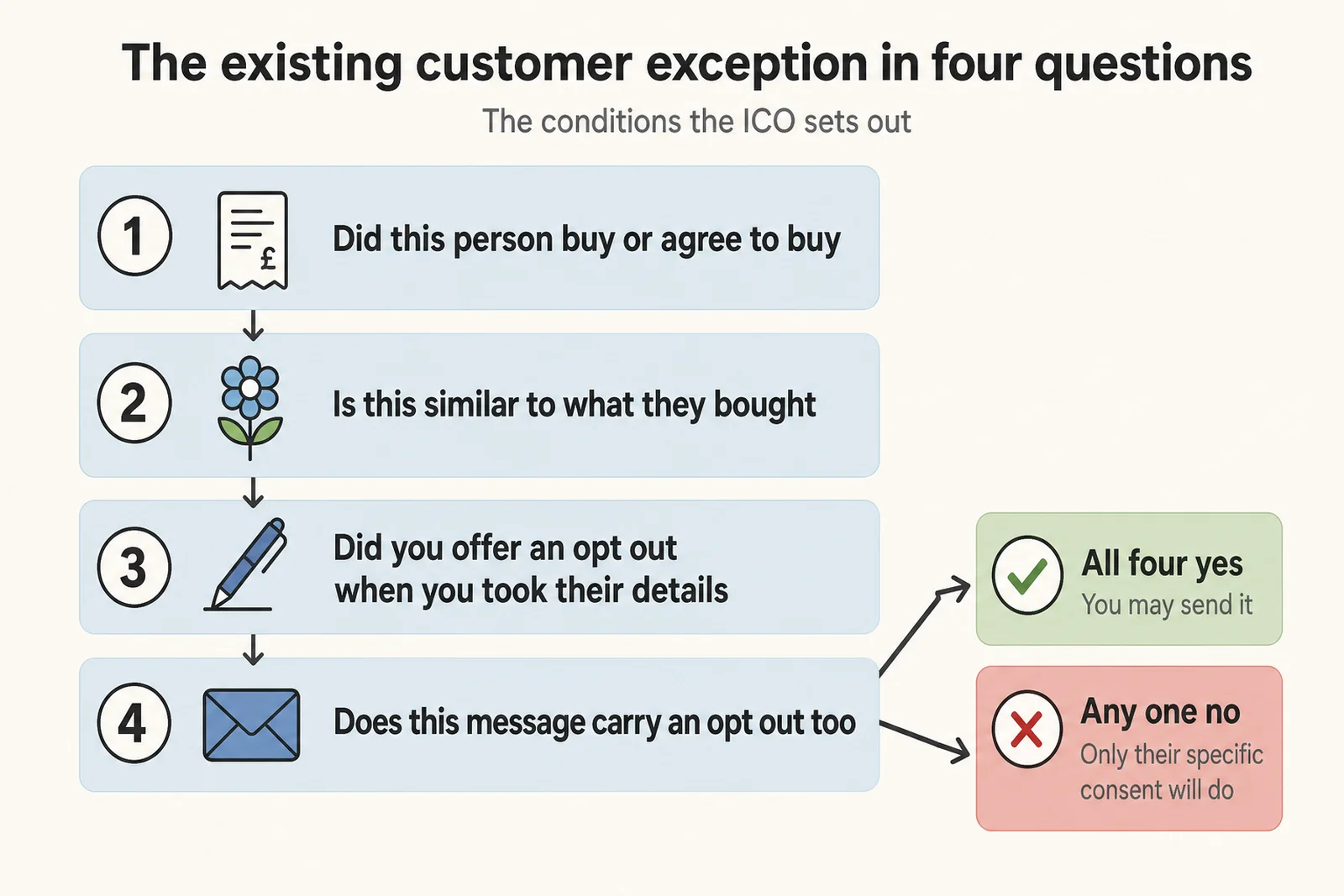
Four questions the exception turns on, and a no to any of them puts the name back to specific consent.
The word the rule itself does not use
Read the ICO's explanation of that exception, because one word in it is aimed straight at you. The ICO calls it the soft opt-in, the rule about existing customers. The thinking, it says, is that someone who bought something from you recently, gave you their details and did not opt out is probably happy to receive marketing about similar products or services, even without their specific consent.
The rule says "in the past". The explanation of why the rule exists says "recently", and a win back is aimed at exactly the people whose purchase was not recent. That gap is a judgement you have to make, not a box the exception ticks for you.
Nor does permission sit still. The ICO's direct marketing guidance states that consent for direct marketing does not last forever, and that how long it lasts depends on the circumstances, such as people's expectations and their relationship with you. Someone who buys every February expects to hear from you in January. Someone who bought once, years ago, for a funeral, does not. Where you cannot work out the basis for a name, leave it off the list, or take professional advice before anything is sent to it.
A recipient never bought anything
The exception is built around a person who bought or negotiated to buy, and the woman whose name is in the book because the flowers arrived at her door has done neither. She is not inside it. Nothing but her own specific consent would put her on your list.
The phone is not the free alternative
Under the ICO's telephone marketing guidance you must not make unsolicited live marketing calls to any number registered with the TPS or CTPS. That holds unless the person has specifically consented to your calls, even if they are an existing customer. A company switchboard can sit on the CTPS exactly as a home number can sit on the TPS, so the check comes before the call, including the call to the account you most want back.
Notice what all this demands: an opt out that works, and honest knowledge of who bought from you. That is an outcome, not an architecture. A pen and the order book can meet it.
If you do move the list into an email tool, take only the fields the job needs: the buyer's name, their address for messages, and the date. Leave recipients out of the upload, leave your supplier prices and margins where they are, and read the tool's current account and data use settings before anything goes across.
Three florist win back campaigns to run this quarter
One list, one trigger, one message each. Everything in square brackets is a placeholder and every detail inside one is invented. Replace every bracket with something true of your shop and your customer before you send anything. A bracket that goes out unfilled is sloppy; a bracket filled with something you did not check is a lie told in your name.
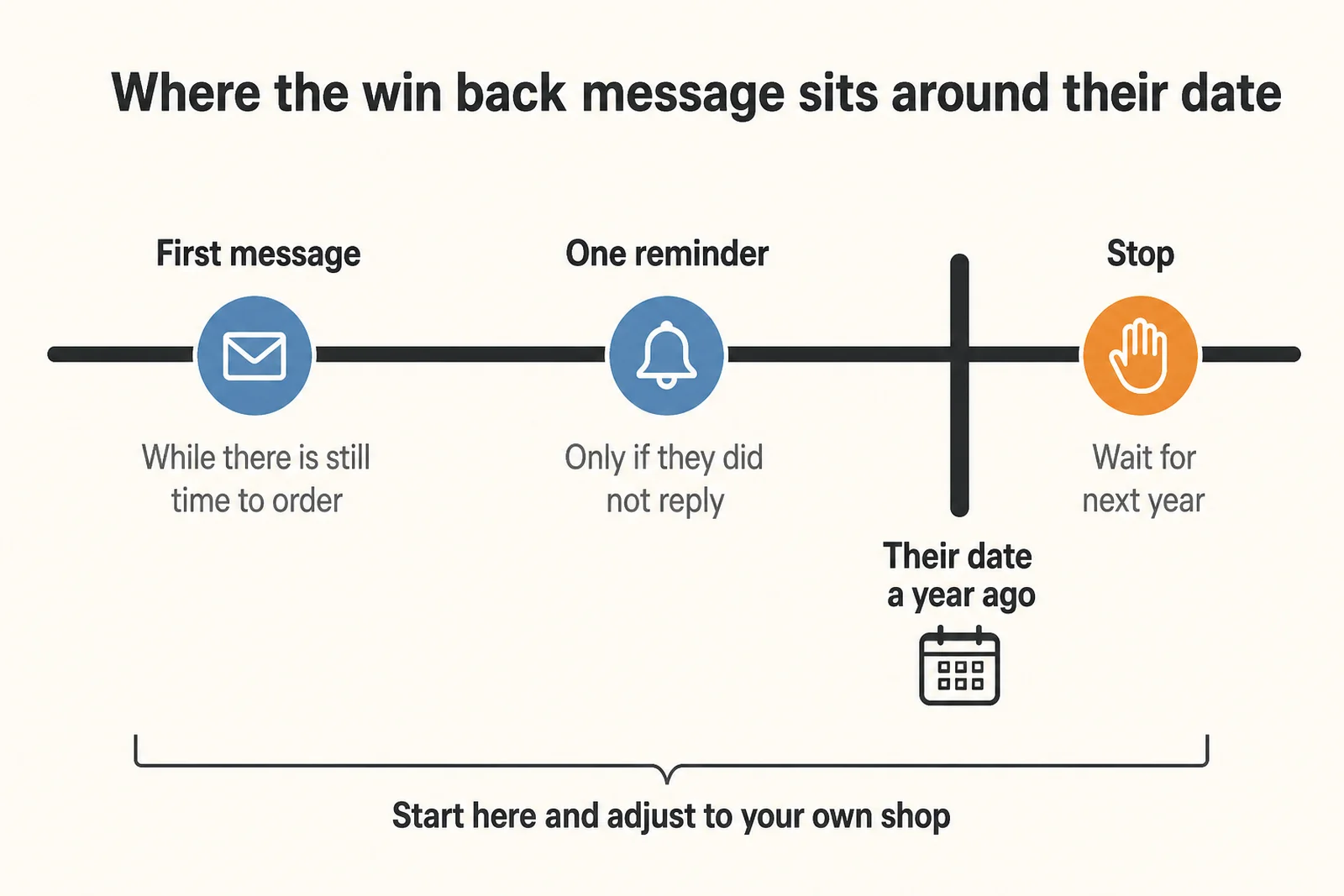
One message, one reminder, then stop. Treat the spacing as a starting experiment and adjust it to your own trade.
1. The missed date
Trigger: their date from the previous year is close enough that a pre-order is still possible, and nothing is in the book.
Subject: [MONTH] coming round again
Hello [FIRST NAME], this time twelve months ago we made up [WHAT THEY ORDERED] for [WHO IT WAS FOR], and I have [THEIR DATE] written down here. If you would like something for it again, reply with a rough idea and I will look after it. If not, no bother at all, and there is an unsubscribe link below.
[YOUR NAME], [SHOP NAME]
No offer, no urgency, no countdown. You are not persuading anybody to buy flowers. You are reminding a busy person of something they already meant to do.
2. The one off buyer
Trigger: a single order with no repeating date, and something in the shop now that genuinely connects to what they chose.
Subject: The [FLOWER OR STYLE THEY CHOSE] you had from us
Hello [FIRST NAME], you came to us in [MONTH] for [OCCASION] and went for [WHAT THEY CHOSE]. We have [WHAT IS ACTUALLY GOOD THIS WEEK] in at the moment and it put me in mind of it. If anything is coming up where flowers would help, send me the date.
This only works if the connection is real. Check what they bought before you write, or leave them be until a date gives you a better reason.
3. The account that went quiet
Trigger: a standing order that stopped without a conversation, and nobody on either side has raised it since.
Subject: The [WEEKLY OR FORTNIGHTLY] flowers at [COMPANY]
Hello [CONTACT NAME], we used to do the [WEEKLY OR FORTNIGHTLY] arrangement for [RECEPTION OR TABLES] at [COMPANY] and it stopped around [MONTH]. I would rather ask than guess: was it budget, was it something we did, or did it fall off somebody's list? If it was budget, there is a smaller version I can do for less.
Ask the question, do not send an offer. A discount aimed at a company that left because your driver kept arriving at half past four is money spent on the wrong problem. Ask, and they might tell you. Guess, and you will be paying to fix something that was never broken.
What counts as a win back that worked?
Count orders. Not opens, not replies, not the lovely note from someone who has moved to Norwich and misses your window.
A reply says the message landed well. An order is the outcome you sent it for, and the two come apart more often than you would like. Give each list a line in a notebook and let the next attempt be shaped by what the last one brought.
Then stop. Our house rule is one message and one reminder, and if the date passes in silence the name goes back on the list for next year rather than into a monthly newsletter nobody asked for. Filling the quiet weeks between the big dates is a different job, and a library of ready made seasonal campaigns like the one inside LocalBrandHub is built for those.
Frequently Asked Questions
What is a florist win back campaign?
A short, targeted message to past customers who have stopped ordering. In a flower shop the trigger is rarely silence. It is a date they bought for a year ago coming round again without them.
How do I know which florist customers have lapsed?
Read the previous year's book forwards instead of counting days backwards. A dated order that has not repeated goes on the missed date list, one off buyers on a second, stopped standing orders on a third. Bouquet recipients belong on none of them.
Can I email customers who have not ordered in over a year?
Only with a lawful basis for that particular person. The ICO's guidance on the PECR electronic mail marketing rules states you must not send marketing emails or texts to individuals without specific consent. The exception covers an existing customer who bought a similar product or service and was given a simple way to opt out when their details were collected and in every message since. Its direct marketing guidance adds that consent for direct marketing does not last forever.
Should I offer a discount to win back a flower customer?
Not as the opening move. Someone who bought for an anniversary is not waiting for money off, they are waiting for the date. Our house rule is to lead with the date and keep anything free in reserve for accounts you would be sorry to lose.
Can I ring lapsed customers instead of emailing them?
Check the number first. The ICO's telephone marketing guidance states you must not make unsolicited live marketing calls to any number registered with the TPS or CTPS. An existing customer relationship does not lift that; the person's specific consent does. Business numbers sit on the CTPS, so screening comes before dialling.
Your 30-Minute Plan
Key Takeaway
Half an hour with last year's order book gives you a first list and the lawful basis behind it, in this order.
- Open it at the month coming up and list every dated order from a year ago with nothing against it this time.
- Mark whether each set of details is the buyer's or a recipient's, and where it came from.
- Check the lawful basis for each buyer before anybody gets a message.
- Send the missed date message to the handful you are surest of, opt out on every one.
- Note what came back, and leave the other two lists until this one has told you something.
For restaurants, salons, and local businesses
Need help with your marketing?
We help UK businesses turn social media into real results, not busywork.
Start freeSources
Get More Marketing Tips
Practical marketing tips for UK business owners, straight to your inbox. No spam, unsubscribe anytime.
About the Author
Local Brand Hub
Empowering UK Businesses
Local Brand Hub provides comprehensive business management tools designed specifically for UK local businesses to streamline operations, automate marketing, and grow revenue.
More articlesRelated Articles
 Marketing Tips
Email Marketing for Florists: A UK Flower Shop Guide
Email marketing for florists that drives repeat orders and peak-day pre-sales: a UK guide to building a list and sending emails customers actually open.
 Marketing Tips
Wedding Flower Consultation: The Florist's Question Sheet
How to run a wedding flower consultation that ends in a quotable list of pieces, with a copyable question sheet to send couples before you meet.
 Marketing Tips
Florist Pre Orders: Run One Round Without the Panic
Florist pre orders for UK flower shops: when to open the round, what the order page has to settle, how to date the cut off, and how to fill the list.