Marketing to engaged couples for wedding florists: aim at the dates your diary still needs, work local venues, and log where every enquiry came from.
Marketing to engaged couples means getting your wedding work in front of couples planning one specific date: the venue's recommendation first, then a feed they can judge your style from. The useful question is not where couples look. It is which of your dates are still empty.
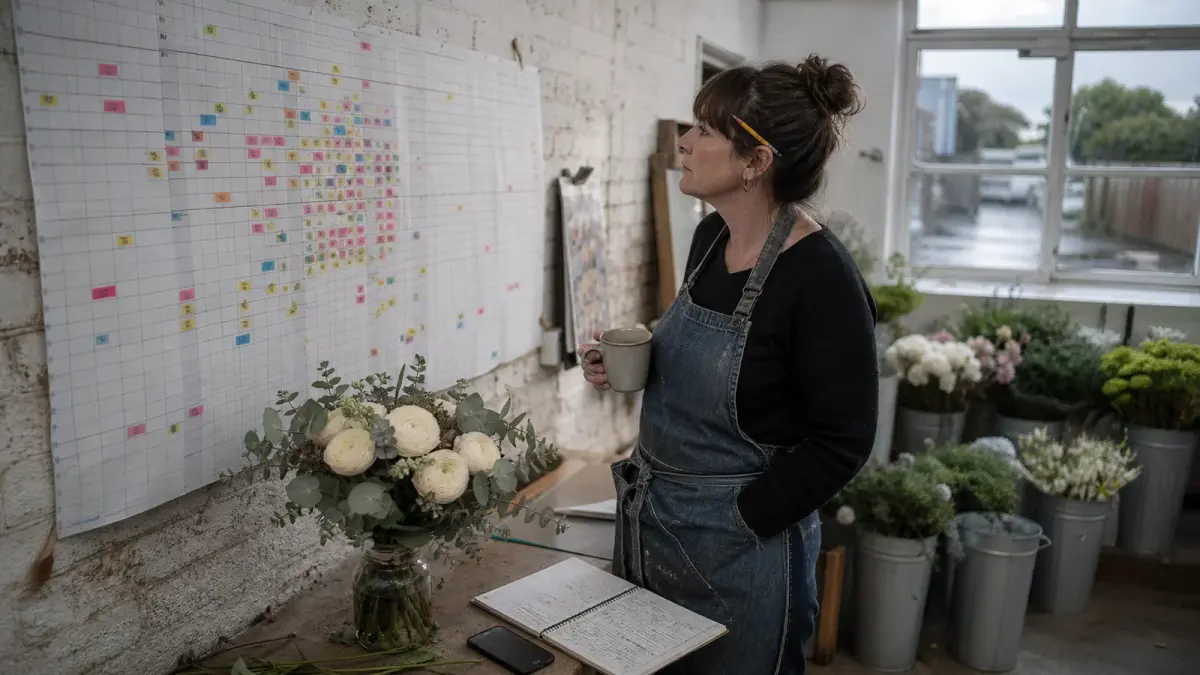
Two enquiries land before nine. Both want the same Saturday in August. You can take one, and the fortnight in February that has been blank since Christmas is still blank.
That is the shape of a wedding florist's year, and it is why so much wedding marketing advice slides off. It sells visibility, and undirected visibility mostly reaches the couples already chasing the dates that fill without you. The dates that need help are the ones few couples are asking for in the first place.
So this guide starts from your diary rather than from a list of channels.
Related: still deciding whether to take weddings at all? Start with our guide to building a wedding florist business.
Why wedding marketing is really date selling
Because a couple is not shopping for flowers. They are shopping for one date at one venue, which means the first thing they need from you is a yes or a no about that day. Style is what the second conversation is about.
Demand piles onto a small number of days. Office for National Statistics figures for England and Wales in 2023 show Saturday remained the most common day to marry, accounting for 41.9% of all marriages, and August the most popular month, with 14.3% of marriages taking place in it.
Read that carefully, because it says less than it looks like it says. It tells you where demand sits, not where your problem is. It does not promise that a Friday in November will sell if you discount it. What it does say is that the busiest dates are the ones you were always most likely to fill anyway, and the quiet ones are the dates you will have to go and find a couple for.
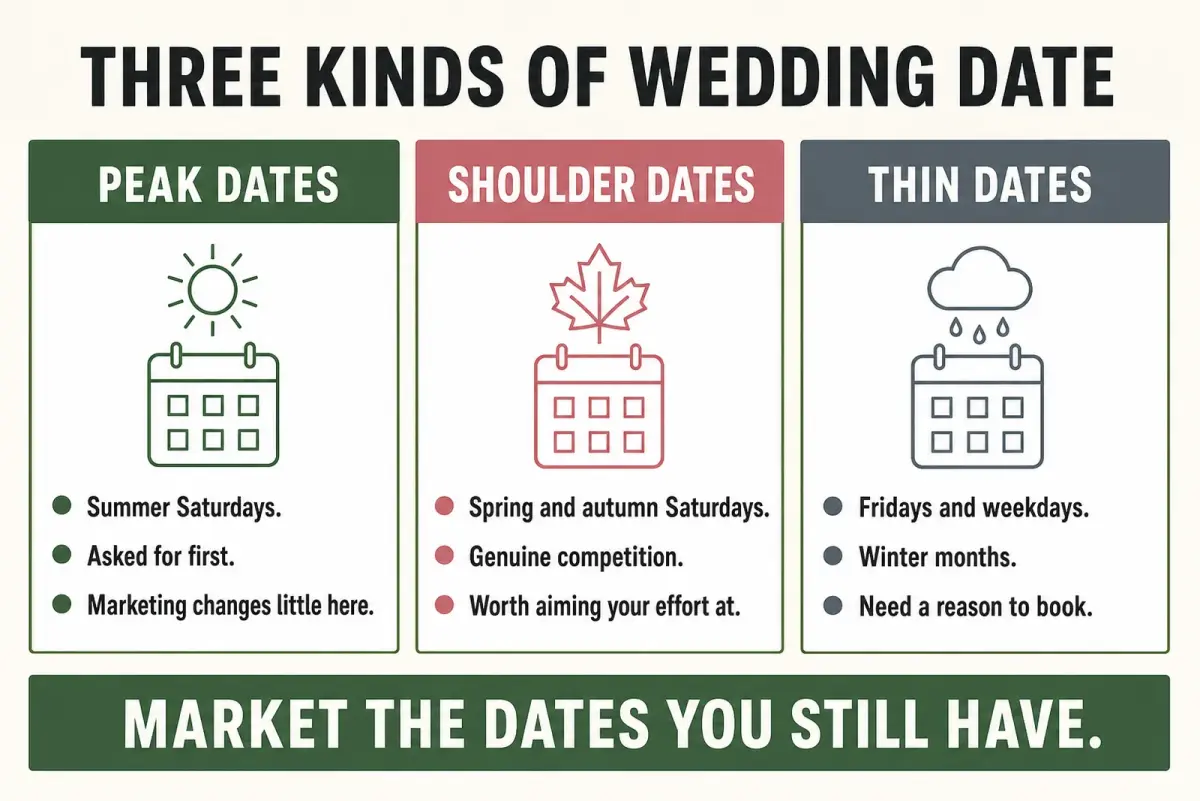
Sort your own year this way before you spend anything on marketing.
Sort your own dates into three piles.
- Peak dates that fill without you.
- Shoulder dates in spring and autumn where you are genuinely competing.
- Thin dates, the weekdays and deep winter, that need a couple to be given a reason.
That sorting is a judgement about your diary, not a measured law. The shoulder and thin piles are what your marketing is for.
You are not marketing to engaged couples. You are marketing to the ones whose date you can still take.
Who is actually getting married
Not the couple in the stock photography. The pool is smaller than it was, older than the imagery suggests, and it does not consist entirely of a bride and a groom.
The pool is not obviously growing. ONS recorded 231,949 marriages and civil partnerships in England and Wales in 2023, an 8.6% decrease on the previous year's 253,776. One year of change is a one year change, not a proven trend, so do not build a plan on it.
Age matters more for your copy. The median age at opposite-sex marriage in England and Wales that year was 34.8 years for men and 33.0 years for women, among the highest median ages ever recorded. Half of them were older still. These are people who have bought a car and probably a kitchen. Wide-eyed language about their special day reads to them the way a hard sell reads to you.
The assumption of a bride and a groom quietly excludes people. Civil partnership formations contributed 3.3% of all legal partnership formations in England and Wales that year, made up of 6,179 opposite-sex and 1,368 same-sex civil partnerships. Writing "couples" where you would have written "brides" costs nothing.
How do wedding florists find clients?
Through the venue, first and hardest. The date and the place get settled before the flowers do, so a venue meets the couple before you do and knows the date before you do. Its recommendation reaches them earlier than anything you could buy.
Which is where the usual venue approach goes wrong. Florists arrive with a portfolio a coordinator cannot use, and without the thing a coordinator actually gets asked for: who is free that day.
Turn it round and tell the venue what you have left. A short message in January naming the dates you can still take at their place gives a coordinator something to hand a panicking couple, and costs you nothing to send.
Three things get you recommended twice, and none of them are floral.
- You arrive when you said you would.
- You leave the room clean.
- You never become the coordinator's problem at the worst hour of their day.
The flowers get you on the list. Being easy keeps you there.
And go deep rather than wide. Four venues that know your name are worth more than forty that have had one email.
Imagine a florist with four venues within half an hour. In January she emails each one her open dates and a photo of the last wedding she did there. Nothing else changes. The point is not the email. It is that she now knows which of the four ever replies.
Settle the money before the referrals arrive: a recommendation you cannot price confidently is worse than none. Our wedding florist pricing guide covers what a wedding costs you, and wedding flower packages covers how to shape what you sell.
What should a wedding florist post on Instagram?
Real weddings at named venues, shot honestly, plus what you still have free. A feed is a portfolio a couple browses at midnight, and it should answer the question they arrived with, which is whether you are free on their date.
Tag the venue in every wedding post. A tagged post can surface where couples browsing that venue already are, which is worth doing, but treat it as a working rule rather than a mechanism you can lean on: platforms change how tagging and reach behave without announcing it, so check what those features currently do in your own account before you build a routine on them.
Posting one real wedding a week is a reasonable starting experiment, not a proven minimum. Run it for a season, watch which enquiries follow, and change the number. Feeds get abandoned over a cadence somebody else set.
Shoot in the light couples will have rather than the light you wish they had, so a March barn looks like a March barn. Then name the venue, the season and the palette in the caption, because that is what a couple searching their own venue is scanning for. Our notes on social media for florists go further into the posting side, and our wedding florist portfolio guide covers the work itself.
If keeping a feed going through a season you are actually working is the problem, a social calendar and a library of ready made seasonal campaigns is the part LocalBrandHub handles for florists.
How do you know which marketing worked?
By asking, every time, and writing the answer down. Wedding enquiries are few enough to count by hand, which is exactly why nobody bothers.
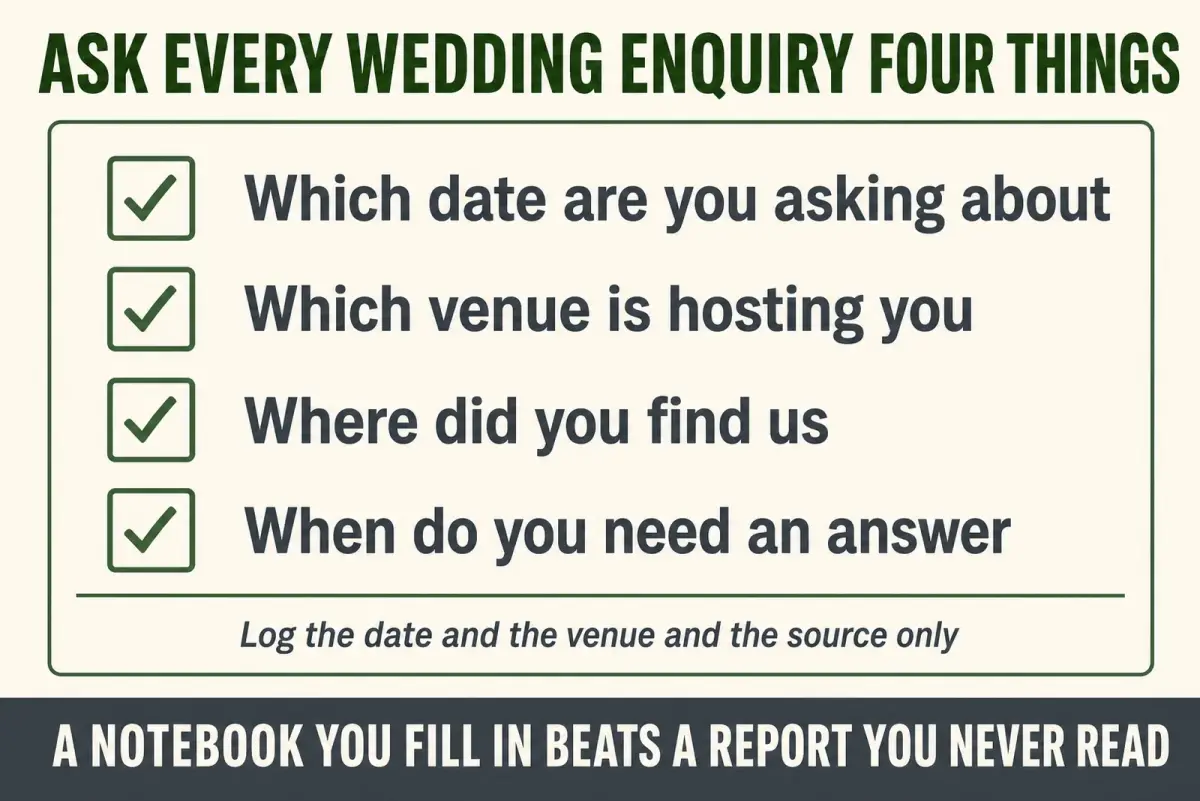
Four questions, asked every time, tell you more than any amount of guessing.
Ask every enquiry four things: which date they want, which venue is hosting, where they found you, and when they need an answer. Keep the log to the date, the venue and the source. You do not need the couple's name or their contact details in a tally of where enquiries come from, and if that log lives in a shared tool, check what the account currently does with what you put in it.
After a season the log tells you something guesswork cannot: not merely which channel produced enquiries, but which channel produced enquiries for the dates you needed filling. Those are different lists, and the second is the one worth spending on.
A notebook you fill in beats a report you never read.
What to do this week
Key Takeaway
Weekly action
- Write your emptiest month at the top of a page
- Message the three venues nearest you with the dates you can still take there
- Post the last wedding you did at one of those venues
- Ask your next three enquiries where they found you, and write it down
None of that is a campaign. It is four small acts aimed at a specific hole in your year, which is the argument of this guide: the couples worth marketing to are the ones whose date you can still say yes to. When those enquiries land, our guide to the wedding flower consultation covers turning them into bookings.
Frequently asked questions
How do wedding florists find clients?
Through the venue, through a feed couples can judge your style from, through reviews, and through word of mouth between couples who married at the same place. Each of those reaches a couple who already has a date and a venue to brief you with, which is why the venue tends to be the earliest and strongest of the four.
How do I get on a wedding venue's recommended supplier list?
Turn up early, leave the site clean, make the coordinator's day easier, and tell them plainly which dates you still have. Venues recommend the florists who cause them no trouble and can take the booking. Ask what the list actually is before you chase it, because some are a printed sheet and some are a phone call.
When do engaged couples book their florist?
It varies far more than the guides suggest, from a couple booking eighteen months out to one calling six weeks before. Rather than trust a number you read, log the gap between enquiry and wedding date across your own recent enquiries. That spread is the one your marketing has to work inside.
What should a wedding florist post on Instagram?
Real weddings at named venues, shot in the conditions couples will actually see, plus the occasional bench shot of a piece being built. Say which venues you work at and which dates you have left. A feed that never mentions availability makes a couple guess whether you are free.
Do wedding florists need to advertise?
Not necessarily. The venue's recommendation, a referral and a portfolio a couple can find cost time rather than media spend, which is why this guide spends its effort there first. Paid directories and local ads are worth testing against a specific empty date rather than buying as general visibility, because general visibility is the thing you already have least trouble selling.
For restaurants, salons, and local businesses
Need help with your marketing?
We help UK businesses turn social media into real results, not busywork.
Start freeSources
Get More Marketing Tips
Practical marketing tips for UK business owners, straight to your inbox. No spam, unsubscribe anytime.
About the Author
Local Brand Hub
Empowering UK Businesses
Local Brand Hub provides comprehensive business management tools designed specifically for UK local businesses to streamline operations, automate marketing, and grow revenue.
More articlesRelated Articles
 Marketing Tips
Wedding Flower Consultation: The Florist's Question Sheet
How to run a wedding flower consultation that ends in a quotable list of pieces, with a copyable question sheet to send couples before you meet.
 Marketing Tips
Mothers Day Florist Marketing: A Countdown That Holds
Mothers day florist marketing run as a countdown: what to publish and when, what your order page must say before an order, and when to close orders.
 Marketing Tips
Valentines Day Florist: How Many Orders Can You Take?
Valentines day florist planning for UK flower shops: work out how many orders your bench and van can handle, then set your cut off, prices and staffing.