
Wedding florist portfolio guide for UK florists: get the pictures, clear the two permissions in writing, then curate what survives and show it.
A wedding florist portfolio is the small set of images you can prove you are allowed to use, arranged so a couple can see their own wedding inside it. Shoot what you control, agree the rest in writing, then curate what survives and put it where couples look.
You have delivered forty weddings. You can show four pictures. Between them sits a photographer who never replied, a couple who asked you not to post, and a phone gallery of dark reception shots.
The standard advice is to curate ruthlessly. Curation is the easy half. The hard half is that the pictures worth curating usually belong to somebody else, and the people smiling in them get a say too. Sharpening your own shots is its own craft, covered in our florist photography tips.
Why your best wedding photos are probably not yours
Because whoever pressed the shutter owns them, and paying for the shoot does not change that. Ownership moves on a written agreement or it does not move at all.
GOV.UK guidance from the Intellectual Property Office states that when you ask or commission another person or organisation to create a copyright work for you, the first legal owner of copyright is the person or organisation that created the work and not you the commissioner, unless you otherwise agree it in writing.
The styled shoot you paid for sits inside that. The ceremony install is further out of reach still: you never hired that photographer at all.
One route does land ownership with you. GOV.UK also states that where an artistic work is made by an employee in the course of his employment, his employer is the first owner of any copyright in the work, subject to any agreement to the contrary. Your Saturday assistant on the payroll shoots the bouquet as part of the job, and unless you have agreed otherwise the shop owns that picture. A self-employed friend who invoices you for the morning is not an employee, and their pictures stay theirs.
Nor does it quietly age out. GOV.UK's table for written, dramatic, musical and artistic work gives copyright usually lasting 70 years after the author's death. That marquee shot from three seasons ago stays someone else's property long after you have handed the shop on.
The bouquet is yours for a morning. The picture of it belongs to whoever pressed the shutter.
Does the couple have a say in what you post?
They do, and it is a different question from copyright, running on different rules. A photograph the couple can be recognised from is information about them, and marketing your business with it is a use they have an interest in.
The ICO, in its advice for small organisations, says that if someone can be recognised from a photograph it is usually considered their personal data. Its guide to lawful basis says you must have a valid lawful basis to handle personal information. Both apply across the UK.
Put those together and the couple in your best ceremony shot stop being scenery. They are a second permission on the same image, and the photographer agreeing changes nothing about it.
Two permissions sit on one photograph. The photographer can only ever hand you one of them.
Asking is how you settle it. If you rely on consent, ICO guidance says it must be as easy to withdraw consent as it was to give it. Which carries a consequence people skip past: you have to be able to find the picture again, in the gallery, the grid, the venue's supplier page. A yes you cannot trace is a yes you cannot undo.
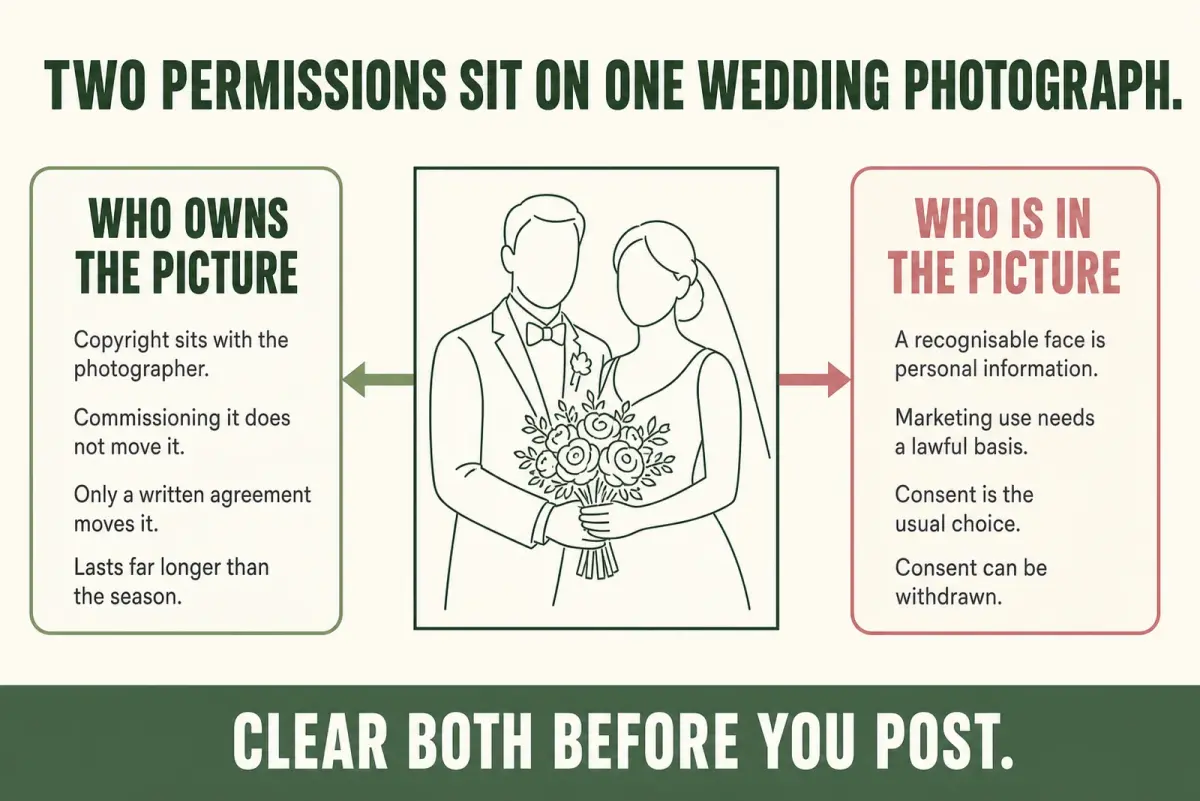
Every image in your portfolio has to clear both columns before it goes up.
There is a shortcut. A tight crop of the bouquet, the arch, the tablescape with nobody recognisable in frame answers the second column before it is asked. Half a good florist portfolio is flowers rather than faces, and the crop costs you nothing but the wider shot.
How do you get pictures you can actually keep?
Shoot the pieces you control, and ask for everything else before the wedding rather than eight weeks after it. A photographer who agreed a credit and a usage line back in March has already said yes, so in October you are chasing a file rather than asking a favour in the middle of their busy season.
Three sources, ordered by how much control you hold:
- Your own bench shots. The bouquet in window light before it goes in the van, buttonholes on a tea towel, the pedestals before anyone moves them. No second permission to chase.
- The wedding photographer. Ask at enquiry stage, and agree in writing what you may use the images for, where, and how you will credit them.
- A styled shoot. It can fill a thin portfolio in a day, and it is the easiest place to mistake paying for the day for owning the files. Put the usage line in the booking email.
Written does not mean legal drafting. An email is writing. "Happy to credit you as @yourname on every post. Can I have your permission to use these on my website and socials for as long as I trade?" starts it, and the reply is your record. Swap the handle for theirs before you send it.
Your booking paperwork is the other home for this. Put the couple's agreement to be shown in the same document as the delivery window and you stop having to remember to ask. Our guide to wedding florist contracts covers where that clause goes.
What should a wedding florist portfolio include?
The work you want more of. Shown at the size a couple will actually judge it. Ten strong images that pull in one direction beat forty that wander, because a couple is trying to picture their own wedding in your work, and an image pulling a different way makes that harder.
A useful test: could a couple point at three of your pictures and say "that, but in cream"? Ten is a starting number to adjust, not a law.
Cover the decisions a couple actually makes. The bridal bouquet, the one piece a couple carries all day. One ceremony install at real scale, so they can see you handle height. Table designs at eye level rather than from above, because that is how a guest sees them.
Leave out the weddings you took because it was February. Honest work, and it drags your average down.
Picture a florist with thirty weddings behind her and eight images she can prove permission for. The eight bring better enquiries than the thirty ever did, because they share a style and the thirty were whatever walked in.
Where should you show it?
Three places do three different jobs. A wedding page on your own site, a social feed couples browse before they enquire, and something you can turn around on a table at a consultation.
Your own site is the only public one of the three that is not a rented room. The full gallery lives there and everything else points at it.
Social is where couples form an impression long before they enquire, and the home for the picture you would never hang in a formal gallery: the van loaded at six, the arch half built. Our notes on social media for florists go further.
The consultation copy is the easiest one to skip. A dozen or so images in a fixed order on a tablet let you tell the story as you want it heard, instead of scrolling past your own worst work while a couple watches. It pairs with the rest of your marketing to engaged couples.
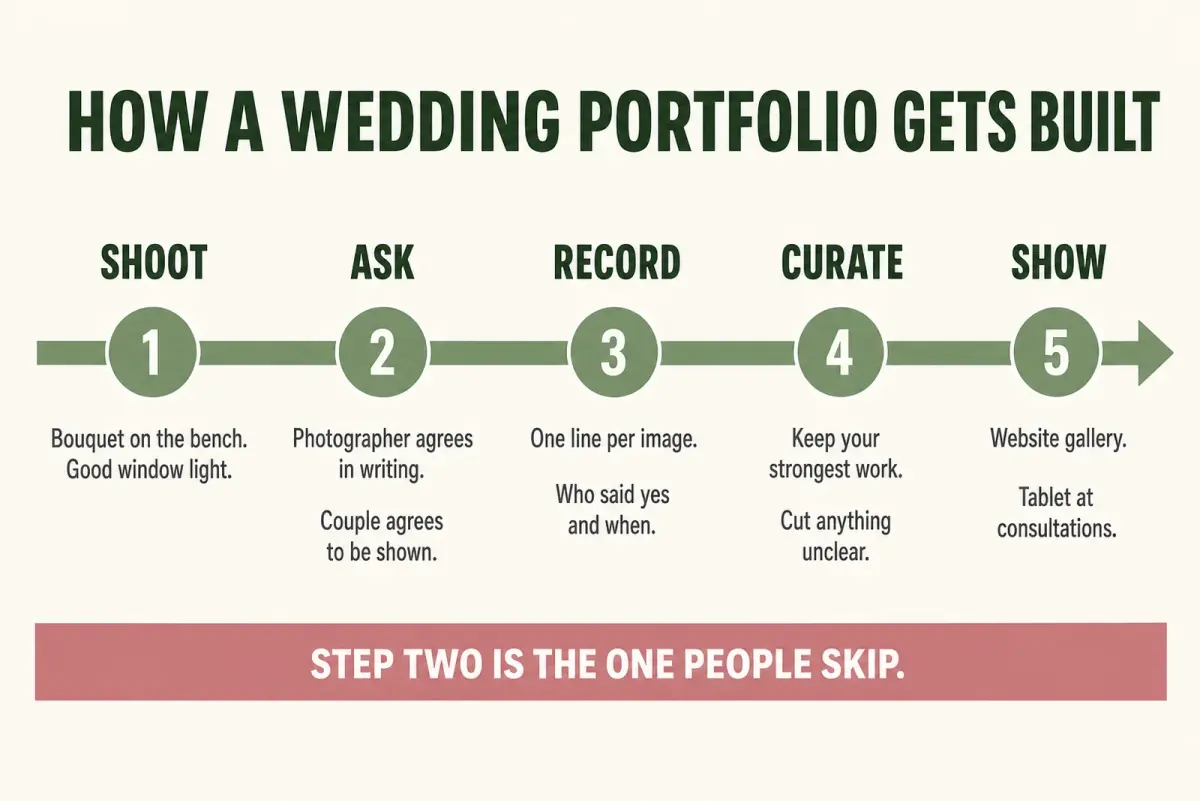
Shoot, ask, record, curate, show. The asking is the stage that gets skipped.
Your first move this week
Key Takeaway
Photograph your next bridal bouquet properly, in daylight, before it goes in the van. Then email the last photographer you worked alongside and ask for permission in writing. That is one image you own outright and one you can prove.
Find out how many of your current images you could actually defend. That number, not the number of weddings, is your portfolio.
A portfolio is not a folder of pictures. It is a set of permissions with pictures attached.
Keeping those images in front of couples week after week is the part LocalBrandHub helps florists with, through a social calendar and ready-made posts rather than another place to store photos.
For restaurants, salons, and local businesses
Need help with your marketing?
We help UK businesses turn social media into real results, not busywork.
Start freeFrequently Asked Questions
Who owns the photos of my wedding flowers?
Whoever took them, in almost every case. GOV.UK guidance states that when you commission a copyright work, the first legal owner is the person or organisation that created it and not you the commissioner, unless you otherwise agree it in writing. Paying for a styled shoot buys the shoot, not the pictures.
Do I need the couple's permission to post their wedding flowers?
Treat it as a separate question from copyright and settle it before the day. ICO advice for small organisations says a photograph someone can be recognised from is usually their personal data, and its guide to lawful basis says you must have a valid lawful basis to handle personal information. A close crop of the bouquet avoids the question entirely.
How many images should a wedding florist portfolio have?
Fewer than you think, and all pulling in one direction. Ten strong images a couple can see their own wedding in are worth more than forty that wander between styles, because the forty give a couple nothing to place themselves in.
How do I build a wedding portfolio with no weddings booked?
Shoot the work you already control, then arrange one styled shoot with a photographer and a venue. Bench shots of a bouquet in window light cost nothing and are unambiguously yours. Agree usage in the booking email beforehand.
What do I do if a couple asks me to take a photo down?
Take it down, then find every other place it lives. ICO consent guidance says it must be as easy to withdraw consent as it was to give it, which in practice means keeping a record you can search. One line per image, noting who agreed and where you published it, turns an awkward request into five minutes of tidying.
Sources
Get More Marketing Tips
Practical marketing tips for UK business owners, straight to your inbox. No spam, unsubscribe anytime.
About the Author
Local Brand Hub
Empowering UK Businesses
Local Brand Hub provides comprehensive business management tools designed specifically for UK local businesses to streamline operations, automate marketing, and grow revenue.
More articlesRelated Articles
 Marketing Tips
Wedding Flower Consultation: The Florist's Question Sheet
How to run a wedding flower consultation that ends in a quotable list of pieces, with a copyable question sheet to send couples before you meet.
 Business Growth
Wedding Florist Contracts: The Clauses That Hold Up
What a UK wedding florist contract should say about deposits, cancellations and changes, with copyable clause wording and the law behind each one.
 Business Growth
Wedding Flower Packages: How to Build and Price Them
Wedding flower packages for UK florists: build three tiers couples can count, fix the right things, and publish a price that survives the wait.