
A florist business plan made simple: a UK template and step-by-step guide to the sections that matter, so you can plan a flower shop without the jargon.
If you're starting out, a florist business plan is a short document that proves your flower shop idea adds up: your model, costs, customers, pricing and a realistic forecast. It doesn't need to be 40 pages of jargon; a focused few pages is plenty to guide your decisions and show a bank or landlord you've thought it through.
You know flowers, but "executive summary" and "cash-flow forecast" make you want to shut the laptop. Sound familiar? The reality for most new florists is that a business plan feels like homework, yet a simple one is the cheapest way to avoid an expensive mistake before you spend a penny. 8 min read.
What You'll Learn
- Why a florist business plan is worth the afternoon it takes
- The sections a flower shop plan actually needs
- A simple florist business plan template you can fill in
- How to forecast costs and sales without a finance degree
- The planning mistakes that trip up new florists
Related: How to Start a Florist Business
Why You Need One (Even a Simple One)
First, the point of a plan. A florist business plan isn't bureaucracy: it's you stress-testing your idea on paper, where mistakes are free, before testing it with real money.
It forces the useful questions: who buys from me, what does it cost, will the numbers work? For example, a florist who drafted a quick plan realised her dream high-street unit would never cover its rent on her expected orders, so she started from home instead and thrived. The plan saved her thousands before she'd spent a thing.
Rule of thumb only: keep your florist business plan to a focused few pages: long enough to answer the hard questions, short enough that you'll actually use it.
The Sections a Florist Plan Needs
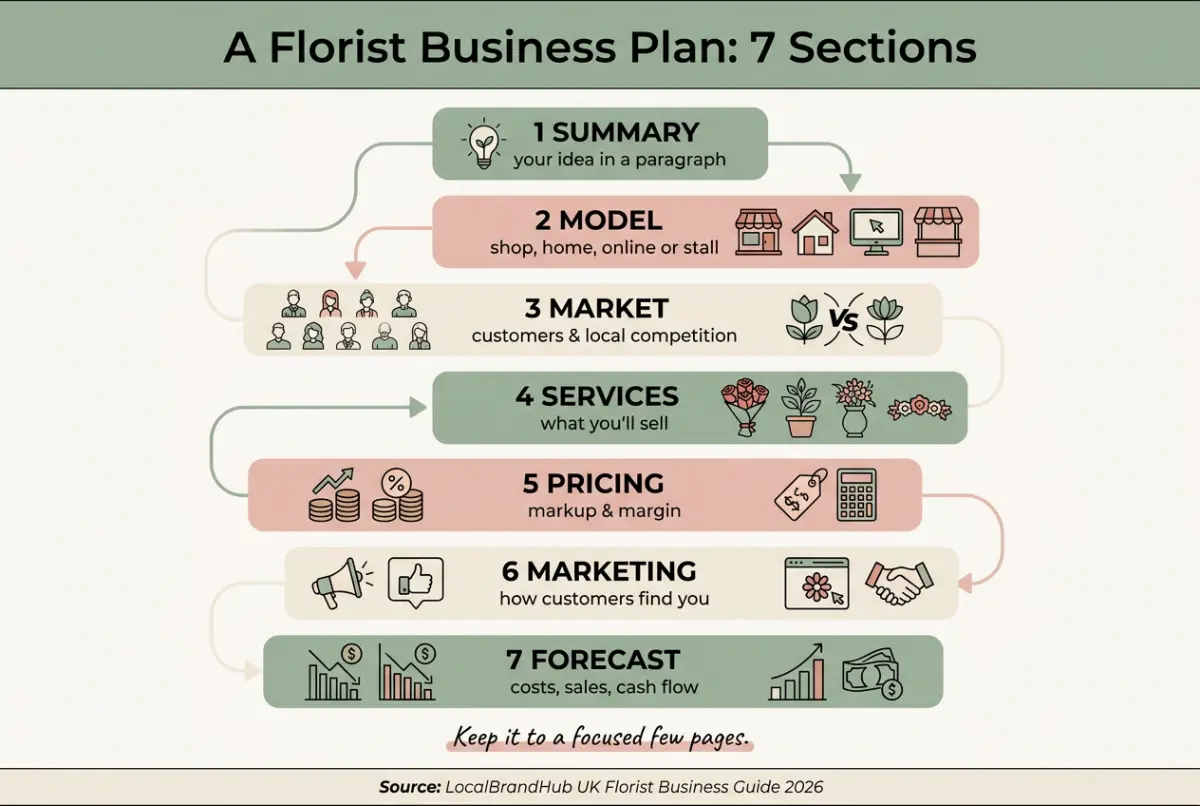
Next, what to put in it. A simple flower shop plan needs just seven sections, and most fit on a page each.
| Section | What it covers |
|---|---|
| Summary | Your idea in a paragraph |
| Model | Shop, home, online or stall |
| Market | Your customers and local competition |
| Services | What you'll sell (and to whom) |
| Pricing | Markup and how you'll profit |
| Marketing | How customers will find you |
| Forecast | Costs, sales and cash flow |
Why this matters: the forecast section is where dreams meet arithmetic. If the numbers don't work on paper with optimistic figures, they won't work in real life with real ones.
For example, a florist who filled in each section in a single afternoon ended up with a 6-page plan clear enough to open a business bank account and negotiate a fair market-stall pitch.
Related: Florist Startup Costs
A Simple Template to Fill In
Now that you know the sections, here's how to fill them fast. Answer these prompts and you have a working plan.
- Summary: "I'm starting a [model] florist serving [customers] in [area]."
- Model & setup: where you'll work and what you need to start.
- Market: who buys flowers locally and who you'll compete with.
- Services: bouquets, weddings, sympathy, subscriptions (your focus).
- Pricing: your markup (often around 3x) and target margin.
- Marketing: local SEO, social, email. See our florist marketing guide.
- Forecast: startup costs, monthly costs, and expected monthly sales.
For example, a florist used this exact 7-prompt template to go from a vague idea to a fundable plan in under 3 hours: proof it doesn't need to be daunting.
Forecasting Without a Finance Degree
However, the numbers scare people most, so let's keep them simple. You only need three figures to start: what it costs to launch, what it costs to run each month, and what you expect to sell.
List your startup costs (cooler, tools, stock, website), add up your monthly overheads, and estimate realistic monthly sales, then check there's something left. For example, a florist who forecast £1,200 of monthly sales against £900 of costs saw straight away that £300 a month wouldn't pay her a wage yet, so she started from home and cut her overheads to almost nothing. For deeper figures, see our how much florists make guide. If the gap between sales and costs is thin, plan a leaner start.
Related: How Much Do Florists Make?
Florist Business Plan Mistakes
Knowing what to skip keeps your plan useful. The biggest mistake is writing a beautiful plan full of optimistic numbers you never pressure-test.
- Fantasy forecasts. If you're only plugging in best-case sales you'll always flatter a plan that won't survive a quiet month.
- Skipping the competition. Ignoring local rivals (and the chains) hides real risk.
- Over-length. A 40-page plan you never reread helps no one.
- No pricing logic. A plan without margins is a wish, not a forecast.
The question isn't how polished your plan looks. It's whether the numbers hold up when you're honest with them.
Frequently Asked Questions
How do I write a florist business plan?
Cover seven short sections: summary, model, market, services, pricing, marketing and forecast. Answer each in a paragraph or page, keep the numbers realistic, and stress-test the forecast. Most florists can draft a working plan in an afternoon: it doesn't need to be long to be useful.
Do I need a business plan to start a florist?
Not legally, but it's strongly worth it. A simple plan stress-tests your idea where mistakes are free, helps you avoid over-committing on premises, and is usually required to open a business bank account or secure finance, a lease or a stall pitch.
What should a flower shop business plan include?
A one-paragraph summary, your business model, a market and competition view, the services you'll offer, your pricing and margins, a marketing approach, and a financial forecast covering startup costs, monthly costs and expected sales. Seven focused sections are plenty.
How long should a florist business plan be?
A focused few pages, often 5 to 8. Long enough to answer the hard questions about customers, costs and pricing, but short enough that you'll actually use it to guide decisions rather than file it away.
Your First Steps
A florist business plan is far less daunting when you treat it as seven short answers, not an essay.
Weekly Action
Work through your plan one section at a time:
- Write your one-paragraph summary
- Decide and note your business model
- List your likely customers and local competitors
- Estimate startup costs and monthly overheads
- Forecast realistic monthly sales and check the gap
If you only have 30 minutes a week, do this: fill in just one section of the template: summary one week, forecast the next. That's enough; a complete florist business plan is only ever seven short answers away.
Ask yourself: do the numbers still work when you use honest, not hopeful, figures? If yes, you've got a plan worth backing. Turning that plan into real customers is exactly the local marketing LocalBrandHub handles for new florists. Before you commit, you can estimate the time it could save you and factor that into your forecast.
If you run a florist and want to see how Local Brand Hub can support your marketing, explore our florist marketing tools.
For restaurants, salons, and local businesses
Need help with your marketing?
We help UK businesses turn social media into real results, not busywork.
Start freeKey Takeaway
Key Takeaways: Florist Business Plan
A florist business plan is a short, honest stress-test of your idea, not a corporate document.
- Keep it to a focused few pages you'll actually use.
- Cover seven sections: summary, model, market, services, pricing, marketing, forecast.
- The forecast is the heart: where dreams meet arithmetic.
- Use honest figures, not fantasy best-cases.
- Plan a leaner start if the gap between sales and costs is thin.
Get More Marketing Tips
Practical marketing tips for UK business owners, straight to your inbox. No spam, unsubscribe anytime.
About the Author
Local Brand Hub
Empowering UK Businesses
Local Brand Hub provides comprehensive business management tools designed specifically for UK local businesses to streamline operations, automate marketing, and grow revenue.
More articlesRelated Articles
 Business Growth
How Much Do Florists Make? UK Salary & Profit Guide
How much do florists make in the UK? A realistic guide to florist salaries, shop profit margins, and how to make a florist business pay.
 Business Growth
Florist Startup Costs: What It Costs to Start in the UK
Florist startup costs explained: a UK breakdown of what it really costs to start a flower shop, home studio or online florist, line by line, from £500 up.
 Business Growth
How to Start a Florist Business: A UK Owner's Guide
How to start a florist business in the UK: an owner's guide to choosing your model, costs, profitability, registration and winning first customers.