
Compare UK hospitality POS systems: cloud, mobile, and kiosk options. Discover real costs, key features, and find which system fits your restaurant or bar.
You're processing fifty covers on a Saturday night. Orders are flying in. One server's handwriting is illegible, another forgot to fire a table's main course, and the till receipt paper just ran out. Meanwhile, you're trying to track whether that party of eight paid for the extra bottle of wine.
If this sounds familiar, you're not alone. Nearly half of all hospitality operators are now investing in hospitality POS systems upgrades. This isn't about keeping up with technology. It's about whether your restaurant POS system helps you run service or just gets in the way.
Info
What you'll learn
- What hospitality POS systems are and how they differ from basic tills
- The four main types of POS systems and which suits your operation
- Which systems UK hospitality businesses actually use (with real costs)
- How to choose the right hospitality POS system without overspending
This guide covers what hospitality POS systems actually do, which types suit different operations, and how to make a decision that works for your business.
What is a POS system in hospitality?
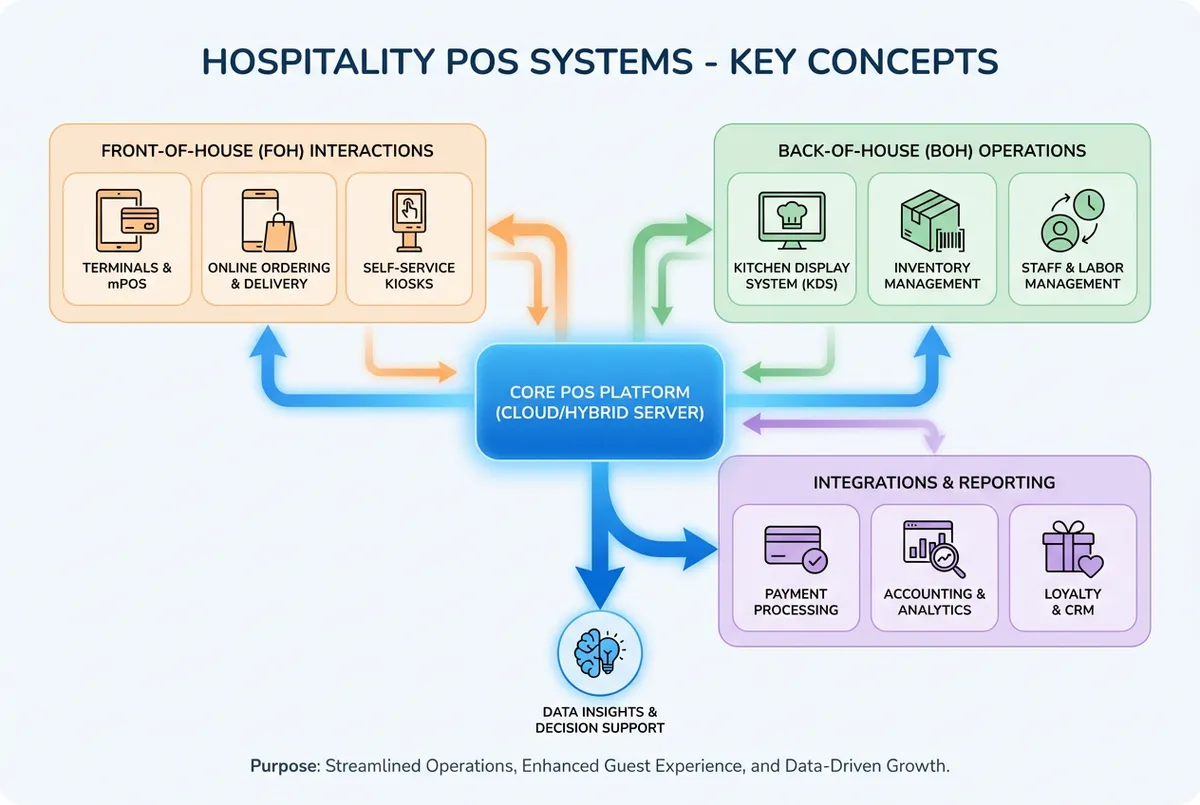
A hospitality POS system is a framework that combines hardware and software to process payments while managing real-time operations including inventory, sales tracking, and customer data. Think of it as the central nervous system connecting front-of-house orders with kitchen operations, payment processing, and business reporting.
Why does this matter to you? The right hospitality POS system means you can check last night's takings from your phone, see which dishes are selling, and know exactly what's in your stockroom without leaving your office.
Technology Should Simplify
If you're thinking "I don't have time to learn new technology," you're not alone. Modern systems are designed for hospitality staff, not IT professionals. A good POS should make your life easier, not give you another thing to worry about at 11pm on a Friday.
For example, a busy gastropub might use their hospitality POS system to automatically alert kitchen staff when a table orders, track which beers are running low, and generate end-of-shift reports without anyone touching a spreadsheet.
What is the most common POS system used in hospitality in the UK?
With the basics covered, let's look at what UK businesses actually use. The cloud-based POS category is a framework that stores data online and typically offers subscription pricing. It's the most common hospitality POS system in the UK. No single vendor dominates the market, but cloud technology has become the clear industry standard.
The UK cloud POS market is growing rapidly, projected to reach US$938.8 million by 2030.
What's driving this shift? Contactless payments. Over 60% of UK in-person transactions are now contactless, and your hospitality POS systems need to handle this seamlessly.
Cloud-based POS has become the UK hospitality standard
Popular UK hospitality POS providers include:
- Square - Popular with smaller independents, free starter tier
- Lightspeed - Strong inventory management for bars and restaurants
- Epos Now - UK-headquartered with good local support
- Zonal - Enterprise focus, common in pub chains
- SumUp - Budget-friendly option for cafes and quick-service
For example, a café in Manchester might start with SumUp's free tier to take card payments, then upgrade to Square or Lightspeed as they grow and need inventory tracking.
If your current system can't handle contactless and mobile payments, that's usually a sign you're losing sales to competitors who've already upgraded.
Would you personally tap your card three times before giving up and asking if they take cash? That's what your customers experience with outdated hospitality POS systems.
What POS system do most restaurants use?
Beyond the UK specifically, what does the global restaurant market use? Globally, NCR/ALOHA holds the largest market share, but the landscape varies significantly by restaurant size. Cloud-based hospitality POS systems now dominate new installations.
Market leadership varies by establishment size:
| Restaurant Type | Preferred System Features |
|---|---|
| Quick-service (QSR) | Mobile ordering, self-service kiosks |
| Large enterprises | Scalable solutions (Square, Toast, NCR) |
| SMEs | Affordable cloud-based systems |
Based on industry surveys; individual needs vary
Tablet-based hospitality POS systems have become one of the most popular hardware choices, driven by their portability and lower upfront costs compared to traditional terminals.
The reality for most independent UK restaurants? You don't need the same system as a 200-site chain. You need something that works reliably, doesn't cost a fortune, and can be learned by your team in an afternoon.
If you're only chasing the cheapest price you'll always lose to competitors who chose systems with responsive UK-based support.
Info
What POS system does Gordon Ramsay use?
Speaking of well-known restaurant operations, many wonder what celebrity chefs use. Gordon Ramsay has been associated with multiple hospitality POS systems across his various restaurants and TV shows. The systems frequently cited are Lavu POS and TouchBistro.
Lavu POS appears in current marketing as being used in Hell's Kitchen restaurants. It holds a 4.5/5 star rating on review platforms and serves over 20,000 restaurants worldwide.
TouchBistro has been featured on Gordon Ramsay's TV shows.
Here's the thing: what works for Gordon Ramsay's multi-million pound restaurant empire often isn't what works for your independent bistro. These celebrity endorsements are typically tied to TV production deals and sponsorship arrangements.
If you're only choosing systems based on endorsements you'll always lose to competitors who tested their options first.
What matters more for your hospitality POS systems decision:
- Does the system handle your specific payment and ordering needs?
- Can your team learn it within a single shift?
- Is the support responsive when something breaks at 7pm on a Saturday?
For example, a family-run Italian restaurant in Leeds doesn't need the same enterprise features as a Gordon Ramsay flagship. A simpler system like Square or SumUp might serve them better at a fraction of the cost.
What are the four types of POS systems?
Now that you know what UK restaurants use, let's break down your options. The four types of hospitality POS systems are: cloud-based POS, on-premise POS, mobile POS, and self-service kiosks. Each offers distinct advantages depending on your operation type.

Four POS types serve different hospitality needs
Cloud-Based POS
Cloud-based hospitality POS systems let you access data and manage operations from anywhere with an internet connection. They offer automatic updates and typically lower upfront costs.
Best for: Multi-location businesses, owners who want remote access, venues prioritising flexibility.
For example, a pub chain owner in Birmingham can check last night's sales from all five locations on their phone while having breakfast.
On-Premise POS
On-premise systems run on local hardware, giving you complete data control. The trade-off is higher upfront costs and manual updates.
Best for: Venues with unreliable internet, operations requiring complete data control, businesses with existing hardware.
If you can't tell whether your current system speeds up service or slows it down, that's usually a sign you need to time a busy service and compare.
Mobile POS
Mobile hospitality POS systems use tablets or smartphones for tableside ordering. Staff can take orders and payments directly at the table, potentially improving turnover.
Choosing a POS system isn't about features. It's about having the right fit for your specific operation.
Best for: Table-service restaurants, venues wanting faster turnover, operations with limited counter space.
For example, a fine-dining restaurant in London might use iPad-based POS so servers never leave the dining room during service.
Self-Service Kiosks
Self-service kiosks let guests order and pay independently. Research suggests kiosk users often spend more due to upsell prompts.
Best for: Quick-service restaurants, high-volume operations, venues dealing with staff shortages.
For many UK restaurants, cloud-based hospitality POS systems with mobile capabilities often offer a good balance of flexibility and cost. The ability to take orders at the table and access reports remotely typically outweighs internet reliability concerns.
If you're only comparing on price you'll always lose to competitors who tested during a real busy service.
How to choose the right hospitality POS system
So you've seen the four types, but how do you actually decide? Choosing the right hospitality POS system means matching features to your specific operation. Integration with your existing tools is often the deciding factor.
For example, a wine bar with 50 labels might prioritise inventory tracking, while a fish and chip shop needs fast, simple checkout above all else.
Questions to ask before choosing your hospitality POS systems:
- What payment methods do your customers expect? Contactless is non-negotiable in 2026.
- How many terminals do you need? Cloud systems often charge per terminal.
- Do you need delivery platform integration? Consider Deliveroo, Just Eat, Uber Eats compatibility.
- What's your internet reliability like? Cloud systems need consistent connectivity.
- Who provides UK-based support? When something breaks at 8pm, you need someone who answers.
Cost considerations for hospitality POS systems
| Cost Type | Typical Range | Notes |
|---|---|---|
| Hardware | £200-£1,500 per terminal | Tablets cheaper than dedicated terminals |
| Software | £30-£150/month per location | Often includes updates and basic support |
| Payment processing | 1.5-2.5% per transaction | Negotiate if processing high volumes |
Cloud solutions typically offer better long-term value compared to on-premises options. The same value-for-money thinking applies to the other tools you pay for monthly: it's worth checking what marketing software costs and what it returns before adding another subscription.
If You Only Have 30 Minutes a Week
Day 1-2: List your three biggest current pain points (slow payments, stock confusion, report access)
Day 3-4: Request demos from two cloud-based hospitality POS systems providers that address those specific issues
Day 5-7: Ask each provider for UK restaurant references you can actually call
Weekly Action
This week, audit your current POS situation:
- Time how long card payments take during your busiest hour
- Note which features you wish you had (remote reporting, delivery integration, table ordering)
- Contact one provider for a no-obligation demo
If you run a restaurant and want to see how Local Brand Hub can support your marketing, explore our restaurant marketing tools.
Key Takeaways: Hospitality POS Systems
The hospitality POS systems market is growing rapidly, driven by cloud adoption and contactless technology. Here's what matters for your decision:
- Cloud-based dominates: Cloud-based hospitality POS systems account for the majority of new implementations.
- Mobile is often essential: Tablet and smartphone POS options continue gaining popularity for many restaurants.
- Contactless is typically expected: UK consumers generally expect contactless payment options as standard.
- Integration often matters: Good hospitality POS systems typically connect with your existing booking, delivery, and accounting tools.
The bottom line: Your hospitality POS system should make service smoother, not give you another headache. A good system is often one your team actually uses properly, captures the data you need, and doesn't leave customers waiting.
If you're still running orders on paper pads and processing payments on an outdated terminal, you're working harder than you need to. The technology has caught up with hospitality's needs. The question is whether you're ready to let it help.
Ready to compare options? Start with our complete restaurant POS system guide or jump straight to UK provider comparisons.
Related reading:
Get More Marketing Tips
Practical marketing tips for UK business owners, straight to your inbox. No spam, unsubscribe anytime.
About the Author
Local Brand Hub
Empowering UK Businesses
Local Brand Hub provides comprehensive business management tools designed specifically for UK local businesses to streamline operations, automate marketing, and grow revenue.
More articlesRelated Articles
 Technology
Cafe POS System: UK Guide to Costs, Features & Fees
Compare UK cafe POS systems: Square, Clover, Toast costs and fees explained. Find the best system for your coffee shop with our practical comparison guide.
 Technology
EPOS Systems for Restaurants UK: A Practical Guide for 2026
Find the right EPOS system for your UK restaurant. Compare features, costs, and key benefits that help streamline your operations and serve more customers.
 Technology
POS Meaning: Point of Sale, Slang & Banking (2026)
What does POS mean? Guide to POS in retail, banking, and Gen Z slang. Learn how point of sale systems work for UK hospitality.