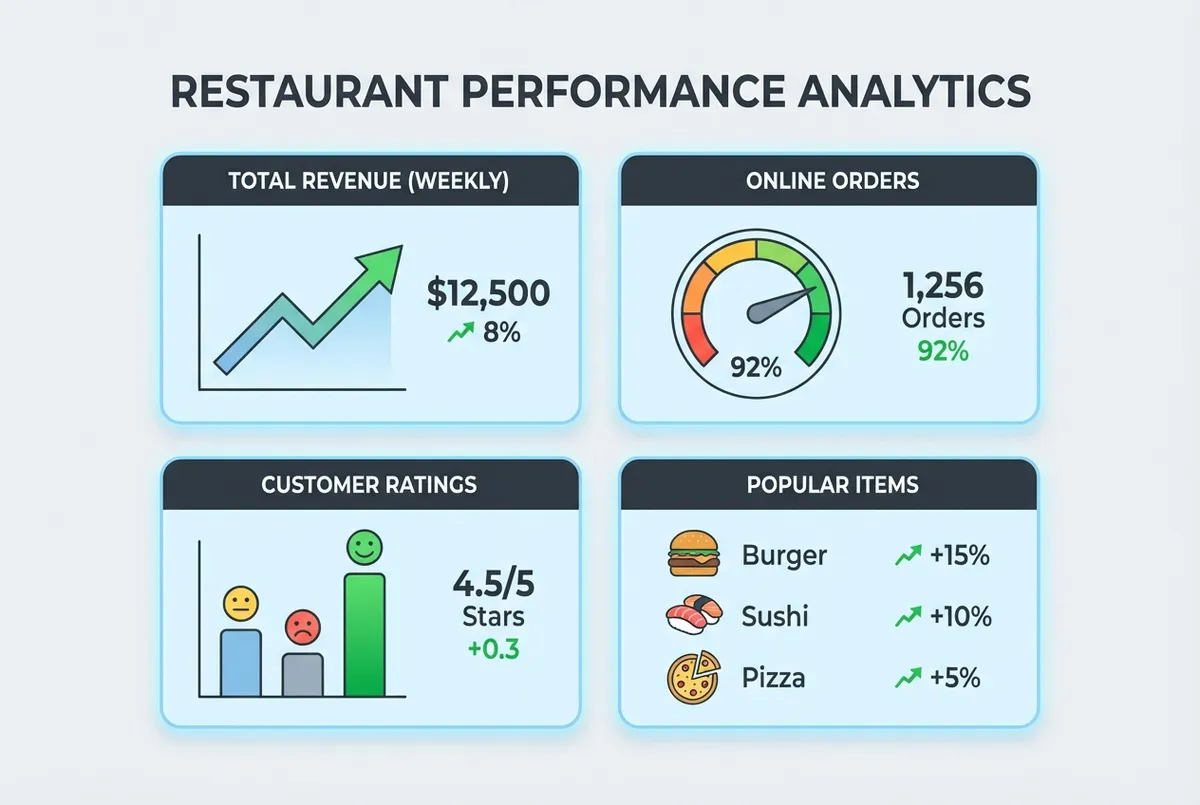
Track 5 restaurant KPIs: prime cost, food %, labour %, table turns, gross profit. Formulas, benchmarks, and templates included.
Many restaurant failures happen because owners don't spot problems until it's too late. You're checking your bank balance more than you'd like. Tables are filling up at lunch, but the numbers don't add up. Your chef's ordering too much salmon again, and you only noticed when three trays went in the bin.
This is what happens when you're running blind. You feel busy, but you don't know if you're profitable. You're working harder, but you can't tell if it's working.
Key performance indicators for restaurants solve this. Not all of them - just the ones that tell you if your business is healthy or heading for trouble. In this guide, you'll learn the five core KPIs that help restaurants stay profitable, what they mean, and what to do when the numbers go wrong.
What You'll Learn About Key Performance Indicators For Restaurants
By the end of this article, you'll understand:
- The five essential KPIs every restaurant owner should track weekly
- How to calculate critical metrics like prime cost, labour percentage, and gross profit
- Which benchmarks matter for independent restaurants (not chains with corporate budgets)
- How to spot problems before they show up in your bank account
- A realistic system for tracking KPIs when you're working 12-hour shifts
Info
Related: Restaurant KPIs: The Complete Guide
Table of Contents
- What are the 5 key performance indicators examples?
- What are KPIs in the food industry?
- What KPIs do restaurants use?
- What are the metrics for restaurants performance?
- How to Calculate Your Most Important KPIs
- Setting Up a Simple KPI Tracking System
- Common KPI Mistakes Restaurant Owners Make
- Key Performance Indicators For Restaurants Pdf and Templates
- Frequently Asked Questions
What are the 5 key performance indicators examples?
The five core KPIs for restaurants are prime cost, food cost percentage, labour cost percentage, table turn time, and gross profit margin.
Here's how they break down:
- Prime cost combines your food and labour expenses - it should stay below 60% of revenue
- Food cost tracks ingredient spending
- Labour cost measures staffing expense
- Table turn time shows how quickly you seat new customers
- Gross profit margin reveals how much money you keep after direct costs
These five metrics work together. Prime cost tells you if your two biggest expenses are under control. Food and labour percentages show which one needs attention. Table turn time affects revenue potential. Gross profit margin tells you if the business model works.
For example, a gastropub might have higher food costs because they use premium ingredients, but compensate with lower labour costs by running a smaller team. A pizza restaurant might flip tables quickly during peak times, generating more revenue per seat than a fine-dining establishment with longer service times.
Why these five matter
These metrics work because they predict problems before they show up in your bank balance.
The numbers don't just measure performance - they predict problems. When your food cost percentage creeps up two points over three weeks, that's your early warning that portion sizes have drifted or waste is increasing.
If you can't tell whether rising revenue brings better margins or just covers increased waste, that's usually a sign you're not tracking the right metrics consistently enough.
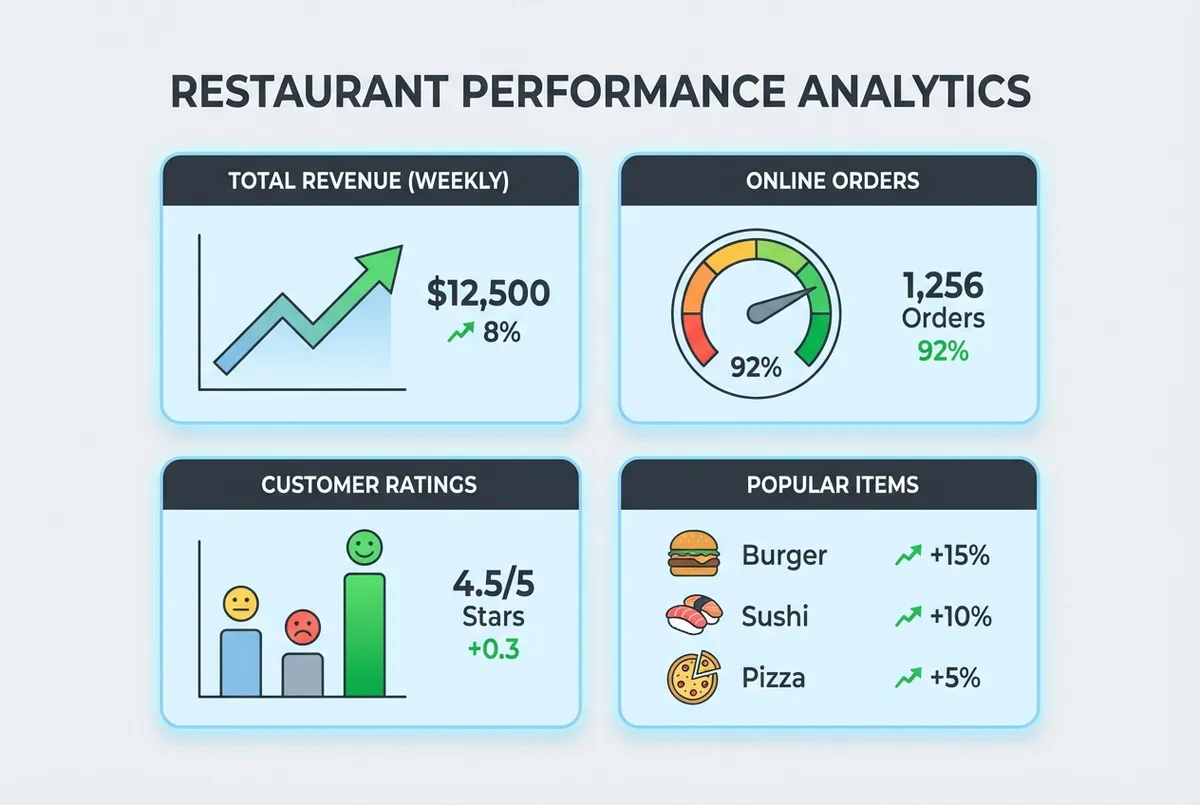
The five core restaurant KPIs explained
What are KPIs in the food industry?
Now that you understand the five core metrics, let's look at how KPIs work specifically in food service.
KPIs in the food industry are quantifiable metrics that measure operational efficiency, financial health, and customer experience. They transform subjective feelings ("we seem busy") into objective data ("we served 180 covers at 35% food cost").
Unlike general business metrics, food industry KPIs focus on:
- Perishable inventory management
- Labour scheduling around service peaks
- Per-seat revenue optimisation
The food industry uses specialized KPIs because the business model differs from retail or services. You're managing products that expire in days, staff schedules that change by the hour, and revenue that fluctuates by day of the week.
Here's the difference: A clothing retailer tracks inventory turnover monthly. You track it daily - because yesterday's fish is today's problem. A consultancy measures billable hours. You measure covers per labour hour - because an empty table during peak service is lost revenue you can never recover.
Industry-specific context: Food service businesses in the UK face unique cost pressures. According to UK Government data on National Living Wage, labour costs have risen significantly, making labour percentage tracking critical for survival.
Common food industry KPIs include:
- Cost of Goods Sold (COGS): What you spend on ingredients and beverages
- Revenue per Available Seat Hour (RevPASH): How much each seat generates per hour
- Staff turnover rate: How often you're recruiting and training new team members
- Average check size: What customers spend per visit
- No-show rate: Reservations that don't arrive (costing you potential revenue)
Successful operators typically don't track every possible metric. They focus on the 5-7 KPIs that matter most for their concept and review them weekly. That's typically prime cost, food cost percentage, labour cost percentage, covers per service, and gross profit margin.
Info
What KPIs do restaurants use?
So you know the core five. But what happens when you're running a takeaway instead of a gastropub? Different operations need different metrics.
Beyond the five core metrics, different restaurant types prioritise different KPIs based on their business model.
Restaurants use three main categories of KPIs:
- Financial KPIs: prime cost, profit margins, average check
- Operational KPIs: table turn time, covers per labour hour, waste percentage
- Customer experience KPIs: review ratings, repeat visit rate, reservation conversion
The specific mix depends on restaurant type - quick-service focuses on speed metrics, while fine dining prioritises average check and experience scores.
Each category answers a different question:
- Financial KPIs: "Are we making money?"
- Operational KPIs: "Are we running efficiently?"
- Customer KPIs: "Are people coming back?"
What matters by restaurant type:
Quick-Service Restaurants:
- Average transaction time
- Drive-through accuracy rate
- Labour cost percentage
Casual Dining:
- Table turn time
- Average check per cover
- Food cost percentage
Fine Dining:
- Average check per cover
- Cost per acquisition
- Wine-to-food ratio
For example, a casual Italian restaurant tracking lunch table turn times might notice service slowing from 60 to 75 minutes over two months. That's not obvious from bank statements, but slower turns mean fewer sittings per day and lost revenue.
After investigating, the owner discovers the kitchen slowed down when they promoted someone to head chef who prioritises perfection over pace. That's valuable for evening service but less appropriate for lunch rushes. One conversation about lunch pacing solves a problem costing significant monthly revenue.
That's what KPIs do - they surface problems while you still have time to fix them.
What are the metrics for restaurants performance?
You've got the theory. Now let's talk about what these numbers actually mean in practice - and how to interpret them when the data lands on your desk.
Restaurant performance metrics fall into four categories:
- Revenue-based: sales per square foot, revenue per seat
- Cost-control: prime cost, variance from budget
- Efficiency: covers per labour hour, ingredient yield percentage
- Customer: average spend, repeat rate, online review score
Together, these metrics reveal whether your restaurant is profitable, efficient, and sustainable.
Performance metrics answer different questions depending on who's asking. Owners want profit margins. Managers want labour efficiency. Accountants want cash flow. The metrics that matter most are the ones that align with your current priorities.
Key performance metrics by category:
| Category | Metric | What It Measures |
|---|---|---|
| Revenue | Sales per square foot | Space efficiency |
| Cost Control | Prime cost | Combined food + labour |
| Efficiency | Covers per labour hour | Staff productivity |
| Customer | Repeat visit rate | Loyalty |
Target ranges vary by restaurant type - quick-service often runs leaner than fine dining.
Understanding the patterns: Restaurants tracking performance metrics weekly tend to maintain better profitability compared to those checking monthly or quarterly. The difference isn't tracking more metrics - it's tracking consistently.
Many restaurant owners start with prime cost because it tends to predict profitability better than individual metrics:
- Above 65%: typically losing money
- Below 55%: potentially leaving profit on the table
- 57-62%: healthy range for most independent restaurants
Reality check: If you're reading this thinking "I don't have time for this" - you're not alone. But consistency beats perfection here. Set a recurring 30-minute Monday morning calendar block. That weekly rhythm catches problems while they're small and fixable.
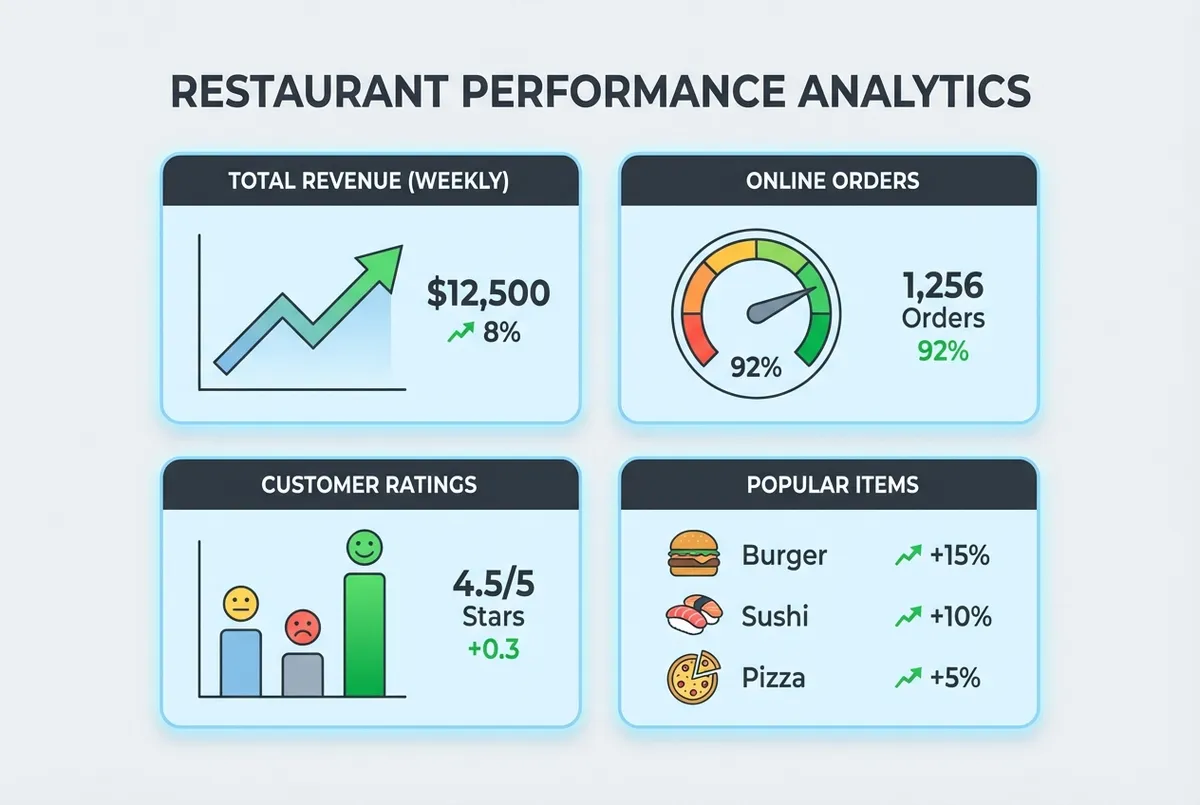
Restaurant performance metrics dashboard
How to Calculate Your Most Important KPIs
Enough theory. Let's get into the maths - the actual formulas you'll use every Monday morning.
Here are the step-by-step calculations for the five core metrics.
Prime Cost Formula
Prime Cost = Cost of Goods Sold (COGS) + Total Labour Costs
Include everything: hourly wages, salaries, payroll taxes, benefits, and workers' compensation. Aim for 55-60% of your total revenue.
Example: If you generated £10,000 in revenue last week with £3,200 in food costs and £2,500 in total labour, your prime cost is £5,700 - that's 57%, which falls in the healthy range.
Food Cost Percentage
Food Cost % = (Cost of Goods Sold / Total Food Sales) x 100
Track this weekly. Most restaurants target a range depending on your concept. Fine dining often runs higher due to premium ingredients. Quick-service typically runs lower due to simpler menus and better buying power.
Example: You sold £8,000 worth of food and spent £2,400 on ingredients. Your food cost percentage is 30% - a healthy number for most concepts.
Labour Cost Percentage
Labour Cost % = (Total Labour Costs / Total Revenue) x 100
Restaurants typically aim for a target range depending on service style. Higher for full-service, lower for counter-service.
Red flag
If this creeps above your target for three consecutive weeks, you may be overstaffed or underpriced.
Table Turn Time
Table Turn Time = Total Minutes Occupied / Number of Parties
Calculate this during peak service periods (lunch rush, Friday dinner). Faster isn't always better - fine dining typically takes longer. But if your target is 75 minutes and you're consistently running 95 minutes, you're often losing revenue.
Gross Profit Margin
Gross Profit Margin = ((Revenue - COGS) / Revenue) x 100
This tells you how much money you keep after paying for ingredients.
Example: £10,000 revenue minus £3,000 COGS equals 70% gross profit margin. The remaining amount must cover labour, rent, utilities, marketing, and profit. Marketing is one of the few costs you can dial up or down at will, so it pays to work out the return it's actually generating before you trim it.
Info
Related: Restaurant Financial Management: Beyond the Basics
Setting Up a Simple KPI Tracking System
Formulas are useless if they live in a guide you never open again. Here's how to build a tracking routine that actually sticks.
You don't need expensive software or a finance degree. You need consistency and a system that fits into your actual schedule.
Weekly tracking system (30 minutes every Monday):
Day 1-2: Gather your numbers
- Pull last week's sales from your POS system
- Collect food invoice totals (or estimate from budget if waiting on invoices)
- Calculate total labour costs (payroll + taxes, roughly 25% above gross wages)
Day 3-4: Calculate your KPIs
- Use the formulas above or a simple spreadsheet
- Compare to previous week and your target ranges
- Flag anything outside normal range
Day 5-7: Take action
- If food cost spiked, check portion sizes and waste
- If labour cost jumped, review last week's schedule
- If table turns slowed, talk to front-of-house team
The goal isn't perfection. It's pattern recognition. You're looking for trends, not reacting to single bad weeks.
Ask yourself
Would you trust your own gut feeling about profitability without checking the numbers? Many operators discover their intuition is off by several percentage points once they start tracking consistently.
Tools that help:
- Simple spreadsheet (free, works forever)
- Your POS system's built-in reports (most have basic KPI tracking)
- Accounting software like Xero or QuickBooks (auto-calculates many metrics)
What NOT to do: Don't track 20 different metrics. Don't create complex dashboards you'll abandon in three weeks. Don't obsess over daily fluctuations. Focus on your five core KPIs, reviewed weekly, acted on when patterns emerge.
Common KPI Mistakes Restaurant Owners Make
Before you dive in, learn from the mistakes other operators have made - so you don't repeat them.
Tracking KPIs isn't enough if you're measuring the wrong things or misinterpreting the data. Here's what trips up most operators.
Mistake 1: Comparing yourself to chain restaurant benchmarks
Corporate benchmarks include buying power and operational efficiencies you don't have. Your food costs typically run higher than chains. Your labour costs might run higher because you can't spread management salaries across multiple locations. Use independent restaurant benchmarks instead.
Mistake 2: Focusing on revenue instead of profit
Growing sales by 20% sounds great. Not if you grew costs by 25%. It's important to look at margins alongside revenue. Restaurant failures can happen during revenue growth periods when operators prioritise top-line growth while margins collapse.
Mistake 3: Ignoring seasonal patterns
Your July food cost will differ from December. Your January labour percentage will differ from August. Track year-over-year comparisons, not just month-to-month.
Mistake 4: Treating KPIs as academic exercises
Numbers mean nothing if they don't trigger action. If your labour cost jumped 4 points, you need to know why and fix it. If table turns slowed by 15 minutes, you need to investigate. KPIs are diagnostic tools, not report cards.
Mistake 5: Waiting for perfect data
You'll never have perfect numbers. Invoice dates don't align with weeks. Staff work across pay periods. Estimates are fine. Tracking 90%-accurate numbers weekly beats tracking perfect numbers monthly.
Info
Key Performance Indicators For Restaurants Pdf and Templates
Not everyone wants to build spreadsheets from scratch. Here's where to find ready-made tools.
Many restaurant owners prefer tracking KPIs using printable templates or spreadsheets rather than expensive software. Free and low-cost options exist for every tracking method.
Free KPI tracking resources:
- Google Sheets templates: Search "restaurant KPI dashboard template" - dozens of free options with formulas pre-built
- Excel templates: Microsoft offers free small business templates including restaurant P&L and KPI trackers
- PDF worksheets: Print weekly tracking sheets and calculate by hand (surprisingly effective for many operators)
What to look for in a template:
- Pre-calculated formulas for prime cost, food %, labour %
- Week-over-week comparison
- Visual indicators (red/yellow/green) for target ranges
- Space for notes ("Why did food cost spike this week?")
Many operators start with a simple spreadsheet and graduate to dedicated software only when they open a second location or hire a general manager who needs remote access.
The tracking method matters less than tracking consistency. A notebook with five numbers written down every Monday beats sophisticated software you check quarterly.
Real-world example: A 40-seat Italian restaurant in Leeds tracks five metrics every Monday morning: total revenue, food cost, labour cost, covers served, and average check.
The owner calculates food percentage, labour percentage, and prime cost in five minutes. The entire process takes 20 minutes, and it's caught multiple problems before they became serious:
- Food cost drift when portion sizes got generous
- Labour cost spikes when shifts were overstaffed
- Declining average check signaling ordering pattern changes
For official guidance on restaurant financial management and benchmarks, UKHospitality provides industry research and resources specific to UK operators.
Frequently Asked Questions
Still have questions? Here are the ones restaurant owners ask most often.
What is a KPI for a restaurant?
A KPI (Key Performance Indicator) is a method that tracks business performance through measurable numbers. Unlike vague feelings ("we were busy today"), KPIs give you concrete data to act on.
What are the 5 KPIs?
Prime cost, food cost percentage, labour cost percentage, table turn time, and gross profit margin. These five cover your biggest expenses and revenue drivers.
How do I calculate prime cost for my restaurant?
Add your food/beverage costs to your total labour costs (including taxes and benefits). Divide by total revenue, multiply by 100. Aim for 55-60%.
How often should I track restaurant KPIs?
Weekly - every Monday morning for the previous week. Monthly is too slow to catch problems before they become expensive.
What's a good food cost percentage for restaurants?
It depends on your concept. Fine dining typically runs higher (premium ingredients), quick-service runs lower. Consistency matters more than hitting a specific number.
Why is prime cost more important than profit margin alone?
Because food and labour are the only major costs you can control week to week. Rent and insurance are fixed. Prime cost is where your daily decisions show up first.
KPI Tracking Quick-Start Checklist
Got the FAQs covered? Good. Now let's make this practical. For example, a 30-seat cafe in Bristol might complete this entire checklist in under 25 minutes on their first Monday.
Use this checklist to get your first week's numbers:
- Pull last week's total sales from POS system
- Gather all food and beverage invoices (or estimate from budget)
- Calculate total labour costs (gross payroll x 1.25 for taxes/benefits)
- Calculate prime cost: (COGS + Labour) / Revenue x 100
- Calculate food cost percentage: COGS / Food Sales x 100
- Calculate labour cost percentage: Labour / Revenue x 100
- Check if prime cost is within 55-60% target range
- Flag any metrics outside normal range for investigation
- Set recurring Monday morning calendar reminder for next week
- Choose tracking method: spreadsheet, notebook, or POS reports
Weekly Action
Start tracking your core five this week. You don't need to analyse years of history or build a perfect dashboard - just establish the habit.
This week, get your baseline numbers:
- Day 1-2: Pull last week's sales from your POS system and calculate total revenue
- Day 3-4: Gather food costs (invoices or estimates) and labour costs (payroll x 1.25 for taxes)
- Day 5-7: Calculate your five core KPIs using the formulas in this guide
Write them down. That's your baseline. Next Monday, do it again. Compare the two weeks. You're now tracking trends.
If you only have 30 minutes this week, focus on prime cost. For most operators, it's the most important metric to track first. Food cost + labour cost / revenue. If it's above 60%, you need to investigate. If it's below 55%, you might be underpricing or over-controlling portions.
The goal isn't perfect tracking from day one. It's establishing a weekly habit that gives you early warning when numbers drift. Many restaurant problems are fixable when spotted early. By the time they show up in your bank balance, you're often weeks or months behind.
For UK restaurants
Need help getting your restaurant marketing running consistently?
LocalBrandHub handles your weekly content, social posting, and local SEO in one simple system - no marketing experience needed.
See how it worksKey Takeaways: Key Performance Indicators For Restaurants
If you run a restaurant and want to see how Local Brand Hub can support your marketing, explore our restaurant marketing tools.
Key Takeaways: Key Performance Indicators For Restaurants
You've made it through the detail. Here's what matters most from this guide.
- Track five core KPIs weekly: prime cost, food cost %, labour cost %, table turn time, and gross profit margin
- Prime cost (food + labour) should stay between 55-60% of revenue for most independent restaurants
- Don't compare yourself to chain restaurant benchmarks - your costs will run 2-5 points higher
- Spend 30 minutes every Monday reviewing last week's numbers and comparing to previous weeks
- Focus on patterns and trends, not individual bad days or weeks
- Take action when metrics drift outside target ranges for 2-3 consecutive weeks
- Simple tracking beats perfect tracking - a spreadsheet you actually use is better than software you ignore
The restaurants that survive long-term often aren't the ones with the best food or the trendiest concepts. They're the ones that know their numbers, spot problems early, and make small corrections before small problems become big ones. Start tracking this week.
Get More Marketing Tips
Practical marketing tips for UK business owners, straight to your inbox. No spam, unsubscribe anytime.
About the Author
Local Brand Hub
Empowering UK Businesses
Local Brand Hub provides comprehensive business management tools designed specifically for UK local businesses to streamline operations, automate marketing, and grow revenue.
More articlesRelated Articles
 Operations
Measure Restaurant Performance: 7 Metrics
Master the 7 essential restaurant performance metrics: prime cost, labour, and retention. Make smarter, data-driven decisions without complex spreadsheets.
 Marketing Tips
Restaurant Benchmarks: Standards Every Owner Needs
Track your restaurant against UK industry benchmarks: food cost 28-35%, labour 25-35%, prime cost under 65%. Includes monthly tracking checklist.
 Operations
Restaurant KPI Dashboard: Build One That Gets Used
Build a restaurant KPI dashboard on one screen: which tabs to make, how to pull numbers from your till and rota, and the Monday review that keeps it alive.