Set a realistic restaurant advertising budget using UK CPM benchmarks, platform-by-platform ROI data, and the 30/30/30 budget allocation framework.
You've spent £20 boosting a last-minute Facebook post. Three tables still empty. Most restaurant owners either spend too little on ads to see results or waste their budget on campaigns that never convert. Getting your restaurant ad budget right means understanding what works for UK independents, not what agencies sell.
Info
Related: This guide focuses on budget allocation. For a complete overview of advertising options, see our restaurant advertising guide.
What You'll Learn About Restaurant Ad Budget
- The recommended percentage of revenue to allocate to marketing
- Realistic Facebook and Instagram ad costs for UK restaurants
- How to calculate your ideal daily ad spend based on your goals
- Whether £500 per month is enough to see real results
- A minimum viable plan if you only have 30 minutes a week
What Is a Good Budget for Facebook Ads?
A good Facebook ads budget for restaurants is a framework that typically ranges from £10-30 per day for local campaigns. That's the quick answer. But the real question is whether that spend matches your goals and competition.
The oft-quoted £5 daily minimum is a platform requirement, not strategy. Meta's conversion campaigns need about 50 conversions weekly to exit the learning phase. Budgets that are too low struggle to gather enough data for the algorithm to work (Madgicx, 2025). Meta for Business explains budget optimisation and the learning phase.
The biggest mistake isn't spending too little. It's spreading money across too many platforms before proving ROI on one.
For UK restaurants, costs are lower than national advertisers (Service World UK, 2025). A £500 monthly restaurant ad budget can generate enough clicks to test whether paid ads work for you.
For example, a gastropub might start with £15/day testing two ad creatives. Then scale up the winner to a wider local radius. If you're reading this after a long shift thinking "I tried £5/day and got nothing," that's usually a sign the spend was too low for the algorithm to learn your best audience.
How Much Should a Restaurant Spend on Advertising?
Now for the bigger picture. Industry benchmarks suggest restaurants allocate 3-6% of revenue to marketing if established. Newer restaurants building awareness often need 6-10% (RestroWorks, 2025).
Here's what that looks like in practice for a restaurant turning over £500,000 annually:
- Conservative (3%): £15,000/year on marketing
- Moderate (6%): £30,000/year on marketing
These figures represent total marketing spend, not just paid advertising.
Quick-service restaurants spend more because they rely on volume. Fine dining spends less on ads, more on PR and reputation (Back of House, 2025).
For a single-location independent, your restaurant ad budget should be 30-50% of total marketing spend.
For example, a neighbourhood Italian turning over £400,000 might spend 5% on marketing (£20,000/year). With 40% going to digital, that's £667/month for Facebook and Google combined.
How Much Does 1,000 Views Cost on Facebook Ads?
Understanding costs helps you plan. The cost per 1,000 impressions (CPM) varies by location and season. UK advertisers pay around £10.85 CPM on average (Lebesgue, 2025).
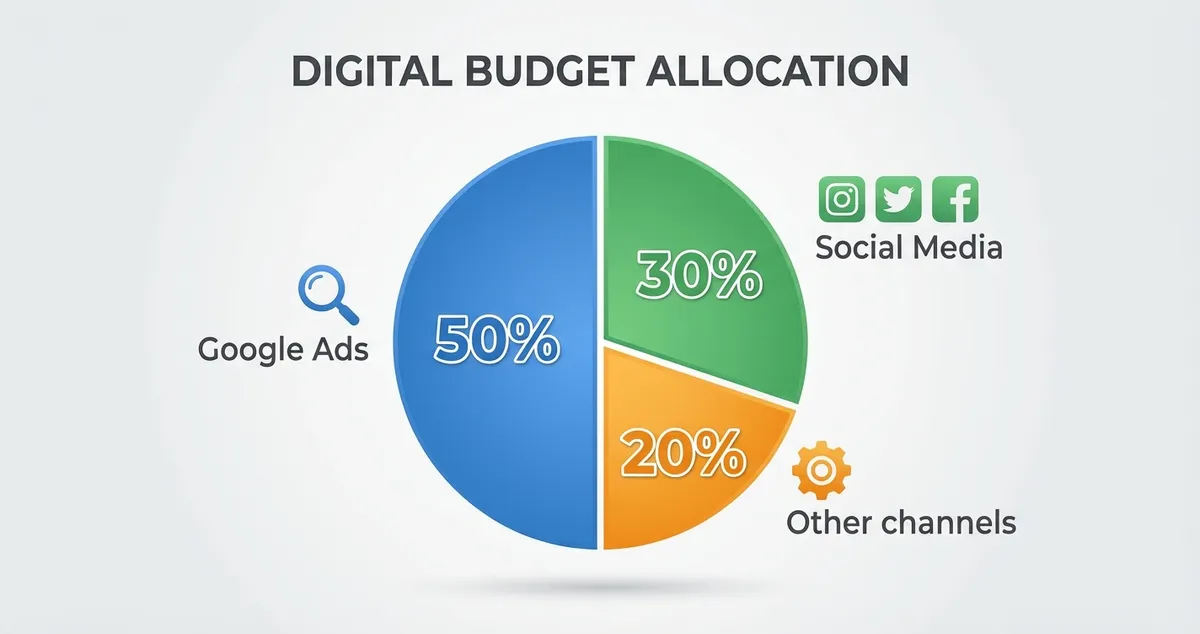
Allocate your budget strategically across channels
Restaurant ads often see lower CPMs because you target locally. You might pay £5-8 per 1,000 impressions when targeting a 3-mile radius around your location.
Key factors that affect your CPM: Location (London costs more than Leeds), time of year (Q4 costs more than Q1), audience size (narrow targeting increases costs), and ad quality (higher engagement lowers costs). For planning, assume £8-12 CPM for local campaigns.
Impressions sound impressive, but they don't fill tables. What matters is whether those impressions convert to bookings.
Is £500 Enough for Facebook Ads?
Here's the question every restaurant owner asks. Yes, £500 per month can deliver results, but only if you're strategic.
A £500 monthly spend works when well-targeted to local audiences (Restaurant Growth, 2025).
Making a Modest Budget Work
- Tight geographic targeting: Focus on a 3-5 mile radius
- Single clear objective: Don't split spend across awareness AND bookings
- Limited creatives: Test only 2-3 variations to avoid diluting data
- Full-month runs: Stopping and starting resets the algorithm
If you're running ads and seeing zero results, that's usually a sign of creative problems rather than budget constraints.
Commit Before Judging
Many owners give up after spending £100 across three platforms over two weeks. That's not a failed experiment. That's not enough data. Commit to one platform for one month before judging results.
How to Allocate Your Restaurant Ad Budget
With your total budget decided, allocation matters. Here's how to split it based on your goals.
Prioritising immediate bookings: Give the majority to Google Ads (captures people searching now), a quarter to Facebook retargeting (brings back visitors), and the rest to testing.
Building brand awareness: Flip the emphasis. Give half to Instagram/Facebook for visual storytelling, and the rest to Google Ads and testing.
For instance, a casual dining restaurant with a £600 monthly spend might put £360 toward Google Ads for restaurants targeting "dinner near me" searches.
Platform Budgeting
Google Ads works best with daily budgets. Facebook performs better with lifetime budgets that give the algorithm flexibility.
If you're reading this after a 12-hour shift thinking "this is getting complicated," remember: start simple. One platform. One campaign. One month of data.
Tracking Your Ad Spend ROI
Your restaurant ad budget means nothing without measurement.
Essential metrics to track: Cost per click (what each visit costs), cost per booking (total spend divided by bookings), and return on ad spend (revenue per pound spent).
Before spending a pound on ads, set up tracking. Install Meta Pixel on your website. Configure Google Ads conversion tracking. Use unique booking codes.
Example: A £500 monthly spend generating 25 bookings at £80 average table spend means a 4:1 return. Anything above 3:1 typically indicates a campaign worth scaling.
If you can't tell whether your advertising brings bookings or just impressions, that's usually a sign your tracking setup needs work.
Facebook Ads Cost Per 1,000 Impressions: What You Need to Know
Understanding CPM helps you forecast reach. But the metric that matters is cost per result: bookings, calls, or reservation requests.
Average UK benchmarks: CPM around £8-10, cost per click under £1, cost per booking £13-£20. These vary based on your creative, landing page, and offer. A "50% off midweek lunch" promotion converts better than "Visit us."
Seasonal considerations matter. CPM drops 15-20% in January after Christmas. Q1 is excellent for testing. November and December cost significantly more: plan accordingly.
Common Advertising Budget Mistakes to Avoid
Finally, let's look at what not to do.
Spreading Budget Too Thin
Running £100 across three platforms sounds diversified. But none generates useful data. Pick one platform and commit.
Stopping and starting campaigns: Every pause resets the learning phase. Consistent campaigns outperform interrupted ones.
Ignoring mobile experience: Most browsing happens on mobile. If your booking page doesn't work on phones, your ad spend is wasted.
Chasing vanity metrics: Impressions feel good but don't pay bills. A campaign with zero bookings isn't "building awareness". It's failing.
No testing structure: Running the same ad for months wastes money. Always run at least two ad variations.
Copying national brands: What works for Nando's won't work for your independent. They have brand recognition; you need to build it. Start with local, targeted campaigns.
If you're only spending when it's quiet in the restaurant, your advertising will always lose to competitors who treat it as part of operations, not an afterthought.
Minimum Viable Advertising Plan
If you only have 30 minutes a week, here's the simplest path to setting up your restaurant ad budget:
This week, set up your restaurant advertising foundation:
- Day 1-2: Check your Facebook Business page is complete with current hours, menu link, and booking button
- Day 3-4: Set up Meta Pixel on your website to track conversions
- Day 5-7: Create your first test campaign with a modest daily budget targeting nearby diners
The bare minimum that works: One platform, one objective, one geographic radius, one month of running. That's enough to gather real data. Add complexity once you know what works.
Restaurant Ad Budget Checklist
Before launching your first campaign, tick off these essentials:
- Calculate your marketing budget (3-6% of revenue)
- Decide digital allocation (30-50% of marketing budget)
- Choose ONE platform to start (Google Ads or Facebook)
- Install tracking (Meta Pixel, Google conversion tracking)
- Set a minimum 30-day run time before evaluating
- Create at least two ad variations to test
- Check your booking page works on mobile
These budget levels are guidelines. Results depend on your location, competition, and ad quality.
| Budget Level | Best For | Expected Results |
|---|---|---|
| £300-£500/month | Testing if ads work | Data collection, initial bookings |
| £500-£1,000/month | Consistent local reach | Steady booking flow |
| £1,000+/month | Growth and scaling | Strong local presence |
Budget Allocation by Platform
| Platform | % of Budget | Best For | Minimum Spend |
|---|---|---|---|
| Google Ads | 40-60% | Immediate bookings | £300/month |
| Facebook Ads | 20-40% | Awareness + offers | £200/month |
| Instagram Ads | 10-20% | Visual engagement | £150/month |
| Retargeting | 10-15% | Re-engaging visitors | £100/month |
| Testing | 5-10% | New platforms | Variable |
For most UK restaurants, focusing 70-80% of your advertising spend on Google Ads initially often delivers the fastest measurable results.
Quick Test
Would you follow your own restaurant's ads? If the answer is no, start there before increasing budget.
Key Takeaways: Restaurant Ad Budget
If you run a restaurant and want to see how Local Brand Hub can support your marketing, explore our restaurant marketing tools.
Key Takeaways: Restaurant Ad Budget
Getting your restaurant ad budget right doesn't require a marketing degree. Here's what matters:
Budget benchmarks: Established restaurants typically spend 3-6% of revenue on marketing. New restaurants may need 6-10%. Digital advertising takes 30-50% of that, with a minimum Facebook budget starting around £300-500 monthly.
What to expect from £500/month: Tens of thousands of local impressions, hundreds of clicks, and enough data to optimise future campaigns.
The restaurant down the road with a queue out the door probably isn't spending more than you. They're just spending smarter. Start with £500, track everything, and let the data tell you what works.
Weekly Action
This week, calculate your ideal monthly ad budget using the percentage-of-revenue rule:
- Take your annual revenue
- Multiply by 4% (middle ground for established restaurants)
- Divide by 12 for monthly marketing budget
- Multiply by 0.4 for your monthly digital ad budget
Write that number down. Then commit to spending it consistently for three months before deciding whether ads work for your restaurant. It is also worth seeing how much time and money the right tools save you with our ROI calculator.
Next steps: Ready to create your first campaign? See our guide on Facebook Ads for restaurants for creative tips, or explore our complete guide to restaurant advertising for the full picture.
For UK restaurants
Need Help With Your Ad Budget?
Local Brand Hub helps UK restaurants plan and allocate advertising budgets that actually deliver results.
Start freeGet More Marketing Tips
Practical marketing tips for UK business owners, straight to your inbox. No spam, unsubscribe anytime.
About the Author
Local Brand Hub
Empowering UK Businesses
Local Brand Hub provides comprehensive business management tools designed specifically for UK local businesses to streamline operations, automate marketing, and grow revenue.
More articlesRelated Articles
 Marketing Tips
Facebook Ads for Restaurants: UK Budget Guide 2025
Run effective Facebook ads for UK restaurants. Master the 3-2-2 testing method, local targeting, and budget tips that fill tables.
 Marketing Tips
Restaurant Advertising: The Complete UK Guide for 2025
Master restaurant advertising with proven UK strategies for Google Ads, Facebook, and local marketing. Budget tips and tactics to fill tables.
 Marketing Tips
Restaurant Paid Marketing: Where to Spend Your Ad Budget
Where to invest your restaurant marketing budget. Compare Google, Facebook, Instagram, TikTok ad costs with real UK benchmarks.