Watch the visual overview· 80 seconds
Master restaurant advertising with proven UK strategies for Google Ads, Facebook, and local marketing. Budget tips and tactics to fill tables.
You're spending money on ads and posting on social media. Yet the restaurant down the road has a queue while your Tuesday nights stay empty. With 47% of UK restaurants investing in paid advertising, the competition is fierce. The difference isn't luck: it's having the right advertising strategy.
Info
Related: This guide covers the fundamentals. For platform-specific tactics, see our guides on Google Ads for restaurants and Facebook Ads for restaurants.
What You'll Learn About Restaurant Advertising
- The best ways to advertise your restaurant in 2025
- How the 30/30/30 rule shapes your marketing budget
- Which advertising channels deliver the best ROI
- The 3-3-3 rule for consistent marketing
- How to attract more customers without breaking the bank
What Is the Best Way to Advertise Your Restaurant?
First, let's tackle a common question. The best way to advertise your restaurant is typically to combine search ads with social media. Google Ads catches people actively looking for food. Facebook and Instagram keep you visible between visits. Most UK restaurants that fill tables use both.
According to SevenRooms' 2025 UK Restaurant Trends Report, 47% of UK restaurant operators invest in paid Google ads. Another 67% plan to pay for social media advertising. Digital channels dominate because most customers check social media before choosing where to eat.
Based on helping UK restaurants with their advertising, successful campaigns typically combine these platforms rather than choosing one.
Here's what works for different restaurant types:
- Fine Dining: Google Ads as primary, Instagram for visual appeal
- Casual Dining: Facebook Ads with Google Local for search visibility
- Quick Service: Instagram and TikTok for younger audiences
- Delivery-Focused: Google Ads capturing "delivery near me" searches
If you're only advertising sporadically you'll always lose to competitors who treat marketing as daily operations. That never works long term.
Info
Related: Learn the specifics of Google Ads for restaurants and Facebook Ads for restaurants in our detailed guides.
Now that we've covered where to focus your advertising, let's look at how much to spend.
What Is the 30/30/30 Rule for Restaurants?
Now let's look at budgeting. The 30/30/30 rule splits restaurant revenue three ways: food costs, labour, and overheads (including marketing). The remaining portion is profit.
This rule provides a financial foundation. According to UKHospitality industry data, established restaurants allocate 3-6% of revenue to marketing. Newer restaurants often spend more.
What this means for your advertising budget: Put roughly half of your marketing spend toward digital channels. The 30/30/30 rule is a guideline, not gospel. Adjust based on your margins.
If you're thinking "those numbers seem high," that's fair. You can start restaurant paid marketing with £10-20 per day and scale once you see results.
Track Every Pound
Track every pound you spend against bookings generated. Without measurement, you're just guessing, and guessing gets expensive.
With your advertising budget sorted, let's explore specific tactics that work.
What Are Some Good Advertising Ideas?
Moving on to tactics, here's what works. Good advertising ideas focus on what makes your restaurant unique. They reach customers at the right moment. The most effective campaigns combine digital precision with local relevance.
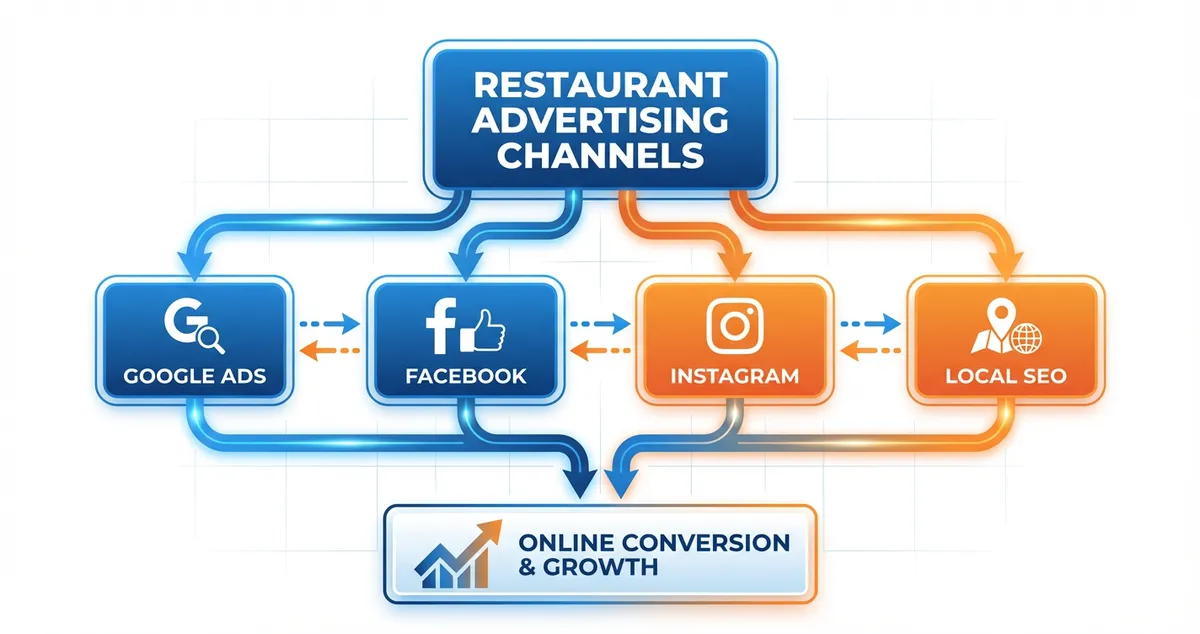
Choose the right mix of advertising channels for your restaurant
Digital advertising ideas that work:
- Google Local Service Ads: Appear when someone searches "restaurants near me" with your Google Business Profile
- Facebook radius targeting: Show ads to people within 5-10 miles of your location
- Instagram Stories ads: Showcase your dishes with swipe-up booking links
- Retargeting campaigns: Re-engage website visitors who didn't book (see our restaurant retargeting ads guide)
Traditional advertising that still delivers:
- Local newspaper features and advertorials
- Community sponsorships (sports teams, school events)
- Loyalty cards with referral incentives
- Window displays and A-boards for passing foot traffic
For example, a family-run Italian might sponsor the local under-12s football team while running a "match day meal deal" Facebook ad targeting parents in the area, combining community presence with digital reach.
Case example: A family-run gastropub in Birmingham used this exact approach. They ran Google Ads targeting "Sunday roast near me" while posting kitchen content on Instagram. The Google Ad brought in weekend bookings. The Instagram built regulars. Within three months, Sunday bookings increased by 40%. This dual approach works because it reaches customers at different stages of deciding where to eat.
Good ideas are one thing. Getting customers through the door is another.
How Do I Attract Customers to My Restaurant?
When it comes to advertising, visibility is everything. Your ads need to appear when people are deciding where to eat. They need to give customers reasons to choose you over competitors. Layer multiple touchpoints: search visibility, social proof, and offers.
According to BrightLocal's Consumer Review Survey, most consumers read online reviews before visiting. The majority only consider businesses with 4+ stars. Your advertising drives traffic. Your reviews convert it.
Five steps to attract more customers:
- Claim and optimise your Google Business Profile: This free listing appears in local searches and Google Maps
- Build your review presence: Encourage happy customers to leave Google and TripAdvisor reviews
- Run location-targeted ads: Focus your budget on people within realistic travel distance
- Create a booking incentive: "Book online and get 10% off your first visit" removes friction
- Retarget website visitors: Bring visitors back with restaurant ad campaigns
For instance, a seaside fish and chip shop might focus on Google Business Profile optimisation during summer (tourists searching on phones) and Facebook ads in winter (reminding locals they're still open).
If you can't tell whether your current marketing brings bookings or just likes, that's usually a sign your strategy needs tightening. If you're reading this after yet another slow week despite "doing marketing," you're not alone: most restaurant owners struggle with this until they focus on tracking what actually works.
Spend Smarter, Not More
The restaurant with queues isn't spending more on advertising. They're spending smarter, putting money where they can measure results.
Attracting customers is one thing. Keeping up with your advertising consistently is another challenge entirely.
What Is the 3-3-3 Rule in Marketing?
Additionally, consistency matters more than perfection. The 3-3-3 rule is a consistency framework: post 3 times per week, engage for 3 minutes daily, and track 3 key metrics. This creates sustainable marketing habits without overwhelming busy owners.
Here's how it applies to your advertising:
3 posts per week:
- Monday: Behind-the-scenes or team content
- Wednesday: Menu highlight or special offer
- Friday: Weekend booking reminder or user-generated content
3 minutes of engagement daily:
- Reply to comments on your posts
- Respond to direct messages
- Engage with local community posts
3 metrics to track:
- Website clicks from ads
- Booking conversions
- Cost per new customer
This framework works because it's realistic. If you're reading this after a 12-hour shift with your feet aching, you don't need a complex marketing system. You need something you can actually stick to, like lining up your three weekly posts ahead of time in our social media calendar.
Info
Related: Build your social media foundation with our restaurant social media marketing guide.
With consistency covered, let's explore the different types of advertising available to you.
What Are the 4 Types of Advertising?
Furthermore, understanding the different advertising types helps you choose wisely. The four main types are paid search, paid social, display advertising, and traditional media. Each serves a different purpose in your marketing mix.
1. Paid Search (Google Ads, Bing Ads) Captures high-intent searches like "Italian restaurant near me." You pay per click: best for immediate bookings. See our restaurant PPC guide for details.
2. Paid Social (Facebook, Instagram, TikTok) Builds awareness and engagement with visual content. Lower cost per click but lower intent. Best for brand building and promotions.
3. Display Advertising (Banner ads, Retargeting) Shows visual ads across websites to people who've visited your site or match your target demographics. Best for staying top-of-mind.
4. Traditional Media (Print, Radio, Local TV) Reaches broader local audiences but harder to track ROI. Best for established restaurants with larger budgets.
For most UK restaurants, Google Ads and Facebook Ads often offer the best combination of targeting precision and results you can measure. Start with one channel. Prove ROI. Then expand.
That said, if you're throwing money at advertising without a clear plan, you'll waste budget before seeing results. Here's a simpler approach.
Minimum Viable Restaurant Advertising
Here's the practical starting point. If you only have 30 minutes a week for marketing, focus on these essentials:
This week, audit your advertising presence:
- Day 1-2: Claim your Google Business Profile and add current photos, hours, and menu link
- Day 3-4: Set up a £10/day Facebook ad targeting people within 5 miles who are interested in "restaurants" and "dining out"
- Day 5-7: Create a simple booking incentive ("10% off when you book online") and add it to your website
That's enough to start. Perfect is the enemy of done. Refine your restaurant ad landing pages later. The important thing is getting visible.
Once you've started, you'll want to compare channels. Here's how the main options stack up.
Advertising Channel Comparison
Next, let's compare the main options:
| Channel | Best For | Typical CPC | Setup Effort | ROI Timeline |
|---|---|---|---|---|
| Google Ads | Immediate bookings | £1.50-£2.50 | Medium | Days |
| Facebook Ads | Brand awareness | £0.60-£1.00 | Low | Weeks |
| Instagram Ads | Visual engagement | £0.60-£1.00 | Medium | Weeks |
| Google Business | Local discovery | Free | Low | Ongoing |
For most UK restaurants, Google Ads often offers the best combination of intent-based targeting and measurable ROI.
Here's your pre-launch checklist.
Your Restaurant Advertising Checklist
Finally, here's your pre-launch checklist:
- Claim and optimise your Google Business Profile
- Set up Meta Pixel on your website for tracking
- Define your target radius (typically 3-5 miles)
- Choose ONE primary channel to start
- Set a minimum 30-day budget commitment
- Create a booking incentive (discount, free appetiser)
- Prepare at least 2 ad variations for testing
Quick Test
Would you click on your own restaurant's ad? If the answer is no, that's where to start.
With your checklist complete, here's what matters most.
Key Takeaways: Restaurant Advertising
If you run a restaurant and want to see how Local Brand Hub can support your marketing, explore our restaurant marketing tools.
Key Takeaways: Restaurant Advertising
As a result, advertising works when you match the right message to the right customer at the right moment. Here's what to remember:
- Google Ads capture people actively searching to eat out: highest intent, higher cost
- Facebook/Instagram Ads build awareness and work best for visual, emotional content
- The 30/30/30 rule helps allocate revenue, but marketing budgets typically range from 3-10% of turnover
- Start small (£10-20/day), prove ROI, then scale what works
- Consistency beats perfection: the 3-3-3 rule keeps you visible without burnout
If you're thinking "this all sounds like a lot of work," that's where tools like LocalBrandHub can help, automating the routine tasks so you can focus on running your restaurant.
Weekly Action
This week: Pick one advertising channel and take action:
- Day 1-2: Choose your primary channel (Google Ads for immediate bookings, Facebook for brand building)
- Day 3-4: Set up tracking (Meta Pixel or Google conversion tracking)
- Day 5-7: Launch a test campaign with a modest daily budget targeting your local area
Track bookings for two weeks before evaluating results. Document which ads bring actual bookings, not just clicks.
Frequently Asked Questions
How much should a restaurant spend on advertising?
Most restaurants spend 3-6% of revenue on marketing, with new restaurants often investing more to build awareness. See our detailed restaurant ad budget guide for specific figures.
What is the best social media platform for restaurant advertising?
Instagram and Facebook typically deliver good results for restaurants. Both offer visual formats and local targeting. Instagram works well for food photography. Facebook's detailed targeting helps reach specific demographics nearby.
Are Google Ads worth it for small restaurants?
Yes, if you target local keywords with clear booking intent. Restaurants benefit from competitive costs per click compared to other industries. Start with a modest budget targeting "[cuisine] restaurant near me" searches.
How do I measure restaurant advertising ROI?
Track bookings that come directly from your ads. Use UTM parameters, unique booking codes, or "how did you hear about us?" questions. Calculate cost per acquisition by dividing ad spend by new customers gained. Aim for an acquisition cost below your average customer lifetime value.
For UK restaurants
Need Help With Restaurant Advertising?
Local Brand Hub helps UK restaurants create and manage advertising campaigns that actually fill tables.
Start freeGet More Marketing Tips
Practical marketing tips for UK business owners, straight to your inbox. No spam, unsubscribe anytime.
About the Author
Local Brand Hub
Empowering UK Businesses
Local Brand Hub provides comprehensive business management tools designed specifically for UK local businesses to streamline operations, automate marketing, and grow revenue.
More articlesRelated Articles
 Marketing Tips
Google Ads for Restaurants: A Practical UK Marketing Guide
Run Google Ads for your restaurant with real UK cost benchmarks, realistic ROI expectations, and a clear comparison against Facebook Ads.
 Marketing Tips
Facebook Ads for Restaurants: UK Budget Guide 2025
Run effective Facebook ads for UK restaurants. Master the 3-2-2 testing method, local targeting, and budget tips that fill tables.
 Marketing Tips
Restaurant PPC: Pay-Per-Click Advertising Guide for UK
Run profitable PPC campaigns for your restaurant. Covers Google Ads setup, local keyword targeting, budget allocation, and booking-focused ad copy.