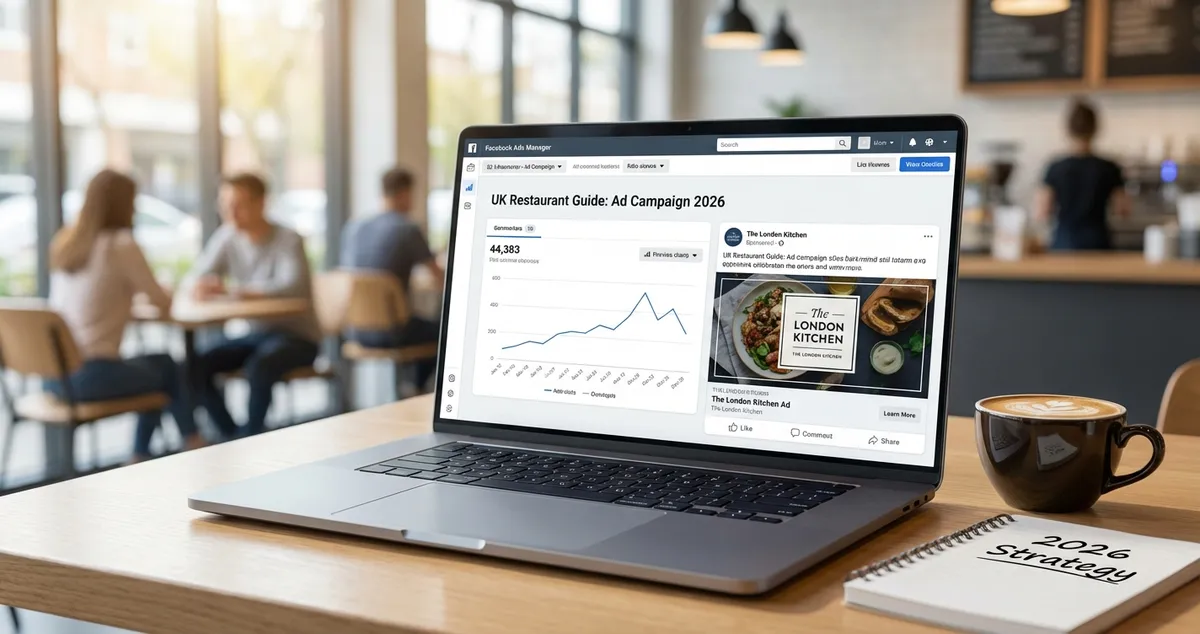
Run effective Facebook ads for UK restaurants. Master the 3-2-2 testing method, local targeting, and budget tips that fill tables.
You've tried boosting posts. You've spent £50 here, £100 there. The likes roll in, but the tables stay empty on Tuesday nights. They're running Facebook ads for restaurants properly, and it's working. This guide shows you exactly how to do the same.
Info
Related: See our complete guide to restaurant advertising for the full picture on paid promotion strategies.
This guide covers what UK restaurants need to know about Facebook ads: from setup to strategy, budget planning to targeting. Whether you're spending £10 or £1,000 monthly, you'll learn how to turn Facebook ad spend into actual bookings.
What You'll Learn in This Facebook Ads Guide
- Whether Facebook ads actually work for restaurants (and when they don't)
- The 30/30/30/10 rule for budgeting your marketing spend
- How to use the 3-2-2 method for testing ad creatives
- Step-by-step setup for your first campaign
- What UK restaurants typically pay per click
Do Facebook Ads Work for Restaurants?
First, let's answer the fundamental question. Facebook ads work for restaurants when you target the right people with the right offer at the right time. The platform reaches over 3 billion monthly users globally, and around 59% of diners use Facebook to discover new places to eat, according to Restaurant Social Media Statistics.
The restaurant and food industry typically has one of the lowest costs per lead on Facebook at around £0.60 (approximately $0.74), making it accessible even for small independents with tight budgets. Mobile-first campaigns deliver 62% higher engagement compared to desktop-targeted ads, so optimising for phones is essential. According to Meta for Business, properly configured local awareness campaigns can help restaurants reach nearby customers who are most likely to visit.
From helping UK restaurants set up their first Facebook campaigns, we've learned that the initial setup matters more than the budget: a well-targeted £10/day campaign consistently outperforms scattered £50 boosts.
That said, Facebook ads for restaurants aren't magic. If you're only boosting posts without proper targeting you'll always lose to competitors who take the time to set up proper campaigns. The key is local targeting combined with offers people actually respond to.
Reality Check
If you're reading this after a 12-hour shift thinking "I don't have time for this," you're not alone. The good news: a well-structured campaign takes about 30 minutes to set up and 15 minutes weekly to monitor.
Campaign Objective
Start with a "traffic" campaign objective rather than "engagement." You want people clicking through to your booking page, not just liking your ad.
What Is the 30/30/30/10 Rule for Restaurants?
Now let's talk budget. When planning Facebook ads for your restaurant, the 30/30/30/10 rule is a framework for allocating restaurant revenue: 30% for food costs, 30% for labour, 30% for overheads (including marketing), and 10% for profit. Marketing typically falls within that overhead bracket.
Many established restaurants allocate between 5% and 10% of total revenue to marketing, according to Restaurant Accounting Services. New restaurants building awareness often spend closer to 10-15%.
Here's what this means for your Facebook ads budget:
- A restaurant turning over £400,000 annually might spend £20,000-£40,000 on marketing
- Of that, 30-50% could go toward digital advertising including Facebook
- That's roughly £6,000-£20,000 annually, or £500-£1,700 monthly for Facebook ads
Important: The 30/30/30/10 rule is a guideline, not gospel. Fast-casual spots often have lower labour costs. Fine dining might spend more on staff but charge higher prices. Use it as a starting point, then adjust based on your actual numbers.
If you're thinking "those numbers seem high for my budget," that's fair. You can start advertising your restaurant on Facebook with as little as £5-10 per day and scale up once you see what works.
How Do I Advertise My Restaurant on Facebook?
Here's the practical setup process. Advertising your restaurant using Facebook ads starts with Meta Business Suite, the platform that manages both Facebook and Instagram ads. For example, a gastropub in Leeds might set up their first campaign targeting a 10-mile radius with a "20% off Sunday roast" offer. Here's the process broken down:
- Create a Meta Business account at business.facebook.com and connect your restaurant's Facebook page
- Set up your payment method in Ads Manager under billing settings
- Define your campaign objective - for restaurants, "Traffic" (website visits) or "Leads" (direct bookings) usually work best
- Build your audience using location targeting (typically 5-15 miles from your restaurant), age ranges, and interests like "dining out" or "local restaurants"
- Create your ad with compelling images, a clear offer, and a call-to-action like "Book Now" or "View Menu"
- Set your budget - start with £10-20 daily and run for at least 7 days to gather meaningful data
The targeting is where Facebook ads for restaurants win or lose. Facebook's local awareness tools let you reach people within walking distance of your door. A gastropub in Manchester shouldn't waste budget showing ads in London.
For detailed guidance on building your restaurant social media marketing foundation before running ads, check our comprehensive guide.
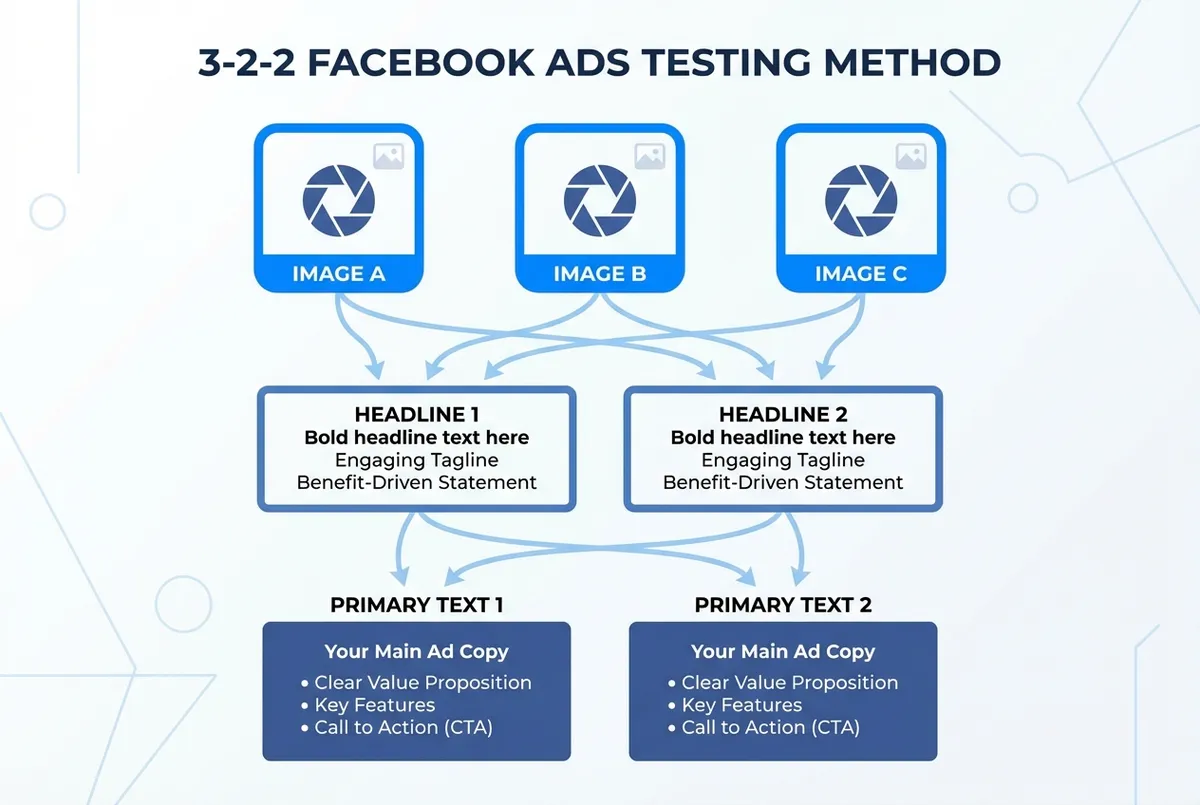
The 3-2-2 method lets Facebook's algorithm find winning combinations
What Is the 3-2-2 Method of Facebook Ads?
The 3-2-2 method is a framework for testing Facebook ad creatives efficiently: create 3 different images or videos, 2 headlines, and 2 primary text variations. Facebook's algorithm then mixes and matches these elements to find what performs well for your audience.
This approach, outlined by Disrupter School, works because it lets Facebook's machine learning do the testing for you. Instead of manually running 12 separate ads, you upload your variations and let the platform optimise.
For a restaurant, your 3-2-2 might look like:
3 Creatives:
- A mouth-watering dish photo
- A video of your chef plating up
- An image of happy diners at a full table
2 Headlines:
- "Your Table Is Waiting"
- "Book Your Weekend Dinner"
2 Primary Texts:
- "Award-winning Sunday roasts in [Location]. Book now and get 10% off your first visit."
- "Tired of the same old takeaway? Treat yourself to proper food. Tables available this weekend."
Why this works: You're testing what resonates without guessing. Maybe your audience responds better to dish photos than atmosphere shots. Maybe they prefer casual language over promotional. The data will tell you.
The difference between Facebook ads for restaurants that work and those that don't? Testing. Consistent testing.
If you're thinking "that sounds like a lot of content to create," consider this: one afternoon of photography and 30 minutes of writing, sped up with an AI social post generator, gives you enough material for weeks of testing.
How to Run Facebook Ads for Restaurants
Running Facebook ads for restaurants effectively means following a structured process rather than boosting random posts and hoping for the best. Ask yourself: would you click on your restaurant's current Facebook posts? If the answer is "probably not," that's exactly why a proper strategy matters. Here's the step-by-step approach:
Week 1: Setup and Launch
- Audit your Facebook page - ensure opening hours, menu link, and booking options are current
- Install the Meta Pixel on your website to track conversions
- Create your first campaign using the 3-2-2 method above
- Set a modest daily budget (£10-20) and let it run for 7 days
Week 2: Analyse and Adjust
If you can't name your top-performing ad creative right now, that's usually a sign your tracking needs work. Check Ads Manager before making changes.
- Check which creative combinations perform best
- Pause underperforming variations
- Double down on winners by increasing their budget
- Test a new offer or audience segment
Ongoing: Scale What Works
Restaurants that succeed with Facebook ads typically test new ads weekly and scale winners. A quiet Wednesday night could become your busiest service if you target the right audience with mid-week offers. For instance, a curry house in Birmingham might run a "Wednesday Wine Down" campaign targeting couples within 8 miles, offering 20% off mains when booking midweek.
Cost expectations for UK restaurants:
UK advertisers typically pay around £0.43-£0.75 per click on Facebook, according to Shopify UK. London and major cities cost more. Seasonal peaks like Christmas push prices higher.
For tracking whether your ads actually bring customers through the door, see our guide on measuring restaurant marketing ROI.
Minimum Viable Facebook Ads for Restaurants Plan
So you've got the strategy. But what if you're short on time? If you only have 30 minutes a week for Facebook ads, do this:
This week, set up your first Facebook ad campaign:
- Day 1-2: Create a Meta Business account and connect your Facebook page
- Day 3-4: Take 5 photos of your best dishes and write 2 short promotional texts
- Day 5-7: Launch one ad set with £10/day budget targeting 10 miles around your restaurant
That's enough to start. For example, a fish and chip shop in Brighton might launch a simple "Friday Night Special" campaign targeting 8 miles around the shop. One well-targeted ad running consistently typically beats scattered boosted posts. You can optimise later once you see what's working.
Facebook Ads vs Google Ads for Restaurants
Here's the thing: both platforms work, but they serve different purposes. Understanding when to use Facebook ads for restaurants versus Google Ads helps you allocate budget effectively.
| Factor | Facebook Ads | Google Ads |
|---|---|---|
| Excels at | Building awareness | Capturing search intent |
| Audience | People who don't know you | People actively searching |
| Average CPC | £0.43-£0.75 | £1.50-£2.50 |
| Creative needs | Visual-heavy | Text-focused |
| Setup time | 30 minutes | 1-2 hours |
Facebook Ads excel at:
- Building awareness with people who don't know you yet
- Promoting specific offers and events
- Reaching locals scrolling during their commute
- Visual storytelling through food photography
Google Ads excel at:
- Capturing people actively searching "restaurants near me"
- Appearing when someone's already decided to eat out
- Targeting high-intent keywords
For most UK restaurants starting out, Facebook often offers the better entry point. The visual format suits food naturally, and the local targeting is precise.
Google catches people who are already hungry. Facebook makes people hungry.
Once you've mastered Facebook ads for restaurants, add Google to capture searchers ready to book.
For the complete breakdown, our restaurant social media marketing guide covers organic strategies. For budget planning, see our restaurant ad budget guide. For Google comparison, check Google Ads for restaurants.
Common Facebook Ads for Restaurants Mistakes to Avoid
That's the framework. Now here's where Facebook ads for restaurants often go wrong. If your campaigns never seem to work, check whether you're making these errors:
- Targeting too broad: Showing ads nationally when you only serve one postcode wastes budget
- Weak imagery: Dark, blurry food photos hurt more than they help
- No clear offer: "Visit our restaurant" isn't compelling; "20% off your first booking" is
- Stopping too early: Ads need 7+ days to gather meaningful data before you judge them
- Ignoring mobile: A large majority of Facebook usage is mobile - if your booking page doesn't work on phones, you'll lose those clicks. For example, a pizzeria in Sheffield discovered their online menu took 8 seconds to load on mobile: that's long enough for most people to give up.
If you can't tell whether your Facebook ads bring bookings or just likes, that's usually a sign the tracking needs tightening. Install the Meta Pixel and set up conversion events properly. Would you be able to name which specific ad brought in your last booking? If not, that's exactly what proper tracking solves.
For landing page best practices that convert Facebook ad clicks into bookings, see our restaurant ad landing pages guide. If you're only boosting posts without proper conversion tracking you'll always lose to competitors who measure what actually works.
Trying to optimise your restaurant's Facebook ads without clear data? That approach rarely works. You need proper tracking first.
Your Facebook Ads for Restaurants Checklist
Before launching your first Facebook ads campaign, ensure you've completed these essentials:
- Create a Meta Business account and connect your Facebook page
- Install Meta Pixel on your website for conversion tracking
- Take 5+ high-quality photos of your best dishes
- Write 2-3 ad text variations to test
- Define your target radius (5-10 miles typically)
- Set a minimum 7-day run time before evaluating
- Ensure your booking page works perfectly on mobile
Facebook Ads for Restaurants vs Other Platforms
| Factor | Facebook Ads | Google Ads | Instagram Ads |
|---|---|---|---|
| Excels at | Awareness + offers | Immediate bookings | Visual engagement |
| Audience intent | Passive browsing | Active searching | Passive browsing |
| Average CPC | £0.43-£0.75 | £1.50-£2.50 | £0.50-£0.90 |
| Creative needs | Images + copy | Text-focused | High-quality visuals |
| Setup time | 30 minutes | 1-2 hours | 30 minutes |
| ROI timeline | 1-2 weeks | Days | 1-2 weeks |
For many UK restaurants starting with paid advertising, Facebook ads often offer one of the strongest combinations of low barrier to entry and detailed local targeting.
Key Takeaways: Facebook Ads for Restaurants
If you run a restaurant and want to see how Local Brand Hub can support your marketing, explore our restaurant marketing tools.
Key Takeaways: Facebook Ads for Restaurants
Facebook ads for restaurants work when you combine precise local targeting with compelling offers and consistent testing. Here's what to remember:
- Start small: £10-20 daily is enough to gather data
- Use the 3-2-2 method: Test 3 creatives, 2 headlines, and 2 texts to find what resonates
- Target locally: 5-15 miles around your restaurant, not the whole country
- Track properly: Install the Meta Pixel to measure actual bookings from your Facebook ads for restaurants, not just clicks
- Be patient: Give campaigns at least 7 days before making changes
The restaurant and food industry typically benefits from relatively low Facebook ad costs compared to other sectors. With the right approach, even a modest budget can fill empty tables on quiet nights.
Effective Facebook advertising isn't about showing your food to everyone. It's about showing the right food to the right people at the right moment, when they're hungry, nearby, and scrolling.
Frequently Asked Questions
How much should a restaurant spend on Facebook ads?
Most UK restaurants start with £10-20 per day (£300-600 monthly) and scale based on results. The 30/30/30/10 rule suggests marketing typically falls within the 30% overhead allocation, with digital advertising taking 30-50% of that.
Do Facebook ads actually bring customers to restaurants?
Yes, when properly targeted. Facebook ads for restaurants work because the platform allows precise local targeting: you can reach people within walking distance who have interests in dining out. The key is tracking conversions with the Meta Pixel to measure actual bookings.
What type of Facebook ad works well for restaurants?
For most restaurants, "Traffic" campaigns driving people to your booking page often outperform "Engagement" campaigns. Use the 3-2-2 method: 3 creatives (dish photos, videos, atmosphere shots), 2 headlines, and 2 text variations to find what resonates.
Weekly Action: Start Your Facebook Ads Campaign
This week, create a Meta Business account and take 5 photos of your best dishes. Write two short promotional texts (one casual, one with an offer). That gives you everything needed to launch your first Facebook ads for restaurants test campaign next week with a £10/day budget targeting your local area.
For more ways to attract customers without breaking the bank, explore our guide to restaurant marketing.
For UK restaurants
Need Help With Facebook Ads?
Local Brand Hub helps UK restaurants set up and manage Facebook ad campaigns that actually fill tables.
Start freeGet More Marketing Tips
Practical marketing tips for UK business owners, straight to your inbox. No spam, unsubscribe anytime.
About the Author
Local Brand Hub
Empowering UK Businesses
Local Brand Hub provides comprehensive business management tools designed specifically for UK local businesses to streamline operations, automate marketing, and grow revenue.
More articlesRelated Articles
 Marketing Tips
Restaurant Advertising: The Complete UK Guide for 2025
Master restaurant advertising with proven UK strategies for Google Ads, Facebook, and local marketing. Budget tips and tactics to fill tables.
 Marketing Tips
Google Ads for Restaurants: A Practical UK Marketing Guide
Run Google Ads for your restaurant with real UK cost benchmarks, realistic ROI expectations, and a clear comparison against Facebook Ads.
 Marketing Tips
Restaurant Advertising Budget: How Much to Spend
Set a realistic restaurant advertising budget using UK CPM benchmarks, platform-by-platform ROI data, and the 30/30/30 budget allocation framework.