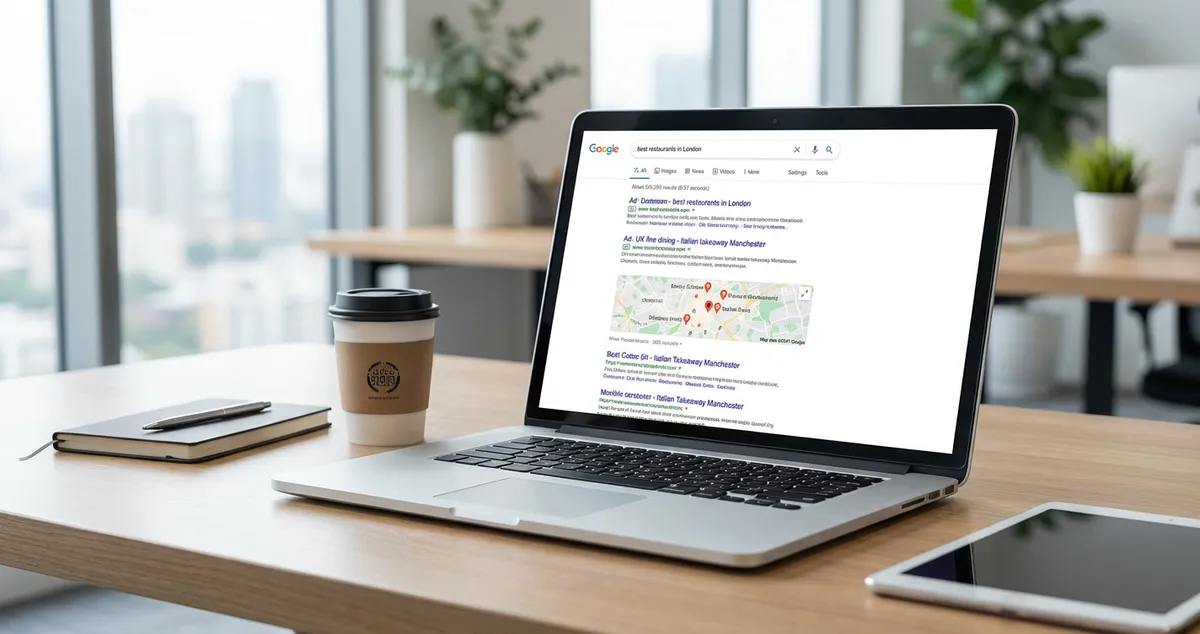
Run Google Ads for your restaurant with real UK cost benchmarks, realistic ROI expectations, and a clear comparison against Facebook Ads.
You're running a restaurant. Your tables are empty on quiet midweek evenings. The place down the road has a queue. They're not better than you. They're just showing up when people search "best Italian near me." That's the reality of Google Ads for restaurants today.
See our restaurant advertising guide for more options.
Info
Related: For a complete overview of paid marketing options, see our restaurant paid marketing guide.
What You'll Learn About Google Ads for Restaurants
- Whether Google Ads are actually worth the investment for your restaurant
- How much you'll realistically spend per click and per customer
- The key differences between Google Ads and Facebook Ads
- A minimum viable approach if you only have 30 minutes a week
- Practical examples of ad campaigns that work for UK restaurants
Are Google Ads Worth It for Restaurants?
First, let's address the core question. Yes, Google Ads are typically worth it for restaurants, if you target the right keywords. The key advantage is intent. Someone searching "Italian restaurant near me" is already hungry. They want to book now, not browse later.
Here's why the numbers work in your favour. According to Google Ads industry benchmarks, restaurants enjoy some of the lowest costs per click. You'll pay around £1.60 to £2.05 per click. Most other industries pay £4-5 per click. That's roughly half the cost. Google Ads works particularly well with location targeting.
Having helped UK restaurants set up their first Google Ads campaigns, we've found that local keywords work best. Broad national campaigns can't compete with hyper-local intent.
The conversion story is even better. Restaurants saw a 72% increase in conversion rates in recent benchmarking data. Cost per lead averages just £24 compared to £55+ for most industries.
For most UK restaurants, Google Ads offers a clear path to more bookings. Commit to at least £500-750 per month and track results properly.
If you're thinking "I don't have time to learn another platform", you're not alone. But ignoring it means letting competitors capture every "restaurant near me" search in your area.
For most UK restaurants, you'll pay around £1.50-£2.50 per click. Start with several hundred pounds monthly. When managed well, Google Ads typically delivers strong returns.
What Is the Best Platform to Advertise a Restaurant?
Let's compare platforms. The best platform to advertise a restaurant is a framework for matching your advertising channel to your immediate goal. There's no universal "best" answer. Google Ads captures people actively searching for somewhere to eat. Facebook and Instagram build awareness. They keep your restaurant top-of-mind between visits. Most successful restaurants use both.
According to UK hospitality research, around 47% of UK restaurant operators invest in Google Ads. Meanwhile, 67% of restaurants plan to pay for social media advertising.
Here's how the platforms compare:
- Google Ads typically works well for immediate bookings. You're reaching people who are hungry and searching. It's text-focused and targets by keywords plus location.
- Facebook/Instagram Ads excel at brand awareness and special offers. They're visual-heavy. Costs are lower per click but intent is also lower.
For most UK restaurants, Google Ads often offers the best combination of intent and local discovery. If someone searches "Sunday roast near Clapham," they want to book this weekend, not next month.
That said, if you're only posting when it's quiet in the restaurant you'll always lose to competitors who treat marketing as part of operations, not an afterthought.
Info
Related: See our restaurant paid marketing guide for budget allocation strategies across platforms.
Do Google Ads Work Better Than Facebook Ads?
Here's where context matters. Google Ads and Facebook Ads work differently, not better or worse. Google Ads captures demand: reaching people who are already looking. Facebook creates demand. It puts your restaurant in front of people who weren't thinking about dining out until they saw your post.
According to Google's advertising research, advertisers typically see a 200% return from Google Ads. Facebook results vary more. However, lower costs make it good for building awareness on a budget.
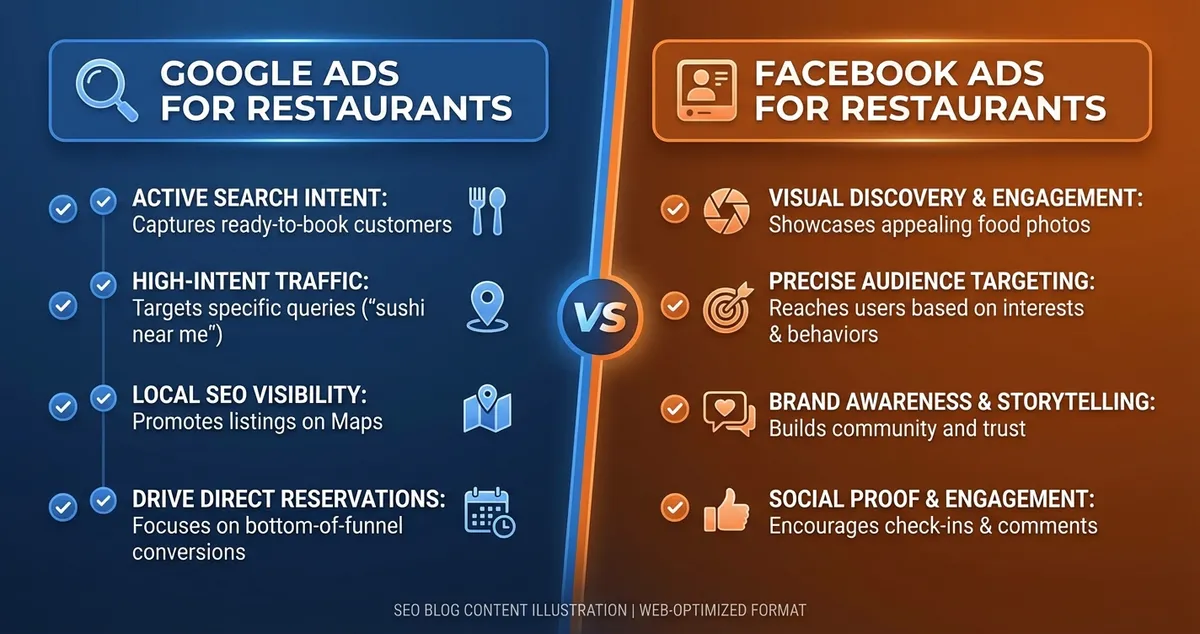
Google captures demand; Facebook creates it
The practical difference comes down to timing:
- Google Ads → Someone's hungry and searching "best pizza delivery [your area]"
- Facebook Ads → Someone sees your seasonal menu while scrolling and thinks "that looks good, maybe this weekend"
A gastropub using both might run:
- Google Ads targeting "Sunday roast near me" and "pub lunch [location]"
- Facebook Ads showcasing behind-the-scenes kitchen content and promoting their midweek specials
If you can't tell whether your marketing brings bookings or just likes, that's usually a sign your strategy needs tightening. Would you know which of your ads are driving bookings versus just generating clicks?
For dedicated ad destination pages that convert, see our restaurant ad landing pages guide. If you're only checking ad performance when the restaurant is quiet you'll always lose to competitors who review their Google Ads campaigns weekly.
The Combined Approach
Most successful restaurant marketing campaigns put the majority of budget into Google Ads. The rest goes to Facebook for awareness and retargeting. This captures customers at different stages. Google grabs them when they're ready to book. Facebook keeps you top-of-mind throughout their decision process.
| When to Use | Google Ads | Facebook Ads |
|---|---|---|
| Customer Intent | Ready to book | Browsing, not decided |
| Budget Priority | Higher (immediate ROI) | Lower (long-term awareness) |
| Creative Effort | Minimal (text-based) | Higher (visual content needed) |
Do Facebook Ads Work for Restaurants?
Additionally, Facebook has its own strengths. Yes, Facebook Ads work well for restaurants. They're great for visual content, special offers, and building local community. With 59% of diners using Facebook for local restaurant discovery according to Cropink research, it remains a powerful platform for UK hospitality.
Time Consideration
The reality for most independent restaurants: Facebook Ads require more creative effort than Google Ads. You need compelling images, engaging copy, and regular refreshes. Start with Google Ads if you're time-poor. Add Facebook once you've proven ROI.
The strength of Facebook Ads lies in precision targeting. You can show ads to people within 5 miles of your restaurant. Target those with upcoming birthdays. Reach people interested in "fine dining" or "Italian cuisine."
When Facebook Ads often work well for restaurants:
- Promoting new menu launches with mouth-watering visuals
- Targeting special occasions (birthdays, anniversaries, Mother's Day)
- Retargeting people who visited your website but didn't book
- Building awareness in a new area after opening
For example, a seafood restaurant might run Facebook Ads:
- Birthday campaign: Targeting people with birthdays in the next 30 days, within 5 miles, offering a free dessert
- Menu launch: Carousel ad showing 5 new summer dishes with a "Book Now" button
When Facebook Ads underperform:
- Trying to drive immediate bookings without urgency, that never works
- Targeting too broadly (everyone within 20 miles)
- Using text-heavy ads instead of quality food photography
- Not having a clear call-to-action
If you're down two staff and barely have time to check your phone, Google Ads is often more manageable. The text-based approach needs less creative effort.
Google Ads for Restaurants: Examples That Work
Here are practical approaches that work in the UK:
1. Local Search Campaigns
Target people searching "[cuisine] restaurant [your area]" or "best [food type] near me." These high-intent keywords convert well. Searchers are ready to book.
For example, an Italian restaurant in East London might target "Italian restaurant Shoreditch" and "pizza near Liverpool Street." The ad copy should emphasise fresh pasta and location.
2. Competitor Targeting
Use Google Ads to bid on competitor searches. When someone searches for another restaurant's name, your ad appears alongside their results.
Example: A wine bar might target searches for nearby competitors, showing ads like "Looking for Wine Bars in Soho? | 200+ Wines by the Glass | Open Late"
3. Event and Occasion Targeting
Run campaigns around high-value occasions. People search for special dining experiences at these times.
Example keywords: "Valentine's Day restaurant London," "birthday dinner [area]," "private dining rooms"
4. Delivery and Takeaway Campaigns
If you offer delivery, target "[cuisine] delivery [location]" searches. These delivery campaigns work well for quiet midweek periods.
Getting Started: The Minimum Viable Approach
If you only have 30 minutes a week, start with this bare-minimum setup:
This week, set up your first restaurant Google Ads campaign:
- Day 1-2: Create a Google Ads account and set up billing (20 minutes)
- Day 3-4: Create one campaign targeting "[your cuisine] restaurant [your area]" with a £10/day budget
- Day 5-7: Write three ad variations and let Google optimise which performs best
Your first campaign checklist:
- One campaign with one ad group
- A handful of location-specific keywords
- 5-mile radius around your restaurant
- Call extension with your booking number
- Location extension showing your address
This won't transform your business overnight. But one Google Ads campaign running consistently beats random posting or no advertising at all.
If you're only setting up ads when the restaurant is quiet you'll always lose to competitors who plan their campaigns in advance.
For example, a Thai restaurant in Leeds might set up Google Ads targeting:
- "Thai restaurant Leeds city centre" (high intent)
- "Thai food near me Leeds" (local search)
- "best Pad Thai Leeds" (dish-specific)
With a modest daily budget, this could generate several clicks daily. Expect a handful of bookings weekly, a solid starting point. An all-in-one marketing platform helps you keep Google Ads working alongside your social and local SEO efforts.
Quick Test
Would you click on your own restaurant's ads? Can you honestly say your ad copy would make you book? If not, start there.
Your Google Ads Checklist
Before launching your first campaign, ensure you've covered these essentials:
- Create a Google Ads account and set up billing
- Link your Google Business Profile to Google Ads
- Install Google conversion tracking on your booking page
- Research 5-10 local keywords using Keyword Planner
- Set location targeting to your service area (3-10 miles)
- Write at least 3 ad variations to test
- Add call and location extensions
Google Ads vs Facebook Ads for Restaurants
| Factor | Google Ads | Facebook Ads |
|---|---|---|
| Best for | Immediate bookings | Brand awareness |
| Audience intent | High (actively searching) | Low (passive scrolling) |
| Average CPC | £1.50-£2.50 | £0.43-£0.75 |
| Creative format | Text-based | Visual-heavy |
| Setup complexity | Medium-high | Low-medium |
| ROI timeline | Days | 1-2 weeks |
| Minimum budget | £500/month | £300/month |
For most UK restaurants seeking immediate bookings, Google Ads typically delivers faster, more measurable results due to higher searcher intent.
Key Takeaways: Google Ads for Restaurants
If you run a restaurant and want to see how Local Brand Hub can support your marketing, explore our restaurant marketing tools.
Key Takeaways: Google Ads for Restaurants
The bottom line: Google Ads for restaurants works because you're reaching people when they're actively searching. Restaurant clicks cost roughly half what most industries pay. The economics favour restaurant advertising.
What to remember:
- Google Ads captures intent; Facebook Ads build awareness
- Start with enough monthly budget to gather meaningful data
- Target location-specific keywords first
- Track actual bookings, not just clicks
- Use both platforms if budget allows: put more into Google Ads for immediate bookings
Weekly Action
This week, research your Google Ads opportunity:
- Day 1-2: Open Google Ads Keyword Planner and search "[your cuisine] restaurant [your area]"
- Day 3-4: Note the top 10 keywords with their search volume and suggested bids
- Day 5-7: Calculate your potential daily budget based on these estimates
Write down your findings. This becomes your starting point for your first Google Ads campaign. For budget planning details, see our restaurant ad budget guide.
The restaurant down the road with the queue? They're not running on luck. They're running on a solid Google Ads for restaurants strategy. And this guide just showed you theirs.
Frequently Asked Questions
How much should a restaurant spend on Google Ads?
Most UK restaurants should start with £500-750 monthly for Google Ads. This gives enough data for optimisation. For example, a neighbourhood Italian might spend £600/month, generating 300-400 clicks and 15-20 new bookings. Increase budget once you can track which clicks become actual bookings.
Can I run Google Ads myself or do I need an agency?
You can manage Google Ads yourself with a few hours per week. Many restaurant owners start solo. They hire help once campaigns grow. The key is learning to read the data. Make adjustments based on what's actually driving bookings.
How long until I see results from restaurant Google Ads?
Expect several weeks before you have enough data to evaluate your Google Ads performance. Clicks should start within hours of launching. But measuring ROI requires tracking which clicks convert to actual covers. Give it at least a month of data.
For UK restaurants
Need Help With Google Ads?
Local Brand Hub helps UK restaurants set up and manage Google Ads campaigns that actually fill tables.
Start freeGet More Marketing Tips
Practical marketing tips for UK business owners, straight to your inbox. No spam, unsubscribe anytime.
About the Author
Local Brand Hub
Empowering UK Businesses
Local Brand Hub provides comprehensive business management tools designed specifically for UK local businesses to streamline operations, automate marketing, and grow revenue.
More articlesRelated Articles
 Marketing Tips
Restaurant Advertising: The Complete UK Guide for 2025
Master restaurant advertising with proven UK strategies for Google Ads, Facebook, and local marketing. Budget tips and tactics to fill tables.
 Marketing Tips
Restaurant PPC: Pay-Per-Click Advertising Guide for UK
Run profitable PPC campaigns for your restaurant. Covers Google Ads setup, local keyword targeting, budget allocation, and booking-focused ad copy.
 Marketing Tips
Restaurant Marketing Agency Cost: What to Budget
What does a restaurant marketing agency cost in the UK? Monthly retainers, project fees, hidden costs, and budgeting tips for independent owners.