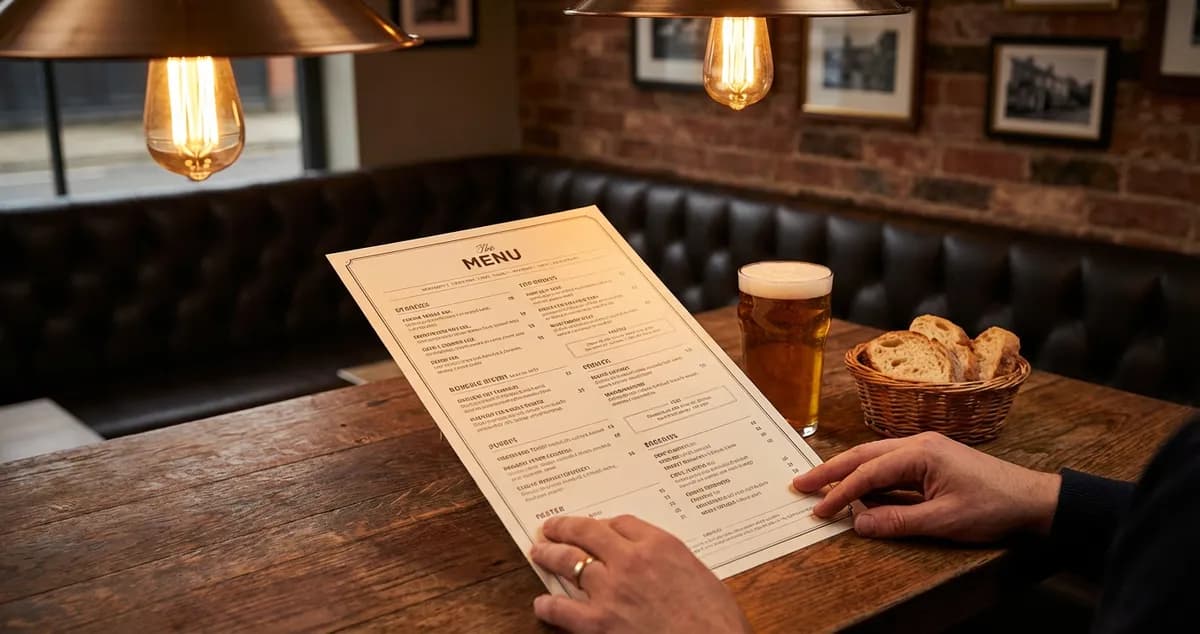
Learn the psychology of menu design and 12 proven tactics restaurants use to guide customer choices. From golden triangles to price anchoring, UK guide.
You've spent hours perfecting your signature dish. The flavours are spot-on, the presentation is beautiful. Yet it sits there, week after week, barely selling. Meanwhile, an average dish in the top-right corner flies out of the kitchen. Why? This is menu psychology in action.
Menu psychology is the science of using design, pricing, and language to influence what customers order. Research from Cornell University's hospitality school shows that strategic menu design can increase profits by 10-15% without changing a single dish. For UK restaurants operating on average margins of 4-6%, understanding these menu psychology principles isn't optional; it's essential.
Info
Related: Menu Engineering covers the data analysis side. Return here for the psychology tactics.
What You'll Learn
- The psychology behind how customers read and process menus
- 12 proven menu psychology tactics that influence ordering behaviour
- The five principles of menu planning that drive profitability
- How to apply pricing psychology without feeling manipulative
- Common mistakes that cost restaurants money
First, let's understand why menu psychology works at all.
What Is the Psychology Behind Menus?
First, here's what this strategy actually involves. The psychology behind menus is a strategy that uses visual design, language, and pricing to influence customer ordering decisions. This approach works because our brains process visual information in predictable patterns, make decisions under time pressure, and respond to subtle cues. When customers open a menu, they're not making purely rational choices; they're influenced by cognitive biases, emotional triggers, and design elements that restaurant owners can leverage.
Here's what happens in those 109 seconds customers spend looking at your menu:
Eye tracking patterns: Research reveals that customers follow predictable patterns. The "golden triangle" describes how eyes move from the centre, to the top right, then to the top left. Items in these zones get the most attention.
For example, a gastropub might place their £18 lamb shank in the centre of the mains section, their £22 ribeye at top-right, and their £16 fish pie at top-left. All three positions capture peak attention, driving orders toward the dishes they want to sell.
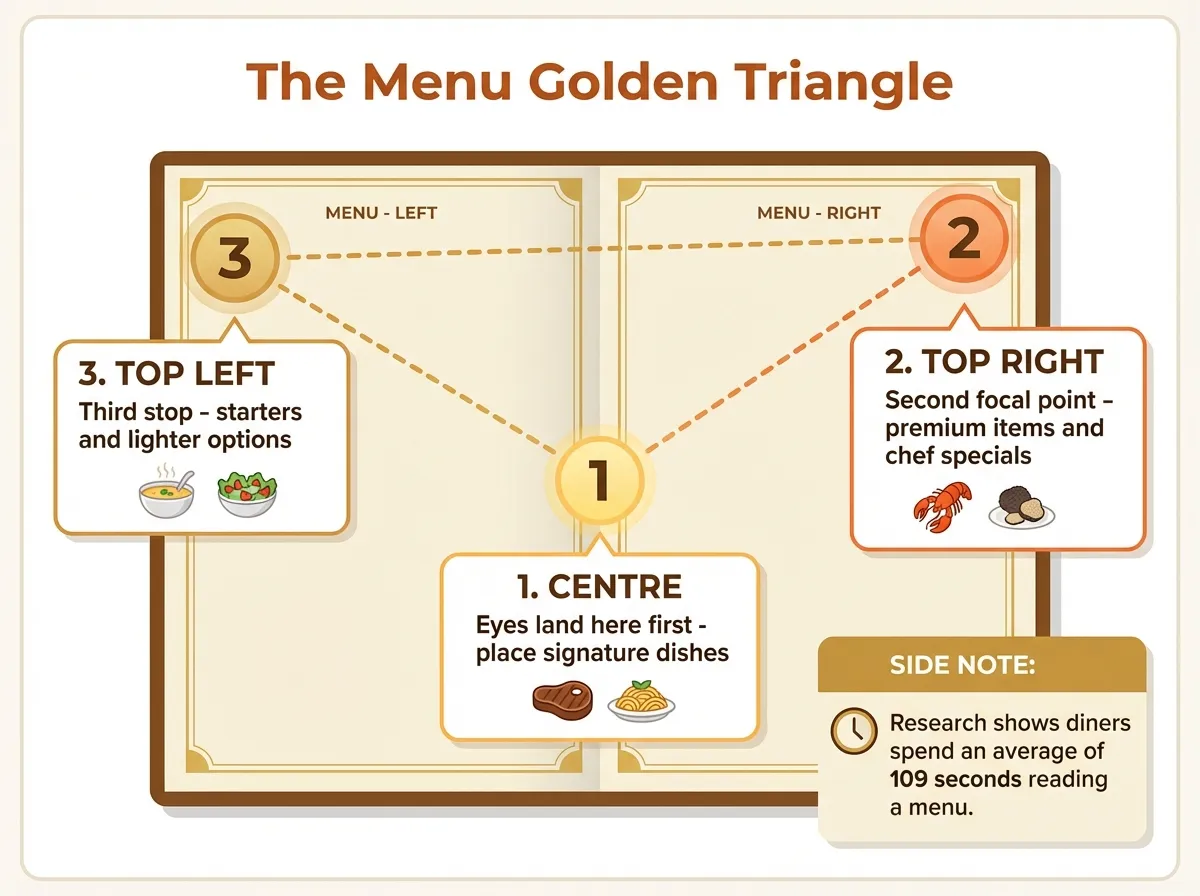
The golden triangle: where customers look first on your menu
Decision fatigue: Too many choices create anxiety. The paradox of choice suggests limiting options to around 7 items per category helps customers decide confidently.
Price perception: How prices are displayed affects what customers think they can afford. Removing pound signs, using charm pricing (£14.95 instead of £15), and strategic positioning all shape perceived value.
If you're thinking "this sounds manipulative," consider this: good menu psychology actually helps customers. Overwhelmed diners who can't decide often order something safe and leave disappointed. A well-designed menu guides them toward dishes they'll genuinely enjoy.
If you're reading this after a quiet Saturday service wondering why your best dishes aren't selling, you're not alone; it's a common frustration.
Pro Tip
If you only think about menu design psychology when reprinting your menu every few years, you'll always lose to competitors who treat it as an ongoing optimisation process.
Now that you understand why menu psychology works, let's explore the foundational principles.
What Are the 5 Principles of Menu Planning?
Building on those concepts, the five principles of menu planning are balance, variety, contrast, colour, and eye appeal. These principles originated in culinary training but have evolved to incorporate psychological insights about how customers perceive and choose food.
1. Balance
Balance refers to both nutritional balance and visual balance on the menu itself. A menu shouldn't feel "heavy" in one section and sparse in another. For restaurant owners, this means distributing high-margin items across different sections rather than clustering them together.
2. Variety
Offering variety without overwhelming customers is crucial. Each category should provide enough options to satisfy different preferences, but research suggests limiting categories to 5-7 items prevents decision paralysis.
For example, a fish and chip shop might offer 5 fish options rather than 15. Customers feel they have choice without becoming paralysed.
3. Contrast
Contrast applies to textures, flavours, temperatures, and visual presentation on the menu. A menu description should paint contrasts: "crispy" against "tender," "warm" against "cool." These contrasts make dishes more appealing by creating sensory anticipation.
4. Colour
Colour psychology extends beyond food presentation to menu design itself. Green suggests freshness, orange stimulates appetite, red encourages action. Strategic colour use can highlight profitable items without customers consciously noticing.
5. Eye Appeal
The overall visual presentation must be clean, professional, and easy to navigate. Cluttered menus with inconsistent fonts and competing colours create cognitive overload. Eye appeal means guiding attention effortlessly to where you want it.
Info
Related: Restaurant Menu Pricing explains how to set prices that align with these principles.
With the principles clear, let's look at a popular framework for menu content distribution.
What Is the 30/30/30 Rule for Restaurants?
Next, let's discuss a popular framework. The 30/30/30 rule is a content distribution framework where restaurants allocate menu space roughly equally across three categories: signature dishes (30%), profitable items (30%), and customer favourites (30%). The remaining 10% typically covers specials or seasonal items.
This rule ensures balance between what the restaurant wants to sell, what makes money, and what customers actually want.
| Category | Allocation | Purpose |
|---|---|---|
| Signature Dishes | 30% | Brand identity and differentiation |
| Profitable Items | 30% | Margin optimisation |
| Customer Favourites | 30% | Satisfaction and retention |
| Specials/Seasonal | 10% | Freshness and flexibility |
For instance, an Italian restaurant might structure their menu this way: signature dishes (their house-made pasta that defines the restaurant), high-margin items (dishes with lower food costs like risotto), customer favourites (the carbonara everyone orders), and seasonal specials.
However, this rule isn't universally applicable. A gastropub with a distinctive culinary identity might allocate more to signature dishes, while a family restaurant focused on value might emphasise customer favourites.
The biggest mistake is ignoring the profitable items category entirely. If you're not deliberately featuring high-margin dishes, you're leaving money on the table.
Info
Related: The 30 30 30 Rule for Restaurants covers the broader cost management framework that complements menu planning.
Let's dive into specific pricing strategies that influence customer behaviour.
Menu Pricing Psychology That Works
Here's where menu psychology becomes immediately actionable. These pricing tactics have been studied extensively and proven effective.
Remove Pound Signs
When customers see "15" instead of "£15.00," they spend up to 30% more. The currency symbol triggers price-focused thinking, while numbers alone feel more abstract and less painful.
Use Charm Pricing Strategically
Prices ending in .95 or .99 feel cheaper than rounded numbers. However, premium restaurants increasingly use rounded prices (£35 instead of £34.95) to signal quality. Choose based on your positioning:
- Value-focused restaurants: £12.95 feels like a deal
- Premium restaurants: £35 signals confidence and quality
Price Anchoring
Place your most expensive item prominently. When customers see a £52 steak, suddenly the £34 sea bass feels reasonable. This "decoy" item reframes value perception for everything below it.
Research shows price anchoring can make mid-range items seem 15-20% more attractive.
If you can't tell whether your menu prices are guiding customers toward profitable choices or simply confusing them, that's usually a sign you need to review your price positioning strategy.
Avoid Price Columns
Never align prices in a column down the right side of your menu. This creates a "price list" effect where customers scan prices rather than reading descriptions. Instead, nest prices within or after descriptions so customers engage with the dish first.
Strategic Price Positioning
Place high-margin items just below anchor prices. Customers comparing options will gravitate toward dishes that seem like good value relative to the anchor.
Info
Related: Restaurant Profit Margin helps you identify which items need margin improvement.
Now let's move into the visual design tactics that complement pricing psychology.
Menu Design Psychology: 12 Tactics
Additionally, these design techniques leverage how our brains process visual information. If you're struggling to know where to start, that's normal; focus on tactics 1, 2, and 6 first.
1. The Golden Triangle
Position your highest-margin items in the centre, top right, and top left of each menu section. Eye-tracking studies consistently confirm these areas receive the most attention.
For example, a curry house might position their £14 chicken tikka masala (high volume, good margin) in the centre, their £18 lamb rogan josh (premium item) at top-right, and their £12 vegetable biryani (excellent margin) at top-left.
2. Boxing High-Profit Items
Placing a subtle box or border around an item draws attention without feeling aggressive. Many restaurants report increases of 15-20% in orders for boxed items.
3. White Space Strategy
Surrounding a profitable dish with empty space makes it stand out. Crowded menus with no breathing room cause customers to skim rather than read.
4. Limit Categories
The paradox of choice suggests optimal menu length is 7-10 items per category. Beyond this, customers experience decision fatigue and often default to safe, familiar choices rather than exploring profitable recommendations.
5. First and Last Positioning
Items at the top and bottom of each category get disproportionate attention. Place your second-best margin items here, while your highest-margin dishes work well in the golden triangle zones.
6. Sensory Language
Descriptive language increases orders by up to 27%. Compare:
| Basic | Sensory |
|---|---|
| Chicken breast | Herb-crusted free-range chicken |
| Chocolate cake | Warm Belgian chocolate torte |
| Fish and chips | Line-caught North Sea haddock in crispy beer batter |
7. Nostalgic Naming
Names that evoke memories or places increase perceived value. "Grandma's recipe" or "Suffolk coastal catch" create emotional connections that justify premium pricing.
8. Ingredient Stories
Brief origin stories ("beef from Yorkshire Dales farms") add authenticity and justify prices. Don't fabricate claims because customers have become sceptical of generic descriptions. Specific, genuine details create trust.
9. Photography Strategy
Contrary to popular belief, photos can work for casual restaurants. However, too many images create a "budget" perception. Use 1-2 professional photos per page maximum for featured items.
10. Font Psychology
Decorative fonts suggest craftsmanship and tradition. Simple fonts suggest efficiency and value. Your font choice should match your positioning.
11. Menu Size and Format
Physical menu size affects perception. Larger menus suggest abundance and generosity. Smaller menus suggest curation and quality. Neither is inherently better: align with your brand.
12. Digital Menu Considerations
For digital menus, menu psychology principles still apply but with modifications. Scrolling behaviour differs from page-turning, so place key items within the first screen view. Tap-to-expand descriptions maintain clean design while enabling sensory language.
The reality for most independent restaurants is that you won't implement all 12 tactics at once. Based on firsthand experience, it's better to pick two or three tactics that match your current menu format, apply them through your menu and offers tools, and test them for a month before adding more.
Key Takeaway
Key Takeaway
Menu psychology isn't manipulation; it's communication. You're helping customers navigate choices and find dishes they'll enjoy while building a sustainable business. Customers spend only 109 seconds with your menu, so make every element count. The golden triangle (centre, top right, top left) gets the most attention, price display matters as much as the prices themselves, and sensory language creates desire while specific details create trust. Start with positioning your highest-margin items in the golden triangle, remove pound signs, and write one sensory description for a dish that isn't selling.
If you run a restaurant and want to see how Local Brand Hub can support your marketing, explore our restaurant marketing tools.
This Week's Action Plan
Day 1-2: Identify your three highest-margin items and check if they're positioned in the golden triangle.
Day 3-4: Review whether your prices are aligned in a price column: if so, plan to nest them within descriptions on your next reprint.
Day 5-7: Rewrite one description using sensory language and add a subtle box around one profitable item.
You don't need a complete redesign. Start with positioning and descriptions, then measure the impact over 4-6 weeks. Ask yourself: if a customer looked at your menu for only 30 seconds, would they naturally find your most profitable dish?
Frequently Asked Questions
What are the 7 types of menus?
The seven main menu types are: a la carte (items priced individually), table d'hote (fixed price, set courses), du jour (daily changing), static (unchanging), cyclical (rotating on schedule), prix fixe (set price for multiple courses), and tasting/degustation (chef's selection). Each type has different psychology implications for customer expectations and spending.
How does menu colour affect ordering?
Menu colour influences mood and appetite. Green suggests health and freshness, orange and yellow stimulate hunger, red creates urgency and draws attention, while blue suppresses appetite (avoid blue near food descriptions). Use colour strategically to highlight profitable items without overwhelming the overall design.
Is menu psychology ethical?
Menu psychology is ethical when it helps customers make satisfying choices while supporting business sustainability. It becomes problematic when it deceives customers about quality, quantity, or value. The goal should be alignment: customers get dishes they enjoy at prices that allow your restaurant to thrive.
How often should I update my menu design?
Review menu performance monthly using sales data. Make minor adjustments quarterly (positioning, descriptions) and major redesigns annually or when significant changes occur. Avoid the trap of redesigning only when the current menu feels outdated: by then, you've likely lost thousands in optimisation opportunities.
Does menu psychology work for digital menus?
Yes, but with adaptations. Digital menus require attention to scroll behaviour (key items in first view), tap interactions, and smaller screen layouts. The core principles of attention management, pricing psychology, and sensory language remain equally effective across formats.
For UK restaurant owners
Apply Menu Psychology Across Your Marketing
LocalBrandHub helps independent UK restaurants systemise their marketing (from menu optimisation to social media) without adding hours to your week.
Start FreeGet More Marketing Tips
Practical marketing tips for UK business owners, straight to your inbox. No spam, unsubscribe anytime.
About the Author
Local Brand Hub
Empowering UK Businesses
Local Brand Hub provides comprehensive business management tools designed specifically for UK local businesses to streamline operations, automate marketing, and grow revenue.
More articlesRelated Articles
 Marketing Tips
Four Quadrants of Menu Engineering: A Complete UK Guide
Master the four quadrants of menu engineering to boost restaurant profits. Learn how Stars, Plough Horses, Puzzles and Dogs increase your margins.
 Marketing Tips
Menu Design Principles: 7 Rules That Drive Sales
Master menu design principles that guide customer choices. Learn golden triangle placement and strategic pricing layouts that boost restaurant profits.
 Marketing Tips
Menu Engineering: Complete UK Restaurant Guide
Master the four quadrants matrix: Stars, Plough Horses, Puzzles and Dogs. Learn how menu engineering boosts UK restaurant profits by 15% or more.