Restaurant efficiency metrics that reveal profit leaks. Track labour costs, table turnover, kitchen output with UK benchmarks.
What You'll Learn About Restaurant Efficiency Metrics
You're tracking sales. Revenue looks decent on paper. But your bank balance doesn't match the till receipts, and you can't figure out where the money's going. This isn't a revenue problem, it's an efficiency problem. Revenue tells you what came in. Restaurant efficiency metrics tell you what you kept.
This guide covers the efficiency metrics that reveal where profit leaks happen:
- Labour cost percentage - Calculate and benchmark against UK standards
- Table turnover rates - Maximise revenue from existing capacity without rushing customers
- RevPASH (Revenue Per Available Seat Hour) - Measure true earning potential per seat
- Food cost control - Track weekly to catch margin erosion before it becomes systemic
- Kitchen productivity - Measure output per labour hour to identify bottlenecks
- Simple tracking systems - Weekly methods that don't require daily spreadsheets
Info
Why Restaurant Efficiency Metrics Matter More Than Revenue
Most restaurant owners focus on daily takings. That number feels good when it's high. But high revenue with low efficiency means you're working harder, not smarter.
Restaurant efficiency metrics reveal the gap between what you earn and what you keep. A £5,000 Saturday service means nothing if you spent most of it on labour, food waste, and overheads. That "good" night might have left you with minimal profit.
Here's the question: Would you rather have £8,000 revenue with 35% profit margin or £10,000 revenue with 15% profit margin? The lower revenue makes you more money.
The restaurants that survive aren't the ones with the highest takings. They're the ones that track where every pound goes and adjust before small inefficiencies become big losses.
Core Restaurant Efficiency Metrics
Now that you understand why efficiency matters more than revenue, let's look at the five restaurant efficiency metrics that form the foundation of profitable restaurant management.
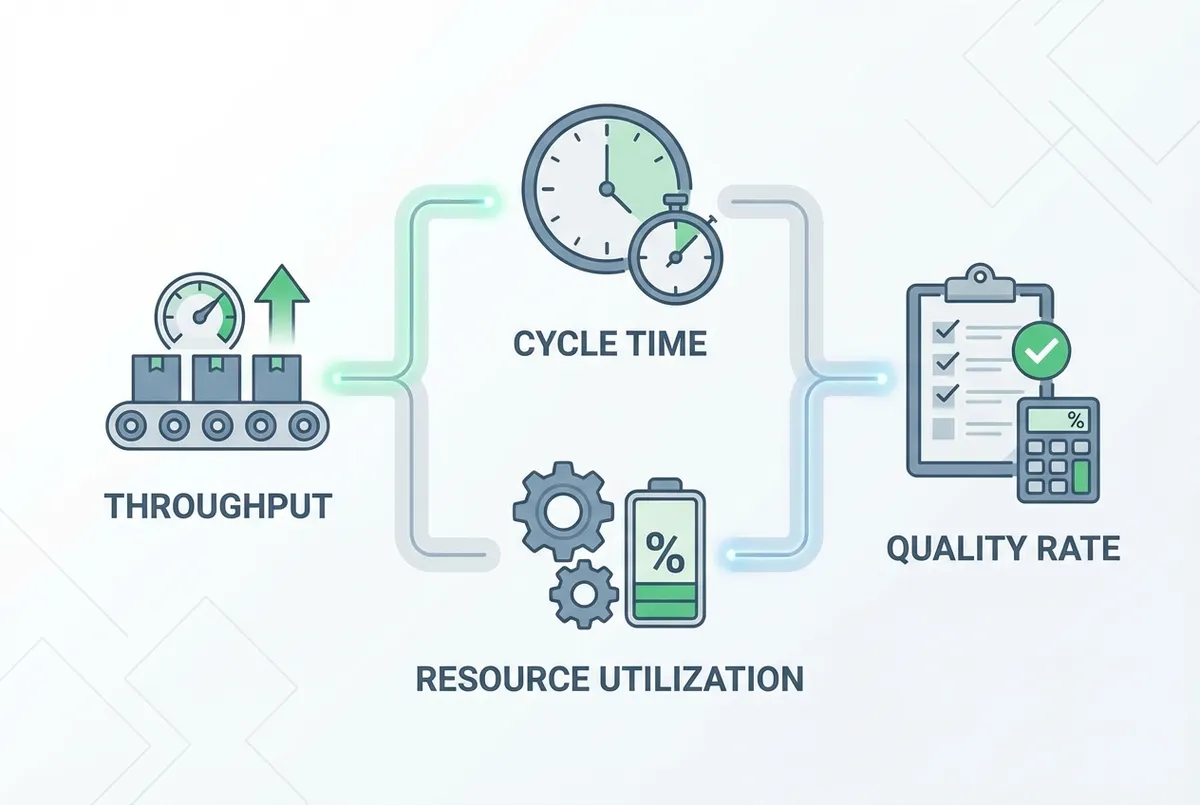
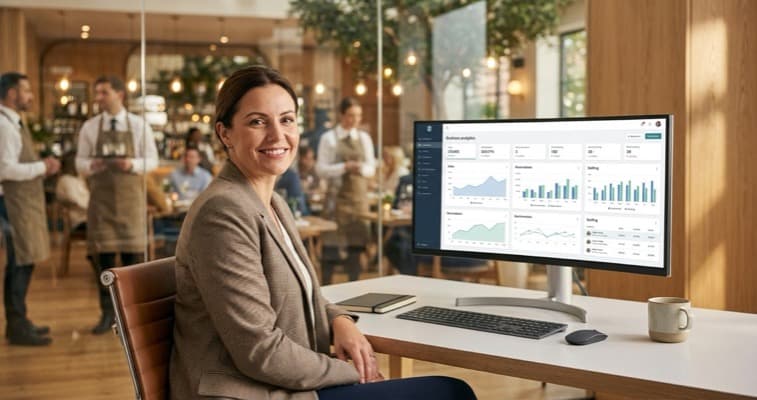
The five core restaurant efficiency metrics dashboard
| Metric | Formula | UK Benchmark |
|---|---|---|
| Labour Cost % | (Labour Costs / Revenue) x 100 | 25-35% |
| Table Turnover | Covers / Tables | Lunch: 1.5-2.5, Dinner: 1.2-1.8 |
| RevPASH | Revenue / (Seats x Hours) | £8-15/seat/hour |
| Food Cost % | (COGS / Food Sales) x 100 | 28-35% |
| Kitchen Output | Covers / Kitchen Hours | 6-10 covers/hour |
Benchmarks are industry rules of thumb for UK independent restaurants. Your targets may vary based on restaurant type, location, and pricing strategy.
1. Labour Cost Percentage
Labour is where most restaurant profit goes to die.
What it measures: Labour costs as a percentage of total revenue
Formula: (Total Labour Costs / Total Revenue) x 100
UK Benchmark: 25-35% for full-service restaurants
Labour is your biggest controllable cost. Most restaurant owners know roughly what they spend on staff, but tracking restaurant efficiency metrics like labour cost percentage reveals patterns invisible in raw numbers.
Moreover, that percentage tells you if you're overstaffed for quiet periods or understaffed during rush times. Consistently high labour costs mean you're either paying too much, scheduling badly, or not generating enough revenue per staff hour.
For example, a gastropub running acceptable labour cost on Fridays but excessive cost on Tuesdays might reduce Tuesday shifts or run a "Tapas Tuesday" promotion to boost revenue without adding labour.
Watch for sudden jumps
If you can't immediately explain why your labour cost jumped significantly in one week that's usually a sign you're reacting to staff shortages by overscheduling rather than fixing the root cause.
That said, tracking percentages sounds like one more task added to an already overwhelming week.
If you're reading this thinking "I don't have time to calculate percentages every week", you're not alone. The reality for most independent restaurants is that tracking efficiency happens in stolen moments between service. Start with one metric. Track labour cost percentage weekly. Once that becomes automatic, add another.
Here's how to actually implement labour cost tracking.
What action looks like:
- Track weekly labour costs vs weekly revenue
- Compare percentages across different days
- Adjust rotas before scheduling next week
2. Table Turnover Rate
So you've got labour costs under control. But if your tables sit empty or turn too slowly you'll always lose to competitors who fill seats faster.
What it measures: How many times each table serves customers during a service period
Formula: Total Covers Served / Number of Tables
UK Benchmark:
- Lunch service: 1.5-2.5 turns per table
- Dinner service: 1.2-1.8 turns per table
Table turnover directly impacts revenue capacity. You can't increase your table count without moving premises, but you can serve more customers with the tables you have.
However, low turnover isn't always bad. Fine dining expects 1-1.2 turns because the experience takes time. But if you're running a casual dining spot and averaging 1.1 turns on a Saturday night, you've got a bottleneck somewhere.
So where are those bottlenecks? Usually one of these four culprits.
Common bottlenecks:
- Slow kitchen output (customers wait too long for food)
- Poor table management (empty tables stay empty)
- Long payment processing (customers wait for the bill)
- Unclear booking policies (tables reserved but not filled)
For example, a pizza restaurant noticed Friday turnover had dropped significantly. The issue wasn't kitchen speed; it was payment processing. Customers waited too long for card machines. They switched to mobile payment terminals at each table and turnover recovered within two weeks.
Info
3. Revenue Per Available Seat Hour (RevPASH)
Table turnover tells you how often seats fill. RevPASH tells you if those filled seats are actually making money.
What it measures: How much revenue each seat generates per hour it's available
Formula: Total Revenue / (Number of Seats x Hours Open)
UK Benchmark: £8-15 per seat hour for casual dining
RevPASH shows whether you're maximising the earning potential of your space. It accounts for both seat utilisation and average spend, making it more useful than simple occupancy rates.
For example, a cafe calculated low RevPASH on quiet Tuesdays versus strong performance on Fridays. Rather than staying open all day Tuesday for minimal return, they reduced Tuesday hours and focused promotional efforts on the midday window when customer density was highest. Tuesday RevPASH improved significantly.
This sounds great in theory. In practice, when you're down two staff on a Wednesday and trying to prep for a private booking on Thursday, calculating seat hours feels irrelevant. The question isn't "should I track this?" It's "what's the easiest way to track this without adding another spreadsheet to my life?"
4. Food Cost Percentage
You can optimise labour and maximise table turnover but if your food costs are bleeding profit you're still losing money.
What it measures: Food costs as a percentage of total food sales
Formula: (Cost of Goods Sold / Food Sales) x 100
UK Benchmark: 28-35% depending on restaurant type
Food cost percentage tells you if your menu pricing is sustainable. According to UK Hospitality industry research, anything above 35% means either portion sizes are too generous, ingredient costs have risen without menu price adjustments, or waste is eating your margin.
Track this weekly. Not monthly. Monthly tracking means you don't notice the problem until you've lost four weeks of profit.
For example, a burger restaurant noticed food cost jumped significantly over two weeks. They tracked it back to a supplier price increase on beef that they hadn't passed on to menu prices. A small menu price adjustment on beef items returned food cost to acceptable levels within a week.
Watch for these warning signs that food cost needs attention.
Red flags:
- Food cost suddenly jumps without ingredient price changes - Check for waste or theft
- Food cost drops too low - Portions might be too small; customers notice
- If you can't explain why your food cost jumped 5% in a single week that's usually a sign of portion inconsistency or inventory tracking problems
5. Kitchen Output Per Labour Hour
You've tracked labour cost, table turnover, seat revenue, and food cost. The final piece is kitchen productivity.
What it measures: How many dishes your kitchen produces per hour of labour
Formula: Total Covers Served / Total Kitchen Labour Hours
UK Benchmark: 6-10 covers per kitchen labour hour
This metric separates efficient kitchens from inefficient ones. Higher output means you're getting more covers per hour of labour investment.
To illustrate, a Thai restaurant noticed kitchen output dropped significantly over three months. The culprit wasn't staffing; it was menu complexity. They'd added many new dishes requiring unique prep. They streamlined the menu to core dishes and output recovered. Same staff, better productivity.
Several factors can slow kitchen output beyond staffing levels.
What impacts kitchen output:
- Menu complexity (more dishes = more prep time)
- Equipment condition (broken or slow equipment kills productivity)
- Kitchen layout (poor flow adds unnecessary steps)
- Staff experience (new team members slow output temporarily)
Why this matters
A restaurant efficiency metric like kitchen output per labour hour reveals whether productivity problems stem from menu design, equipment, or staffing, before those problems tank your profit margin.
How to Track Restaurant Efficiency Metrics Without Spreadsheets
You know what matters. Now here's how to actually track it when you're running a restaurant, not managing a spreadsheet business.
The biggest barrier to tracking efficiency isn't the metrics themselves. It's the time required to collect data, calculate percentages, and spot trends.
Note
Most restaurant owners start with good intentions. They build a spreadsheet. Track metrics for two weeks. Then service gets busy, the spreadsheet gets forgotten, and six months later they're back to guessing.
Here are three realistic approaches that actually work.
Daily Snapshot Method (10 minutes per day)
The simplest approach requires just three numbers.
Track three numbers every day:
- Revenue
- Labour hours worked
- Covers served
At the end of the week, calculate:
- Labour cost percentage
- Revenue per labour hour
- Average covers per day
In practice, a small restaurant owner writes three numbers in a notebook each night before leaving. On Sunday, they spend a few minutes calculating the week's averages. No software required.
Weekly Review Method (30 minutes per week)
If daily tracking feels like too much, try weekly tracking instead.
Once weekly, sit down with:
- Till receipts (revenue)
- Rota (labour hours and costs)
- Booking system (covers served and table turns)
- Supplier invoices (food costs)
Calculate the five core restaurant efficiency metrics. Track them on a simple weekly log. Look for patterns: "Labour cost spiked on Tuesday. Why? Bank holiday Monday meant fewer customers but same staffing."
As an example, a gastropub owner blocks out Sunday afternoon every week. They pull the data, calculate the five restaurant efficiency metrics, and write them in a simple table. If something looks wrong they investigate immediately rather than discovering the problem a month later.
Monthly Benchmark Check (1 hour per month)
Once you've got weekly tracking down, add this monthly review.
Compare your weekly averages to industry benchmarks. If you're consistently outside the range (e.g., 38% labour cost when the benchmark is 25-35%), investigate. One week at 38% might be an anomaly. Four weeks at 38% is a systemic issue.
To get started this week, audit your restaurant efficiency metrics:
This week's audit checklist
- Day 1-2: Calculate current labour cost percentage and food cost percentage using last week's data
- Day 3-4: Track table turnover for one busy service and one quiet service to establish your baseline
- Day 5-7: Set up a simple weekly tracking system (even a notebook works) to record the three core numbers (revenue, labour hours, covers)
The restaurants that track efficiency aren't the ones with the fanciest systems. They're the ones that track something consistently, every week, without fail.
The same weekly habit pays off on the marketing side too, where automated weekly reports surface how your promotions and local visibility are trending without adding another spreadsheet.
Restaurant Efficiency Metrics by Restaurant Type
Now that you've got tracking systems in place, here's where priorities differ. The five core restaurant efficiency metrics apply to every restaurant, but which ones matter most depends on your format.
Fast Casual & QSR
Speed and volume drive fast casual success, so these metrics matter most.
Priority metrics:
- Kitchen output per labour hour
- Labour cost percentage
- Average transaction value
Fast casual relies on volume. If kitchen output drops, revenue drops. Labour must stay lean because margins are tight. Track daily.
Full-Service Casual Dining
If you're running full-service rather than fast casual, the priorities shift slightly.
Priority metrics:
- Table turnover rate
- Food cost percentage
- RevPASH
Casual dining balances speed with service. Too slow, and you're leaving revenue on the table. Too fast, and service quality suffers. Track weekly.
Fine Dining
Fine dining operates differently again, with lower turnover but higher average spend.
Priority metrics:
- Food cost percentage
- Labour cost percentage
- Average spend per cover
Fine dining accepts lower table turnover because average spend is higher. Efficiency comes from food cost control and ensuring labour cost justifies the service level. Track monthly.
Common Restaurant Efficiency Metrics Mistakes
Knowing what to track matters. But most restaurants fail because they make one of these three mistakes.
Mistake 1: Tracking Everything, Changing Nothing
The first mistake is collecting data but never using it.
Measuring restaurant efficiency metrics without acting on them is pointless. If your labour cost percentage has been 40% for six months and you haven't changed rotas, cut shifts, or found ways to boost revenue, you're not managing efficiency; you're just documenting failure.
Fix: Pick one metric. Track it for two weeks. Make one change based on what you find. Measure again. Repeat.
Mistake 2: Comparing Your Metrics to Chain Restaurants
Even if you're tracking consistently and taking action, comparing yourself to the wrong benchmark kills motivation.
Independent restaurants don't have the buying power, economies of scale, or centralised systems that chains use to hit low food cost or high table turns consistently.
Your benchmark isn't McDonald's. It's other independent restaurants in your area, running similar formats, with similar constraints.
Instead, fix: Use industry benchmarks as guides, not absolutes. If you're within the recommended range, you're fine. If you're significantly outside it, investigate.
Mistake 3: Ignoring Seasonal Variation
You're tracking the right metrics, comparing them correctly, but then panic when numbers shift month to month.
Restaurant efficiency metrics fluctuate seasonally. December might deliver strong turnover and acceptable labour cost. January might show weaker performance. That's normal.
The mistake is comparing January to December and panicking. Compare January this year to January last year. Seasonal businesses need seasonal comparisons.
Therefore, fix: Track year-on-year changes, not month-to-month changes.
Weekly Action: Start Tracking One Metric
With those common mistakes avoided, here's the simplest path forward. If you're reading this after a 12-hour shift and thinking "this all sounds useful but I don't have time", start with one metric.
If you run a restaurant and want to see how Local Brand Hub can support your marketing, explore our restaurant marketing tools.
Start here
Pick labour cost percentage. It's the easiest to calculate and the biggest cost you control.
Track it weekly for one month. See what patterns emerge. Then add table turnover. Then food cost.
Consider this real example:
- A casual dining restaurant in Manchester started tracking only labour cost percentage
- Within four weeks, they noticed Tuesday and Wednesday were running excessive labour costs
- They adjusted the rota, reducing those days from four front-of-house staff to three
- Labour cost dropped into the acceptable range: same service quality, better profitability
- Once that became automatic, they added table turnover tracking
Ultimately, efficiency metrics aren't about perfection. They're about progress. Track one thing. Improve one thing. Then move to the next.
Before you start, ask yourself: Can you name your current labour cost percentage without looking it up? If not, you're managing by feeling rather than data, and that's when profit leaks happen.
This week:
- Calculate labour cost percentage for last week
- Write it down
- Calculate it again next week
- Compare
That's it. No dashboard required. No software needed. Just one number, tracked consistently, every week.
For UK restaurant owners
Keep the Marketing Side on Track
LocalBrandHub gives you a visibility score and a weekly marketing report, so you can watch the marketing side of these numbers without building spreadsheets.
See how it worksFrequently Asked Questions
Finally, here are the most common questions about tracking restaurant efficiency metrics.
What's the most important restaurant efficiency metric?
Labour cost percentage. It's your largest controllable expense and directly impacts profit margins. According to UK Hospitality, labour typically represents 25-35% of revenue for full-service restaurants, making it the most significant efficiency lever you control. Track it weekly to catch inefficiencies before they become systemic problems.
How do I improve table turnover without rushing customers?
This is the balance every restaurant struggles with: more covers without sacrificing service quality.
Focus on reducing wait times, not dining times. Speed up kitchen output, streamline payment processing, and improve table management. Customers don't mind a longer meal if they're not waiting ages for the bill. For instance, adding mobile payment terminals can cut payment wait time significantly without changing the dining experience.
Should I track efficiency metrics daily or weekly?
The tracking frequency matters as much as what you track.
Weekly for most metrics. Daily tracking creates too much noise: one quiet Tuesday skews everything. Weekly averages smooth out daily variation and reveal actual trends.
What food cost percentage should I aim for?
Food cost varies by restaurant type, but here's the general range.
Most UK restaurants should target 28-35% for restaurant efficiency metrics related to food costs. Fine dining can run lower due to higher menu prices. Casual dining with competitive pricing might run higher. Above 35%, investigate portion sizes, waste, or supplier costs.
How can I reduce labour costs without cutting staff?
You can lower labour costs through better efficiency rather than fewer people.
Improve scheduling efficiency. Match staffing levels to actual demand rather than guessing. Cross-train team members so you need fewer specialists. Focus on revenue per labour hour, not just total labour cost. For example, training front-of-house staff to prep simple starters can reduce kitchen staffing needs during quiet periods.
Get More Marketing Tips
Practical marketing tips for UK business owners, straight to your inbox. No spam, unsubscribe anytime.
About the Author
Local Brand Hub
Empowering UK Businesses
Local Brand Hub provides comprehensive business management tools designed specifically for UK local businesses to streamline operations, automate marketing, and grow revenue.
More articlesRelated Articles
 Tutorials
Restaurant Tech Stack: UK Integration Guide
Build a restaurant tech stack that works together. Covers the five essential systems, integration priorities and realistic costs for UK independents.
 Tutorials
Restaurant Opening: UK Checklist and Timeline
Plan your restaurant opening with our 16-24 week UK timeline, essential checklist, licences guide, and biggest mistakes to avoid.
 Industry Insights
All-in-One Restaurant Software: UK Comparison
Compare all-in-one restaurant software for UK venues. See top platforms, UK pricing, and what to look for when choosing an integrated system.