
The 12 restaurant performance metrics UK operators actually use: how to calculate prime cost, covers, cash days and repeat visits, without fake benchmarks.
A full room is a fact about tonight. Restaurant performance metrics tell you whether it is also a fact about March's rent: prime cost, spend per head, covers, cash days and repeat visits. This guide covers the 12 numbers that matter for UK independents, and the weekly rhythm that keeps them honest.
Related: Restaurant KPIs: the complete guide, the hub this article sits under, covering every metric family in more depth.
Saturday, 9pm. A queue past the window, the pass in full flight, the card machine still warm when you lock up. On nights like that the business feels safe. Then Tuesday: rent leaves the account, payroll lands, the meat supplier's direct debit follows, and the balance sits lower than it did this time last month. Nothing about Saturday warned you, because Saturday only ever tells you about Saturday. The twelve numbers in this guide are how you hear from Tuesday early.
What Are Restaurant Performance Metrics?
Restaurant performance metrics are the small set of recurring measurements that connect what happens in your room (covers, spend, turns) to what happens in your bank account (margin, cash, survival). They exist to answer one question early: is this busy week building a business, or just burning stock and staff faster?
The margin for error keeps shrinking. UKHospitality put the extra costs that landed on the sector in April 2025 at £3.4bn (UKHospitality, Quarterly Members' Survey). Wages are the biggest single line for most operators, and the National Living Wage rises again to £12.71 an hour from 1 April 2026 (GOV.UK). When every input gets dearer at once, the operator who spots a two-point drift in week two beats the one who finds it in the quarterly accounts.
One warning before the list. Most benchmark tables online are US rules of thumb with the dollar signs swapped for pounds. This guide takes a different route: real formulas, honest worked examples, and named UK operators whose numbers are on the public record.
Which 12 Restaurant Performance Metrics Should You Track?
The 12 metrics worth a UK independent's time sit in four families: money, seats and service, cash, and guests. Together they cover profit, capacity, liquidity and loyalty, the four ways a restaurant quietly goes wrong.
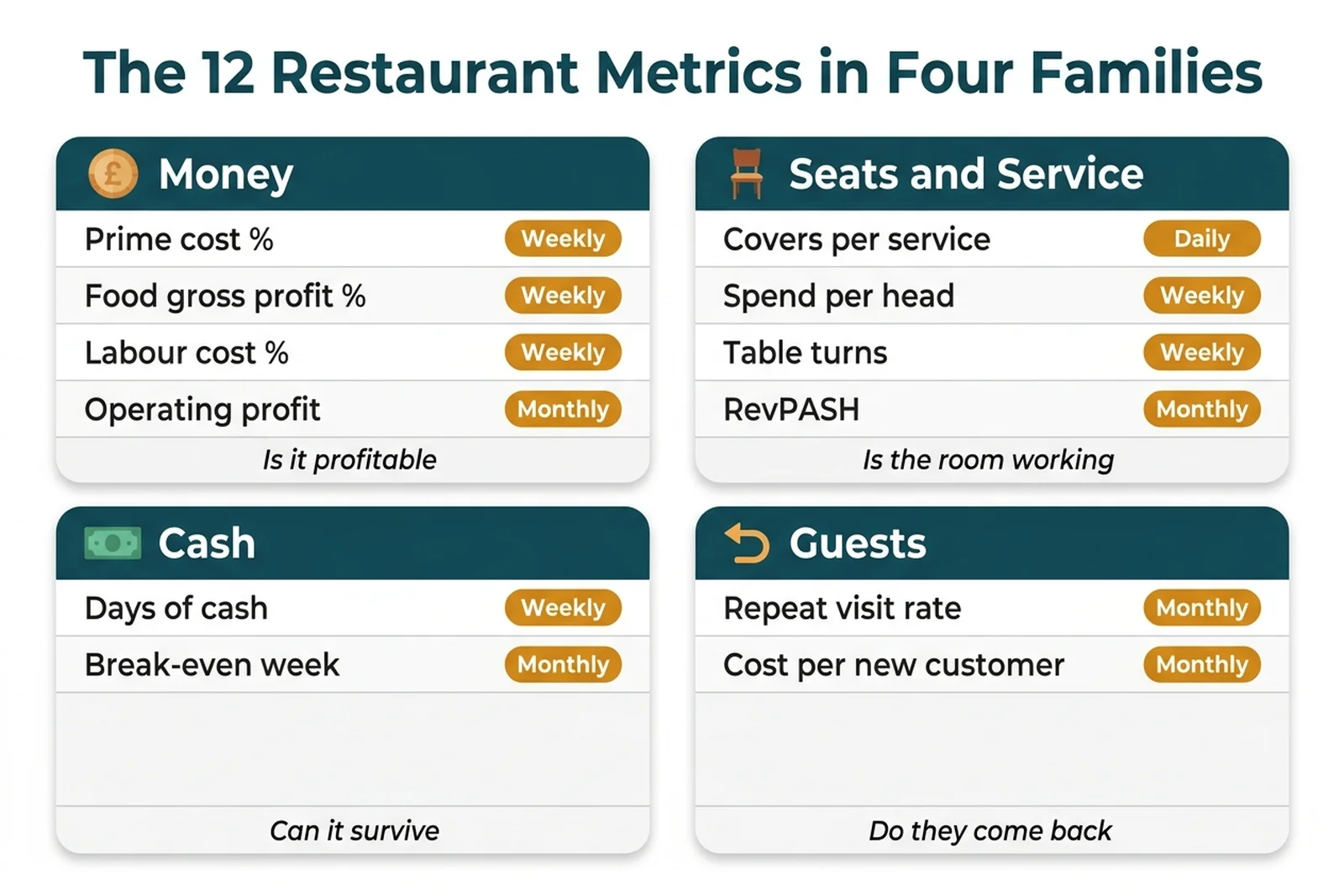
Twelve numbers, four families. If a metric never changes a decision (table turns in a bookings-led room, for instance), it is decoration, not measurement.
| # | Metric | Family | What it tells you | Check |
|---|---|---|---|---|
| 1 | Prime cost % | Money | Room left after food plus labour | Weekly |
| 2 | Food gross profit % | Money | How purchases convert into margin | Weekly |
| 3 | Labour cost % | Money | Whether the rota fits your trade | Weekly |
| 4 | Operating profit margin | Money | What is left after every cost | Monthly |
| 5 | Covers per service | Seats and service | Raw demand, service by service | Daily |
| 6 | Spend per head | Seats and service | Menu design and upselling in one | Weekly |
| 7 | Table turns per service | Seats and service | Seat productivity while open | Weekly |
| 8 | Revenue per available seat hour | Seats and service | Room earnings across the week | Monthly |
| 9 | Days of cash on hand | Cash | Survival time if takings stopped | Weekly |
| 10 | Break-even week | Cash | Takings level where losses stop | Monthly |
| 11 | Repeat visit rate | Guests | Whether tonight's guests come back | Monthly |
| 12 | Cost per new customer | Guests | True marketing cost of a first visit | Monthly |
Treat the check column as a rule of thumb; the right cadence varies with your service pattern.
Twelve is a ceiling, not a starting line. Begin with five and add the rest once the habit sticks.
What Are the 5 Key Performance Indicators for a Restaurant?
If you only track five KPIs, make them prime cost percentage, average spend per head, covers per service, days of cash on hand and repeat visit rate. One profit number, two demand numbers, one survival number, one loyalty number. The other seven metrics in this guide refine these five; they never replace them.
Those five are not a rival list to the twelve above. They are rows 1, 5, 6, 9 and 11 of the same table, chosen because each comes straight from your POS, bank and booking system, and each changes a decision within the week.
For example, prime cost decides the rota and the menu. Covers and spend per head decide promotions. Cash days decide whether the new fryer waits. Repeat rate decides where the marketing budget goes.
For how the wider set fits together, see our guide to measuring restaurant performance.
The Money Metrics: Prime Cost, Margins and Operating Profit
Prime cost percentage sits at the top of the starter five because it moves before anything else when trade shifts: it is food and drink purchases plus total labour, divided by revenue, over the same period. Labour means the true UK cost: wages plus employer National Insurance and pension contributions, not just what appears on the rota. Labour cost percentage on its own is that same labour figure divided by revenue.
Gross profit percentage is revenue minus cost of sales, divided by revenue, and it is worth calculating food cost and drinks separately because they behave differently. Operating profit margin is the fourth money number: what remains after every cost, rent and overheads included, divided by revenue. It moves slower than the weekly pair, which is why the table has it as a monthly check.
Imagine a 60-seat bistro taking £13,000 in a week. Food and drink purchases cost £4,200, and the wage bill, including employer National Insurance and pension contributions, comes to £4,500. Add those together and prime cost lands at 67% of revenue. Whether that is survivable depends on the rent. The owner now has one number to push on: two points off purchases through tighter ordering, or a Tuesday rota trimmed by one shift, and the picture changes.
Notice what that example does not do: quote a magic target percentage. Your ceiling depends on your rent, your concept and your council's parking policy. What transfers is measuring the same way every week and interrogating the trend. Our guide to labour cost percentage covers the wage side, including where the rota fat usually hides.
The sharpest operators design the menu so the money metrics behave before anyone opens a spreadsheet. Flat Iron built its model on one overlooked cut, launching with high quality steak at £10 (Piper). By the time investor Piper backed the group, four London sites were selling more than 10,000 flat iron cuts a week (Piper). One hero product means concentrated purchasing power, minimal waste and a kitchen that runs on repetition. That is a food cost strategy wearing a menu's clothes.
Scale does not change the logic, it proves it. Pizza Pilgrims reported site-level EBITDA margins over 20%, on like-for-like sales still growing, in its 2025 update (Restaurant Online, 2025). Margins like that are built dish by dish and rota by rota, which is what metrics 1 to 4 exist to police.
The Seats and Service Metrics: Covers, Spend and Turns
Every money metric above had revenue as its denominator; these are the numbers that build that revenue. Covers per service is a straight count from the POS. Average spend per head is revenue divided by covers. Table turns per service is covers in a single service divided by available seats. The time basis matters: a turnover figure without a stated period cannot be compared with anything, including your own last month.
Picture that same 60-seat bistro on a Friday night. It serves 90 covers between 5pm and 11pm, so the room turned 1.5 times that service. Saturday lunch does 45 covers, a 0.75 turn. Neither number is good or bad on its own. The question is what the same service did last month, and whether the £26 spend per head on Friday could be £29 with a better dessert list.
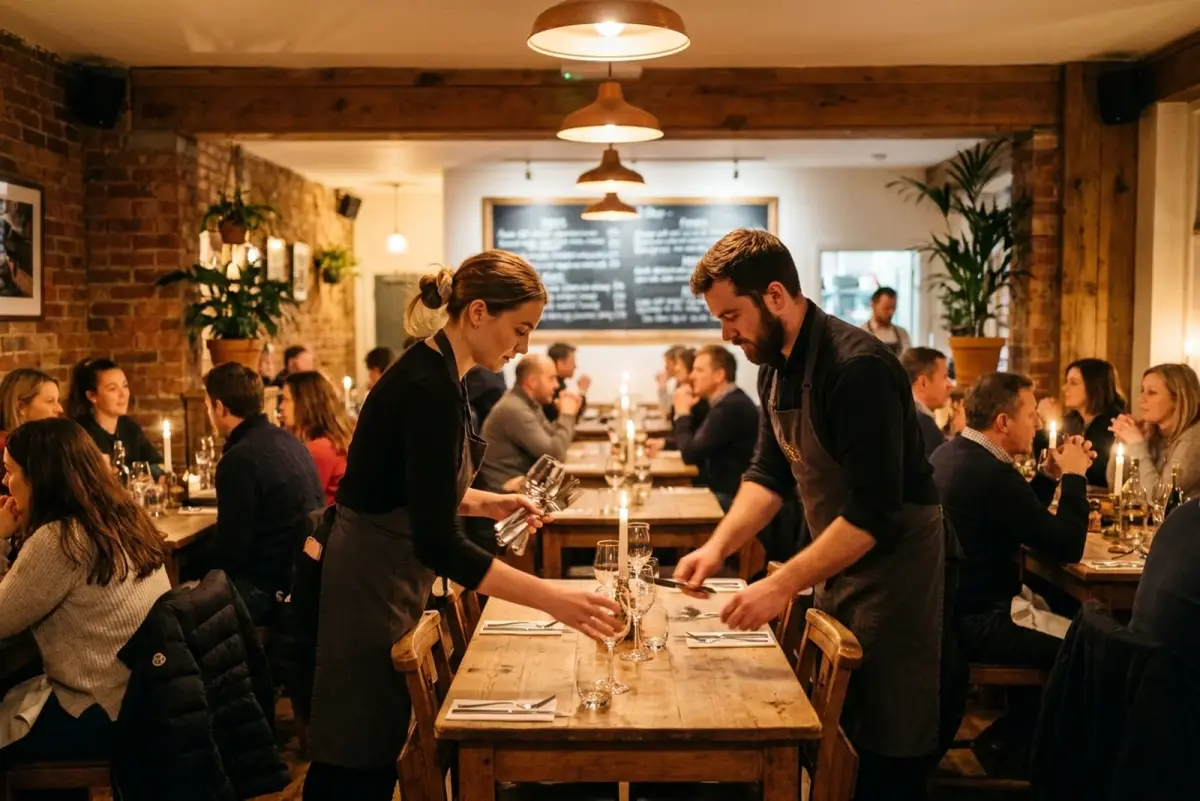
Turns and spend per head are set in the room: the pace of the pass, the reset time, the second drink offered or not.
Revenue per available seat hour (RevPASH) rolls demand, pricing and opening hours into one figure: total revenue divided by seats times open hours. Its real use is exposing hours you are open out of habit. If Monday lunch earns a tenth of what Friday dinner earns per seat hour, that is a rota conversation.
Capacity numbers are also the earliest warning that a concept is working. Fallow in London went from pop-up to an operation employing 300 people and serving up to 1,000 covers a day in under two years (City A.M.). Nobody scales like that by watching the P&L alone; covers, turns and spend per head move first, weeks before the accounts catch up. Our guide to restaurant sales metrics goes deeper on reading demand signals.
Why Does Cash Flow Deserve Its Own Metrics?
You will often read that cash flow kills more restaurants than bad food does. No official body counts failures by cause, so treat that line as folklore.
What the public record does show is bracing enough: accommodation and food service businesses accounted for 3,233 company insolvencies in England and Wales in the 12 months to June 2026. That is around 14% of cases where an industry was recorded (The Insolvency Service, 2026). Zoom out and the ONS finds that only 38.4% of UK businesses born in 2019 were still trading five years on (ONS, Business demography 2024). Watching cash weekly does not beat those odds by itself, but you will see trouble while it is still negotiable.
Two numbers do most of the work. Days of cash on hand is money available now divided by average daily outgoings. Break-even week is the takings level at which contribution covers fixed costs: work it out by dividing your fixed weekly costs by your contribution margin, the share of each pound of takings left after food, drink and variable labour. It moves whenever rent, energy or the wage floor moves, so recalculate it after every cost change.
Say the bistro holds £12,800 across its accounts and spends £1,600 on an average day once rent, stock, wages and VAT are smoothed out. That is eight days of cash. Not a crisis on a good week, but one broken glasswasher and one slow fortnight away from being one. The owner who knows the number is eight can plan; the owner who has never done the sum finds out from a bounced supplier payment.
How much cushion is enough? Enough that a quiet fortnight is an annoyance rather than an emergency. The precise figure hangs on your rent day, VAT quarter and payroll dates, which is a conversation for a qualified accountant; the habit that generalises is knowing your number and its direction every week. The strongest operators build the cushion into strategy: Pizza Pilgrims told trade press that, with minimal debt, new site expansion would be almost entirely self-funded from cash flow (Restaurant Online, 2024). You may never open a second site, but running one site so that growth could be self-funded is a fine definition of financial health.
The Guest Metrics That Predict Repeat Business
Cash buys you time; guests decide what the time is worth. Repeat visit rate is the share of this period's guests who have been before. Without a big CRM you can still get a usable read: booking-system history, loyalty card stamps, or your card acquirer's returning-customer reporting all give a workable proxy. Pick one method and stick with it; a consistent proxy beats a perfect number you calculate twice a year.
Cost per new customer is your marketing spend divided by the new guests it produced. Here is where the old folk rule falls over: comparing that cost to a first visit's bill. A first visit's takings are not profit; the fair comparison is the margin a new guest goes on to generate across every visit that follows.
Suppose the bistro spends £240 on local ads in a month and can trace 20 genuinely new tables to it: £12 per new customer. The average guest spends £27 a visit and contributes roughly £9 after food and labour. If a third of newcomers come back twice more that year, a newcomer who sticks is worth about £27 in margin over the year, and even averaged across the two-thirds who never return, each new customer is worth about £15. Suddenly £12 looks sensible. Judge acquisition against the relationship, not the receipt.
Guest metrics move slowest and decide most. A restaurant that holds spend per head, keeps prime cost steady and lifts its repeat rate by a few points has quietly rebuilt its economics without a single new cover.
How Do You Track Restaurant Metrics Without Drowning in Dashboards?
A tracking system survives if it costs less than 45 minutes a week and answers questions you actually have. The rhythm that works for most independents: money on Monday, room midweek, cash on Friday.
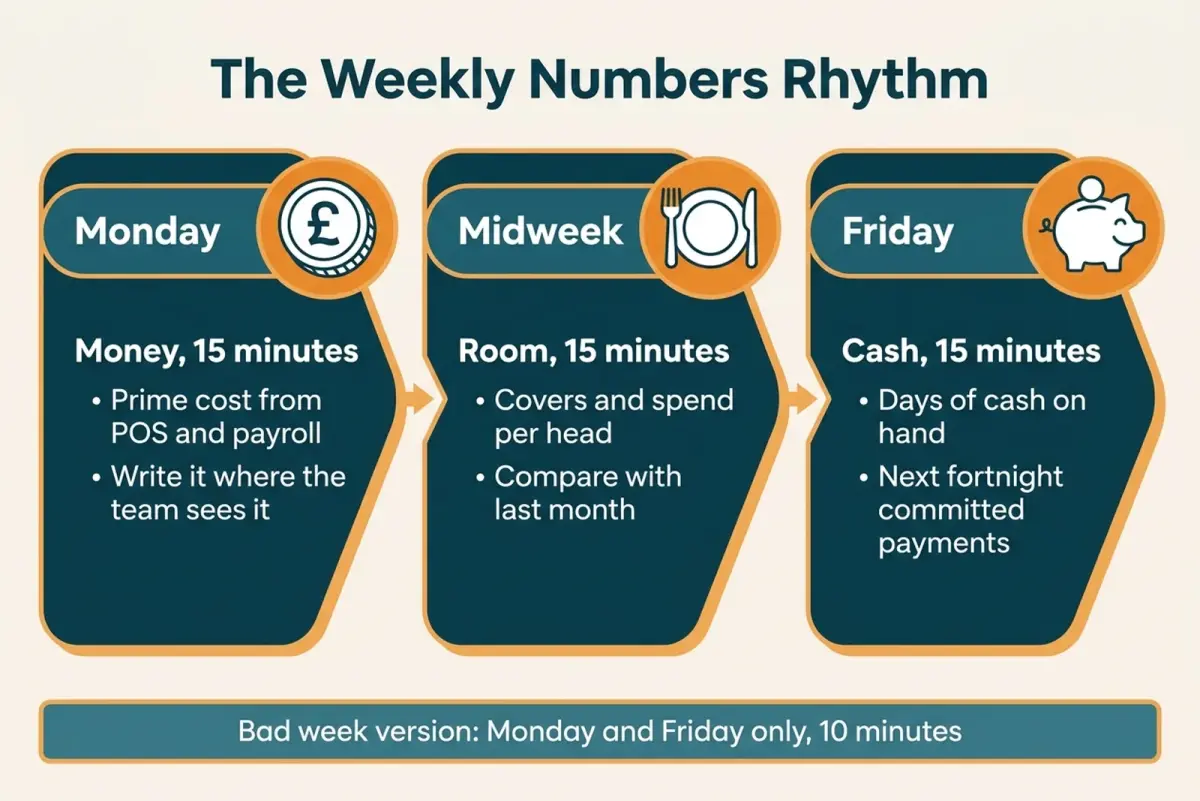
Three short sessions beat one heroic spreadsheet evening: fifteen minutes each on money, room and cash.
- Monday, 15 minutes: last week's prime cost from the POS and your rota or payroll system. One number, written where the team can see it.
- Midweek, 15 minutes: covers, spend per head and turns for the key services, against the same services last month.
- Friday, 15 minutes: bank balances, days of cash, and a glance at the next fortnight's committed payments.
People search for a restaurant performance metrics PDF, and the straight answer is to skip the printable pack, which ages the moment you export it. What you want is one page, rebuilt weekly, with the five starter KPIs and their four-week trend. A KPI dashboard earns its keep when it removes the copying and pasting, not when it adds nineteen charts you never open.
And for the week when a chef quits and the extractor fan dies on the same Tuesday, run the survival version: skip the midweek check but keep Monday's prime cost and Friday's cash. Ten minutes total. Those two numbers are the difference between a bad week and a bad week you did not see coming.
Frequently Asked Questions
What are the KPIs for restaurants?
A restaurant's KPIs fall into four families. Money metrics (prime cost, food gross profit, labour cost, operating profit) and seats and service metrics (covers, spend per head, table turns, RevPASH) cover profit and demand. Cash metrics (days of cash, break-even week) and guest metrics (repeat visit rate, cost per new customer) cover survival and loyalty. Start with one from each family rather than all twelve at once.
What are the four P's of a restaurant?
The four P's are the classic marketing mix applied to hospitality. Product is the food and the experience; price is what you charge and the value guests perceive; place covers site, room and delivery channels; promotion is how new guests hear about you. They are a planning lens rather than performance metrics. Attach one number from your KPI set to each P: spend per head tests price, for example, and cost per new customer tests promotion.
What is a good food cost percentage for a UK restaurant?
There is no official UK benchmark, and the ranges quoted online are mostly US rules of thumb, so treat any single target with suspicion. Concepts differ too much for one number to serve them all. Measure your own percentage the same way each week, act on the trend, and check that prime cost as a whole leaves enough gross profit for rent, overheads and margin. Our restaurant benchmarks guide covers building comparisons that mean something.
What is RevPASH and is it worth tracking for a small restaurant?
RevPASH is revenue per available seat hour: total revenue divided by seats multiplied by open hours. It shows whether the room earns across the whole week rather than just at Saturday peak. For a small independent, monthly is enough; its best use is testing one decision, such as trimming Monday hours, where the before-and-after comparison is clean.
How many days of cash should a restaurant keep on hand?
No regulator or trade body publishes a universal minimum, so be wary of articles that quote one. Know your current figure, check its direction weekly, and agree with your accountant what cushion your cost base needs around rent day, VAT quarters and payroll. A cushion measured in weeks gives you options; a cushion measured in days turns every quiet fortnight into a crisis.
Key Takeaway
The Numbers Are the Early Warning, Not the Verdict
Back to that Saturday queue past the window. It might be a great business; it might be a busy way to lose money. The twelve restaurant performance metrics in this guide exist so you know which one you are running while Tuesday is still negotiable.
Flat Iron counted cuts of steak, and Pizza Pilgrims counts cash it does not have to borrow. The bistro in our examples counts eight days of runway and a 67% prime cost it is about to argue with. None of them waits for the year-end accounts to find out how the story went.
Pick your five this week. Write Monday's prime cost where the whole team can see it, and let the first trend line settle before adding metric six.
LocalBrandHub helps independent UK restaurants turn weekly numbers into weekly actions, from covers to repeat visits: see how it works.
Guide reviewed and last updated August 2026. Figures cited are from the named public sources; treat every worked example as arithmetic to copy, not a benchmark to hit.
For restaurants, salons, and local businesses
Need help with your marketing?
We help UK businesses turn social media into real results, not busywork.
Start freeRelated reading: Restaurant KPIs · How to Measure Restaurant Performance · Restaurant Sales Metrics · Restaurant KPI Dashboard
Sources
- GOV.UK, Chancellor announces increase to the National Living Wage and National Minimum Wage
- The Insolvency Service, Company Insolvency Statistics June 2026
- Office for National Statistics, Business demography, UK
- UKHospitality, Quarterly Members' Survey
- Piper, Our Brands: Flat Iron
- Restaurant Online, Pizza Pilgrims to expand into Scotland and Wales
- Restaurant Online, Pizza Pilgrims looking to grow to 38 sites by 2027
- City A.M., Fallow founder James Robson: Labour is killing hospitality
Get More Marketing Tips
Practical marketing tips for UK business owners, straight to your inbox. No spam, unsubscribe anytime.
About the Author
Local Brand Hub
Empowering UK Businesses
Local Brand Hub provides comprehensive business management tools designed specifically for UK local businesses to streamline operations, automate marketing, and grow revenue.
More articlesRelated Articles
 Operations
Restaurant KPI Dashboard: Build One That Gets Used
Build a restaurant KPI dashboard on one screen: which tabs to make, how to pull numbers from your till and rota, and the Monday review that keeps it alive.
 Operations
Restaurant KPI Examples: 12 Metrics to Track
Twelve restaurant KPI examples UK operators track, with cited benchmarks, real cases from Flat Iron and Pizza Pilgrims, and a weekly tracking routine.
 Business Growth
Restaurant Key Performance Indicators: Track What Works
Track 5 restaurant KPIs: prime cost, food %, labour %, table turns, gross profit. Formulas, benchmarks, and templates included.