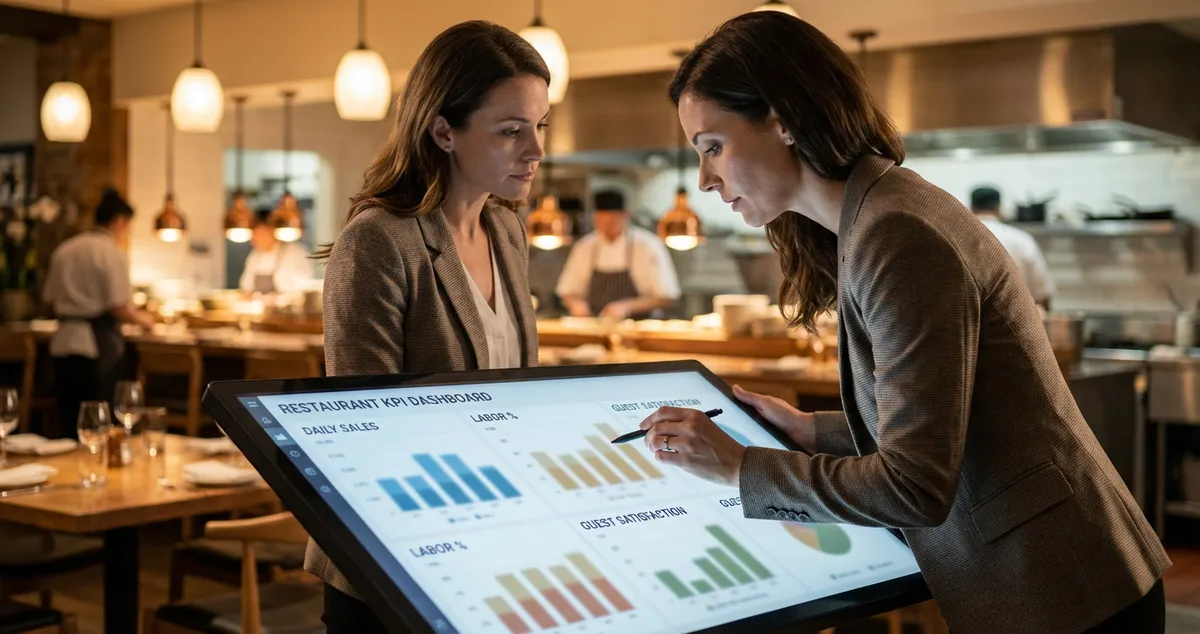
Twelve restaurant KPI examples UK operators track, with cited benchmarks, real cases from Flat Iron and Pizza Pilgrims, and a weekly tracking routine.
Monday morning, and the bar still smells of sanitiser. Fanned across the counter sits the weekend's paperwork: two curling till reports, a rota export, one supplier invoice with the turbot price circled in biro because it cannot be right. Everything that decides whether this restaurant is trading next spring is somewhere in that pile.
Most owners slide the pile into the office drawer and start on the prep list. The few who sit down with it first are the ones who catch a creeping food cost before it quietly eats a month of profit.
Restaurant KPI examples include food cost percentage, labour cost percentage, prime cost, net profit margin, covers per service, average spend per head, table turnover, food waste, staff turnover, sales per labour hour, hygiene rating and online review average. Track a handful weekly against your own baseline rather than borrowed targets; what counts as good varies by concept.
Related: Restaurant KPIs: The Owner's Guide
The stakes are not theoretical. Accommodation and food service businesses recorded 3,233 company insolvencies in England and Wales in the 12 months to June 2026, one of the highest counts of any industry (The Insolvency Service, 2026). Plenty of those kitchens served good food. Fewer of them knew their prime cost.
A key performance indicator is any number you track deliberately, on a schedule, because it changes a decision. This guide does three things. It names the twelve metrics worth your attention, shows how real UK operators use them, and gives you a tracking routine that costs nothing but a Monday morning.
What Are the KPIs for a Restaurant?
The KPIs for a restaurant fall into four groups: money (food cost percentage, labour cost percentage, prime cost, net profit margin), volume (covers per service, average spend per head, table turnover), efficiency (food waste, sales per labour hour, staff turnover) and reputation (hygiene rating, online review average). Twelve numbers, and your till, rota and inbox already hold most of the raw data.
| # | KPI | What it tells you | Where the number comes from |
|---|---|---|---|
| 1 | Food cost percentage | Menu pricing vs supplier prices | Food purchases and food sales |
| 2 | Labour cost percentage | Whether staffing matches trade | Payroll incl. employer costs, revenue |
| 3 | Prime cost | Both big controllable costs in one | Food, drink and labour vs revenue |
| 4 | Net profit margin | What is actually left at the end | Full profit and loss account |
| 5 | Covers per service | How busy you really were | Till or booking system |
| 6 | Average spend per head | How much each diner is worth | Sales divided by covers |
| 7 | Table turnover | Sittings per table per service | Booking system or floor plan notes |
| 8 | Food waste percentage | What you bought but binned | Waste log against purchases |
| 9 | Sales per labour hour | What each rota'd hour earns | Revenue divided by scheduled hours |
| 10 | Staff turnover | Whether people stay and get good | Leavers against average headcount |
| 11 | Hygiene rating | The inspection result diners check | Your local authority inspection |
| 12 | Online review average | Your reputation, quantified | Google and the booking platforms |
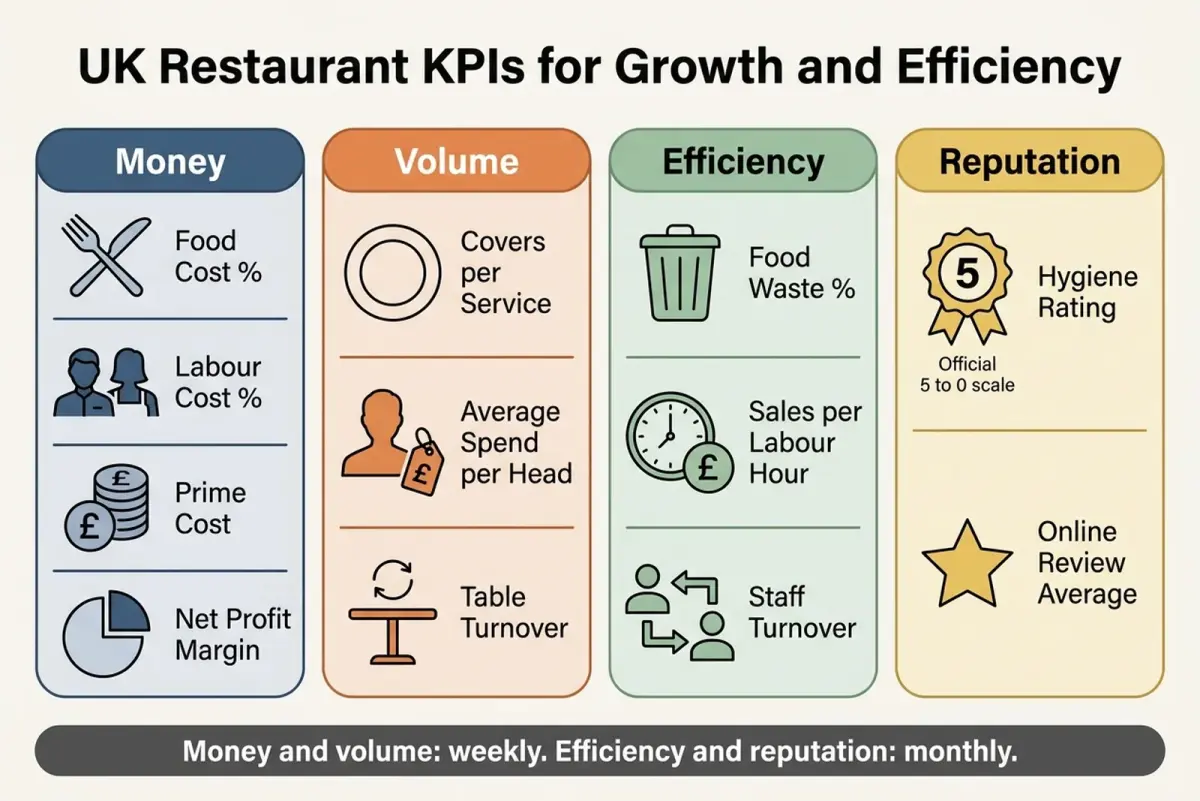
The twelve KPIs in four stacks: money and volume metrics need weekly eyes, efficiency and reputation metrics reward a monthly look.
Nobody needs to review twelve numbers every week, and nobody should try. The grouping exists so you can pick deliberately: money metrics weekly, volume metrics weekly, efficiency and reputation monthly. Food cost, for example, needs Monday eyes, while staff turnover only means something over a quarter.
Which Five KPIs Should You Track First?
Start with the two costs that can sink you, the one number that combines them, and the two that explain your revenue.
Food cost percentage is your food purchases divided by your food sales, multiplied by 100. There is no universal pass mark: the UKHospitality and Christie & Co benchmarking survey covered 54 companies running 4,791 licensed managed outlets (Restaurant Online, 2022), and found costs varying between market segments. Our restaurant food cost percentage guide covers the mechanics, including why theoretical and actual food cost drift apart.
Labour cost percentage is total payroll, including employer National Insurance and pension contributions, divided by revenue. The pressure on this number runs one way: the National Living Wage rises by 4.1% to £12.71 per hour for workers aged 21 and over from 1 April 2026 (GOV.UK, 2025). A rota built on last year's assumptions will read wrong by spring. There is a full breakdown in our restaurant labour cost percentage guide.
Prime cost adds food, drink and labour together and divides by total revenue. It is the single most useful line on the sheet because it captures nearly everything you can influence this week. The wider survey backdrop explains why it deserves respect: across all segments, average operating costs came to 55.2% of turnover before rent even entered the picture (UKHospitality and Christie & Co, 2022).
Average spend per head is sales divided by covers. When revenue dips, this number tells you whether fewer people came or the same people spent less, which are two different problems with two different fixes.
Covers per service is the raw count of diners, split by lunch and dinner, weekday and weekend. It turns "it felt quiet" into a fact you can compare with last month.
A warning from someone on your side: the first Monday you assemble these five will take a couple of hours of digging through invoices and rota exports. It gets faster every week after that. Anyone who promises you a complete KPI habit in a few spare minutes has never actually built the spreadsheet.
KPI Examples From Real UK Restaurants
You learn more about measurement from watching operators who are ruthless about it than from any list of definitions.
Flat Iron: one product, relentless throughput. The steak group simplified the KPI problem at the menu level. The concept was built around a single hero dish, a flat iron steak originally offered for £10 (Piper). By the time investor Piper backed the group, its four London sites were serving more than 10,000 flat iron steaks a week (Piper). With one hero product, food cost, waste and speed of service stop being abstractions; every number in the business hangs off how many steaks left the pass.
Pizza Pilgrims: profit measured where it is earned. Group accounts can flatter, so the pizza group talks about performance site by site. In its latest reported results it pointed to like-for-like growth of around 8% and an EBITDA margin at site level of over 20% (Restaurant Online, 2025). Site-level margin asks each restaurant to justify itself before head office costs blur the picture, which is exactly the discipline a single-site owner gets free of charge.
Fallow: volume with a labour bill to match. The London group has grown rapidly without private equity backing and employs over 300 staff across its sites (The Caterer). Co-founder James Robson has said that doing 750 covers in February would once have sounded like "no way", and that with a summer terrace doubling the site, "1,000 covers a day is coming" (Restaurant Online). At that scale, covers and sales per labour hour decide whether a 300-person payroll swallows the margin, so the volume KPIs stop being dashboard decoration and start being the operating model.
None of these operators found a magic metric. Each picked the numbers that matched their model and watched them until the numbers behaved.
How Do You Set Realistic KPI Targets?
Set restaurant KPI targets from your own baseline: record four weeks of data, take the average, and aim to improve one metric at a time from there. Survey figures and published benchmarks describe what other businesses achieved; they were never instructions, and copying them ignores your concept, your rent and your postcode.
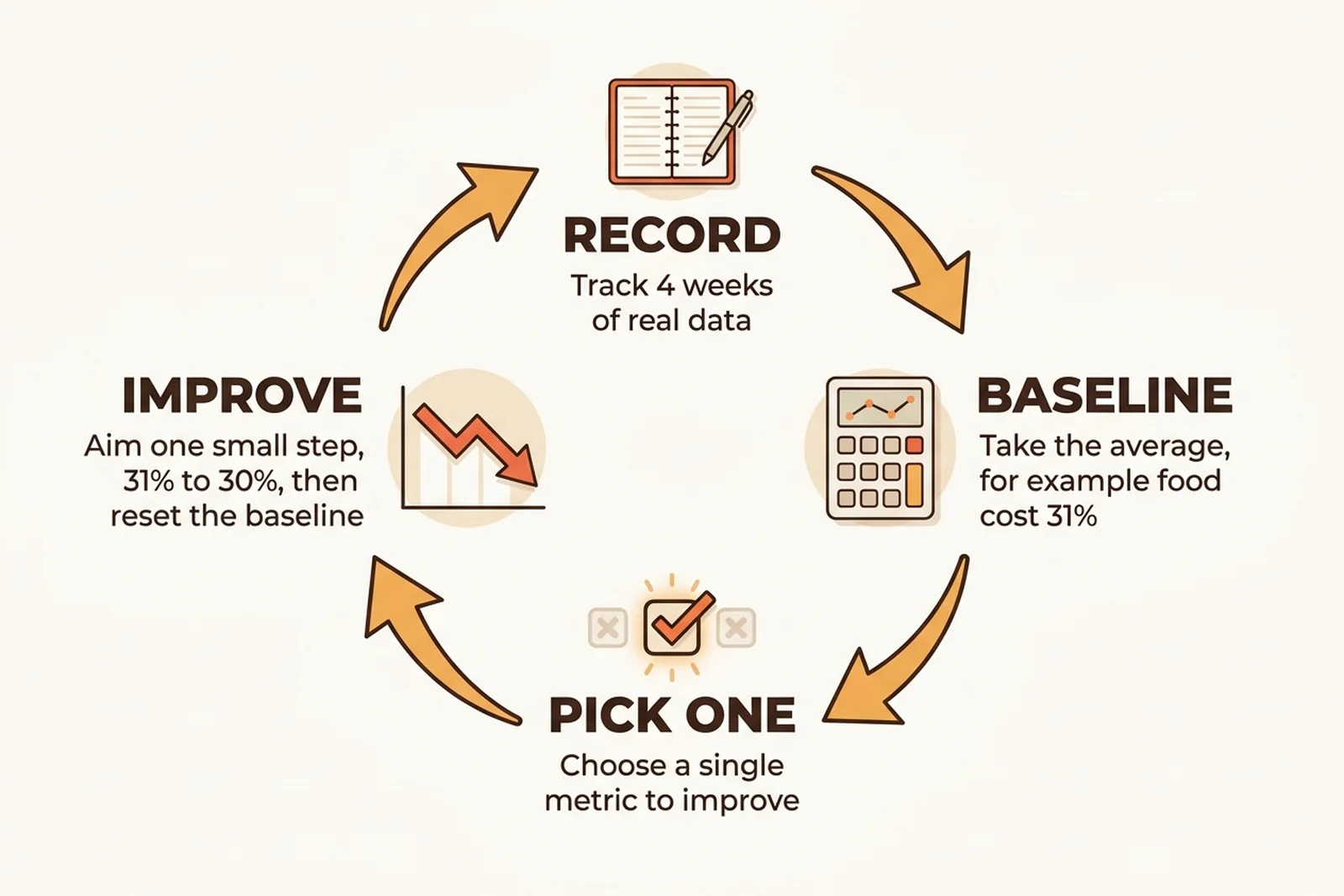
Targets built from your own baseline survive contact with reality; borrowed benchmarks rarely do.
Concept matters more than any table of targets. A tasting-menu room, for instance, may seat each table once an evening by design, while a fast-casual counter can turn the same table many times over lunch. A universal table turnover target would mislead both of them. The same logic applies to spend per head, service time and food cost. Compare yourself with your own last quarter before you compare yourself with an industry average.
One reputation KPI does come with an official scale. Under the Food Hygiene Rating Scheme in England, Wales and Northern Ireland, your business gets a rating from 5 to 0 (Food Standards Agency). Scotland runs its own Food Hygiene Information Scheme with a different result format, so a Glasgow bistro and a Bristol one are not reading the same scorecard. Either way, this is the one KPI where the only sensible ambition is the top of whatever scale you are on, because diners can check it before they book.
How Do You Track Restaurant KPIs Without Expensive Software?
A spreadsheet with seven columns will carry an independent restaurant a long way: week number, revenue, food purchases, labour cost, covers, then calculated food cost percentage and labour cost percentage. Fill it in on the same morning each week and the patterns start talking to you within a month.
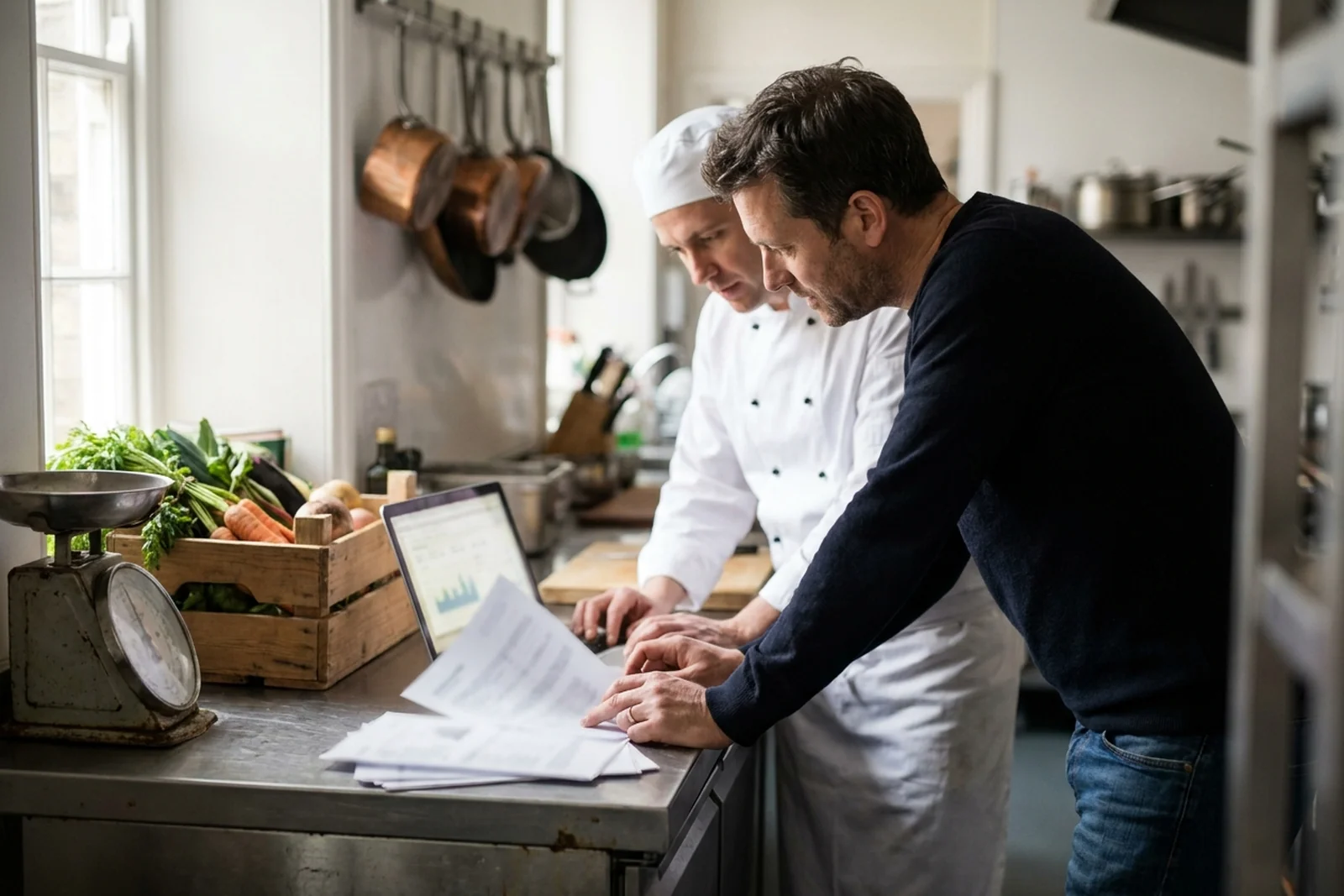
The Monday habit: one hour with the invoices, the rota export and the till report before the first delivery arrives.
Know what your till reports well out of the box, and where the numbers need your help. Sales, covers and average spend usually come straight from the standard reports. Food cost percentage is a different animal: the big till platforms do offer it, usually through a separate stock module, and the figure only means anything once recipes, portion sizes and current supplier prices have been entered and kept up to date. Either budget real setup time or keep food cost in the spreadsheet where you control the inputs. When you outgrow the spreadsheet, our restaurant KPI dashboard guide covers the step up without the sales pitch.
Pro tip: before you buy any tracking tool, ask the supplier to show you food cost percentage calculated live on their demo account. If the demo needs a caveat about recipes being set up first, you have just learned where your setup hours will go.
Picture the drift in practice. Imagine a 45-cover neighbourhood bistro whose owner starts the seven-column sheet in September. Covers hold steady around 480 a week for a month, yet food cost percentage climbs from 29% to 33%. Nothing on the menu changed, so the sheet points at the kitchen or the suppliers.
Weighing portions on the three best sellers finds the answer in ten minutes: a new chef has been reaching for the bigger ladle and serving the ragu a third heavy. Mark the correct ladle with a strip of tape, and the following week the number settles back where it started. That is the whole point of weekly tracking: the sheet cannot fix anything, but it tells you where to stand when you ask questions.
The KPI Mistakes That Cost Restaurants Money
Tracking everything, changing nothing. A dashboard of twenty metrics reviewed never is worth less than three metrics reviewed every Monday. Pick numbers you are genuinely willing to act on, and let the rest wait until you have the habit.
Confusing audience with revenue. Follower counts feel like progress and pay no invoices. If social media matters to your model, measure the part that converts, for example bookings from your profile links, and treat the rest as noise. Our restaurant social media marketing guide covers which numbers deserve the attention.
Reviewing monthly what moves weekly. By the time a monthly report shows food cost drifting, the drift has had four weeks to compound. Costs move at the speed of deliveries and rotas, so they need weekly eyes. Monthly reviews belong to the slow metrics: staff turnover, review averages, repeat trade.
Reading turnover ratios instead of the bins. A stock turnover ratio counts what leaves the stockroom, not whether it earned money on a plate or died in a bin bag, so heavy waste can hide inside a healthy-looking number. Fresh produce should move through the kitchen in days, and if the walk-in holds a fortnight of it, the KPI you actually need is a waste log. Count what you bin before you admire how fast stock moves.
Adopting borrowed targets. The published survey averages earlier in this guide describe other people's businesses, not yours. Use them to sanity-check your ballpark, and let your accountant give the cost lines a professional once-over before any figure gets promoted to a target on your sheet.
Frequently Asked Questions
What is the difference between COGS and food cost percentage?
Cost of goods sold covers everything you buy in to produce what you sell, including food, drink and sometimes packaging, and as a percentage it is measured against total revenue. Food cost percentage is narrower: food purchases against food sales alone. Track drinks separately, because wet margins behave differently and a good bar week can hide a bad kitchen week.
How do you calculate prime cost for a restaurant?
Add your food and drink costs to your total labour cost, divide by total revenue, then multiply by 100. There is no official UK target figure, and the survey actuals cited earlier show how much of turnover the cost lines already consume, so judge your prime cost by its trend. Steady or falling is healthy; creeping upward means one of its two ingredients needs a closer look that week, and the sheet will tell you which.
How often should you review restaurant KPIs?
Review cost KPIs weekly, on the same morning each week so the habit survives a busy patch. Problems with food and labour compound too fast for monthly reporting to catch them cheaply. Trend KPIs such as staff turnover, review averages and repeat visits earn a monthly look, when enough data has accumulated to mean something.
Do you need software to track restaurant KPIs?
No. The seven-column spreadsheet described above will serve a single site well, and it forces you to understand each number before any tool automates it. Check what your till system already reports before paying for anything extra, and remember that food cost percentage in any system is only as good as the recipes and supplier prices somebody keeps updated.
Which KPIs matter most for a small restaurant?
Food cost percentage, labour cost percentage and average spend per head give the fastest signal for the least effort, because together they explain most of the gap between busy and profitable. Add the two reputation numbers diners see before they see your food: your hygiene rating and your online review average. Five numbers, one morning a week, and you know more than most of your competitors.
Key Takeaway
Key Takeaways: Restaurant KPI Examples
- Twelve KPIs cover the whole business, in four groups: money, volume, efficiency and reputation. Nobody needs all twelve weekly.
- Start with five: food cost percentage, labour cost percentage, prime cost, average spend per head and covers.
- Real operators tie KPIs to their model: Flat Iron, for example, hangs every number off steaks through the pass, while Pizza Pilgrims measures margin site by site.
- Targets come from your own four-week baseline. Published averages are context, never pass marks.
- A seven-column spreadsheet and a protected Monday hour beat any dashboard you do not open. Our restaurant performance metrics guide goes deeper on reading the trends.
Want the tracking without the spreadsheet admin? LocalBrandHub's restaurant dashboard pulls your key metrics together and flags the drift before it costs you a month of margin. See how it works.
For restaurants, salons, and local businesses
Need help with your marketing?
We help UK businesses turn social media into real results, not busywork.
Start freeSources
- The Insolvency Service, Company Insolvency Statistics June 2026
- GOV.UK, Chancellor announces increase to the National Living Wage and National Minimum Wage, 2025
- UKHospitality and Christie & Co, Benchmarking Report
- Restaurant Online, Hospitality operators labouring under extreme pressure as costs soar
- Food Standards Agency, How food hygiene ratings work
- Piper, Flat Iron brand page
- Restaurant Online, Pizza Pilgrims results coverage, 2025
- The Caterer, Fallow hires managing director amid plans to expand chicken concept Fowl
- Restaurant Online, Fallow trio on Roe, their biggest restaurant project
Get More Marketing Tips
Practical marketing tips for UK business owners, straight to your inbox. No spam, unsubscribe anytime.
About the Author
Local Brand Hub
Empowering UK Businesses
Local Brand Hub provides comprehensive business management tools designed specifically for UK local businesses to streamline operations, automate marketing, and grow revenue.
More articlesRelated Articles
 Operations
Restaurant KPI Dashboard: Build One That Gets Used
Build a restaurant KPI dashboard on one screen: which tabs to make, how to pull numbers from your till and rota, and the Monday review that keeps it alive.
 Operations
Restaurant Performance Metrics: 12 KPIs That Actually Matter
The 12 restaurant performance metrics UK operators actually use: how to calculate prime cost, covers, cash days and repeat visits, without fake benchmarks.
 Business Growth
Restaurant Key Performance Indicators: Track What Works
Track 5 restaurant KPIs: prime cost, food %, labour %, table turns, gross profit. Formulas, benchmarks, and templates included.