
Run a full restaurant SEO audit in 30 minutes. Step-by-step checks for your Google Business Profile, citations, and local rankings.
A restaurant SEO audit is a framework that systematically reviews your online presence to identify what's working, what's missing, and what needs immediate improvement across local search factors including Google Business Profile completeness, review presence, citation consistency, and mobile website performance.
Your competitor shows up first on Google. Every single time. You know your food is better. You know your service is better. So what are they doing that you're not?
You've got a Google Business Profile. You've asked for reviews. Your website is live. But you're not sure if any of it's actually working. Your competitor down the street has 200 reviews and shows up in the top 3 for "best Italian restaurant Leeds." You have 47 reviews and you're on page two.
That's where an audit helps. It gives you a clear picture of your current situation so you can focus on what actually needs improving rather than guessing, and spot the gaps costing you customers. We've helped hundreds of UK restaurants improve their local search visibility using this exact framework.
This restaurant SEO audit guide walks you through the complete process you can complete yourself in about 30 minutes, no technical skills required. Keep our local SEO checklist open alongside it so nothing slips through.
Related: Restaurant SEO
What You'll Learn
- How to audit your Google Business Profile properly
- What to check in your review presence
- How to find and fix citation inconsistencies
- Website checks that matter for restaurants
- A scoring system to track your progress
Contents:
- Google Business Profile Audit
- Review Presence Audit
- Citation Consistency Audit
- Website Audit
- Competitive Comparison
- Your Audit Scorecard
Part 1: Google Business Profile Audit
Your Google Business Profile is the foundation of restaurant SEO. According to BrightLocal's research, GBP signals account for approximately 32% of local pack ranking factors. Start your restaurant SEO audit here.
Here's where to start: check whether your profile is actually complete.
Completeness Check
Log into your Google Business Profile and review each section. These fields typically have the biggest impact on your visibility:
Quick Audit Checklist:
- Business name matches signage exactly
- Primary category is specific (e.g., "Italian Restaurant" not just "Restaurant")
- Secondary categories added
- Address complete with unit/floor if applicable
- Phone number rings directly to you
- Website URL working
- Hours current including bank holidays
- Services marked (dine-in, takeaway, delivery, outdoor)
- Attributes complete (payments, accessibility, Wi-Fi)
- Menu link added
- Business description written (750 characters)
- Photos uploaded (50+ target)
- Posts published weekly
| Field | Status | Notes |
|---|---|---|
| Business name | Correct? | Should match your signage exactly |
| Primary category | Specific? | "Italian Restaurant" not just "Restaurant" |
| Secondary categories | Added? | Include all relevant options |
| Address | Complete? | Include unit/floor if applicable |
| Phone number | Correct? | Should ring directly to you |
| Website URL | Working? | Test the link |
| Hours | Current? | Include bank holiday hours |
| Services | Marked? | Dine-in, takeaway, delivery, outdoor |
| Attributes | Complete? | Payments, accessibility, Wi-Fi |
| Menu link | Added? | Link to your menu page |
| Business description | Written? | 750 characters describing your restaurant |
Score yourself: Count completed fields. Aim for 100% completion. These targets are rules of thumb: your specific market may vary.
After completing your profile, the work isn't over. Google rewards restaurants that maintain activity and regular updates.
Activity Check
Recent activity signals engagement. Check these metrics (these are rules of thumb, adjust for your market):
| Activity | Target |
|---|---|
| Last photo uploaded | Within 7 days |
| Last post published | Within 7 days |
| Total photos | 50+ |
| Posts last month | 4+ |
A curry house in Birmingham discovered they hadn't posted in 6 weeks with only 23 photos. After setting a weekly schedule and uploading photos, their visibility improved immediately.
Related: Restaurant Google Business Profile
Part 2: Review Presence Audit
Reviews influence both your rankings and whether customers choose you. In this section, you'll learn to audit your review health.
First, gather your actual numbers across platforms.
Review Metrics
Track these across platforms (these benchmarks are rules of thumb):
| Metric | Target |
|---|---|
| Google reviews | Exceed local competitors |
| Google rating | 4.3+ |
| Recent reviews (30 days) | Check momentum |
| TripAdvisor reviews | Secondary platform |
Review count matters, but the timing of reviews matters equally. When those reviews came in is a key signal to Google.
Review Recency
Google values recent reviews. If you haven't asked for reviews in months, you're not alone: most restaurants lack a system for this.
Check:
- Reviews in the last 30 days?
- Reviews in the last 90 days?
- Growing, stable, or declining?
If reviews have slowed, that's usually a sign your system broke down. The gap between active restaurants and those without campaigns shows immediately in rankings and trust.
Here's where most restaurants fail: they don't respond to those reviews. Response rate is critical.
Response Rate
| Review Type | Response Rate |
|---|---|
| Positive reviews | ? % responded |
| Negative reviews | ? % responded |
| Last review response | When? |
Target: Respond to 100% of reviews within 48 hours.
You've now audited your reviews. But reviews are only half the equation. The other half is consistency.
Related: Restaurant Google Reviews
Part 3: Citation Consistency Audit
With GBP and reviews assessed, the next critical area is consistency.
Citations are business mentions on other websites. Consistent Name, Address, Phone (NAP) across platforms signals trustworthiness to Google. Inconsistencies hurt your rankings.
In this section, you'll verify your details match everywhere they're listed.
NAP Consistency Check
Your Name, Address, and Phone (NAP) should match everywhere. Check these key platforms:
| Platform | Name Correct? | Address Correct? | Phone Correct? |
|---|---|---|---|
| Google Business Profile | |||
| Your website | |||
| TripAdvisor | |||
| Yell.com | |||
Watch for: Old phone numbers, previous addresses, name variations ("Joe's" vs "Joes"), missing suite numbers.
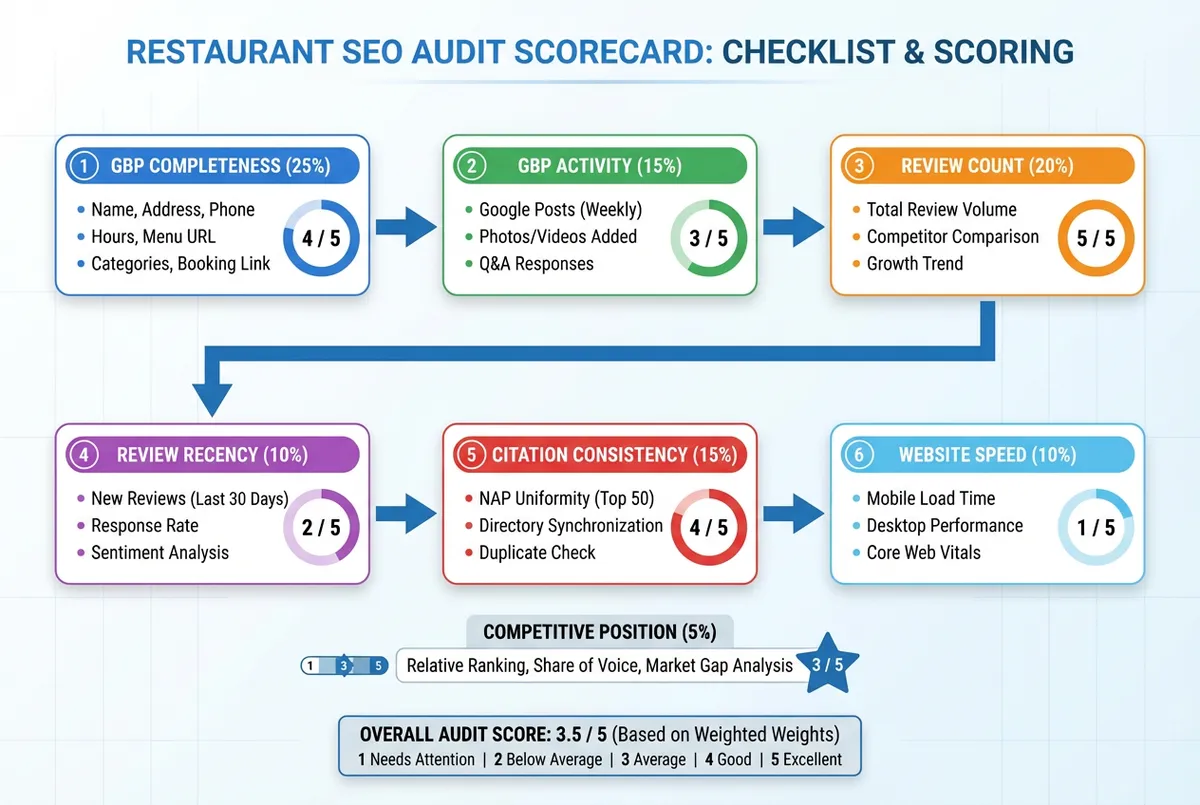
Restaurant SEO Audit Checklist
However, consistency is only half the picture. After verifying your details match, check whether you're actually listed on all major platforms.
Citation Coverage
Are you listed on key UK platforms?
| Platform | Listed? | Claimed? | Information Correct? |
|---|---|---|---|
| TripAdvisor | |||
| Yell.com | |||
| OpenTable | |||
| The Good Food Guide | |||
| Time Out | |||
| Local council directory |
Missing citations represent quick wins. Getting listed on major platforms you're not yet on improves your citation profile with minimal effort.
If you're only monitoring Google Business Profile and ignoring TripAdvisor and Yell.com you'll always lose to competitors who maintain consistent information everywhere. Citation consistency isn't optional: it's how Google builds trust in your business data.
Now you've covered local listings. But what happens when customers actually find your website?
Related: Restaurant Citations
Part 4: Website Audit
GBP, reviews, and citations matter. But if your website is slow or broken, customers leave before reserving.
Here's the next critical check: mobile performance.
Mobile Performance
Most restaurant searches happen on mobile phones. If you're thinking "My website looks fine on my phone", that's not the same as being fast. Test your site's mobile speed with free tools like Google PageSpeed Insights or Lighthouse.
| Metric | Your Score | Target |
|---|---|---|
| Mobile Performance score | 50+ | |
| First Contentful Paint | Under 2 seconds | |
| Time to Interactive | Under 4 seconds |
If mobile score is below 50, that's usually a sign your images are too large or your hosting can't handle the traffic. If you're only checking desktop speed and ignoring mobile you'll always lose customers who bounce before your menu loads.
However, speed matters but it's just the starting point. The real test is whether your site guides customers to conversion.
Local SEO Elements
| Element | Present? | Notes |
|---|---|---|
| NAP in footer on all pages | Same as GBP | |
| Embedded Google Map | On contact page | |
| Location/area page | If serving specific area | |
| Schema markup | LocalBusiness or Restaurant | |
| Mobile-responsive design | Test on your phone |
One element stands above all others for restaurants: your menu.
Menu Accessibility
| Issue | Problem? |
|---|---|
| Menu is PDF only | Google can't read it well |
| Menu is images only | Google can't read it |
| Menu is text on page | Good for SEO |
| Menu items have descriptions | Better for SEO |
If you're only publishing your menu as a PDF and leaving your website text-light you'll always lose visibility to competitors who publish full menu details with descriptions. Google can't rank what it can't read.
For instance, a fish and chip shop in Blackpool discovered their menu was a large image file. Converting it to text with descriptions for each dish improved their visibility for specific searches like "fish and chips Blackpool" and "best mushy peas near me."
Therefore, having completed your self-assessment, the final step is discovering where you actually stand against the restaurants beating you.
Related: Restaurant Website Design
Part 5: Competitive Comparison
Internal audits provide valuable data. External competitive analysis reveals where the real opportunities lie.
Identify Competitors
To find your real competitors, search for your cuisine + location (e.g., "Thai restaurant Leeds"). List the top 5 results. These are your SEO competitors.
If you're thinking "I know who my competitors are", you might be wrong. Your walking-distance competitors aren't necessarily your SEO competitors. The restaurants beating you in search are the ones you need to study.
Competitive identification is the first step. Direct comparison reveals specific gaps.
Compare Key Metrics
| Metric | You | Comp 1 | Comp 2 |
|---|---|---|---|
| Google reviews | |||
| Google rating | |||
| GBP photos | |||
| GBP posts (recent) |
Once you've collected this data, the next step is clear gap identification.
Identify Gaps
Where do competitors beat you significantly?
- 100+ more reviews? Focus on review generation.
- Better-completed GBP? Complete your profile fields.
- More active posting? Set up a weekly schedule.
If you're only comparing yourself to one competitor and ignoring the rest of the top 5 you'll always miss critical patterns in what's actually working. Compare the full picture.
The diagnosis is complete. Tracking progress over time is how you measure improvement.
Your Restaurant SEO Audit Scorecard
Use this restaurant SEO audit scorecard to track your current state and improvements over time.
Convert your findings into a single score for easy tracking and comparison.
Scoring Guide
| Category | Weight | Score (1-5) | Weighted Score |
|---|---|---|---|
| GBP Completeness | 25% | ||
| GBP Activity | 15% | ||
| Review Count | 20% | ||
| Review Recency | 10% | ||
| Citation Consistency | 15% | ||
| Website Mobile Speed | 10% | ||
| Competitive Position | 5% | ||
| Total | 100% |
Use this scoring system for each category.
Scoring Criteria
These ratings are rules of thumb: adjust based on your market competitiveness.
5 = Excellent: Better than competitors 4 = Good: On par with competitors 3 = Average: Some gaps 2 = Below Average: Significant gaps 1 = Poor: Major issues
For example, a gastropub in Bristol might score themselves: GBP Completeness (4/5), GBP Activity (2/5 - posting inconsistently), Review Count (3/5 - 87 reviews vs competitor's 156), Review Recency (5/5 - 12 reviews this month), Citation Consistency (2/5 - old phone number on 3 platforms), Website Mobile Speed (3/5 - score of 58), Competitive Position (3/5 - ranking 4th for main keyword). Total weighted score: 3.1/5 or 62%.
List your priority improvements in order of impact.
Priority Actions
Based on your audit, list your top 3 priorities:
Focus on these before moving to lower-priority improvements.
Time-constrained restaurants have a solution. Complete the essentials in 30 minutes with this compressed approach.
If You Only Have 30 Minutes a Week
If you're reading this thinking "I don't have time to fix all this", you're not alone. Here's how to work through your restaurant SEO audit findings with minimal time.
This week, complete your restaurant SEO audit:
Day 1-2 (15 mins): Complete the Google Business Profile audit section. Note your scores.
Day 3-4 (10 mins): Complete the review audit. Check your numbers against competitors.
Day 5-7 (5 mins): Check NAP consistency on Google, your website, and TripAdvisor.
Then over the following weeks, tackle one priority issue per week based on what your restaurant SEO audit revealed.
Pro Tip: Run this audit quarterly. Track your scores over time to measure improvement.
The highest-impact focus areas emerge from audit data. These are the areas to prioritise.
Key Takeaways
If you run a restaurant and want to see how Local Brand Hub can support your marketing, explore our restaurant marketing tools.
Key Takeaways
- A restaurant SEO audit focuses on local search factors: GBP, reviews, citations, mobile performance
- Google Business Profile completeness and activity are the highest-impact audit areas
- Review count, recency, and response rate all influence rankings
- Citation consistency helps Google trust your business information
- Compare yourself to local competitors to identify real gaps
Here's what changes when you audit properly: You stop guessing and start prioritising. Restaurant SEO isn't about doing everything: it's about doing the right things first. A restaurant SEO audit shows you where your time has the biggest impact.
If you're only monitoring your own metrics and not comparing against competitors you'll miss critical shifts in the market. Regular competitive restaurant SEO audits reveal the gaps you need to address.
With LocalBrandHub, you can automate ongoing monitoring of these metrics: getting alerts when reviews need responses, when competitors change, or when profile activity drops.
Weekly Action
This week, run your restaurant SEO audit:
Monday (10 mins): Log into Google Business Profile. Complete the GBP audit checklist above.
Wednesday (10 mins): Check your review metrics on Google and TripAdvisor. Note your numbers.
Friday (10 mins): Search for your cuisine + location. List top 3 competitors and their review counts.
Ask yourself: "What's the biggest gap between me and my top competitor?" That's your first restaurant SEO audit priority.
Frequently Asked Questions
How often should I run a restaurant SEO audit?
Run a full restaurant SEO audit quarterly. Between audits, monitor key metrics monthly (review count, review recency, GBP insights). More frequent audits are useful if you're actively working on improvements.
If you're only doing one audit per year you'll miss seasonal opportunities and gaps competitors are filling. Stay on top of quarterly audits to catch shifts early.
Can I do a restaurant SEO audit myself?
Yes. GBP, reviews, and citations require no technical tools. Website audits benefit from free tools but don't require paid software.
What's the most important thing a restaurant SEO audit will reveal?
Usually your review gap versus competitors. Most restaurants underestimate this: review improvement typically has the highest ranking impact for local search.
How long does a restaurant SEO audit take?
A single-location restaurant SEO audit takes 30-45 minutes using the scorecard in this guide.
Get More Marketing Tips
Practical marketing tips for UK business owners, straight to your inbox. No spam, unsubscribe anytime.
About the Author
Local Brand Hub
Empowering UK Businesses
Local Brand Hub provides comprehensive business management tools designed specifically for UK local businesses to streamline operations, automate marketing, and grow revenue.
More articlesRelated Articles
 Marketing Tips
Google Restaurant Reviews: Complete UK Guide
Discover why 75% of consumers regularly check reviews before dining out. Get actionable tips to boost reviews, respond professionally, and handle fakes.
 Marketing Tips
15 Restaurant SEO Tips That Actually Work in 2026 (Updated)
Practical restaurant SEO tips you can implement this week without technical skills. Focus on Google Business Profile, reviews, and local visibility basics.
 Marketing Tips
Can You Delete Google Reviews? Honest UK Answer
Can you delete Google reviews as a business? No, but here's what UK restaurants can do about unfair reviews, removal costs, and reputation.